Showing posts with label Bede. Show all posts

Wednesday, 24 February 2016

The Death of King Ethelbert

Worth, Kent

Today is the 1400th anniversary of the death of Ethelbert, king of Kent, the first English king to convert to Christianity. Ethelbert died on 24 February 616, around twenty years after receiving the mission of St Augustine and his companions, who had been sent from Rome to spread Christianity to (what they thought) a 'barbarous, fierce, and unbelieving nation'. So today is a good day to read Bede's account of Augustine's meeting with Ethelbert in 597, and what came after it. This is how Bede describes Augustine's coming, in Book I of his Historia Ecclesiastica (beginning at chapter 25, taken from here):

Augustine, thus strengthened by the confirmation of the blessed Father Gregory, returned to the work of the word of God, with the servants of Christ, and arrived in Britain. The powerful Ethelbert was at that time king of Kent; he had extended his dominions as far as the great river Humber, by which the Southern Saxons are divided from the Northern.

On the east of Kent is the large Isle of Thanet containing, according to the English way of reckoning, 600 families, divided from the other land by the river Wantsum, which is about three furlongs over, and fordable only in two places, for both ends of it run into the sea. In this island landed the servant of our Lord, Augustine, and his companions, being, as is reported, nearly forty men.

Augustine landing (St Laurence, Ramsgate)
They had, by order of the blessed Pope Gregory, taken interpreters of the nation of the Franks, and sending to Ethelbert, signified that they were come from Rome, and brought a joyful message, which most undoubtedly assured to all that took advantage of it everlasting joys in heaven and a kingdom that would never end with the living and true God.

The king, having heard this, ordered them to stay in that island where they had landed, and that they should be furnished with all necessaries, till he should consider what to do with them. For he had before heard of the Christian religion, having a Christian wife of the royal family of the Franks, called Bertha; whom he had received from her parents, upon condition that she should be permitted to practice her religion with the Bishop Luidhard, who was sent with her to preserve her faith.

The traditional site of Augustine's landing, Thanet
Some days after, the king came into the island, and sitting in the open air, ordered Augustine and his companions to be brought into his presence. For he had taken precaution that they should not come to him in any house, lest, according to an ancient superstition, if they practiced any magical arts, they might impose upon him, and so get the better of him. But they came furnished with divine, not with magic virtue, bearing a silver cross for their banner, and the image of our Lord and Saviour painted on a board; and singing the litany, they offered up their prayers to the Lord for the eternal salvation both of themselves and of those to whom they were come.

When he had sat down, pursuant to the king's commands, and preached to him and his attendants there present the word of life, the king answered thus: ­ "Your words and promises are very fair, but as they are new to us, and of uncertain import, I cannot approve of them so far as to forsake that which I have so long followed with the whole English nation. But because you are come from far into my kingdom, and, as I conceive, are desirous to impart to us those things which you believe to be true and most beneficial, we will not molest you, but give you favourable entertainment, and take care to supply you with your necessary sustenance; nor do we forbid you to preach and gain as many as you can to your religion."

Augustine preaching to Ethelbert (Christ Church Cathedral, Oxford)
Accordingly he permitted them to reside in the city of Canterbury, which was the metropolis of all his dominions, and, pursuant to his promise, besides allowing them sustenance, did not refuse them liberty to preach. It is reported that, as they drew near to the city, after their manner, with the holy cross, and the image of our sovereign Lord and King, Jesus Christ, they, in concert, sung this litany: "We beseech Thee, O Lord, in all Thy mercy, that thy anger and wrath be turned away from this city, and from the holy house, because we have sinned. Hallelujah."

Augustine processing to Canterbury (St Augustine's, Ramsgate)
As soon as they entered the dwelling­-place assigned them they began to imitate the course of life practiced in the primitive church; applying themselves to frequent prayer, watching and fasting; preaching the word of life to as many as they could; despising all worldly things, as not belonging to them; receiving only their necessary food from those they taught; living themselves in all respects conformably to what they prescribed to others, and being always disposed to suffer any adversity, and even to die for that truth which they preached. In short, several believed and were baptized, admiring the simplicity of their innocent life, and the sweetness of their heavenly doctrine.

There was on the east side of the city a church dedicated to the honour of St. Martin, built whilst the Romans were still in the island, wherein the queen, who, as has been said before, was a Christian, used to pray. In this they first began to meet, to sing, to pray, to say mass, to preach, and to baptize, till the king, being converted to the faith, allowed them to preach openly, and build or repair churches in all places.
A statue of Queen Bertha in the church of St Martin's
When he, among the rest, induced by the unspotted life of these holy men, and their delightful promises, which, by many miracles, they proved to be most certain, believed and was baptized, greater numbers began daily to flock together to hear the word, and, forsaking their heathen rites, to associate themselves, by believing, to the unity of the church of Christ. Their conversion the king so far encouraged, as that he compelled none to embrace Christianity, but only showed more affection to the believers, as to his fellow­-citizens in the heavenly kingdom.

For he had learned from his instructors and leaders to salvation, that the service of Christ ought to be voluntary, not by compulsion. Nor was it long before he gave his preachers a settled residence in his metropolis of Canterbury, with such possessions of different kinds as were necessary for their subsistence.
Ethelbert and the towers of Canterbury Cathedral
Later on, in Book II:

In the year of our Lord's incarnation 616, which is the twenty-first year after Augustine and his companions were sent to preach to the English nation, Ethelbert, king of Kent, having most gloriously governed his temporal kingdom fifty-six years, entered into the eternal joys of the kingdom which is heavenly. He was the third of the English kings that had the sovereignty of all the southern provinces that are divided from the northern by the river Humber, and the borders contiguous to the same; but the first of the kings that ascended to the heavenly kingdom...

King Ethelbert died on the 24th day of the month of February, twenty-one years after he had received the faith, and was buried in St. Martin's porch within the church of the blessed apostles Peter and Paul, where also lies his queen, Bertha. Among other benefits which he conferred upon the nation, he also, by the advice of wise persons, introduced judicial decrees, after the Roman model; which, being written in English, are still kept and observed by them.
The ruins of St Augustine's, Canterbury;
in the foreground is the porticus where Ethelbert was buried

...post regnum temporale, quod L et VI annis gloriosissime tenuerat, aeterna caelestis regni gaudia subiit...

In telling of the king's death, Bede carefully (though not perhaps accurately) notes the length in years of Ethelbert's reign and the geographical extent of his kingdom, as if to underline the point that the king is departing from these temporal and territorial limits to a kingdom without boundaries and without time. Here in the realm of time and space, we make a virtue of these limits by commemorating the when and where of history: keeping anniversaries and marking sites. Most of the images in this post are of physical memorials to Ethelbert and Augustine from the area where they are most plentifully memorialised, in Canterbury and the Isle of Thanet. In this region a disparate collection of memorials, many more than are pictured here, commemorates not just the people in this story but the places where it played out, the meaning-rich landscape of island and mainland, marginal shore and royal capital, which is symbolic as well as real. Thanks to a combination of folklore, genuine continuity, and dedicated local history-making, you can visit most of the sites mentioned in Bede's story, from the shore where Augustine landed to the well where he baptised the king, to the city where Queen Bertha's church still stands, the cathedral soars, and the foundations of King Ethelbert's burial-place are neatly marked out in English Heritage stone. If so inclined, you can now walk the way (or even canoe it) in Augustine's footsteps.

St Augustine's Cross, Cliffsend

Some of these memorials also mark anniversaries. This cross, erected in 1884, is near the supposed site of Ethelbert's meeting with Augustine, and was the focus of celebrations for the 1300th anniversary of Augustine's arrival in 1897. One of my own first encounters with Anglo-Saxon history was witnessing the commemoration of the 1400th anniversary in Ramsgate in 1997 (I was eleven years old, and it would be nice to say that this event fired me with a love of Anglo-Saxon history and inspired me then and there to become a medievalist - but actually I don't recall being especially clear on what we were commemorating...). Ethelbert is the first Anglo-Saxon king whose date of death we know in part because the coming of Augustine, of Christianity, also brought to the English new ways of marking time and of recalling and commemorating history. Like the making of memorials, the marking of anniversaries is a creative act, a work of the historical imagination through which we can locate ourselves in time as well as place, with ever-richer possibilities as the passage of time adds more and more layers. So perhaps it's a good day to celebrate not only Ethelbert but the historian who gives him to us. Bede looked back on Ethelbert from the distance of 140 years, and we're now 1400 years away; but with even the historian's history under threat, it's all the more important to go on telling his stories.

A memorial of a memorial (St Laurence, Ramsgate)

Wednesday, 18 March 2015

The Days of Creation

God creating the world (BL Royal 1 E VII, f. 1v, 11th century, Canterbury)
On þissum monðe gesceop God ælmihtig ealle gesceafta, gesewenlice & ungesewenlice. He cwæð, ‘gewurðe leoht’, & hyt gewearð. Se dæg wæs on .xv. kalendis Aprilis.

In this month almighty God created the whole of creation, visible and invisible. He said, 'Let there be light', and it was done. That day was on 18 March.
According to some medieval calculations, today, 18 March, was the date of the first day of creation - the beginning of the world. It's sometimes even marked as such on medieval calendars (for example, this twelfth-century English calendar). It might seem like an arbitrary date, but it's very far from that; for the complex theological and scientific arguments which lay behind this dating, and its long and varied history, I refer you to this book. Like many such medieval calculations, the significance of the date is less to do with a belief that it was literally true than with a sense of what would be the most fitting and appropriate date for the first day of creation, the date most in harmony with the medieval Christian understanding of time. So why 18 March? To summarise very briefly: it was worked out backwards from the most important such calculation in the early church's calendar, the dating of Easter. From a combination of factors, including the information given about Christ's death in the Gospels, the date of the equinox, the beginning of spring and, most importantly, the essential link between the death of Christ and the Jewish Passover, the historical date of Good Friday was worked out to be 25 March. (The day on which it should be commemorated by the church was a separate, and even more complex issue...) Since 25 March was therefore the date of - as they saw it - the most significant event in history, the central turning-point around which all time and space revolved, it was seen to be fitting to link to this date key events in salvation history connected to, or prefiguring, the death and resurrection of Christ: the Annunciation, the sacrifice of Isaac, the crossing of the Red Sea. It was thought fitting too for 25 March to be the eighth day of creation - and that means, if you count backwards, that 18 March is the first.

The exactness of this date might raise a smile, and it's a way of thinking about time which is foreign to a modern secular mindset; the day derives its meaning not only from a historical event but also from its place in the interlocking cycles of lunar, solar, seasonal and even zodiacal calendars, which were all understood to be imbued with purpose by the divine Creator who was their source. The complexity of the calculations (much more intricate than I can attempt to describe here) is so impenetrable that you can understand why today people prefer to believe that the date of Easter was just 'stolen' from some equinox-loving pagans - a much more immediately accessible explanation, if unfortunately wrong! But there is something beautiful about the desire to identify these dates with precision and care. It's of a piece with the way the creation of the world is often depicted in medieval art, as in the image above from an Anglo-Saxon manuscript: God is shown with scientific instruments, tools and scales which are images of balance and precision. When the first divine act of creation was imagined as careful, scientific workmanship, it would have seemed only right to be as exact as possible in understanding the world's origins.

Creation (BL Cotton Tiberius C VI, f. 7v; 11th century, Winchester)

There were of course various alternative ways of interpreting all this data, and the 18-25 March theory I described above was far from universal. It was, however, popular in early medieval England, mostly due to the influence of Bede. The quotation at the top of this post comes from an Old English text known as Byrhtferth's Enchiridion, which was written at Ramsey Abbey, in what's now Cambridgeshire, in 1011. Byrhtferth, a monk of Ramsey, was a learned historian and scientist, and his Enchiridion is a guide to the scientific thinking of his day, written in English for the benefit of those less skilled in Latin than Byrhtferth himself. Since on this blog I often post about medieval historical narratives, I thought it might be interesting - on this anniversary of the first day of the world - to look at the story in Old English of the very first days of history, as described by Byrhtferth and an Anglo-Saxon translation of the Book of Genesis.

The translation, and all the illustrations below, come from an amazing manuscript of the Old English Hexateuch (British Library, Cotton MS. Claudius B IV), an English translation of the first six books of the Old Testament. It survives in several manuscripts but this one, the most complete, was produced in the eleventh century at St Augustine's, Canterbury, and is richly illustrated with hundreds of detailed and spirited pictures. You can zoom in and explore the full manuscript to your heart's content on the British Library's site here; the illustrations I've used of the days of creation are from ff. 2v-4v. Quotations are from Byrhtferth's Enchiridion, ed. Peter S. Baker and Michael Lapidge (Oxford, 1995).

The first day, we've already heard about: on 18 March he cwæð, ‘gewurðe leoht’, & hyt gewearð. For Byrhtferth this date might have had a little extra personal resonance: he tells us elsewhere in his work that his own monastery of Ramsey was founded (that is, the first stone was laid) on 18 March 965, so Byrhtferth's own 'world', the abbey where he spent most of his life and where he acquired all the learning he displays in this treatise, was created on this date too. And at the time he was writing his Enchiridion, 18 March also happened to be the feast of England's newest and most controversial saint, the murdered teenage king Edward the Martyr, who was killed in murky circumstances on this day in 978. The second of these dates is coincidence, though Byrhtferth was certainly aware of it, but the first may well have seemed meaningful; in the computistical view of the world, there really are no coincidences.

The first illustration in this manuscript of the Old English Hexateuch is a full-page depiction of the fall of the angels, and the first day of creation illustrated is actually the second day (shown above). Just before this image in the manuscript, the text reads:
God cwæð ða eft: Gewurðe nu fæstnys tomiddes ðam wæterum, 7 totwæme ða wæteru fram ðam wæterum. 7 God geworhte ða fæstnysse, 7 totwæmde ða wæteru ða wæron under ðære fæstnysse fram ðam ðe wæron bufan ðære fæstnysse. Hit wæs ða swa gedon. 7 God het ða fæstnysse heofenan. 7 wæs ða geworden æfen 7 mergen: oðer dæg.
God said then: Let there be now a firmament between the waters, to separate the waters from the waters. And God made the firmament, and separated the waters which were under the firmament from those which were above the firmament. So it was then done. And God called the firmament 'sky'. And then evening and morning were past: the second day.
The Old English word for 'firmament' here is fæstnys, i.e. 'fastness', a fixed thing, and the name God gives to it is heofen, 'heaven', in the sense of 'sky'. So we have various words for this thing which is created, but despite all those names it's a difficult concept to talk about. Byrhtferth, borrowing from Ælfric's De Temporibus Anni, says:
On þam oðrum dæge he geworhte firmamentum, þæt ys þeos heofon. Heo ys gesewenlic and lichamlic, ac swa þeah we ne magon hig næfre geseon for þære fyrlenan heahnysse. Seo heofon beligð on hyre bosme ealne middaneard, and heo æfre tyrnð onbutan us; heo ys swyftre þonne ænig mylenhwiol, eall swa deop under þisre eorðan swa heo ys bufan. Eall heo ys synewealt and ansund and mid steorrum amet. Soðlice þa oðre heofenan þe bufan hyre synt and beneoðan synt ungesewenlice and mannum unasmeagendlice. Synd swa þeah ma heofena, swa swa se witega cwyð: ‘celi celorum’.

On the second day he made the firmament, that is, the heaven. It is visible and corporeal, but nonetheless we are never able to see it, because of its great height. The heaven encompasses the whole earth in its bosom, and it is always turning about us; it is swifter than any mill-wheel, just as deep below this earth as it is above. It is entirely spherical and whole, and adorned with stars. Truly, the other heavens which are above and beneath it are invisible and inscrutable to men; but there are more heavens, as the prophet says: 'heavens of heavens'.
The firmament is visible (gesewenlic) and yet we can't see it (we ne magon hig næfre geseon) because it extends so far beyond mortal vision, in every direction around the globe of the earth. This passage is a wonderful combination of science and mystery (and poetry: 'swifter than any mill-wheel', 'adorned with stars...')


Of the third day, Byrhtferth only says:
On þam þriddan dæge, þæt ys on .xiii. kalendas Aprilis, he gesceop ealle trywcynna and ealle grennyssa.

On the third day (that is, on 20 March), he created all kinds of trees and all green things.
The Old English Hexateuch is more expansive:
He cwæð, Sprytte seo eorðe growende gærs 7 sæd wyrcende, 7 æppelbære treow wæstm wyrcende æfter his cynne, ðæs sæd sy on him syluum ofer eorðan. Hit wæs ða swa gedon. 7 seo eorðe forð teah growende wyrta 7 sæd berende be hyre cynne, 7 treow wæstm wyrcende 7 gehwilc sæd hæbbende æfter his hiwe. God geseah ða ðæt hit god wæs. 7 wæs geworden æfen 7 mergen, se ðridda dæg.

He said, Let the earth sprout green plants, growing and yielding seed, and apple-bearing trees yielding fruit after their kind, whose seed is in itself upon the earth. So it was done. And the earth brought forth growing plants, bearing seed according to their kind, and trees bearing fruit, each having seed according to its kind. God saw that it was good. And evening and morning were passed: the third day.
 

The fourth day is particularly important, because it's the day when time itself was created, with the creation of the sun and moon (shown above!). Byrhtferth says:
On þam feorðan dæge, þæt ys on .xii. kalendas Aprilis, he gesceop sunnan and monan and steorran and ealle tungla, and on ærnemergen þæs dæges uparas seo beorhte sunne riht on eastende þære heofon, and þæne monan þæs ylcan æfenes he gesette on þære ylcan stowe, and he wæs full swa swa he byð þonne he byð fiftyne nihta eald. Þæne forman dæg þisre worulde man mæg findan, swa ic herbufan cwæð, þurh þæs lengtenlican emnihtes dæg, forþon se emnihtes dæg ys se feorða dæg þissere worulde. Þry dagas wæron ær þam dæge butan sunnan and monan and eallum steorrum.

On the fourth day (that is, on 21 March), he created the sun and moon and stars and all planets, and at dawn of that day the bright sun rose right at the eastern edge of heaven, and on the same evening he placed the moon in the same place, and it was as full as it is when it is fifteen days old. The first day of the world can be calculated, as I said above, by the day of the spring equinox, because the day of the equinox is the fourth day of this world. There were three days before that day without sun or moon or any stars.
The idea that the sun rose at the dawn of the fourth day and was followed in the evening by the moon at its fullest ties in with the important question of the dating of Easter, of course. The significance of this is explained more fully by Bede, who says that the moon
was full at sunset, for the Creator, Who is justice itself, would never make something in an imperfect state. It appeared, together with the glittering stars, in the mid-point of the east, and stood in the fourth degree of Libra where the autumn equinox is fixed, and by its rising, it sanctified the beginning of Easter. For the only Paschal rule to observe is that the spring equinox be completed, with a full Moon following. But if the full Moon precedes the equinox by a single day, it is considered to be the Moon of the last month, and not of the first. For it is fitting that just as the Sun at that point in time first assumed power over the day, and then the Moon and stars power over the night, so now, to connote the joy of our redemption, day should first equal night in length, and then the full Moon should suffuse [the night] with light. This is for the sake of a certain symbolism, because the created Sun which lights up all the stars signifies the true and eternal light which lighteth every man that cometh into the world, while the Moon and stars, which shine, not with their own light (as they say), but with an adventitious light borrowed from the Sun, suggest the body of the Church as a whole, and each individual saint. These, capable of being illumined but not of illuminating, know how to accept the gift of heavenly grace but not how to give it.
Bede, The Reckoning of Time, trans. Faith Wallis (Liverpool, 2004), p. 25.

Scripture and science are in harmony here; every aspect of the natural world is filled with meaning, and reveals God's creative purpose. This is a view of the world which sees nothing - no date, no rule, no custom - as meaningless or random, for those who have the will to understand.

As we've seen before, Byrhtferth's contemporary Ælfric thought 21 March should be the beginning of the new year, such was its importance as the day 'when all times were appointed'. 21 March is also the feast of St Benedict, a supremely important saint to Benedictine monks like Ælfric and Byrhtferth, and the saint to whom Ramsey Abbey was dedicated. One Old English poem notes of this dating:

Swylce Benedictus
embe nigon niht þæs nergend sohte,
heard and higestrang, þæne heriað wel
in gewritum wise, wealdendes þeow,
rincas regolfæste. Swylce eac rimcræftige
on þa ylcan tiid emniht healdað,
forðan wealdend god worhte æt frymðe
on þy sylfan dæge sunnan and monan.

And Benedict
after nine nights sought the Saviour,
strong and stout-minded, he whom
rulefast men well praise in wise writings,
the Master's servant. And, too, the number-skilled
keep the equinox at that same time,
because the Lord God created in the beginning
the sun and moon on that same day.


For the fifth day, this illustration from the OE Hexateuch shows the creation of winged creatures - and a 'great whale' in the water! Byrhtferth says:
On þam fiftan dæge, þæt ys on .xi. kalendas, he gescop eall wyrmcynn and creopende and fleogende and swymmende and slincgende and þa myclan hwælas and þa lytlan sprottas and eall fisckynn on myslicum and mænigfealdum hiwum.

On the fifth day (that is, on 22 March), he created all kinds of serpents, and creeping, flying, swimming and slinking creatures, and the great whales and the little sprats and all kinds of fish in various and manifold shapes.
What a wonderfully evocative list: creopende and fleogende and swymmende and slincgende...


And, finally, the creation of Adam and the animals.
On þam syxtan dæge, þæt ys on .x. kalendas Aprilis, he gescop eall deorcynn and ealle nytenu þe on feower fotum gað and þæne man Adam, and Euan, and þa he gebletsode.

On the sixth day (that is, on 23 March), he made all species of animals and all beasts that go on four feet, and the man Adam, and Eve, and he blessed them.
The creation of Adam is sometimes marked on March 23 in medieval calendars (in this thirteenth-century calendar, for example).

On þam seofoðan dæge he geendode his weorc, þæt ys .ix. kalendas Aprilis, and seo wucu wæs agan, and he gebletsode þæne dæg. Se eahtoða dæg com þa æfter þam seofoðan and gewearð to þam þæs dæges þe wæs .viii. kalendas Aprilis. Se dæg wæs amearcod on Godes foresceawunge. On þam dæge wæron englas gesceapene; on þam dæge wæs se heahengel Gabriel asend to Sancta Maria; on þam dæge he aras of deaðe; on þam dæge Godes gast com to mancynne. He ys halig Sunnadæg; þonne ealle dagas ateoriað, þonne þurhwunað he aa on his symbelnysse. He ys engla bliss and ealra haligra ece frofor.

On the seventh day he ended his work (that is, on 24 March), and the week was finished, and he blessed that day. The eighth day then came after the seventh, and it fell on the day which was 25 March. That day was marked out in God's providence. On that day the angels were created; on that day the archangel Gabriel was sent to St Mary; on that day he arose from death; on that day God's spirit came to mankind. It is holy Sunday; when all days fail, it will endure forever in its festiveness. It is the joy of angels and eternal benefit to all the saints.

Friday, 7 November 2014

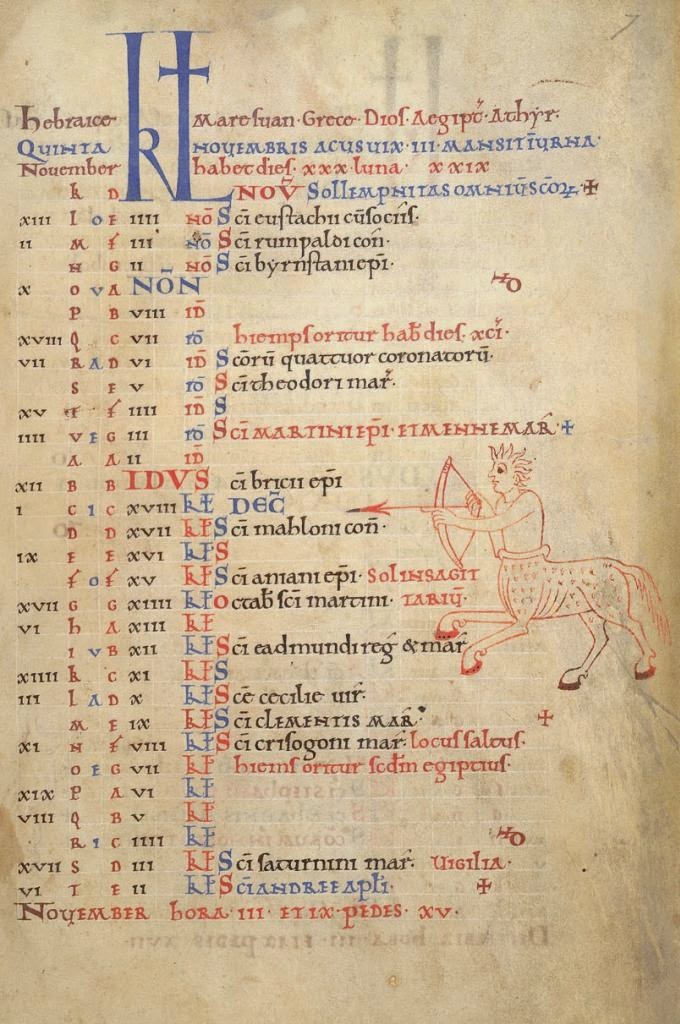
'After that comes Winter's Day'


I'm sorry to break this to you, but it's now officially winter. At least, it is according to the Old English calendar poem The Menologium, which calls 7 November 'winter's day' - the first day of winter:

And þy ylcan dæge ealra we healdað
sancta symbel þara þe sið oððe ær
worhtan in worulde willan drihtnes.
Syþþan wintres dæg wide gangeð
on syx nihtum, sigelbeortne genimð
hærfest mid herige hrimes and snawes,
forste gefeterad, be frean hæse,
þæt us wunian ne moton wangas grene,
foldan frætuwe.

And on the same day [November 1] we keep
the feast of All Saints, of those who recently or long ago
worked in the world the will of the Lord.
After that comes Winter’s Day, far and wide,
after six nights, and seizes sun-bright autumn
with its army of ice and snow,
fettered with frost by the Lord's command,
so that the green fields may no longer stay with us,
the ornaments of the earth.

The phrase 'Winter's Day' doesn't occur elsewhere with this precise meaning, but November 7 is dated as the first day of winter by the best Anglo-Saxon authorities on the calendar: Bede in his De Temporum Ratione and Byrhtferth in his Enchiridion. According to their reckoning winter has 92 days and runs from 7 November to 6 February, which means that midwinter falls around the time of the solstice - as you would expect, the turn of the year occurs at the midpoint of the season. (In recent years it has become popular to say that winter begins on the winter solstice; Bede would not be impressed...) There are of course lots of ways of dating such changes, and early medieval practice varied; but Bede took his dating from Roman authorities and explored its theological significance, and in this, as in many other matters, his opinion was very influential. As a result, many later Anglo-Saxon calendars mark the beginning of spring, summer, autumn and winter on 7 February, 9 May, 7 August and 7 November. These are cross-quarter days, which fall halfway between the solstices and equinoxes.

In its description of 'Winter's Day' the Menologium is following in this learned, scientific tradition, but it's also drawing on a conventional topos of Old English poetry: the threat of winter. This is a poem which finds beauty in almost everything about the turning year; in its formulaic phrases, every month is ‘ornamented’ or ‘adorned’ or ‘distinguished’ by the features and feasts it contains, and in past posts on this poem we’ve seen the exuberance of spring, the brightness of summer, the plenty of autumn. But there’s no such lingering on the beauty of winter; all the beauty belongs to what's lost when winter takes hold. We have a last glimpse of the loveliness of the abundant harvest, sigelbeortne hærfest, 'sun-bright autumn'. Then winter seizes it (the verb is a violent one, genimð ‘plucks, snatches’) with its army of frost and snow, and captures the earth for another year. Winter comes in like an invading warrior and puts autumn in chains, and the green fields which decorate the earth are permitted to stay with us no longer. There's a melancholy contrast between the two similar-sounding words frætuwe and gefeterad – between the green summer fields adorned (‘fretted’) with beauty, and the winter fetters of frost.

11th-century calendar from Christ Church, Canterbury (BL Arundel 155, f.7) 
with the beginning of winter marked on 7 November

This idea of winter imprisoning and chaining the earth will be familiar to anyone who's read a little Old English poetry. There are many, many examples of winter as danger and sorrow: The Seafarer lamenting his cold feet and his burning heart as he sails on the icy ocean, the speaker in The Wife's Lament imagining her lover alone and grieving beneath a storm-dashed cliff, Weland in chains in Deor suffering 'wintercealde wræce', 'winter-cold exile'. But perhaps the most famous - and my favourite - instance is The Wanderer, in which an exile, mourning the loss of home, lord and friends, is trapped in a winter which is his own grief:

Oft ic sceolde ana uhtna gehwylce
mine ceare cwiþan. Nis nu cwicra nan
þe ic him modsefan minne durre
sweotule asecgan. Ic to soþe wat
þæt biþ in eorle indryhten þeaw,
þæt he his ferðlocan fæste binde,
healde his hordcofan, hycge swa he wille.
Ne mæg werig mod wyrde wiðstondan,
ne se hreo hyge helpe gefremman.
Forðon domgeorne dreorigne oft
in hyra breostcofan bindað fæste;
swa ic modsefan minne sceolde,
oft earmcearig, eðle bidæled,
freomægum feor, feterum sælan,
siþþan geara iu goldwine minne
hrusan heolstre biwrah, ond ic hean þonan
wod wintercearig ofer waþema gebind...
Wat se þe cunnað, hu sliþen bið sorg to geferan,
þam þe him lyt hafað leofra geholena.
Warað hine wræclast, nales wunden gold,
ferðloca freorig, nalæs foldan blæd...

Often I must alone, every day before dawn,
lament my sorrow. There is now none living
to whom I dare openly speak
the thoughts of my mind. I truly know
that it is a noble virtue among warriors
for a man to bind his spirit-chest fast,
conceal his heart, whatever he may think.
The weary mind cannot withstand fate,
nor the troubled heart provide help.
And so those eager for glory often
bind fast sorrowful thoughts in their breasts;
so I have had to keep my mind –
often wretched, deprived of homeland,
far from kinsmen – fastened in fetters,
since long ago I buried my lord
in the darkness of the earth, and I from there
journeyed, winter-sorrowful, over the binding waves...
He who has experienced it knows
how cruel sorrow is as a companion
for him who has few beloved friends.
The path of exile holds him, not twisted gold;
a frozen spirit, not the glory of the earth.

In this poem winter infects you, it gets into your heart: the speaker describes himself as wintercearig, 'winter-sorrowful', perhaps 'as desolate as winter', and he has a 'frozen spirit', ferðloca freorig. This is a painful, claustrophobic kind of enclosure; the earth is trapped beneath its winter covering like the aching heart concealed in the grieving warrior’s breast, which strains at its enforced silence. But this is not only a personal but a universal sorrow, the fate of all human society, as if the future of the world could be summed up in one phrase: winter's coming.

Ongietan sceal gleaw hæle hu gæstlic bið,
þonne ealre þisse worulde wela weste stondeð,
swa nu missenlice geond þisne middangeard
winde biwaune weallas stondaþ,
hrime bihrorene, hryðge þa ederas.
Eorlas fornoman asca þryþe,

wæpen wælgifru, wyrd seo mære,
ond þas stanhleoþu stormas cnyssað,
hrið hreosende hrusan bindeð,
wintres woma, þonne won cymeð,
nipeð nihtscua, norþan onsendeð
hreo hæglfare hæleþum on andan.
Eall is earfoðlic eorþan rice,
onwendeð wyrda gesceaft weoruld under heofonum.
Her bið feoh læne, her bið freond læne,
her bið mon læne, her bið mæg læne,
eal þis eorþan gesteal idel weorþeð.


The wise hero must perceive how terrible it will be
when all this world's wealth lies waste,
as now in various places throughout this earth
walls stand blown by the wind,
covered with frost, the buildings snow-swept...
The warriors were taken away by the power of spears,
weapons greedy for slaughter, fate the famous;
and storms batter those rocky cliffs,
snow falling fetters the earth,
the tumult of winter. Then dark comes,
night-shadows deepen; from the north comes
a fierce hailstorm hostile to men.
All is full of hardship in this earthly realm,
the course of events changes the world under the heavens.
Here wealth is fleeting, here friend is fleeting,
here man is fleeting, here kinsman is fleeting,
all the foundation of this world turns to waste.


Ac forhwon fealleð se snaw, foldan behydeð,
bewrihð wyrta cið, wæstmas getigeð,
geðyð hie and geðreatað, ðæt hie ðrage beoð
cealde geclungne?

But why does snow fall, cover the ground,
conceal the shoots of plants, bind up fruits,
crush and repress them, so that they are for a time
shrivelled with cold?

So asks the pagan prince Saturn in The Dialogue of Solomon and Saturn, as he seeks answers from Solomon about the nature of the world; but the answer wise Solomon would have given to this question is lost (on a missing leaf in the manuscript). So we don't know.

But another poem, Maxims I, has a promise of something better:

Forst sceal freosan, fyr wudu meltan,
eorðe growan, is brycgian,
wæter helm wegan, wundrum lucan
eorðan ciðas. An sceal onbindan
forstes fetera, felamihtig God;
winter sceal geweorpan, weder eft cuman,
sumor swegle hat.

Frost must freeze, fire burn up wood,
the earth grow, ice form bridges,
water wear a covering, wondrously locking up
shoots in the earth. One alone shall unbind
the frost’s fetters: God most mighty.
Winter must turn, good weather come again,
summer bright and hot.

This is a more positive image of winter: it not only promises that the season will end, will turn again as everything in the year turns, but it actually finds something marvellous in winter itself, in the 'bridges' miraculously formed by the ice. 'Water wears a covering' is like the beginning of a riddle - and in fact there is a one-line riddle in the Exeter Book which reads:

Wundor wearð on wege; wæter wearð to bane.
There was a wonder on the waves: water turned to bone.

'Ice' seems the most likely solution; winter has its wonders, too. And Maxims I asserts that, inexplicable as may be the oppression of winter and the sorrow of human life, God has power to unlock the chains; just as in Beowulf, when the monster's blood melts the hero's sword,

þæt wæs wundra sum,
þæt hit eal gemealt ise gelicost,
ðonne forstes bend Fæder onlæteð,
onwindeð wælrapas, se geweald hafað
sæla ond mæla.


That was a great wonder:
it all melted, just like ice
when the Father loosens the bonds of frost,
unwinds the water's chains, he who has power
over times and seasons.

11th-century calendar from Winchester, 
noting the beginning of winter on 7 November (BL Arundel 60, f. 7)

I could go on listing examples all day, but that's probably enough for now to welcome winter. I'm aware that many of my readers live in more fortunate climates, where it's not winter yet (or where summer is just beginning), but here in the south of England it does suddenly feel like winter: a few unusually warm days at the end of October were suddenly laid waste by cold and fog, though not yet by ice and snow. So I'm happy to agree with the Anglo-Saxon calendars that this really is the beginning of winter; in this respect, as in many others, you can't wrong following Bede. It's Bede, of course, who in the voice of a counsellor to King Edwin gives us perhaps the most famous use of winter in Anglo-Saxon literature, which I quoted here recently but will unashamedly quote again, in the Old English translation:

Þyslic me is gesewen, þu cyning, þis andwearde lif manna on eorðan, to wiðmetenesse þære tide þe us uncuð is, swylc swa þu æt swæsendum sitte mid þinum ealdormannum 7 þegnum on wintertide, 7 sie fyr onælæd 7 þin heall gewyrmed, 7 hit rine 7 sniwe 7 styrme ute; cume an spearwa 7 hrædlice þæt hus þurhfleo, cume þurh oþre duru in, þurh oþre ut gewite. Hwæt he on þa tid, þe he inne bið, ne bið hrinen mid þy storme þæs wintres; ac þæt bið an eagan bryhtm 7 þæt læsste fæc, ac he sona of wintra on þone winter eft cymeð. Swa þonne þis monna lif to medmiclum fæce ætyweð; hwæt þær foregange, oððe hwæt þær æfterfylige, we ne cunnun.

"O king, it seems to me that this present life of man on earth, in comparison to that time which is unknown to us, is as if you were sitting at a feast in the winter with your ealdormen and thegns, and a fire was kindled and the hall warmed, while it rained and snowed and stormed outside. A sparrow came in, and swiftly flew through the hall; it came in at one door, and went out at the other. Now during the time when he is inside, he is not touched by the winter's storms; but that is the twinkling of an eye and the briefest of moments, and at once he comes again from winter into winter. In such a way the life of man appears for a brief moment; what comes before, and what will follow after, we do not know."

Dark and cold the winter may be, but this vignette also conjures up one of its best features: feasting in good company, 'the fire kindled and the hall warmed, while it rained and stormed and snowed outside'. Something to look forward to in the 92 days ahead.


This image is from BL Harley 5431 (f.38v), a copy of the Rule of St Benedict made in Canterbury at the end of the tenth century. St Benedict's Rule divides the monastic year into two seasons, summer and winter, which had their different timetables and schedules of prayer; winter began in November, and this section describes the schedule hiemis tempore 'in the time of winter'. Its big initial H is formed from spiky lines which always look to me like brambles, or like bare branches black against the winter sky.

Friday, 10 October 2014

St Paulinus and the Sparrow

Paulinus in Rochester Cathedral

Paulinus, a member of St Augustine's mission to the Anglo-Saxons who became the first bishop of York, died on 10 October 644, and was commemorated as a saint on this day. Bede's Historia Ecclesiastica gives us a wealth of fascinating detail about Paulinus' missionary work in Northumbria after he accompanied Ethelburga, daughter of the king of Kent, when she went to marry the pagan King Edwin. I wrote about Ethelburga here, but Paulinus deserves a post of his own too. When I post about Anglo-Saxon saints I generally attempt to do more than just reproduce extracts from the relevant sources, but in this case there's really no substitute for reading Bede's account of Paulinus, Edwin and Ethelburga; it's one of the most memorable parts of the Historia Ecclesiastica, and needs no embellishments. So here are some extracts from HE Book II, taken from this site.

At this time the nation of the Northumbrians, that is, the nation of the Angles who live on the north side of the river Humber, with their king, Edwin, received the faith through the preaching of Paulinus... The occasion of this nation's embracing the faith was their aforesaid king being allied to the kings of Kent, having taken to wife Ethelburga, otherwise called Tate, daughter to King Ethelbert. He having by his ambassadors asked for her in marriage from her brother Eadbald, who then reigned in Kent, was answered, "It was not lawful to marry a Christian virgin to a pagan husband, lest the faith and the mysteries of the heavenly King should be profaned by her cohabiting with a king who was altogether a stranger to the worship of the true God." This answer being brought to Edwin by his messengers, he promised in no manner to act in opposition to the Christian faith, which the virgin professed; but would give leave to her, and all that went with her, men or women, priests or ministers, to follow their faith and worship after the custom of the Christians. Nor did he deny but that he would embrace the same religion, if, being examined by wise persons, it should be found more holy and more worthy of God.

Hereupon the virgin was promised, and sent to Edwin, and pursuant to what had been agreed on, Paulinus, a man beloved of God, was ordained bishop, to go with her, and by daily exhortations, and celebrating the heavenly mysteries, to confirm her and her company, lest they should be corrupted by the company of the pagans. Paulinus was ordained bishop by the Archbishop Justus, on the 21st day of July, in the year of our Lord 625, and so he came to King Edwin with the aforesaid virgin as a companion of their union in the flesh. But his mind was wholly bent upon reducing the nation to which he was sent to the knowledge of truth; according to the words of the apostle, "To espouse her to one husband, that he might present her as a chaste virgin to Christ." Being come into that province, he laboured much, not only to retain those that went with him, by the help of God, that they should not revolt from the faith, but, if he could, to convert some of the pagans to a state of grace by his preaching.
The opening of Book II of the Historia Ecclesiastica, in a 12th-century Rochester MS (BL Harley 3680, f.36v)

The next year there came into the province a certain assassin, called Eumer, sent by the king of the West Saxons, whose name was Cuichelm, in hopes at once to deprive King Edwin of his kingdom and his life. He had a two-edged dagger, dipped in poison, to the end that if the wound were not sufficient to kill the king, it might be performed by the venom. He came to the king on the first day of Easter, at the river Derwent, where then stood the regal city, and being admitted as if to deliver a message from his master, whilst he was in an artful manner delivering his pretended embassy, he started suddenly, and drawing the dagger from under his garment assaulted the king. Lilla, the king's beloved minister, observed this, and having no buckler at hand to secure the king from death, interposed his own body to receive the stroke; but the wretch struck so home, that he wounded the king through the knight's body. Being then attacked on all sides with swords, he in that confusion also slew another soldier, whose name was Forthhere.

On that same holy night of Easter Sunday, the queen had brought forth to the king a daughter, called Eanfled. The king, in the presence of Bishop Paulinus, gave thanks to his gods for the birth of his daughter; and the bishop, on the other hand, returned thanks to Christ, and endeavoured to persuade the king, that by his prayers to Him he had obtained that the queen should bring forth the child in safety and without much pain. The king, delighted with his words, promised that if God would grant him life and victory over the king by whom the assassin had been sent, he would cast off his idols and serve Christ; and as a pledge that he would perform his promise, he delivered up that same daughter to Paulinus, to be consecrated to Christ. She was the first baptized of the nation of the Northumbrians, on Whitsunday, with twelve others of her family.

(Which gods would a pagan Northumbrian have thanked for his wife's delivery in childbirth, I can't help wondering...)

At that time, the king, being recovered of the wound which he had received, marched with his army against the nation of the West-Saxons; and having begun the war, either slew or subdued all those that he had been informed had conspired to murder him. Returning thus victorious unto his own country, he would not immediately and unadvisedly embrace the mysteries of the Christian faith, though he no longer worshipped idols, ever since he made the promise that he would serve Christ; but thought fit first at leisure to be instructed, by the venerable Paulinus, in the knowledge of faith, and to confer with such as he knew to be the wisest of his prime men, to advise what they thought was fittest to be done in that case. And being a man of extraordinary sagacity, he often sat alone by himself a long time, silent as to his tongue, but deliberating in his heart how he should proceed, and which religion he should adhere to.
 
Paulinus (St John the Baptist, Norwich)

Bede's lengthy and detailed account of Edwin's conversion includes Paulinus' preaching, long letters from the Pope, and a miraculous vision - and this, one of the most famous sections in Bede's history, and in all Anglo-Saxon literature:

The king... answered [to Paulinus] that he was both willing and bound to receive the faith which he taught; but that he would confer about it with his principal friends and counsellors, to the end that if they also were of his opinion, they might all together be cleansed in Christ the Fountain of Life. Paulinus consenting, the king did as he said; for, holding a council with the wise men, he asked of every one in particular what he thought of the new doctrine, and the new worship that was preached? To which the chief of his own priests, Coifi, immediately answered, "O king, consider what this is which is now preached to us; for I verily declare to you, that the religion which we have hitherto professed has, as far as I can learn, no virtue in it. For none of your people has applied himself more diligently to the worship of our gods than I; and yet there are many who receive greater favours from you, and are more preferred than I, and are more prosperous in all their undertakings. Now if the gods were good for any thing, they would rather forward me, who have been more careful to serve them. It remains, therefore, that if upon examination you find those new doctrines, which are now preached to us, better and more efficacious, we immediately receive them without any delay."

Another of the king's chief men, approving of his words and exhortations, presently added: "The present life of man, O king, seems to me, in comparison of that time which is unknown to us, like to the swift flight of a sparrow through the room wherein you sit at supper in winter, with your commanders and ministers, and a good fire in the midst, whilst the storms of rain and snow prevail abroad. The sparrow, I say, flying in at one door, and immediately out at another, whilst he is within, is safe from the wintry storm; but after a short space of fair weather, he immediately vanishes out of your sight, into the dark winter from which he had emerged. So this life of man appears for a short space, but of what went before, or what is to follow, we are utterly ignorant. If, therefore, this new doctrine contains something more certain, it seems justly to deserve to be followed." The other elders and king's counsellors, by divine inspiration, spoke to the same effect.

But Coifi added that he wished more attentively to hear Paulinus discourse concerning the God whom he preached; which he having by the king's command performed, Coifi, hearing his words, cried out, "I have long since been sensible that there was nothing in that which we worshipped; because the more diligently I sought after truth in that worship, the less I found it. But now I freely confess, that such truth evidently appears in this preaching as can confer on us the gifts of life, of salvation, and of eternal happiness. For which reason I advise, O king, that we instantly abjure and set fire to those temples and altars which we have consecrated without reaping any benefit from them." In short, the king publicly gave his licence to Paulinus to preach the Gospel, and renouncing idolatry, declared that he received the faith of Christ: and then he inquired of the high priest who should first profane the altars and temples of their idols, with the enclosures that were about them, he answered, "I; for who can more properly than myself destroy those things which I worshipped through ignorance, for an example to all others, through the wisdom which has been given me by the true God?" Then immediately, in contempt of his former superstitions, he desired the king to furnish him with arms and a stallion; and mounting the same, he set out to destroy the idols; for it was not lawful before for the high priest either to carry arms, or to ride on any but a mare. Having, therefore, girt a sword about him, with a spear in his hand, he mounted the king's stallion and proceeded to the idols. The multitude, beholding it, concluded he was distracted; but he lost no time, for as soon as he drew near the temple he profaned the same, casting into it the spear which he held; and rejoicing in the knowledge of the worship of the true God, he commanded his companions to destroy the temple, with all its enclosures, by fire. This place where the idols were is still shown, not far from York, to the eastward, beyond the river Derwent, and is now called Godmundinghan, where the high priest, by the inspiration of the true God, profaned and destroyed the altars which he had himself consecrated.
The Old English translation of the nameless adviser's speech is a beautiful piece of prose (hear it read here):

Þyslic me is gesewen, þu cyning, þis andwearde lif manna on eorðan, to wiðmetenesse þære tide þe us uncuð is, swylc swa þu æt swæsendum sitte mid þinum ealdormannum 7 þegnum on wintertide, 7 sie fyr onælæd 7 þin heall gewyrmed, 7 hit rine 7 sniwe 7 styrme ute; cume an spearwa 7 hrædlice þæt hus þurhfleo, cume þurh oþre duru in, þurh oþre ut gewite. Hwæt he on þa tid, þe he inne bið, ne bið hrinen mid þy storme þæs wintres; ac þæt bið an eagan bryhtm 7 þæt læsste fæc, ac he sona of wintra on þone winter eft cymeð. Swa þonne þis monna lif to medmiclum fæce ætyweð; hwæt þær foregange, oððe hwæt þær æfterfylige, we ne cunnun. Forðon gif þeos lar owiht cuðlicre 7 gerisenlicre brenge, þæs weorþe is þæt we þære fylgen.

"O king, it seems to me that this present life of man on earth, in comparison to that time which is unknown to us, is as if you were sitting at table in the winter with your ealdormen and thegns, and a fire was kindled and the hall warmed, while it rained and snowed and stormed outside. A sparrow came in, and swiftly flew through the hall; it came in at one door, and went out at the other. Now during the time when he is inside, he is not touched by the winter's storms; but that is the twinkling of an eye and the briefest of moments, and at once he comes again from winter into winter. In such a way the life of man appears for a brief moment; what comes before, and what will follow after, we do not know. Therefore if this doctrine offers anything more certain or more fitting, it is right that we follow it."

(Worcester Cathedral)

King Edwin, therefore, with all the nobility of the nation, and a large number of the common sort, received the faith, and the washing of regeneration, in the eleventh year of his reign, which is the year of the incarnation of our Lord 627, and about one hundred and eighty after the coming of the English into Britain. He was baptized at York, on the holy day of Easter, being the 12th of April, in the church of St. Peter the Apostle, which he himself had built of timber, whilst he was catechising and instructing in order to receive baptism. In that city also he appointed the see of the bishopric of his instructor and bishop, Paulinus. But as soon as he was baptized, he took care, by the direction of the same Paulinus, to build in the same place a larger and nobler church of stone, in the midst whereof that same oratory which he had first erected should be enclosed. Having therefore laid the foundation, he began to build the church square, encompassing the former oratory. But before the whole was raised to the proper height, the wicked assassination of the king left that work to be finished by Oswald his successor. Paulinus, for the space of six years from that time, that is, till the end of the reign of that king, by his consent and favour, preached the word of God in that country, and all that were preordained to eternal life believed and were baptized.
This prosperous state of affairs ended when Edwin was killed in battle on 12 October 633 (or 634), and Paulinus and Ethelburga had to flee back to Kent. Paulinus "brought with him many rich goods of King Edwin, among which were a large gold cross, and a golden chalice, dedicated to the use of the altar, which are still preserved, and shown in the church of Canterbury." (Sadly, no longer!) While Ethelburga went to Lyminge, Paulinus was made Bishop of Rochester; "and held it until he departed to heaven, with the glorious fruits of his labours."

His successor at Rochester was Ithamar, the first English-born bishop since the conversion. Although Paulinus' achievements at York are more significant than the years he spent in Rochester, in his latter see he was commemorated as Rochester's first and for a long time its only saint. His cult was particularly important in the period after the Norman Conquest, when Archbishop Lanfranc, having installed Gundulf as bishop of Rochester, arranged for the translation of Paulinus' relics to a grander shrine. A marginal note in this twelfth-century manuscript of the HE (BL Harley 3680, f.31) draws attention to the first appearance of Paulinus, as a matter of local interest:


I wrote about beautiful underrated Rochester and its memorials to its medieval bishops, Paulinus included, here.

'St Paulinus rests at Rochester' (BL Stowe 944, f.38)

Friday, 12 September 2014

St Eanswythe of Folkestone


Today is the feast of one of Kent's more obscure Anglo-Saxon saints, Eanswythe of Folkestone. We know very little about Eanswythe, but the two things we do know about her are interesting: she was the granddaughter of Ethelbert, Kent's first Christian king, and she may have been one of the first women in England to head a religious community. Her father King Eadbald supposedly founded an abbey for her in the 630s at Folkestone, on the south coast of Kent, a few decades after Ethelbert was baptised by Augustine of Canterbury.

The records of Eanswythe's life are so scanty that we can't be sure whether the distinction of 'first English abbess' belongs to her or to her aunt Æthelburh (Ethelburga) who is said by Anglo-Saxon sources to have founded a community at nearby Lyminge, a little way inland from Folkestone, shortly after 633. (The traditional dates for these foundations in the 630s are probably a bit too early, but even if the real dates are a few decades later, that would still make these the earliest religious communities for women in England.) I wrote about Ethelburga and Lyminge here. We have a lot of information about her because she was married to Edwin, king of Northumbria, and therefore plays an important role in Bede's narrative of Edwin's conversion. If there had been a southern Bede, we might have known more about Eanswythe of Folkestone. However, let's have a look at what evidence we do have for her life, and then at some pictures of the church at Folkestone which preserves Eanswythe's memory - and not only her memory, but, perhaps, the relics of the saint herself.

Eanswythe was one of a number of royal women involved with the foundation of Christian communities in this period: besides Lyminge and Folkestone, abbeys were established at Ely, Barking, Repton, Whitby, Coldingham, Wenlock, Minster-in-Thanet, Minster-in-Sheppey, and more, all founded before the end of the seventh century and closely associated with a particular female patron. Royal abbesses are perhaps the most prominent 'type' of native saint, male or female, in the early Christian history of southern England, and the abbeys they led formed a closely-linked network of secular and spiritual power. In Kent, in successive generations - from Bertha, wife of King Ethelbert, to her daughter Ethelburga, granddaughter Eanswythe, great-granddaughter Domneva (Eanswythe's niece) and great-great-granddaughter Mildred of Thanet - it's royal women who were most closely associated with the spread of Christianity and the first communities of monks and nuns. The Kentish women were also connected by marriage to the 'lady saints' of Ely, St Etheldreda and her sisters and nieces, and to royal saintly women of Mercia and Northumbria, of whom the most famous is St Hilda. (More on all these women can be found in the following posts: St Etheldreda, St Wihtburh, St Eormenhild, St Ethelburga of Lyminge, Domneva, St Mildred of Thanet, St Ethelburga of Barking, and St Werburh of Chester.)

Royal men, by contrast, were often notably less keen on the Christian missionaries, and Eanswythe's father, Ethelbert's son Eadbald, is a case in point. Although Bede doesn't mention Eanswythe, he provides a useful context for her life by telling us that after the death of Ethelbert in 616, Eadbald rejected Christianity:

The death of Ethelbert and the accession of his son Eadbald proved to be a severe setback to the growth of the young church; for not only did [Eadbald] refuse to accept the faith of Christ, but he was also guilty of such fornication as the Apostle Paul mentions as being unheard of even among the heathen, in that he took his father's wife as his own. His immorality was an incentive to those who, either out of fear or favour to the king his father, had submitted to the discipline of faith and chastity, to revert to their former uncleanness. However, this apostate king did not escape the scourge of God's punishment, for he was subject to frequent fits of insanity and possessed by an evil spirit.
Without royal support, the missionaries saw no alternative but to leave England. But just as Laurence, second (and nearly the last) Archbishop of Canterbury, was about to flee, he had a miraculous dream:

On the very night before Laurence too was to follow Mellitus and Justus from Britain, he ordered his bed to be placed in the church of the blessed Apostles, Peter and Paul, of which we have spoken several times. Here after long and fervent prayers for the sadly afflicted church he lay down and fell asleep. At dead of night, blessed Peter, Prince of the Apostles, appeared to him, and set about him for a long time with a heavy scourge, demanding with apostolic sternness why he was abandoning the flock entrusted to his care, and to which of the shepherds he would commit Christ's sheep left among the wolves when he fled. "Have you forgotten my example?" asked Peter. "For the sake of the little ones whom Christ entrusted to me as proof of his love, I suffered chains, blows, imprisonment, and pain. Finally I endured death, the death of crucifixion, at the hands of unbelievers and enemies of Christ, so that at last I might be crowned with him." Deeply moved by the words and scourging of blessed Peter, Christ's servant Laurence sought audience with the king [Eadbald] early next morning, and removing his garment, showed him the marks of the lash. The king was astounded, and enquired who had dared to scourge so eminent a man; and when he learned that it was for his own salvation that the archbishop had suffered so severely at the hands of Christ's own Apostle, he was greatly alarmed. He renounced idolatry, gave up his unlawful wife, accepted the Christian faith, and was baptised, henceforward promoting the welfare of the church with every means at his disposal.
Bede, A History of the English Church and People, trans. Leo Sherley-Price (Penguin, 1974), pp. 108-9, 110-11.

So Eadbald was converted. He made a more acceptable marriage to a Frankish princess named Emma, and with her had three children, Eanswythe and two sons. The name of Eanswythe's mother is provided by the 'Kentish Royal Legend', an Old English text (or rather, group of related texts) dealing with the history of the Kentish royal family; here's one iteration of it in an eleventh-century manuscript, BL Stowe 944, f.34v:


I've posted extracts from this text before for Ethelburga and Mildred, who both have fairly substantial entries, but Eanswythe gets only one sentence:


þonne wæs Imme Eadbaldes cwen, Francena cyninges dohtor, 7 hi begeaton Sancte Eanswiðe þe æt Folcanstane resteð 7 Earcanbyrht Cantwara cyninge 7 Eormenræd æþelinge.
Eadbald's queen was Emma, daughter of the king of the Franks, and they had St Eanswythe, who rests at Folkestone, and Eorcenberht king of Kent, and Eormenred the Ætheling.

It's worth noting that although this calls Eanswythe a saint it does not say she was abbess of Folkestone, nor that she founded it, only that she was buried there. It's possible that later tradition has exaggerated her role, especially as she seems to have died young - the traditional date of her death is 31 August 640, when she might have been not even 25. Her father died the same year, and this time there was no reversion to paganism; his son Eorcenberht married St Etheldreda's sister (Seaxburh of Minster-in-Sheppey) and was the father of St Eormenhild, while his other son Eormenred was the father of Domneva and the two boys whose murder prompted the foundation of Minster-in-Thanet.

(That's the last of the genealogy, I promise; we're coming to the pictures...)

After Eanswythe's death there seems to have been a community at Folkestone for about two centuries, but like several other early Kentish abbeys it was apparently abandoned in the course of the ninth century, when Viking attacks made coastal monasteries vulnerable. After this its history is not entirely clear; there are occasional references to priests based at Folkestone, so there was probably a small community of some sort guarding the shrine and ministering to the town. By the mid-eleventh century Folkestone belonged to Earl Godwine, and formed part of the formidable power-base the earl had built up along the south coast. The monks of Christ Church, Canterbury, claimed Godwine had stolen Folkestone from their possession, after they had acquired Eanswythe's church in the tenth century. The Christ Church historian Eadmer - no fan of Godwine - says the earl had obtained it by bribing Eadsige, Archbishop of Canterbury (1038-50). In the 1080s the monks engaged in a lawsuit to get it back again, and forged charters in support of their claim that first Athelstan and then Cnut had granted them the ruins of Eanswythe's monastery. (The claim might perhaps be genuine, but the charters are not!)

However, they lost the lawsuit, and Folkestone remained in the hands of the king. The post-Conquest story of Folkestone is therefore one of secular patronage: the foundation of a priory in place of the former monastery by Nigel de Mundeville, Lord of Folkestone, in 1095, and then, when that fell into the sea - Vikings aren't the only threat faced by coastal monasteries - a new priory on a safer site in 1137. It was apparently on 12 September 1138 that the relics of St Eanswythe were translated to the new church, and that's the date kept as Eanswythe's feast today. The present-day church in Folkestone, originally thirteenth-century but much restored, is dedicated to St Mary and St Eanswythe:


When I visited the church earlier this year we had atrocious weather (it was April, but this is the English seaside) so unfortunately all my pictures are dark and damp; I prefer to photograph churches when the sun is shining, of course, but sometimes you have to take what you can get! When you live by the sea you learn to love a foggy day as much as a sunny one, in any case. The church is on the cliff above the port of Folkestone; the rain and wind were coming in straight off the Channel, which was rendered invisible by a curtain of mist. But the advantage of the torrent which descended just as we reached the church was that the congregation finishing their Sunday morning service were solicitously eager to welcome us, dripping wet, into the shelter of their church.


The fifteenth-century tower, high on the clifftop, must have been a landmark for shipping (though not on a day like this, when even standing at the foot of the tower the mist hid the top).

The churchyard and the buildings surrounding it are very pretty, and in April full of blossoming trees (damp blossom that day, but still).


The interior of the building is thoroughly Victorian, but there are enough memorials to Eanswythe to make it clear that the church values its Anglo-Saxon history.


To the south of the chancel is a chapel dedicated to St Eanswythe, which contains a motley assortment of memorials to the saint.


This was my favourite, a really lovely window dating to (I think) 1955.


It shows Eanswythe as a determined-looking woman, rather than a sweet-faced princess.


Two scenes from her legend show how 'Saint Eanswythe causes a stream of water to be diverted to the service of her nunnery' (note the cliffs of Folkestone behind her):


And 'Saint Eanswythe forbids the birds to settle on her fields and destroy her crops':


These illustrate stories which appear in the late-medieval legend of Eanswythe, as found for instance in the Nova Legenda Anglie here.

The chapel also has a painting, donated by a past organist of the church, showing 'Saint Eanswythe ministering to the poor' at the door of her monastery, the cliffs in the background:


A little lancet window also depicts the saint:


And there are two banners, an underrated form of saintly memorialisation:


The second here shows the location of Folkestone within Kent, plus Eanswythe as she appears on the town crest of arms. At some point in her iconography she's acquired a fish, apparently because of the town's long association with fishing rather than anything connected to Eanswythe herself.

Regular readers will know that I collect 'medieval people in modern stained glass', and there are a few more examples from Folkestone; Eanswythe's grandfather Ethelbert appears elsewhere in the church:


As does his baptism by Augustine:


As quite often in modern depictions of this scene, he's shown being baptised in something approximating the (Norman) font now in St Martin's, Canterbury.

Augustine also appears in the east window:


And Eanswythe is there too:

There's a good window depicting John the Baptist and St Elizabeth (not 'medieval people', but I do like the angel wings!)


And a medieval effigy, rather incongruous in this very Victorian church, of Sir John de Segrave, baron of Folkestone:


But the real excitement is in the chancel, by the north side of the altar, where the glow of the votive candles are in the picture below:


In 1885, during renovation of the church, a lead casket was discovered in the north wall of the chancel, containing the bones of a young woman. It seems plausible that these are the relics of St Eanswythe, hidden or overlooked perhaps at the dissolution of the priory (the community had dwindled to almost nothing by that point). After inspection the relics were returned to their position within the wall of the chancel, which makes this church one of very few in England to still possess the relics of its patron saint:


The survival of these relics is extremely unusual, and to be in their presence was strangely moving. We know so little about Eanswythe that it's difficult to feel much for her personally, but the whole story of Kentish Christianity, which is so important a part of the history of Anglo-Saxon England, is embodied in this young woman's bones. The bodies of her more famous relatives, laid to rest in less obscure places, did not survive the Reformation: the tombs of her parents and grandparents, after being honoured for more than 900 years at St Augustine's Abbey in Canterbury, were destroyed there at the abbey's dissolution, along with the tombs of St Augustine and his companions and other kings and queens of Kent. The reformers who left St Augustine's in ruins were destroying not only a great monastery but a royal mausoleum, Anglo-Saxon Kent's answer to Westminster Abbey. The sites of their graves are marked out amid the ruins, but there's no physical presence there. Other royal saints of Kent fared little better: Ethelburga's relics probably left Lyminge as early as the eleventh century, and are now lost; St Mildred's body left Minster-in-Thanet during the reign of Cnut, and was also lost at St Augustine's - though some relics of her did return to Minster in 1935, after being preserved on the continent during the intervening centuries. But St Eanswythe has never left Folkestone, and it hasn't forgotten her.