Showing posts with label Old English Poetry. Show all posts

Wednesday, 16 October 2019

Beowulf - and more


Just a short post to say that I've written a piece on Beowulf for this month's issue of the BBC History Magazine (not online at the moment, but I'll add a link if it turns up on their website.) It's very much a basic introduction to the poem, but I tried also to suggest some of the complexities of the poem's worldview and its approach to legend and history.

Shocking as this might be to confess, Beowulf is not a poem I'm naturally drawn to; I had to teach myself to find it interesting, and though I do appreciate its fine qualities I somewhat regret that it so much dominates public perception of early medieval English literature. It's the only Anglo-Saxon text most people have ever heard of - in the UK, Beowulf is often the very first thing people think of when they hear the term 'Anglo-Saxon'. (Second is primary school lessons about the Battle of Hastings!) Don't get me wrong, I'm glad that even one Anglo-Saxon poem has that kind of name-recognition, and it's important to have a reference point which can help people steer their way through this largely unfamiliar landscape. Yet in many ways Beowulf is not particularly representative of the rich and varied body of literature which survives from early medieval England (for one thing, it doesn't take place in early medieval England!). There are many other fascinating texts, poetry and prose, which will never make their way into any popular history magazine, nor ever be turned into a blockbuster film, but which are nonetheless very much worth exploring - remarkable for their poetic dexterity, their sensitivity of thought, their glimpses into an unfamiliar cultural world.

So if you're new to Anglo-Saxon literature other than Beowulf , and would like to explore some less well-known texts from the period in translation, here a few freely accessible online resources which you may not have come across before:

The Anglo-Saxon Narrative Poetry Project is an extraordinarily ambitious and wide-ranging collection of open-access translations of Old English poems - from short lyrics on all kinds of subjects to long and complex narratives telling stories from the Bible and the lives of saints.

The Riddle Ages blog translates and discusses the Old English riddles of the Exeter Book, a fabulous set of little poems by turns witty, beautiful, and mystifying (and often all at the same time).

A diversity of many types of short Old English texts, with valuable discussion, can be found at the wonderful blog 'For the Wynn' - there you will encounter Anglo-Saxon prayers, prognostics, medical and scientific texts, charms, and much more...

If you like Beowulf, you'll really like this post on the poem Widsith, and other material at the same fine blog.

I've written here often about some of my own favourite Old English poems: this tag will take you back through the archive, and if you'd rather go through it seasonally, here's a page with links to many posts on The Anglo-Saxon Year. A couple of times I've written for History Today about Anglo-Saxon texts: this on a beautiful poem about the seasons and the natural world, and this on a collection of 11th-century proverbs.

In terms of prose, you can read many of the sermons of the great Anglo-Saxon teacher, preacher and writer Ælfric in parallel-text translation here - the translation is old-fashioned, but solid. There are some of his saints' lives available here and here, and I've posted a few translations and discussions of Ælfric's sermons under this tag. (His works for teaching are fun too...) You can also read a translation of Ælfric's short work which he intended to introduce a few key principles of early medieval science, from equinoxes to leap years and the causes of different kinds of weather.

You can also read the entirety of Bede's Ecclesiastical History online in translation from the Latin. Translations (older, but still useful) of the longer prose Old English works are available through archive.org, such as the English version of Boethius' Consolation of Philosophy associated with Alfred the Great. You could even read the West Saxon translation of the Gospel of John, and follow along in a modern English translation...

And because English and Latin were not the only literary languages to be found in Anglo-Saxon England, let's have a word for the Old Norse poems I sometimes talk about which were (probably) performed in this country, such as those composed for Cnut when he was king of England and Denmark. Translations of some of these can also be found online, if you know where to look: this is a poem in praise of Cnut's conquest of England which glories in his victories over the English, enumerating his battles across the country, north and south, by the Ouse, the Tees and the Thames. (Just in case you ever wondered what the Vikings called Norwich or the Forest of Dean.) If you prefer your triumphal poetry to be at the expense of the the Normans, here's a short poem about the Anglo-Danish earl Waltheof and his victory over Norman forces at York in 1069.

Should you read those and then decide 'forget the Anglo-Saxons, I want to read Old Norse!', the Viking Society have got you covered with their wonderfully generous archive of open-access publications. It's a long way from Beowulf, but not entirely so - because Beowulf is about Scandinavians, after all... ;)

Saturday, 22 December 2018

The Anglo-Saxon O Antiphons: O wondrous exchange

Grimbald Gospels, made in Canterbury in the 11th century, BL Add. 34890, f. 115

This is the last section of the Anglo-Saxon poem inspired by the Advent O Antiphons. It follows directly on from the section in my last post (comprising lines 416-439 of the poem), and is based on the antiphon 'O admirabile commercium', which has been set to music by a number of composers.

Eala hwæt, þæt is wræclic wrixl in wera life,
þætte moncynnes milde scyppend
onfeng æt fæmnan flæsc unwemme,
ond sio weres friga wiht ne cuþe,
ne þurh sæd ne cwom sigores agend
monnes ofer moldan; ac þæt wæs ma cræft
þonne hit eorðbuend ealle cuþan
þurh geryne, hu he, rodera þrim,
heofona heahfrea, helpe gefremede
monna cynne þurh his modor hrif.
Ond swa forðgongende folca nergend
his forgifnesse gumum to helpe
dæleð dogra gehwam, dryhten weoroda.
Forþon we hine domhwate dædum ond wordum
hergen holdlice. þæt is healic ræd
monna gehwylcum þe gemynd hafað,
þæt he symle oftost ond inlocast
ond geornlicost god weorþige.
He him þære lisse lean forgildeð,
se gehalgoda hælend sylfa,
efne in þam eðle þær he ær ne cwom,
in lifgendra londes wynne,
þær he gesælig siþþan eardað,
ealne widan feorh wunað butan ende. Amen.

O, that is a wondrous exchange in the life of men!
that mankind's merciful Creator
received from a maiden flesh unmarred,
and she had not known the love of a man,
nor did the Lord of Victory come
by the seed of a human on earth; but that was a more skilful art
than all earth-dwellers could comprehend
in its mystery, how he, glory of the skies,
high lord of the heavens, brought help
to the race of men through his mother's womb.
And coming forth thus, the Saviour of the peoples
deals out his forgiveness every day
to help mankind, Lord of hosts.
And so we, eager for glory, praise him
devotedly in deeds and words. That is high wisdom
in every person who has understanding,
ever to most often and most intently
and most eagerly praise God.
He will grant him the reward of grace,
the holy Saviour himself,
even in that homeland where he never before came,
in the joy of the land of the living,
where he will dwell, blessed, from thenceforth,
live forever without end. Amen.

Virgin and Child (BL Add. 49598, f. 22v)

What strikes me about this section of the poem is its ending, which offers something quite different from anything that has come before - in pronouns, if nothing else! (What could be more Christmassy than a bit of poetic grammar?) When human beings appear in Christ I, it's usually in the plural: either as the plural pronouns 'we' and 'us' or as multitudes of humanity, 'speech-bearers' and 'earth-dwellers'. Mary, exalted in her uniqueness, is an important exception; in the whole 439-line poem only Mary and Joseph (and on one occasion an angel) speak in the first person singular. Otherwise this poem is full of groups and collective voices, of human beings and of angels alike. But here, though we don't get a first-person voice, we get a brief closing image of a single person: someone þe gemynd hafað, 'who has gemynd'. I always find gemynd difficult to translate; it refers to the powers of the mind, particularly memory and recollection, but also intellect and wisdom. Any of those (and probably all of them) are possible connotations of gemynd here. I'm sometimes tempted to translate it with the relatively modern word mindfulness: in the sense people use that word today it suggests a collected power of conscious, intentional reflection, and that's rather what this poet is suggesting. This individual with whom the poem closes is anyone who chooses to gather up the powers of their mind, to reflect upon the mysterious 'exchange' of human flesh and holy spirit, and - here at the end of the poem - to hold in memory all that has come before. By doing so this 'he' (who is any of us) comes to an eternal joy which is expressed, oddly but rather beautifully, in a closing muddle of pronouns:

He him þære lisse lean forgildeð,
se gehalgoda hælend sylfa,
efne in þam eðle þær he ær ne cwom,
in lifgendra londes wynne,
þær he gesælig siþþan eardað,
ealne widan feorh wunað butan ende. 

He will grant him the reward of grace,
the holy Saviour himself,

even in that homeland where he never came before,
in the joy of the land of the living,
where he will dwell, blessed, from thenceforth,
live forever without end.

Who is 'he' here? Sometimes clearly Christ, and sometimes the mindful man, but the last, at least, might well be both. Perhaps they become one in that strange place, a final wonder from a poem full of marvels: a land where humans have never yet been, but which is their true home.

Tuesday, 18 December 2018

The Anglo-Saxon O Antiphons: O Beautiful Trinity

The Trinity, with Mary ('Ælfwine's Prayerbook', BL Cotton Titus D XXVII, f.75v)

In the last week before Christmas, I'd like to turn once again to the Anglo-Saxon poem inspired by the 'O Antiphons', texts sung at Vespers in the closing days of Advent. You may have sung or heard a version of these texts without knowing it, because some of them are the basis of the popular hymn 'O Come, O Come, Emmanuel'; and more than a thousand years ago an anonymous Anglo-Saxon poet used them as the basis for a dramatic, beautiful and allusive poem, which today is known as the Advent Lyrics or as Christ I.

This poem is the first text in the precious manuscript called the Exeter Book (currently to be seen sitting alongside three other major manuscripts of Old English poetry - together with many other items which testify to the richness of Anglo-Saxon literature and culture - in the British Library's Anglo-Saxon Kingdoms exhibition). It's an intricate poem, which repays close and attentive reading - meditative reading - and over the past few years I've translated and discussed different sections of the poem, one by one. Here are links to those posts, in the order in which they appear in the poem (not the order in which I, illogically, wrote them!):

O rex gentium (lines 1-17)
O clavis David (18-49)
O Jerusalem (50-70)
O virgo virginum (71-103)
O oriens (104-129)
O Emmanuel (130-163)
O Joseph (164-213)
O rex pacifice (214-274)
O mundi domina (275-347)
O caelorum domine (348-377)

Most commonly today seven O Antiphons are used, which are all addressed directly to Christ, but in medieval practice there were other antiphons grouped with these which meditate on other figures in the story of the Incarnation. In the Anglo-Saxon poem several of the sections focus on Mary, including a wonderful sequence I looked at in detail last year, as well as a dialogue between Mary and Joseph. There are also two - the last in the whole sequence - which are more general reflections on Advent themes, and I'll look at those this week.

First, a poem addressed to the Trinity (lines 378-415 of Christ I). It's not entirely clear which antiphon may have inspired this section, but as you read the translation you may spot allusions to some other, much more familiar, liturgical texts.

Eala seo wlitige, weorðmynda full,
heah ond halig, heofoncund þrynes,
brade geblissad geond brytenwongas
þa mid ryhte sculon reordberende,
earme eorðware ealle mægene
hergan healice, nu us hælend god
wærfæst onwrah þæt we hine witan moton.
Forþon hy, dædhwæte, dome geswiðde,
þæt soðfæste seraphinnes cynn,
uppe mid englum a bremende,
unaþreotendum þrymmum singað
ful healice hludan stefne,
fægre feor ond neah. Habbaþ folgoþa
cyst mid cyninge. Him þæt Crist forgeaf,
þæt hy motan his ætwiste eagum brucan
simle singales, swegle gehyrste,
weorðian waldend wide ond side,
ond mid hyra fiþrum frean ælmihtges
onsyne weardiað, ecan dryhtnes,
ond ymb þeodenstol þringað georne
hwylc hyra nehst mæge ussum nergende
flihte lacan friðgeardum in.
Lofiað leoflicne ond in leohte him
þa word cweþað, ond wuldriað
æþelne ordfruman ealra gesceafta:
Halig eart þu, halig, heahengla brego,
soð sigores frea, simle þu bist halig,
dryhtna dryhten! A þin dom wunað
eorðlic mid ældum in ælce tid
wide geweorþad. Þu eart weoroda god,
forþon þu gefyldest foldan ond rodoras,
wigendra hleo, wuldres þines,
helm alwihta. Sie þe in heannessum
ece hælo, ond in eorþan lof,
beorht mid beornum. Þu gebletsad leofa,
þe in dryhtnes noman dugeþum cwome
heanum to hroþre. Þe in heahþum sie
a butan ende ece herenis.

O beautiful, plenteous in honours,
high and holy, heavenly Trinity
blessed far abroad across the spacious plains,
who by right speech-bearers,
wretched earth-dwellers, should supremely praise
with all their power, now God, true to his pledge,
has revealed a Saviour to us, that we may know him.
And so the ones swift in action, endowed with glory,
that truth-fast race of seraphim
and the angels above, ever praising,
sing with untiring strength
on high with resounding voices,
most beautifully far and near. They have
a special office with the King: to them Christ granted
that they might enjoy his presence with their eyes,
forever without end, radiantly adorned,
worship the Ruler afar and wide,
and with their wings guard the face
of the Lord almighty, eternal God,
and eagerly throng around the prince's throne,
whichever of them can swoop in flight
nearest to our Saviour in those courts of peace.
They adore the Beloved One, and within the light
speak these words to him, and worship
the noble originator of all created things:
'Holy are you, holy, Prince of the high angels,
true Lord of Victories, forever are you holy,
Lord of Lords! Your glory will remain eternally
on earth among mortals in every age,
honoured far and wide. You are the God of hosts,
for you have filled earth and heaven
with your glory, Shelter of warriors,
Helm of all creatures. Eternal salvation
be to you on high, and on earth praise,
bright among men. Dearly blessed are you,
who come in the name of the Lord to the multitudes,
to be a comfort to the lowly. To you be eternal praise
in the heights, forever without end.'

The Trinity, surrounded by angels with multi-coloured wings
(from the Grimbald Gospels, made in Canterbury in the 11th century, BL Add. 34890, f. 114v)

This is a poem peopled by many beings: the Trinity, multitudes of angels, and all of us creatures here on earth. It opens with the Trinity - the Old English word for that is simply þrynes, 'threeness' - and a triplet of alliterating adjectives, a little trinity of words: heah, halig, heofoncund 'high, holy, heavenly'. The first seven lines reflect on this threeness and its relationship to us, the eorðware, 'earth-dwellers'. There's another beautiful triplet in the sixth line, which packs together all in one half-line us hælend god, 'us, Saviour, God' (i.e. '[to] us a Saviour God [has revealed]'). The syntax underlines the idea that the Saviour (hælend means 'healer, saviour' but is also the usual name for 'Jesus' in Old English) unites us and God - a meaningful bit of grammar it's difficult to reproduce in translation.

As often in Old English religious verse, human beings - you and me - are here called 'speech-bearers', reordberende. This is a word which might perhaps be familiar from The Dream of the Rood, and it's a kenning which defines human beings by their ability to speak; but Anglo-Saxon poets were interested too in all the other creatures who might also have, or be imagined to have, voices of their own. In The Dream of the Rood it's when human 'speech-bearers' are asleep that a solitary wakeful listener is able to hear the voice of Christ's cross, a tree speaking to him out of the silence and the darkness. And in this poem, the loudest voices are those of the angels - not us earth-dwelling reordberende. They are 'ever praising', singing unaþreotendum þrymmum 'with untiring strength', beautifully and with voices which resound through the universe.

Christ and angels (BL Harley 603, f. 69v)

The angels here are a busy flock of flying creatures, 'eagerly' pressing close to the throne of God:

hwylc hyra nehst mæge ussum nergende
flihte lacan friðgeardum in.

whichever of them can swoop in flight
nearest to our Saviour in those courts of peace.

This is a lovely moment: lacan is a verb which means (as one dictionary defines it) 'to swing, wave about, move as a ship does on the waves, as a bird does in its flight, as flames do'. It's a free and unfettered movement, full of life and energy. The angels are like a flock of birds in flight, a murmuration swooping with one intent and calling with one voice: halig, halig, halig. This is an unearthly sight, but in those heavenly courts the king they serve is not a stranger: he's called ussum nergende, 'our Saviour', and he belongs to the earthbound as well as to the angels.

Within the light of heaven, they sing the words which human voices can join - and do join every time the Mass is celebrated, cum angelis et archangelis. Here the poem is drawing on a number of Biblical and liturgical texts which allude to the angels, but especially on the Sanctus and Benedictus:

Holy, Holy, Holy Lord God of hosts.
Heaven and earth are full of your glory.
Hosanna in the highest.
Blessed is he who comes in the name of the Lord.
Hosanna in the highest.

The Old English poet is directly using this liturgical source (which he presumably knew in Latin) and yet in the middle of the passage translating the Sanctus, there are also two epithets which seem to belong to another world - non angeli, sed angli! God is called wigendra hleo, 'shelter of warriors', a phrase used in Anglo-Saxon poetry of kings and heroes; exactly the same phrase is used in Beowulf of Hrothgar, of the hero Sigemund, and of Beowulf himself. The word hleo means 'shelter' or 'refuge' (it survives in the word 'lee', as in 'leeward' or the lee of a hill - the side sheltered from the wind). It's paired here with the phrase helm alwihta, 'helm of all creatures', another kingly epithet. This too is a form of protection - a helm is a covering, a literal covering like a helmet or a metaphorical one like the 'helm' of night above the earth. So God is imagined as the lord and guardian and beloved leader of a heavenly troop, those flocks of angels, and of an earthly one too - the multitudes of the lowly, to whom comfort is coming.

 Christ with angels (BL Harley 603, f. 71)

Wednesday, 19 September 2018

'This fast is kept four times in the year'

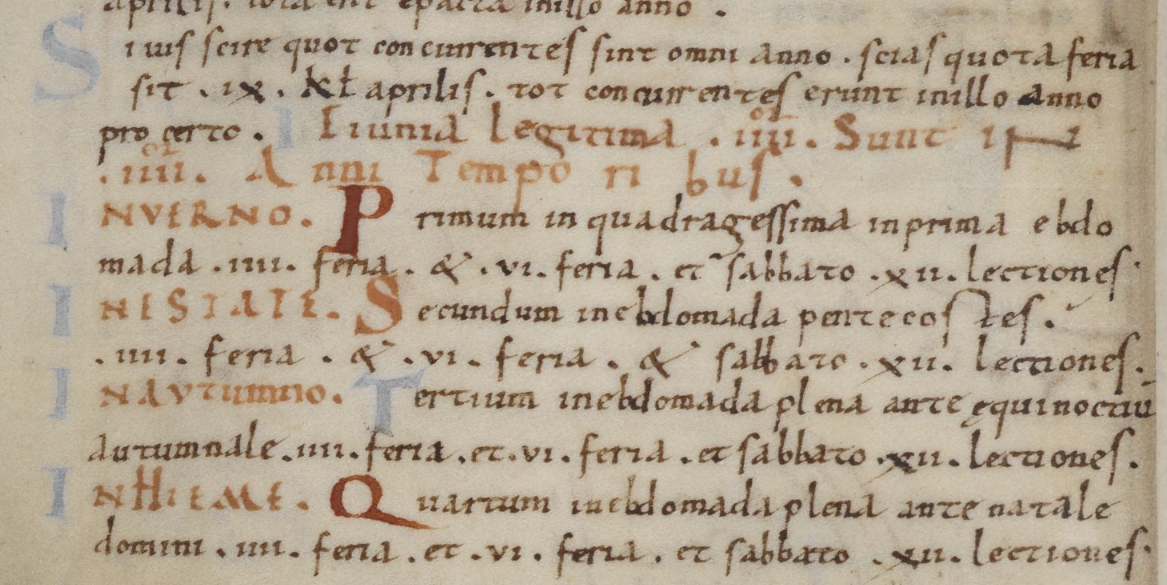
A diagram of the Ember Days in a manuscript made at Thorney Abbey, c. 1110

Wednesday, Friday and Saturday of this week are the harvest Ember Days, a three-day period of prayer and fasting which recurs four times over the course of the year. By ancient tradition there are four periods of Ember Days, corresponding with the four seasons: they fall in the weeks following the first Sunday in Lent, Whitsun, the Feast of the Exaltation of the Cross (September 14), and St Lucy's Day (December 13). The last two, being tied to fixed rather than moveable feasts, will always fall fairly close to the autumn equinox and the winter solstice, and so at the mid-point of these seasons (in traditional reckoning the solstices and equinoxes were usually understood to mark the middle or height of seasons rather than, as often today, the beginning).

The origins of the Ember Days are usually explained as lying in pagan Roman custom, petitioning the gods for aid at different points in the agricultural cycle, from the seed-time to the harvest, in the height of summer and the depth of winter. By the fifth century, and perhaps before, they had been adopted for Christian use by the church in Rome, and as they gradually spread further afield they were widely observed by the medieval church. Though not much noticed today, they are a reminder of how closely linked the medieval church was to the natural world, intently attuned to its seasons and cycles, and always ready to see human life not as separate from nature or from God but as part of one organic whole, in which the natural, the human, and the divine are interrelated at the most essential level.

(I've written about this many times, especially in reference to the Anglo-Saxon church - a collection of links can be found on this page.)

The Ember Days were observed in Anglo-Saxon England from at least the eighth century onwards; they are regularly prescribed in lawcodes and mentioned in standard learned works on computus (the calculation of time and church calendars - a very complicated science, which was an endless fascination to mathematically-minded early medieval scholars!). Most of the images in this post come from 11th and 12th-century English manuscripts which find different ways of representing the Ember Days in diagram form - divine science which is turned into art, too.


In Latin these days are called quatuor tempora, and tempora might perhaps be the origin of the Old English name, ymbren, from which we get 'Ember'. However, since ymb- is a very common Old English prefix, meaning 'around', a learned Anglo-Saxon might have perceived a (perhaps etymologically spurious, but nonetheless meaningful) connection between the word ymbrendæg and a large group of words relating to cycles and circles, such as ymbhweorfan 'to revolve, turn around', ymbhwyrft 'a ring, a circular course, an orbit', ymbhabban 'to surround, encircle', and so on.

The link between the Ember Days and the cycle of the year was made clearly visually in diagrams such as the one above (where the Ember Days are in the four corners of the circle), and in the works of scholars of computus, such as Byrhtferth of Ramsey, who links them to the numerous other patterns of four and its multiples which, to him, structure not just the year but everything in the world: four seasons, four solstices/equinoxes, twelve months, twelve astrological signs, the elements, the winds, the four cardinal virtues, and the four seasons of human life (childhood, youth, adulthood, old age). It's all connected...

Byrhtferth's diagram of interconnection (BL Harley 3667, f. 8)

Other scholars in Anglo-Saxon England were less interested in the calculation of the Ember Days than in their history and their moral purpose. There was a firm belief, mentioned in several late Anglo-Saxon sources, that they had been introduced into England by St Augustine of Canterbury himself when he was sent by Pope Gregory to evangelise the Anglo-Saxons at the end of the sixth century. (It's possible this is true, though it would be hard to prove either way.) A homily attributed to Wulfstan gives a memorably rhyming encapsulation of this detail: 'Ymbrenfæstena healde man rihte, swa swa Scs. Gregorius Angelcynne sylf hit gedihte' (roughly: 'Ember-fasting keep we ought, / as St Gregory the English taught'). To Anglo-Saxon Christians of this period, educated in the tradition of Bede's narrative of the English church, there was no greater earthly authority than that of St Gregory and Augustine; they were the founders and fathers of English Christianity, and a custom linked with them must be supremely venerable.

An Old English poem known as 'Seasons for Fasting', probably written in the eleventh century, describes the history and practice of the Ember Days in this light. It traces their history back to Moses and four fasts of the year described in the Old Testament, emphasising continuity between the Christian practice and the Jewish heritage of the church. It goes on:

Nu we herian sceolan her for life
deorne dædfruman, and him dogera gerim
ælmesdædum ure gefyllan,
and on fæstenum, swa se froda iu
Moyses mælde, and we þa mearce sceolan
heoldan higefæste mid Anglum,
swa hie gebrefde us beorn on Rome,
Gregorius, gumena papa.

Now we should praise here for life
the glorious Deed-doer, and for him complete
our tally of days with almsdeeds
and fasting, as the wise one, Moses,
taught long ago, and we should keep
the dates resolutely among the English,
as the princely man in Rome appointed for us,
Gregory, Pope of the people.

The poem describes the dating of each of the four periods of Ember Days, and then goes on to preach about the benefits of fasting in reconciling human beings to God. (At the time there was some dispute about the dating of the spring and summer Ember Days, and part of the poet's purpose is to urge people to keep the 'English' dates supposedly taught by Gregory rather than any continental alternatives; don't let any Bretons or Franks tell you differently, he says, these are the right days! The dates the poem recommends are the ones we keep now, since the controversy was settled later in the eleventh century.)

In the poem the discussion of the Ember Days and fasting in general is followed by a fervent denunciation of sinful priests, whose duty is to help the laity become closer to God, but who are themselves, it says, too often stained by sin: they 'daily offend the Lord by their neglect', misleading their people and caring more for drinking wine and eating oysters (!) than for their sacred duties. At this point the poem breaks off, before the poet can enumerate any further enormities of the contemporary clergy. The gluttony and self-indulgence for which the poem attacks priests are, of course, meant to be tamed by fasting and self-denial such as practised in the Ember Days.


Another and more widespread explanation of the Ember Days is provided by the Golden Legend, the hugely popular medieval compendium of saints' lives which originated in the thirteenth century and circulated for centuries in various different forms. This text offers no fewer than eight ways of understanding the four-fold pattern of the Ember Days and their relation to the four seasons of the year. Here's what it has to say (in Caxton's 15th-century translation):

The fasting of the Quatretemps, called in English Ember days, the Pope Calixtus ordained them. And this fast is kept four times in the year, and for divers reasons. For the first time [first season, i.e. spring], which is in March, is hot and moist. The second, in summer, is hot and dry. The third, in harvest, is cold and dry. The fourth in winter is cold and moist. Then let us fast in March which is printemps [spring], for to repress the heat of the flesh boiling, and to quench luxury or to temper it. In summer we ought to fast to the end that we chastise the burning and ardour of avarice. In harvest for to repress the drought of pride, and in winter for to chastise the coldness of untruth and of malice.

The second reason why we fast four times; for these fastings here begin in March in the first week of the Lent, to the end that vices wax dry in us, for they may not all be quenched; or because that we cast them away, and the boughs and herbs of virtues may grow in us. And in summer also, in the Whitsun week, for then cometh the Holy Ghost, and therefore we ought to be fervent and esprised in [inspired by] the love of the Holy Ghost. They be fasted also in September tofore Michaelmas, and these be the third fastings, because that in this time the fruits be gathered and we should render to God the fruits of good works. In December they be also, and they be the fourth fastings, and in this time the herbs die, and we ought to be mortified to the world.

The third reason is for to ensue [follow] the Jews. For the Jews fasted four times in the year, that is to wit, tofore Easter, tofore Whitsunside, tofore the setting of the tabernacle in the temple in September, and tofore the dedication of the temple in December.

The fourth reason is because the man is composed of four elements touching the body, and of three virtues or powers in his soul: that is to wit, the understanding, the will, and the mind. To this then that this fasting may attemper in us four times in the year, at each time we fast three days, to the end that the number of four may be reported to the body, and the number of three to the soul. These be the reasons of Master Beleth.

The fifth reason, as saith John Damascenus: in March and in printemps the blood groweth and augmenteth, and in summer choler, in September melancholy, and in winter phlegm. Then we fast in March for to attemper and depress the blood of concupiscence disordinate, for sanguine [blood] of his nature is full of fleshly concupiscence. In summer we fast because that choler should be lessened and refrained, of which cometh wrath. And then is he full naturally of ire. In harvest we fast for to refrain melancholy. The melancholious man naturally is cold, covetous and heavy. In winter we fast for to daunt and to make feeble the phlegm of lightness and forgetting, for such is he that is phlegmatic.

The sixth reason is for the printemps is likened to the air, the summer to fire, harvest to the earth, and the winter to water. Then we fast in March to the end that the air of pride be attempered to us. In summer the fire of concupiscence and of avarice. In September the earth of coldness and of the darkness of ignorance. In winter the water of lightness and inconstancy.

The seventh reason is because that March is reported to infancy, summer to youth, September to steadfast age and virtuous, and winter to ancienty or old age. We fast then in March that we may be in the infancy of innocency. In summer for to be young by virtue and constancy. In harvest that we may be ripe by attemperance. In winter that we may be ancient and old by prudence and honest life, or at least that we may be satisfied to God of that which in these four seasons we have offended him.

The eighth reason is of Master William of Auxerre. We fast, saith he, in these four times of the year to the end that we make amends for all that we have failed in all these four times, and they be done in three days each time, to the end that we satisfy in one day that which we have failed in a month; and that which is the fourth day, that is Wednesday, is the day in which our Lord was betrayed of Judas; and the Friday because our Lord was crucified; and the Saturday because he lay in the sepulchre, and the apostles were sore of heart and in great sorrow.
This traces eight different ways in which the Ember Days can related to patterns of human and natural cycles, encompassing interpretations moral, allegorical, seasonal, historical, scientific, and medical. Such an assortment of post-hoc explanations for the practice, provided by various authorities and supported by reference to the science of the four humours, might today raise a smile, but it's really rather beautiful in its own way; rather than simply explaining the history of the Ember Days, as a modern preacher might, this seeks to explore deeper correspondences between the four seasons, and the fasts which mark them, and cycles of growth and death which affect everything in the natural world, including the human body. (I particularly like that in autumn 'we fast in order to control melancholy'; that feels about right!) The various explanations are meant to complement each other, and they reflect a view of the world as essentially ordered, in which the cycles of human health, or human emotion, or natural growth and decay, are all connected to divinely-arranged patterns which shape the universe.

The Ember Days in Ælfwine's Prayerbook (Cotton MS Titus D XXVII, f. 13v)

Friday, 13 July 2018

'The jewel of the sky, the sun at its hottest'

Birds in a tree, from the Eadwine Psalter Cambridge, Trinity College, R.17.1, f. 275v

It's very hot at the moment. That's my only reason and excuse for posting some extracts of summer poetry from the Old English poem The Phoenix, in which an Anglo-Saxon poet who must have been a bit of a sun-worshipper comes up with a dazzling array of metaphors for the 'candle of the heavens' which burns so fiercely above us.

This poem, which survives in the tenth-century Exeter Book, is based on a Latin source and describes the legend of the regenerating phoenix. As was common in medieval thought about the phoenix, the story is interpreted as an allegory of Christ's resurrection and the rebirth of the redeemed human soul. You can read a translation of the whole poem here (the translation in this post is my own). The phoenix is imagined as living in a natural landscape of glorious beauty, which means the poem itself, to keep pace, becomes elaborately ornamented and richly beautiful in its language. The language of this poem is not easy, but it contains some of the loveliest nature writing in Old English - Anglo-Saxon poets were pretty adept at describing wintry scenes, and could probably compose word-sketches of stormy seas and hail-scarred cliffs in their sleep, but this poet, for a change, gets to do some lovely things with sunshine and leaf-shade and the full-blown radiance of summer.

Smylte is se sigewong; sunbearo lixeð,
wuduholt wynlic. Wæstmas ne dreosað,
beorhte blede, ac þa beamas a
grene stondað, swa him god bibead.
Wintres ond sumeres wudu bið gelice
bledum gehongen; næfre brosniað
leaf under lyfte, ne him lig sceþeð
æfre to ealdre...

Serene is that plain of victory; the sunny grove glows,
the joyous wooded holt. The fruits never fall,
bright branches, but the trees stand
ever green, as God commanded them.
Winter and summer the wood is alike
laden with fruits; no leaf ever withers
beneath the sky, nor does fire harm them
eternally...

This is the earthly paradise of eternal summer, refreshed by sparkling waters, in which the phoenix lives. There, every day, it pays homage to the glory of the sun:

Se sceal þære sunnan sið behealdan
ond ongean cuman godes condelle,
glædum gimme, georne bewitigan,
hwonne up cyme æþelast tungla
ofer yðmere estan lixan,
fæder fyrngeweorc frætwum blican,
torht tacen godes.

He beholds the journey of the sun
and comes to meet God's candle,
eagerly observes the glad jewel
when that noblest of stars rises up
above the waves, shining from the east;
the Father's ancient work glitters with ornaments,
bright token of God.

Look at all those poetic phrases for the sun, packed into just seven lines: God's candle, jewel of gladness, the noblest of stars... I've written before about how another Anglo-Saxon poet used the image of the sun as a jewel, rising to its highest at the summer solstice, to evoke the Son himself, the ascended Christ; and since the phoenix's resurrection analogises Christ's, perhaps that should be in the back of the reader's mind here too. Both might be called the 'Father's ancient work, the bright token of God'.

As the phoenix grows old, it leaves this beautiful homeland to live on earth and makes itself a dwelling-place closer to the human world, at the top of a lofty tree:

Ðær he heanne beam on holtwuda
wunað ond weardað, wyrtum fæstne
under heofunhrofe, þone hatað men
Fenix on foldan, of þæs fugles noman.
Hafað þam treowe forgiefen tirmeahtig cyning,
meotud moncynnes, mine gefræge,
þæt se ana is ealra beama
on eorðwege uplædendra
beorhtast geblowen; ne mæg him bitres wiht
scyldum sceððan, ac gescylded aa
wunað ungewyrded, þenden woruld stondeð.

There he abides and lives within a lofty tree
in the wood, the roots fast fixed
under the roof of the heavens, a tree which people on earth
call 'Phoenix', from that bird's name.
That tree has the King, mighty in glory,
the Measurer of mankind, granted - I have heard -
that alone of all the trees
which lift up their branches upon the earth
it blooms the brightest. No wicked thing
can do it any harm; it is shielded for ever,
abiding untouched, as long as the world stands.

Again there are delicate but deliberate echoes here of Old English Christian poetry, which don't entirely come across in translation: 'heanne beam' ('lofty tree') is a phrase which elsewhere describes the cross, so often imagined in early medieval literature as a lively and living tree. This tree's unique and superior beauty, 'alone of all trees', might remind you of the Crux Fidelis:

Steadfast cross, above all other,
one and only noble tree;
none in foliage, none in blossom,
none in fruit thy peer may be.

So too its steadfastness, standing 'as long as the world stands': to stand is the characteristic of the cross, the tree which is the still point of the turning world, the axis of the universe, the world-tree.

The sun in an Anglo-Saxon psalter (BL Harley 603, f.33v)

High in this tree the phoenix builds itself a nest, preparing for the cleansing fire which will be kindled by the blaze of the summer sun:

Ðonne wind ligeð, weder bið fæger,
hluttor heofones gim halig scineð,
beoð wolcen towegen, wætra þryþe
stille stondað, biþ storma gehwylc
aswefed under swegle, suþan bliceð
wedercondel wearm, weorodum lyhteð,
ðonne on þam telgum timbran onginneð,
nest gearwian. Bið him neod micel
þæt he þa yldu ofestum mote
þurh gewittes wylm wendan to life,
feorg geong onfon. Þonne feor ond neah
þa swetestan somnað ond gædrað
wyrta wynsume ond wudubleda
to þam eardstede, æþelstenca gehwone,
wyrta wynsumra, þe wuldorcyning,
fæder frymða gehwæs, ofer foldan gescop
to indryhtum ælda cynne,
swetes under swegle. Þær he sylf biereð
in þæt treow innan torhte frætwe;
þær se wilda fugel in þam westenne
ofer heanne beam hus getimbreð,
wlitig ond wynsum, ond gewicað þær
sylf in þam solere, ond ymbseteð utan
in þam leafsceade lic ond feþre
on healfa gehware halgum stencum
ond þam æþelestum eorþan bledum.
Siteð siþes fus. Þonne swegles gim
on sumeres tid, sunne hatost,
ofer sceadu scineð ond gesceapu dreogeð,
woruld geondwliteð, þonne weorðeð his
hus onhæted þurh hador swegl.
Wyrta wearmiað, willsele stymeð
swetum swæccum, þonne on swole byrneð
þurh fyres feng fugel mid neste...

When the wind dies down, the weather is fair,
the holy gem of the heaven shines brightly,
the clouds are dispersed, the tumult of the waters
grows still, every storm beneath the skies
is calmed, the burning candle of the air
shines from the south, giving light to men,
then he begins to build in the branches,
to prepare a nest. He has a great desire
to be able to swiftly turn from old age
back towards life, through a surge of the spirit,
receive youth again. Then from far and near
he collects and gathers the sweetest spices
to that dwelling-place, every kind of noble fragrance,
pleasant herbs and fruits of the woods,
which the King of Glory,
Father of every beginning, created
across the world for the glory of mankind,
sweet under the skies. There he carries
bright ornaments into that tree;
there the wild bird builds his house
in the wilderness, on the tall tree,
fair and joyous, and there he dwells
alone in that sunny chamber, and on the outside
surrounds himself, body and feathers,
in the shade of the leaves, on every side
with blessed scents and the noblest
fruits of the earth. He sits,
eager for a journey. When in the summer
the jewel of the sky, the sun at its hottest,
shines above the shadows and fulfils its destiny,
gazing far across the world, then his house
is heated by the brilliant radiance.
The herbs are warmed, the beloved hall smokes
with sweet fragrances; then, seized by fire,
the bird burns in the flames within its nest...


Gorgeous stuff. This fire of self-immolation, as well as mirroring Christ's sacrifice, also echoes the seasonal cycle of yearly growth, death, and rebirth: the bird building his nest suggests the spring, it's the height of summer when the fire is kindled, and then comes the harvest:

Þonne bræd weorþeð
eal edniwe eft acenned,
synnum asundrad, sumes onlice
swa mon to ondleofne eorðan wæstmas
on hærfeste ham gelædeð,
wiste wynsume, ær wintres cyme,
on rypes timan, þy læs hi renes scur
awyrde under wolcnum; þær hi wraðe metað,
fodorþege gefean, þonne forst ond snaw
mid ofermægne eorþan þeccað
wintergewædum. Of þam wæstmum sceal
eorla eadwela eft alædan
þurh cornes gecynd, þe ær clæne bið
sæd onsawen. Þonne sunnan glæm
on lenctenne, lifes tacen,
weceð woruldgestreon, þæt þa wæstmas beoð
þurh agne gecynd eft acende,
foldan frætwe. Swa se fugel weorþeð,
gomel æfter gearum, geong edniwe,
flæsce bifongen.

At that time the flesh becomes
born again, entirely renewed,
sundered from sins; somewhat like
how in harvest people carry home
the fruits of the earth for sustenance,
pleasant nourishment, before winter comes,
in the reaping time, lest the showers of rain
destroy them beneath the clouds. There they find sustenance,
joy in feasting, when frost and snow
with overwhelming force wrap the earth
in winter garments. From those fruits
shall spring again the blessed plenty of men,
according to the nature of the corn which first is sown
as pure seed, when the sun's light,
life's sign, in spring
wakes the world's wealth, so that these fruits,
according to their own nature are born again,
the ornaments of the earth. In this way the bird,
old after years, becomes young again,
clad in flesh anew.

As the blazing sun of our present heatwave scorches the ground, drying the leaves to dust and turning the grass yellow, it lays bare to the eye the process this poet is describing: summer turning into harvest, as the year begins to die like the phoenix. It's almost Lammas, after all, and autumn is less than a month away - time to be harvesting.

Friday, 22 December 2017

The Anglo-Saxon O Antiphons: O Mundi Domina, the Door Between the Worlds

Wisdom depicted as a female figure enthroned (BL Cotton MS Cleopatra C VIII, f.36)

O mundi domina, regio ex semine orta,
ex tuo iam Christus processit alvo tamquam sponsus de thalamo;
hic iacet in praesepio qui et sidera regit.

O Lady of the World, sprung of royal race,
now Christ has come forth from your womb as a bridegroom from his chamber;
here in a manger lies he who rules the stars.

This is one of a number of antiphons which in medieval tradition were grouped with the seven 'O Antiphons' in the days leading up to Christmas, though they are addressed not to Christ but to other figures or ideas in the story of the Incarnation - in this case Mary, 'Lady of the World'. This text forms the basis, loosely speaking, for the section comprising lines 275-347 of the Anglo-Saxon Advent Lyrics. The Old English poem expands this brief antiphon into a much longer and more allusive meditation on Mary's role in Christ's entry into the world; this is the longest section of the poem (at 72 lines) and it follows immediately on from the second longest (the 60-line poem based on O rex pacifice). It feels like the work of a poet excited by his or her own poetry, wrestling with imagery which is difficult to conceptualise and challenging to put into words - yet determined to go on until it has yielded up everything it has to offer.

Eala þu mæra middangeardes
seo clæneste cwen ofer eorþan
þara þe gewurde to widan feore,
hu þec mid ryhte ealle reordberend
hatað ond secgað, hæleð geond foldan,
bliþe mode, þæt þu bryd sie
þæs selestan swegles bryttan.
Swylce þa hyhstan on heofonum eac,
Cristes þegnas, cweþað ond singað
þæt þu sie hlæfdige halgum meahtum
wuldorweorudes, ond worldcundra
hada under heofonum, ond helwara.
Forþon þu þæt ana ealra monna
geþohtest þrymlice, þristhycgende,
þæt þu þinne mægðhad meotude brohtes,
sealdes butan synnum. Nan swylc ne cwom
ænig oþer ofer ealle men,
bryd beaga hroden, þe þa beorhtan lac
to heofonhame hlutre mode
siþþan sende. Forðon heht sigores fruma
his heahbodan hider gefleogan
of his mægenþrymme ond þe meahta sped
snude cyðan, þæt þu sunu dryhtnes
þurh clæne gebyrd cennan sceolde
monnum to miltse, ond þe, Maria, forð
efne unwemme a gehealdan.
Eac we þæt gefrugnon, þæt gefyrn bi þe
soðfæst sægde sum woðbora
in ealddagum, Esaias,
þæt he wære gelæded þæt he lifes gesteald
in þam ecan ham eal sceawode.
Wlat þa swa wisfæst witga geond þeodland
oþþæt he gestarode þær gestaþelad wæs
æþelic ingong. Eal wæs gebunden
deoran since duru ormæte,
wundurclommum bewriþen. Wende swiðe
þæt ænig elda æfre ne meahte
swa fæstlice forescyttelsas
on ecnesse o inhebban,
oþþe ðæs ceasterhlides clustor onlucan,
ær him godes engel þurh glædne geþonc
þa wisan onwrah ond þæt word acwæð:
"Ic þe mæg secgan þæt soð gewearð
þæt ðas gyldnan gatu giet sume siþe
god sylf wile gæstes mægne
gefælsian, fæder ælmihtig,
ond þurh þa fæstan locu foldan neosan,
ond hio þonne æfter him ece stondað
simle singales swa beclysed
þæt nænig oþer, nymðe nergend god,
hy æfre ma eft onluceð."
Nu þæt is gefylled þæt se froda þa
mid eagum þær on wlatade.
þu eart þæt wealldor, þurh þe waldend frea
æne on þas eorðan ut siðade,
ond efne swa þec gemette, meahtum gehrodene,
clæne ond gecorene, Crist ælmihtig.
Swa ðe æfter him engla þeoden
eft unmæle ælces þinges
lioþucægan bileac, lifes brytta.
Iowa us nu þa are þe se engel þe,
godes spelboda, Gabriel brohte.
Huru þæs biddað burgsittende
þæt ðu þa frofre folcum cyðe,
þinre sylfre sunu. Siþþan we motan
anmodlice ealle hyhtan,
nu we on þæt bearn foran breostum stariað.
Geþinga us nu þristum wordum
þæt he us ne læte leng owihte
in þisse deaðdene gedwolan hyran,
ac þæt he usic geferge in fæder rice,
þær we sorglease siþþan motan
wunigan in wuldre mid weoroda god.

Anglo-Saxon ivory plaque of Christ and Mary (c.1000-20, V&A)

O glory of the world,
the purest queen of all those
who have ever existed across the earth!
How rightly all speech-bearing ones
throughout the world address you and say,
joyous in heart, that you should be the bride
of the best Gift-giver of the skies.
And so too those highest in the heavens,
thegns of Christ, proclaim and sing
that you should be the lady, by holy powers,
of the heavenly host and of all the earthly kinds
of orders under the heavens, and of hell-dwellers.
For you, alone of all mankind,
gloriously resolved, courageous in purpose,
that you would bring your maidenhead to the Measurer,
give it without sin. There has never come another such
among all mankind, any other bride adorned with rings,
who since with shining spirit has sent the bright gift
to heaven-home. For the Lord of Victory commanded
his high messenger to fly here
from his glorious majesty and swiftly make known to you
the abundance of might, that you should bear the Lord’s Son by a pure birth
as mercy to mankind, and you, Mary,
from henceforth would remain ever undefiled.
We have also heard this, what long ago
a truth-bearing prophet said of you
in ancient days, Isaiah:
that he was led to where he beheld
life’s dwelling-place in the eternal home.
The wise prophet gazed across all that country
until he saw a spot where a noble entrance-way
had been established. That immense door
was bound about with precious treasure,
fastened with wondrous clasps.
He was sure that no man
could ever, in all eternity,
lift up those bars so firmly fastened,
or unlock the barriers of the city gates;
until an angel of God unraveled the matter,
glad in thoughts, and spoke these words:
‘I can tell you what will come true:
that God himself, by the power of the Spirit,
intends to pass through these golden gates
at a time yet to come, the Father Almighty,
and to visit the earth through these fastened locks,
and after him they will then stand forever
closed, always and eternally,
so that no other, except the Saviour God,
will ever be able to unlock them again.’
Now it is fulfilled, that which the wise one
there beheld with his own eyes.
You are the door in the wall; through you the All-wielding Lord
once only journeyed out into this world,
and even as he found you, adorned with powers,
chaste and chosen, Almighty Christ,
so the Lord of Angels closed you behind him again
with his limb-key, the Giver of Life,
immaculate in every way.
Show forth to us now the grace which the angel,
God’s word-bearer Gabriel, brought to you.
O, this we city-dwellers pray:
that you reveal that comfort to the people,
your own Son. Then may we all
rejoice in hope, united in mind,
when we gaze at the baby upon your breast.
Intercede for us now, bold in your words,
that he may not allow us any longer
to go astray in this deadly valley,
but that he may bring us into his Father’s kingdom,
where we, free from sorrow, may afterwards
dwell in glory with the God of hosts.

The virtues outside a city gate (BL Cotton MS Cleopatra C VIII, f.31v)

This section of the poem offers two images of Mary, each extraordinary in its own way. Elsewhere among the Advent Lyrics, Mary is the subject of 'O virgo virginum' and of the dialogue which begins 'O Joseph'; the latter brings to life the tension and pain in the story of her child-bearing, dramatising the anguished thoughts of a couple who have had a world-changing miracle erupt in the middle of their marriage. That's an emotional, intimate conversation - the Incarnation as personal human drama.

This poem gives us a very different view of Mary. Here she is a queen, and on a cosmic scale - ruler of the forces of heaven, earth, and hell. God and Mary are described in language and tropes drawn from Anglo-Saxon heroic poetry: they are the brytta and his bryd, the generous ring-giving lord and his resolute queen. Described thus, they might easily be Hrothgar and Wealhtheow in Beowulf, or even Cnut and Emma. Like many another woman in Anglo-Saxon poetry, Mary is a bride 'adorned with rings' (beaga hroden), but this bride is far from a passive figure: she is courageous and determined (þristhycgende, 'steadfast in mind'). This poem frames her situation in a distinctive way, presenting it as if she has decided to undertake a diplomatic mission from earth to heaven. Though literally this decision is made when she accepts Gabriel's message to her, the poem describes it as if she set out to travel on a journey to unite herself with God:

Forþon þu þæt ana ealra monna
geþohtest þrymlice, þristhycgende,
þæt þu þinne mægðhad meotude brohtes,
sealdes butan synnum. Nan swylc ne cwom
ænig oþer ofer ealle men,
bryd beaga hroden, þe þa beorhtan lac
to heofonhame hlutre mode
siþþan sende.

For you, alone of all mankind,
gloriously resolved, courageous in purpose,
that you would bring your maidenhead to the Measurer,
give it without sin. There has never come another such
among all mankind, any other bride adorned with rings,
who since with shining spirit has sent the bright gift
to heaven-home.

This kind of mission calls to mind the idea found in Anglo-Saxon literature of a royal bride as a 'peace-weaver', whose marriage makes a truce between two warring tribes; in this case the tribes Mary unites are heaven and earth, which are brought together in peace through her actions. The beorhtan lac she brings to God as a wedding-gift (lac means both 'gift' and 'offering, sacrifice') probably refers to her virginity, but it would also be an apt epithet for Christ, and it's a reminder that gift-giving too was part of a medieval queen's royal duty - Wealhtheow, the most famous peace-weaving queen in Anglo-Saxon poetry, rewards Beowulf for his services to her people with generous gifts of arkenstone-like treasure.

This view of Mary as a resolute, powerful queen continues to the end of the poem, where she is asked to intercede þristum wordum 'with bold words', on behalf of mankind. All this is perhaps inspired by the antiphon's reference to Mary's 'royal race', which the poem skillfully translates into the imagery and vocabulary of Anglo-Saxon royal womanhood. But in its second half the poem turns away from the antiphon completely to reflect on the vision of Ezekiel of the gate through which only God can pass:

Wlat þa swa wisfæst witga geond þeodland
oþþæt he gestarode þær gestaþelad wæs
æþelic ingong. Eal wæs gebunden
deoran since duru ormæte,
wundurclommum bewriþen. Wende swiðe
þæt ænig elda æfre ne meahte9
swa fæstlice forescyttelsas
on ecnesse o inhebban,
oþþe ðæs ceasterhlides clustor onlucan...
Nu þæt is gefylled þæt se froda þa
mid eagum þær on wlatade.
þu eart þæt wealldor, þurh þe waldend frea
æne on þas eorðan ut siðade.

The wise prophet gazed across all that country
until he saw a spot where a noble entrance-way
had been established. That immense door
was bound about with precious treasure,
fastened with wondrous clasps.
He was sure that no man
could ever, in all eternity,
lift up those bars so firmly fastened,
or unlock the barriers of the city gates...
Now it is fulfilled, that which the wise one
there beheld with his own eyes.
You are the door in the wall; through you the All-wielding Lord
once only journeyed out into this world.

The reference is to Ezekiel 44 (though the vision is mistakenly attributed to Isaiah), and the gate is interpreted as an image for Mary and her unique role in salvation - her unique place in the universe. One interesting feature of this poem is that the imagery of the first half is characteristically Anglo-Saxon, that of the second half firmly Biblical; but they are seamlessly woven together, and support and enrich each other. The union between heaven and earth which is implicitly brought about by Mary's peace-weaving in the first section is here given a different, but parallel expression; now she is the point of intersection between heaven and earth, the door through whom - and only through whom - Christ enters the human world. Mary, the great and terrible queen, is also the 'door in the wall' which separates us from the vast world beyond our universe - beyond human imagination, and yet accessible to us 'when we gaze at the baby upon [her] breast'.

Though Biblical in origin, the idea of this immense door between the worlds is the kind of metaphor which feels more at home in fantasy and science fiction than anywhere else - perhaps that's the only place now where we might encounter such a portal to another dimension as is imagined here. Mary is the wealldor: the door in the back of the wardrobe, the looking-glass with another world behind, the 'magic casements, opening on the foam / Of perilous seas, in faery lands forlorn'.

Stairway to heaven (A Matter of Life and Death)

The idea of Mary as the 'gate to heaven' (porta caeli), and the 'ladder to heaven' (scala caeli) are both metaphors with an ancient history, but to modern ears they can be surprising. I've had students find the image as applied to Mary in this poem difficult to grasp and almost unpleasant, so far is it from the much safer, small-scale religious imagery most of us are familiar with; but it's all the better for that. If it's initially challenging, the more rewarding the process of trying to comprehend it. This is the kind of image which opens a door onto the vast ambition of medieval writing about Advent and the Incarnation, which makes the modern equivalent (squabbles about whether we're allowed to sing about kings in Christmas carols) look utterly banal. Ancient texts about Advent are big: their scope is cosmic, their imagination boundless. They talk about Christ as ruler of time, creator of the stars, mystic fulfilment of all the myriad forms of human desire - not just (although, of course, also) a little baby in a manger. They are the very opposite of an exclusive, domesticated, cosy Christmas; they call down the powers of the whole universe, and all the powers and images which poetry has to offer - from the Bible to Beowulf - to find expression for this unimaginable marvel.

Sunday, 17 December 2017

The Anglo-Saxon O Antiphons: O Caelorum Domine, Lord of the Heavens

Anglo-Saxon ivory plaque of Christ in Majesty, 11th century (V&A)

Of all the poetry you might read in Advent, the great season of paradox and interpretative possibility, the very best choice may be some of the poetry inspired by the 'O Antiphons'. The last week of Advent has for centuries belonged to these ancient songs of appeal, which are sung each day at Vespers as Christmas draws closer. You can read about the history of the O Antiphons here; these texts are now best known via J. M. Neale's hymn 'O Come, O Come Emmanuel', but they have inspired poets since the earliest days of poetry in English. In the past I've posted several Middle English poems based on these texts - two poems and two carols - as well as the exquisite Anglo-Saxon poetic meditation inspired by the antiphons, which is known today as the Advent Lyrics or as Christ I.

This poem, which survives in the tenth-century Exeter Book, is incomplete (the beginning is lost), but as it stands it consists of twelve sections, each opening with the Old English equivalent of the antiphons' 'O': Eala. Some of these sections correspond with the seven antiphons which are today the best-known, but the first three (O Sapientia, O Adonai, O Radix Jesse) are missing, and there are several additions; diverse medieval practice encompassed a range of further antiphons no longer used today. In past years I've looked in detail at different sections of the poem, which you can find in the following posts:

O rex gentium (lines 1-17)
O clavis David (18-49)
O Jerusalem (51-70)
O virgo virginum (71-103)
O Oriens (104-129)
O Emmanuel (130-163)
O Joseph (164-213)
O rex pacifice (214-274)

Of the twelve there are still four I haven't looked at here, and this year I'll translate and explore two more of them. It's not entirely clear whether the Advent Lyrics are one poem or a sequence of poems, but either way they benefit from being read in stages like this, piece by piece - they are poems which ask you to read them slowly and meditate upon them. Each word, each metaphor, gives forth more meaning the more you dwell upon it. The O Antiphons are reflections on the idea of Christ under his different names and titles, a shifting succession of metaphors which attempt to express something, yet not all, of what he might be: the key, the root, the king, the sun, pure and complete wisdom. I've said in the past that I think the antiphons lend themselves particularly well to Anglo-Saxon poetry because this kind of allusive naming and renaming is exactly how much Old English poetry chooses to explore ideas (usually in the form of what's called 'variation') - it's an incremental, oblique progression of thought, where each name offers a new form of understanding or a different glancing light upon the thing described.

So these are texts rich in metaphor, alive with language and images of profound beauty; and yet they are something more, because in Christ, as nowhere else, metaphor collapses into truth. The antiphons suggest that in some mystical sense what is coming at Christmas is more truly the sun (or root, or king) than the sun itself. It is the external world which is the metaphor, Christ who is the reality. God is a poet who has written the world in metaphors which reveal his truth, his self; and our task - our pleasure - is to learn how to read them.

At the same time, there's something about the antiphons, and the poems inspired by them, which is not solely meditative - they are urgent and immediate and dramatic (in every sense of that word). They are to be sung as if in the voice of the whole church, the whole world, calling out in longing to its Lord. Each is a cry of desire, bearing a startling emotional intensity, and they encourage the reader to dwell with that desire - to feel it, explore it, attempt to understand its source. What is it we long for? What do we hope for, what do we seek? Sometimes the poems articulate what they are asking for - they appeal for light, or for freedom, or for strength - but at other times the desire is left undefined, and perhaps more powerful for being so. The poems do not promise that desire will or can be fulfilled; they long for and ask for fulfillment, but they don't possess it yet. They exist forever in a state of hope and uncertainty, acknowledging the world's great wound of need, and appealing for it to be healed.

Christ in Majesty, from a 10th-century English manuscript (Cambridge, Trinity MS. B 10 4, f. 16v)

So, here's the first of this year's translations: 'O caelorum domine'. This is the antiphon on which the poem is (rather loosely) based:

O caelorum domine,
qui cum patre sempiternus es una cum sancto spiritu,
audi tuos famulos,
veni ad salvandum nos, iam noli tardare.

O Lord of the heavens,
who with the Father and the Holy Spirit eternally lives,
hear your servants,
come to save us, do not delay.

This is so simple - what could be simpler? But look what the Anglo-Saxon poet made of it.

Eala þu halga heofona dryhten,
þu mid fæder þinne gefyrn wære
efenwesende in þam æþelan ham.
Næs ænig þa giet engel geworden,
ne þæs miclan mægenþrymmes nan
ðe in roderum up rice biwitigað,
þeodnes þryðgesteald ond his þegnunga,
þa þu ærest wære mid þone ecan frean
sylf settende þas sidan gesceaft,
brade brytengrundas. Bæm inc is gemæne
heahgæst hleofæst. We þe, hælend Crist,
þurh eaðmedu ealle biddað
þæt þu gehyre hæfta stefne,
þinra niedþiowa, nergende god,
hu we sind geswencte þurh ure sylfra gewill.
Habbað wræcmæcgas wergan gæstas,
hetlen helsceaþa, hearde genyrwad,
gebunden bealorapum. Is seo bot gelong
eall æt þe anum, ece dryhten.
Hreowcearigum help, þæt þin hidercyme
afrefre feasceafte, þeah we fæhþo wið þec
þurh firena lust gefremed hæbben.
Ara nu onbehtum ond usse yrmþa geþenc,
hu we tealtrigað tydran mode,
hwearfiað heanlice. Cym nu, hæleþa cyning,
ne lata to lange. Us is lissa þearf,
þæt þu us ahredde ond us hælogiefe
soðfæst sylle, þæt we siþþan forð
þa sellan þing symle moten
geþeon on þeode, þinne willan.

O holy Lord of the Heavens,
from of old you were with your Father
equal-being in the glorious home.
Not one angel had yet been made,
nor one of the mighty and majestic host
which guards the kingdom in the skies,
the splendour-dwelling of the Prince and his thegns,
when first you were with the eternal Lord
yourself establishing this vast creation,
the wide and spacious lands. One with you both
is the sheltering Spirit. Saviour Christ,
we all pray to you in humility
that you may hear the voice of the hostages,
of your captives, Liberating God,
how we are sore pressed by our own desires.
The cursed spirits, hate-filled hell-foes,
have cruelly confined the exiled race,
bound with bale-ropes. The remedy is
dependent entirely on you alone, eternal Lord.
Help the heart-sore, that your coming here
may comfort the wretched, though we
through our desire for wickedness have made a feud against you.
Have mercy now on your servants and think on our sorrows,
how we stumble on, weak at heart,
wandering hopelessly. Come now, king of men,
do not delay too long! We need kindness,
for you to rescue us and give us the true
grace of salvation, so that we may henceforth
always be able to do the better thing
to thrive among the people: your will.

There's a very sudden shift in this poem which occurs around the halfway point - a vertiginous plummet from heaven down to hell. The first half is all glory, eternity, stability, strength; the second half suffering, sorrow, constriction, frailty. By the swiftness of the transition, the poem enacts the descent it asks for: the entry of Christ, 'Lord of the heavens', into the world of exiles and captives. It reminds me of this image from an Anglo-Saxon Psalter of a gigantic Christ leaning down to pluck his people from the jaws of hell:


This is the kind of disparity of scale the poem evokes, with its contrast between the brade brytengrundas, 'the wide and spacious lands' of his dwelling-place, and the confining (genyrwad, i.e. 'narrowed' ) limits of ours.

The first half of the poem is stately and measured, with some elegant negatives:

Næs ænig þa giet engel geworden,
ne þæs miclan mægenþrymmes nan...

Not one angel had yet been made,
nor one of the mighty and majestic host...

There's language of stability and constancy: eternity, of course, and the establishment of the heavens, described as a þryðgesteald, a 'dwelling of glory' (gesteald suggests a fixed dwelling, stable and steadfast.) And we have a reminder too that there was almost no theological concept which Anglo-Saxon translators wouldn't render in English if they could; so notice here efenwesende, 'equal-being', as the Old English for 'consubstantial'!

But the second half is darker and sadder. The last lines are very moving, offering two affecting verbs to characterise what humans do in the world: we stumble and we wander (tealtrigað and hwearfiað). The verb tealtrian suggests tottering, stumbling, unsteady movement, while hwearfian is something more turbulent: 'to turn, change, roll about, revolve, wander'. I particularly associate hwearfian with The Seafarer, where it describes the movement of the soul which flies out of the body to roam restlessly across the earth, 'eager and greedy'. That's an image, and a poem, of ravenous desire - of 'hunger' and 'longing' and 'lust', which drive the speaker out onto the ocean, away from the safe and familiar to an existence which is painful, lonely, but better than the life he has known on land.

In the Advent poem, too, desire is a powerful force. We are in captivity, bound not just by the ropes of devils (bealorapas) but by our own desires: we sind geswencte þurh ure sylfra gewill. By our love of sins (firena lust) mankind has enslaved itself, and placed itself in 'feud' with God. If the O Antiphons take their power in part from the force of their desire for God, this poem suggests what happens when that potent desire is misdirected. The only cure is liss, one of those far-ranging Old English words which means many beautiful things: mercy, favour, grace, gentleness, kindness, joy. Alliteratively speaking, liss often collocates in Anglo-Saxon poetry with life and with love; but here it's with ne lata to lange, a cry of impatience: 'Do not delay too long.'