Showing posts with label Church Year. Show all posts

Friday, 10 April 2020

Good Friday Alone

The Virgin Mary and Christ, in a Book of Hours of c.1510-20 (BL Add MS 35214, f. 27)

Alone alone alone alone
Sore I sigh and all for one.

As I went this enders day [the other day]
Alone walking on my play
I heard a lady sing and say
'Woe is me and all alone!
Alone alone alone alone
Sore I sigh and all for one.'

To that place I drew me near
Of her song somewhat to hear.
There sat a lady with sorry cheer [a sad countenance]
That sore did sigh and groan,
'Alone alone alone alone
Sore I sigh and all for one.

Behold, my son crowned with thorn,
And all his body rent and torn,
Put to death with shame and scorn,
For mankind's sake alone.
Alone alone alone alone
Sore I sigh and all for one.'

For sooth it was a wondrous sight
To see her child, how it was dight [arranged, ordained]
For to bring mankind to light
To save us from our fone. [foes]
Alone alone alone alone
Sore I sigh and all for one.

Sith it will no better be [since it can be no better]
Pray we to that child so free
That we may him in heaven see
What we shall hence gone. [when we depart from here]
Alone alone alone alone
Sore I sigh and all for one.

For many of us this will be a solitary Good Friday, and so I've been thinking about the place of solitude - aloneness - in medieval imaginings of the story of Christ's Passion. This is a carol from the 16th century, an example of a very widespread poetic tradition giving voice to Mary's grief for her son, which takes the word alone as its refrain and keynote. The text is from a printed book of c.1550, and I've modernised the spelling from the carol as edited in Greene's Early English Carols. When I first read this poem, I was reminded of a similar carol, a few decades older, which also makes use of the moving refrain 'alone' - but this is a carol set at an earlier moment in Mary's life, when her son is still an infant. There her baby, as she ('alone') tries to soothe his crying, tells her the real reason why he is weeping so bitterly:

'Mother,' he said, 'how should I sleep?
How should I leave my moan?
I have more cause to sob and weep,
Since I shall die alone.'

She is horrified at this declaration, as anyone would be. He explains to her that it is necessary, since he - and he 'alone' - must save mankind by his death, but she already sees the grief and loneliness it will mean for her:

'Dear son,' she said, 'since thou hast take
Of me both flesh and bone,
If it may be, me not forsake
In care and woe alone...

'Dear son,' she said unto him tho [then]
'When thou from me art gone,
Then shall I live in care and woe
Without comfort alone.'

He cannot tell her she will not grieve or have to bear solitude, but his comfort is to promise her that he will, in the end, ease her loneliness:

'Mother,' he said, 'take thou no thought,
For me make thou no moan;
When I have bought that I have wrought, [when I have redeemed what I created]
Thou shalt not be alone.'

This kind of interaction, where Mary begs her son not to die and leave her alone and grieving, is also a frequent part of poetic dialogues in the 'Stabat Mater' tradition. Many medieval poets devoted attention to imagining Mary's feelings at these different moments of grief: when as a young mother she begins to understand what her child's future will hold, when she sees her son dying in front of her eyes, when she holds his body in her arms. There are countless examples of poems in this tradition, and many of them are absolutely heartbreaking. Even if you don't have much sympathy with this emotive style of devotion, it's hard not to be moved by these poems; they are powerful expressions of grief and love which will resonate - as they are designed to - with every reader's own personal experiences of loss. Mary's grief is unique, but also universal. Hers is a parent's grief, and every time I hear the strange canard that, because infant mortality was high in the Middle Ages, medieval people didn't really love their children or grieve for them when they died, I think of these heart-wrenching poems; they are born of, and absolutely depend on, a widespread cultural acceptance that the loss of a child is one of the most devastating experiences a person can imagine. But these poems aren't only meant for parents, but for everyone, and they aim to draw on wells of tears springing from many other kinds of love and grief. They expect the audience to recognise and respond to it with strong emotion, weeping as Mary weeps.

The 'Alone' carol is probably meant to evoke a Pietà image, Mary holding Christ's body in her arms, and the characteristic feature of that artistic and literary tradition (as distinct from, for instance, Deposition and Entombment scenes where Mary holds her son's body) is that it's only the two of them. She is alone with him, and yet he's not there - she only has his dead body to cradle, a particularly painful kind of solitude. In the first carol the speaker is also 'alone' when they witness Mary's lament, and so her solitude echoes their own. Such poems are often framed as an encounter with Mary, where the speaker of the poem - as here - comes across her unexpectedly, or sees her suddenly appear to them in a vision. We never learn much about the speaker (they're not much more a pair of eyes and ears through which the reader is able to see and hear) but we are told that they are, very often, 'alone' - here wandering out for a solitary ramble, and in other poems lying awake at night, 'alone in my longing'. It's at such moments that these poems might be designed to be read and meditated upon; in solitude, the reader has time to reflect and to feel, to open their heart to what they read, and perhaps even to encounter some kind of mystical or visionary experience.

Alone in quarantine: Christ enters the desert for his 'karenine', his forty-day fast (BL Yates Thompson MS. 13, f. 111)

A focus on aloneness is also appropriate when attempting to consider Christ's own suffering at the Passion, in which there are several key moments where he is, humanly speaking, completely alone. I wrote in my last post about Christ's entry into what was in the Middle Ages called 'quarantine', his solitary forty days in the desert, and the story of his death has more such moments: the Agony in the Garden, the silence of the tomb. In medieval liturgy, the ritual reenactment of those days used a variety of means to powerfully evoke those experiences of isolation and desolation - the gradually enveloping darkness of the Tenebrae service, the stark exposure of the stripped altar and the empty tabernacle, the extensive use of silence both within and around the liturgy of the day. (There's some evidence that in early medieval England the last three days of Holy Week were known as 'the silent days', swigdagas.) Even when experienced collectively, these practices cut off the individual worshipper from those around them, alone in a silent and perhaps invisible crowd.

In extra-liturgical devotional practice, the believer might also be encouraged to go with Christ into that aloneness, to - paradoxically, in a way - share his solitude. One early English example occurs in the Anglo-Saxon poem The Dream of the Rood, a vision of the Passion story narrated by the cross, in which Christ is imagined alone in the tomb, 'weary after the great battle': reste he ðær mæte weorode, 'he rested there, with little company' (that's the understated Anglo-Saxon way of saying 'completely alone'). The same words are then, significantly, repeated of the person who is having this vision, lying awake while others are sleeping; the dreamer says the vision appeared þær ic ana wæs / mæte werede, 'where I was, alone, with little company'. In that aloneness, the dreamer comes so close to Christ that the same words describe them both.

Alone and not alone: the Agony in the Garden, with Christ accompanied in the darkness by faces keeping watch (BL Yates Thompson MS. 13, f. 118v)

But though solitude may offer a way to communicate with the divine, it may also heighten and intensify human grief. In another Anglo-Saxon poem, the focus is instead on Mary Magdalene and the other women among Christ's followers who went to the tomb early on Easter morning, and found it empty. The poem speaks of their anxiety about their Lord being left alone; the word, ana, is repeated twice within a few lines. 'They thought that he would have to lie in the grave / alone on that Easter night.' There's something so poignant about that attribution to them of the very natural desire to be with the body of the person they are mourning - even in death, they don't want him to be alone. It was a key part of medieval meditative practice to enter into these Biblical experiences of grief in the most naturalistic way possible, by drawing on your own knowledge or fear of how it feels to lose someone you love, or not to be able to mourn them as you would wish. An even more powerful expression of this idea is offered by St Anselm, in his prayer to Mary Magdalene, where he imagines with extraordinary sensitivity the depth of her grief at not being able to find the body of Jesus when she went to the tomb to anoint him:

More than all this, what can I say, how can I find words to tell, about the burning love with which you sought him, weeping at the sepulchre, and wept for him in your seeking? How he came, who can say how or with what kindness, to comfort you, and made you burn with love still more; how he hid from you when you wanted to see him, and showed himself when you did not think to see him; how he was there all the time you sought him, and how he sought you when, seeking him, you wept.

But you, most holy Lord, why do you ask her why she weeps? Surely you can see; her heart, the dear life of her soul, is cruelly slain. O love to be wondered at; O evil to be shuddered at; you hung on the wood, pierced by iron nails, stretched out like a thief for the mockery of wicked men; and yet, "Woman," you say, "why are you weeping?" She had not been able to prevent them from killing you, but at least she longed to keep your body for a while with ointments lest it decay. No longer able to speak with you living, at least she could mourn for you dead. So, near to death and hating her own life, she repeats in broken tones the words of life which she had heard from the living. And now, besides all this, even the body which she was glad, in a way, to have kept, she believes to have gone. And can you ask her, "Woman, why are you weeping?" Had she not reason to weep? For she had seen with her own eyes -- if she could bear to look -- what cruel men cruelly did to you; and now all that was left of you from their hands she thinks she has lost. All hope of you has fled, for now she has not even your lifeless body to remind her of you. And someone asks, "Who are you looking for? Why are you weeping?" You, her sole joy, should be the last thus to increase her sorrow. But you know it all well, and thus you wish it to be, for only in such broken words and sighs can she convey a cause of grief as great as hers...

But now, good Lord, gentle Master, look upon your faithful servant and disciple, so lately redeemed by your blood, and see how she burns with anxiety, desiring you, searching all round, questioning, and what she longs for is nowhere found. Nothing she sees can satisfy her, since you whom alone she would behold, she sees not. What then? How long will my Lord leave his beloved to suffer thus? Have you put off compassion now you have put on incorruption? Did you let go of goodness when you laid hold of immortality?

Mary Magdalene was famous for her tears (which is why her name became our word maudlin), and Anselm dwells on them at length in his prayer, with the intention of evoking answering tears in himself and in the reader. These tears of grief will turn to tears of joy, and yet Anselm explores how closely mingled the two must be, must have been:

For love's sake he cannot bear her grief for long or go on hiding himself. For the sweetness of love he shows himself who would not for the bitterness of tears. The Lord calls his servant by the name she has often heard and the servant knows the voice of her own Lord. I think, or rather I am sure, that she responded to the gentle tone with which he was accustomed to call, "Mary." What joy filled that voice, so gentle and full of love. He could not have put it more simply and clearly: "I know who you are and what you want; behold me; do not weep, behold me; I am he whom you seek." At once the tears are changed; I do not believe that they stopped at once, but where once they were wrung from a heart broken and self-tormenting they flow now from a heart exulting.

The Burial of Christ (BL Harley MS. 2915, f. 173v)

Such prayers as this were the beginning of the devotional tradition which sought to approach God through human emotion, and which culminated in such poems as the 'Alone' carol. That song falls into the genre known as Planctus Mariae, 'the lament of Mary', and planctus of all kinds is a very popular form in medieval literature (compleint is the usual Middle English term). One purpose of planctus as a literary genre, whether the one lamenting is Mary or Dido, is that it gives space and voice to sorrow, to the kinds of emotion we all feel, but can't often express except through poetry, through other people's words. On this particular Good Friday, when grief is all around us, it is perhaps more important than ever to make space for those emotions, to acknowledge and find words for them. In the 'Alone' carol the grief is attached to one particular story - Christ's Passion - but much of its expression is taken from the wider tradition of compleint, which encompasses many other kinds of love and sorrow. Its refrain, 'Sore I sigh and all for one', very clearly echoes the language of secular love-songs; it could conceivably have been borrowed from an existing love-song, as was a common practice. Compare the similar phrasing found in the 16th-century manuscript below: 'Alone I live, alone, and sore I sigh for one'. In medieval love poems, too, it's conventional (as you might expect!) to lament loneliness, to pine for the absent and to long for reunion. Here's an example comparable to our 'Alone' carol by the 15th-century poet Charles d'Orleans, which begins:

Alone am y and wille to be alone;
Alone, withouten plesere or gladnes,
Alone in care, to sighe and grone,
Alone, to wayle the deth of my maystres,
Alone, which sorow will me neuyr cesse.
Alone, I curse the liif I do endure.
Alone this fayntith me my gret distres,
Alone I lyve, an ofcast creature.

[Alone am I, and want to be alone;
Alone, without pleasure or gladness,
Alone in sorrow, to sigh and groan,
Alone, to bewail the death of my mistress,
Alone, the sorrow which will never cease for me.
Alone, I curse the life I endure,
Alone, my great distress makes me faint,
Alone I live, an outcast creature.]

Each stanza continues in this way; read the whole thing here.


The transference of language like this between religious verse and secular love-poetry apparently did not seem as odd in the Middle Ages as it might to us today; it could in fact be a source of inspiration for religious poets and preachers, as they sought to articulate the experience of love wherever it might be found - with the belief that ultimately, truly and most completely, it will always be found in Christ. Looking for other comparable 'alone' poems, I came across a 14th-century sermon for Good Friday, which incorporates several short lyrics or couplets in English within the predominantly Latin text. The focus of the sermon is a quotation from the Song of Songs which was immensely popular in medieval devotional writing: amore langueo, 'I languish for love'. (This is also the refrain of two of the finest Middle English lyrics: one spoken by Christ, 'In a valley of restless mind', and the other by Mary, 'In a tabernacle of a tower, as I stood musing on the moon'). Here these words of love - from a book of course full of erotic desire - are interpreted as if they are Christ's, and as if they describe his actions on Good Friday. First, the author explains the paradoxical nature of Good Friday ('a doubtful day of feast and fast', he might have said!):

Dearly beloved, I think I can rightly say that this is a blissful day and a sorrowful day. It is a blissful day because on it occurred one of the greatest joys that ever happened to the human race, for mankind was led out of servitude, and he who was a slave became free. That this day was blessed among all that ever have been is proven by blessed Gregory when he says, 'What would we have gained by Christ's birth if he had not redeemed us?' as if to say, nothing. Since such great joy came to mankind on this day, we can say with the Psalmist, 'This is the day the Lord has made,' etc. Likewise, this is a sorrowful day because one of the most pitiful and sorrowful things that have ever happened occurred on it, for today, he who was innocent and without stain of sin was unreasonably and falsely killed and ended his life in pain like a lamb; and thus is fulfilled what he himself said through the prophet in a psalm: 'My life has ended in pain,' etc.

(This translation is from Siegfried Wenzel, Macaronic Sermons: Bilingualism and Preaching in Late-Medieval England (Ann Arbor, 1994); the bolded phrases mark words which in the original appear in English, while the rest is in Latin.) The preacher then goes on to expound his text, and to explore what it might mean to say that Christ 'languishes for love'.

Dearly beloved, you should understand that not every love is a languishing love, but only intense love is said to be languishing, that is, when someone loves something so much that he thinks of nothing else beside it, nor has any taste or delight except for it alone. Such love did Christ have for us, as he clearly shows today. Hence we must in return have the same love for him. Speaking of such languishing love, it seems to me that I find seven clear signs by which we can recognize a man who languishes in love. They are:

He lesus is myth and waxit wan
He syket as a sorful man
Alone he drawes fro compenye
And euer he herkenes one ys drurie.
Louelyche he spekis to hys herte
For hym he suffrus peynis smert
Thorow tokenys of 3yftes 3yuynge
He schewet in hert loue-murnyng.

[He loses his strength and grows pale;
He sighs as a sorrowful man;
Alone he draws from company,
And he always listens for his beloved.
Lovingly he speaks to his heart,
For whom he suffers pains smart.
Through tokens of gifts given,
He shows in heart love-mourning.]

These are the seven signs by which we can tell a person who languishes from love, and all of them were on this day found in Christ.

He goes on to explain, one by one, how each of these features of the pining human lover could be seen in Christ on the day of his Passion. 'Alone he draws from company' is a characteristic of the lover (like Charles d'Orleans) but in the story of Good Friday, it's literally true of Christ:

The third sign of languishing love is that he who languishes for love withdraws from company, for there can be no companionship for him except that of his beloved. In this way Christ was alone, for no one remained with him, even 'his disciples abandoned him and fled.' At that time they did not yet fully believe in him, for they did not expect him to rise from the dead, all except the Blessed Virgin, in whom the Church's faith stood alive during those three days.

This offers a more positive reading of Christ 'alone' on Good Friday. In one sense his solitude is an abandonment, a painful isolation - but it's also an act of love, undertaken for the good of others. In this analogy 'his beloved' is all mankind; he withdraws from the company of his closest friends as an act of self-sacrifice, putting aside his particular love for his friends for the love of humanity in general. I wonder if there has ever been a Good Friday in the six centuries since this sermon was written when that interpretation of his aloneness has hit so close to home.

Tuesday, 31 March 2020

The Long Lent and the History of Quarantine


Strange new events call for new vocabulary, and over the last few weeks and months we have all been getting used to some novel and unfamiliar language: self-isolation, social distancing, lockdown. In my own mind, I've taken to calling this whole situation 'the Long Lent' - mostly because it sounds less frightening than 'global pandemic', and makes it seem a little bit less weird and impossible. It's also an apt name in several ways which suit the timing of this strange new reality. In the UK and some other parts of the world, this escalating situation has coincided almost exactly with the progress of Lent; at Ash Wednesday lockdown still seemed only a distant possibility, but by mid-Lent Sunday it was our new life. That life is Lenten in some familiar as well as unfamiliar ways. In a literal sense, of course, the constraints and restrictions we are all facing require the kind of self-denial and patience Lenten fasting is meant to teach; if we are lucky enough in ordinary times to have an abundance of all the food, time and pleasure we can wish for (of course not everybody is) that has changed abruptly in the last few weeks. The sombre themes which Lent demands we reflect on are now our daily preoccupation; texts used every year in the liturgy during Lent - contemplations of mortality and the brevity of life, the lamentations of Jeremiah, Psalm 91 with its promise of being saved from plague and pestilence - seem almost too pointed this year.

Even the suspension of worship in churches, though in some ways unprecedented, has a slightly uncanny Lenten parallel. (The date on which it ceased was also, as pointed out here, an extraordinary coincidence with the single comparable precedent for this in British history.) In Lent the church traditionally forgoes, temporarily fasts, from some aspects of the liturgy: the Alleluia is 'locked' away, as it was expressed in medieval England, to be unlocked again at Easter. During Passiontide, the last fortnight in Lent, statues and crucifixes in church are covered up, hidden and shrouded as a token of the deepening solemnity of the season. Last week, many people could still at least see the inside of churches they love via livestreamed services, but tighter restrictions mean that even that is now forbidden for many; and so Passion Sunday marked the beginning of a period when many churches will be entirely shrouded and invisible for a long time to come. It's a strange coincidence, of the kind a medieval historian, trained to be attuned to the intersections between unfolding human history and the liturgical year, would have found fascinating (and most likely they would have said it was not a coincidence at all).

Since these restrictions will not end for us at Easter, even when Lent is over, this looks to be a very Long Lent indeed. But there's an etymological fitness in the phrase 'Long Lent', too, which means the two words naturally collocate. In English, the original meaning of the word 'Lent' (Old English lencten) was simply 'spring', and though it was subsequently transferred in the Anglo-Saxon period to refer to the church season, the two meanings co-existed for a long time. 'Lent' continued to be the most common word for 'spring' in English until at least the 14th century. In medieval English usage, it's often difficult to distinguish whether any particular use of 'Lent' means 'spring' or specifically 'pre-Easter fast'; the two always coincide, and there wasn't often much need to differentiate. In origin, the etymology of 'Lent' probably derives from the same Germanic root as 'long' and 'lengthen', from the idea of spring as the time when the days are growing longer. Whether poets realised that or not (it wouldn't be hard to guess), the alliteration and aural similarity which links these words means they often appear together in medieval English poetry. For instance, here's a verse from a fourteenth-century springtime poem in praise of the Virgin Mary:

Lentun-dayes, thei ben longe,
And nou weor good tyme to amende
That we beforen han do wronge.
This world nis nothing, as I wende;
In sori tyme my lyf I spend.
This world is fals, and that I feel;
But Marie Moder me amende,
Amis I fare, and nothing wel.

(Lent days, they are long, and now is a good time to make amends for what we have previously done wrong. This world is nothing, I think; I spend my life unhappily. This world is false, and I feel that. Unless Mary mother helps me amend, I fare amiss, and in no way well.)

The suggestion here is that the natural lengthening of days in Lent helps to make them a particularly good time to do penance - not exactly, perhaps, because there are more hours of daylight to do good in, but because Lent/spring is a season of amendment, a time of growth and rebirth in the natural world, when light and life are increasing all around us. The lengthening days of Lent can be taken as a sign of hope for better things, a spur to aim for self-improvement. However, I confess that to me this Lent seems like a time when 'the days are growing longer' in a different way, because at times these formless days seem very long indeed...

A bit of more cheerful blossom

If we delve a bit further into linguistic history, we can see some more interesting connections. Along with adjusting to new vocabulary, we're also hearing much more these days of an older term, quarantine - a word most of us probably already knew, without often having the need to use it. This comes from the medieval Latin quarentena, from quaranta, 'forty', and in medieval Latin it's a measurement, both of length and of time: as a unit of length, the equivalent of English furlong (a length of forty rods), and as a unit of time, a period of forty days.

It's the latter which gives us our modern sense of the word. The history of quarantine as a public health measure dates back to the fourteenth century, when Venetian authorities, hoping to avoid outbreaks of plague, enforced a forty-day period of waiting before ships could enter harbour. In time similar measures were adopted elsewhere, and quarantine became a common word for such periods of isolation, whether or not the period in question was actually forty days long. (The OED helpfully quotes Pepys, writing in 1663, observing of a thirty-day quarantine that it's 'contrary to the import of the word; though in the general acceptation, it signifies now the thing, not the time spent in doing it'.)

However, the word quarantine has a longer history than that, and one which aligns it closely with Lent. A period of forty days is not a random unit of time, but one whose significance in medieval custom was established by important Biblical precedent: in the Old Testament both Moses and Elijah went without food for periods of forty days, sustained only by the power of God, and, of course, Christ fasted in the desert forty days and forty nights. In imitation of these fasts, and especially of Christ in the wilderness, a forty-day period of fasting was established in Christian practice in the fourth century, and gradually became codified as the season of Lent (in Latin Quadragesima, from the same root as quarentena). It matches the other significant periods of forty-day seasons which shape the liturgical year, the forty days between Christmas and Candlemas and between Easter and the Feast of the Ascension. Lent, Easter, and Christmas are each attached to a forty-day quarentena.

The well-established significance of the forty-day period meant that it was a convenient one to use for various purposes in the Middle Ages, long before it became a means of keeping out the plague. Some of the earliest appearances of the word quarantine refer to legal customs which stipulated a fixed forty-day period within which a particular thing had to be done. For instance, there was a law that a woman whose husband had just died was allowed a quarantine: she had the right to continue living in her late husband’s house for forty days, unmolested, while her share of the estate was decided. This right to a 'widow's quarantine' was included in Magna Carta.

Another kind of forty-day quarantine might be a time for fasting, chosen or imposed as a penance. It was a way of imitating the Biblical periods of fasting, but at any time of the year. The fourteenth-century English poet John Gower, writing in French, says that 'He who fasts a single day with you [i.e. Charity] receives a more sure reward than another who fasts a quarantine (un quarantain) without you', suggesting that a fast of one day, faithfully undertaken, is of more virtue than the more extravagant commitment of forty days. There are numerous comparable uses of the term in sources in medieval Latin (quarentena) and in Anglo-Norman (quarantaine), in the centuries before the word began to take on its more restricted present-day meaning.

Interestingly, though often used by English writers when writing in Latin or French, the word quarantine doesn't appear in English in any of these senses until after the medieval period. There are several reasons for this, one being that most legal and ecclesiastical business in the period we're looking at (twelfth-fifteenth centuries) was still conducted or at least recorded in either Latin or French, so an English equivalent for a technical term like the 'widow's quarantine' would not have been necessary. But the other reason is that when speakers of Middle English wanted to talk about a forty-day period of fasting, they would call it a lent - a term which by this time could refer to a fast at any time of year, not only the universal pre-Easter fast. If Gower had been writing in English, he would surely have used the word lent where he says quarantain, just as a contemporary of his writes of a penance being imposed for 'the lengthe of a Lenten' at a non-Lent time of the year. This means that to some degree lent and quarantine are basically synonymous, since both can mean 'a forty-day period of penitential fasting'.

And that brings us to the other link between them, the only sense the word quarantine does have in medieval English, according to the Middle English Dictionary.

By yonde ys a wyldernys of quarentyne,
Wher Cryst wyth fastyng hys body dyd pyne;
In that holy place, as we rede,
The deuyl wold had of stonys bred;
Aboue that wyldernys ryght fer and hy
The fende to Cryst schewyd regna mundi,
And sayde, 'Yf thow wylt me worschyp do
Al these shalt thou haue thy lordschyp to.'

This is the fifteenth-century writer William Wey, describing the region around Jerusalem, which he had visited on pilgrimage in 1456 and subsequently wrote about in his Itineraries. One of the pilgrimage sites one could visit in that region was the desert where Christ fasted, which was named Quarantine, because of the forty-day duration of his fast. (Today, Mount Quarantania.) Margery Kempe went there too, in 1413, to 'the Mownt Qwarentyne ther owyr Lord fastyd fowrty days'; she tells us how difficult she and her party found it to get up the mountain, and how she could not manage it at all until she found a kindly 'Sarazyn' to help her. That mountain, pilgrims were told, was where Christ fasted and was tempted by the devil, as Wey explains:

Beyond is a wilderness of Quarantine,
Where Christ with fasting afflicted his body.
In that holy place, as we read,
The devil demanded to have bread from stones.
Above that wilderness, right far and high,
The devil to Christ showed the kingdom of the world,
And said, 'If you will worship me,
You shall have this in your power.'

That was the fast and self-denial which the practice of Lent was supposed to imitate. And it all took place in Quarantine.

Christ in Quarantine (British Library, Add MS 18851, f. 71, opening the readings for the First Sunday of Lent)

Saturday, 2 November 2019

Hallowtide

The ossuary at St Leonard's, Hythe

All Souls, and a rainy November day in the season of remembrance. The three-day season of Hallowtide - Hallowe'en, All Saints, All Souls - is medieval in origin, as a time for remembering the dead both known and unknown. Medieval literature is rich in serious, profound meditations on mortality, on death, on transience, and in the later Middle Ages, particularly, the iconography and art of death abound; if you need a memento mori, go to medieval art. Sometimes this art pops up into view around Hallowe'en, when you might see, for instance, images of grinning skulls and 'The Three Living and the Three Dead' offered as seasonal fare on social media. It's useful to remember, however, that in the Middle Ages this interest in death was not really confined to any one season of the year - not even Hallowtide, though certainly it was important then. A few years ago I posted some medieval prayers, in poetry and prose, 'for all Christian souls'; but though appropriate for All Souls they weren't specifically intended for today's commemoration, and could be prayed at any time of the year. In the Middle Ages almost every day was a saint's feast, a day to remember the glorious dead; prayer for the dead was a Christian duty all year round, especially but certainly not only on All Souls' Day; and the whole point of a memento mori is that it reminds you that at any moment you are close to death - not just at Hallowtide.

In a strange way, which no one could have predicted at the beginning of the last century, the cusp of October and November has now become a more intensive season of remembrance, in England at least, than it has been at any time since the Middle Ages. Over the past few decades Hallowe'en has become more popular here than ever before, and has become much more universally linked with death and ghosts than it seems once to have been (i.e. rather than with love-divination and a bit of licensed lawlessness, as it is in much pre-20th century English folklore). It's only in the past century that All Souls' Day, hunted almost to extinction after the Reformation, has experienced a resurgence in the Anglican church, while Catholics are again able to mark it publicly. And most of all, the still relatively new institution of Remembrance Day on November 11, only a century old this year, means that requiems and services of commemoration are to be found all over the country in the first two weeks of November - and everywhere the splash of the red poppy, ancient symbol of death, new descendant of old beliefs about flowers born of blood shed in battle. In many churches All Saints/All Souls and Remembrance Day are kept on two subsequent weekends, more because of practicalities of when services can be held than because anyone has intended to create a fortnight-long season of remembrance - but the effect is that we think more about death at this time of year, and for longer, than our medieval forebears did.


But let me offer one short extract from a Middle English poem, from exactly this time of year, which chimes with the mood of this sombre season. It's from the fourteenth-century poem Sir Gawain and the Green Knight, which I'm often thinking about at the end of October and beginning of November. That's partly because this is a time when I'm sometimes teaching it, and partly because it offers several memorable passages about the changing of the seasons and the relationship between the natural world and the human experience of time. So at New Year, in spring, and in autumn, its poetry comes to mind.

If you don't know the poem, a plot summary can be found here. It opens at Christmas and New Year, when the Green Knight erupts into King Arthur's court and issues a challenge to the knights: to strike him with his axe, and then accept another blow in return after a year and a day. Young Gawain, Arthur's nephew, best and brightest of the knights of Camelot, takes up the challenge out of loyalty to his uncle and king; but he doesn't quite know what he's undertaken, and a year and a day is a long time to think about it. As the intervening period passes between the challenge and its return, the poet gives us a brief description of the swiftly-turning year, closing with autumn:

Wroþe wynde of þe welkyn wrastelez with þe sunne,
Þe leuez lancen fro þe lynde and lyȝten on þe grounde,
And al grayes þe gres þat grene watz ere;
Þenne al rypez and rotez þat ros vpon fyrst,
And þus ȝirnez þe ȝere in ȝisterdayez mony,
And wynter wyndez aȝayn, as þe worlde askez,
no fage,
Til Meȝelmas mone
Watz cumen wyth wynter wage;
Þen þenkkez Gawan ful sone
Of his anious uyage.

[Wrathful winds from the sky wrestle with the sun
The leaves are loosed from the linden and light on the ground,
And all the grass greys that green was before;
Then all ripens and rots that formerly arose;
And thus runs the year in yesterdays many,
And winter wakes again, as the world asks,
in truth,
Until Michaelmas moon was come
With the first pledge of winter,
Then thinks Gawain all too soon
Of his troubling journey.]

'Michaelmas moon' (a phrase only recorded here) might mean either the full moon closest to Michaelmas, 29 September, or conceivably the month which follows Michaelmas, i.e. October. This is the time of year which brings 'winter wage', the pledge of winter. You might think of that as the first chill in the air in an October dusk, or the first time it seems to be getting dark too early, or the first breath of mist in the morning - anything which says that summer is gone, and the cold is coming. The financial connotations of 'wage' also suggest the idea of accounts to be settled, as they often were at Michaelmas - it was a quarter-day, when rents and bills and salaries would be paid. And so it is for Gawain, who was laughingly told by the Green Knight, last Christmas, that he must come and take his 'wages', the return blow, when Christmas comes again. So he too has an account to settle, to which his anxious thoughts are now beginning to turn. The next stanza takes us from 'Michaelmas moon' to All Saints' Day:

Ȝet quyl Al-hal-day with Arþer he lenges;
And he made a fare on þat fest for þe frekez sake,
With much reuel and ryche of þe Rounde Table.
Knyȝtez ful cortays and comlych ladies
Al for luf of þat lede in longynge þay were,
Bot neuer þe lece ne þe later þay neuened bot merþe:
Mony ioylez for þat ientyle iapez þer maden.
For aftter mete with mournyng he melez to his eme,
And spekez of his passage...

[Yet until All Hallows' Day with Arthur he lingers,
And Arthur made a feast on that day for the knight's sake,
With much revelling and royal splendour of the Round Table.
Courteous knights and comely ladies
Were heart-sore for love of that man,
But nevertheless, not the less did they speak with mirth:
Many, joyless for the noble one's sake, told jokes all the same.
For after the meal, mourning Gawain goes to his uncle,
And speaks of his journey...]

It's time for him to leave the court, to find the Green Knight's castle and meet what awaits him there. The poet seems to be thinking of Hallowtide here partly as the beginning of the Christmas season, as it seems to have been considered, in a general sense, in some other late medieval texts too (There's one for those of you who regret that 'Christmas starts earlier every year!' A Christmas season which runs from 1 November to February 2...) It's exactly six months after May Day, which is conventionally the beginning of summer in medieval literature, and so it makes sense that this should mark the beginning of winter, the dark half of the year.

Most Arthurian knights go on their adventures in May; Gawain is unusual in having to set out in November. But the November setting resonates with the mood of the poem at this point, where All Hallows marks not only the coming of winter, but a shift in tone, a growing darkness. The year has run round swiftly, in less than forty lines of verse - all too fast for Gawain, who would like the time to pass more slowly. Now we're going to follow Gawain out on his journey, through the bleak cold of November and December in 'the wilderness of the Wirral', and by Christmas Eve he'll be at the Green Knight's castle, facing the test he promised to take a year before. All Hallows brings a change of mood for the whole court, even as they celebrate the season - feasting partly in honour of the day, partly in honour of the knight they all love. They feast in defiance of the fear lurking at their hearts, because they are afraid that Gawain, best of them all, is going away to meet what seems like certain death. It's not surprising that the words 'uyage' ('voyage') and 'passage', used to describe Gawain's journey to meet the Green Knight, are terms often used in Middle English as metaphors for death (as you can see from the Middle English Dictionary entries: viage and passage). Gawain's departure is no light-hearted adventure, no pony-ride in May sunshine, but the first realisation of his mortality; and all through the rest of the poem he's haunted by a growing fear of death, so that it even infests his dreams. The shadow of death has come upon them all.

This seems to chime with the feeling of moving into winter at the beginning of November, with spring a very long away ahead. But for all its wintriness, Gawain is a poem of youth, not age. Most of the action is set during Yule and the 'young year', and the court, even King Arthur himself, are all in the first flower of their youth. Gawain is just a boy, talented knight though he is - deeply principled and, as bright young people often are, intolerant of failure in himself and others. And though he faces death, he doesn't die. Unlike those boys, young soldiers too, for the sake of whose memory Hallowtide converged with Remembrance Day, Gawain gets another chance. He learns from his experience, and begins to mature; he comes through winter to another spring, another renewal of life, another opportunity to do better.

God worshipped by the blessed in heaven 

The same poet who wrote so powerfully in Gawain of the fear of death also wrote perhaps the most moving poem of grief in the English language, Pearl. If Gawain has only just begun to think about death, the central figure in Pearl is intimately acquainted with it: he is mourning the loss of his little daughter, his precious pearl, not two years old when she died. Though his faith tells him that a child so young, so innocent, must be safely treasured now in heaven, he can't reconcile himself to her loss. Grieving beside her grave, he falls asleep and dreams of her: not a child now, but a woman dwelling in the New Jerusalem, one of the brides of the Lamb. Gently, patiently, she tries to explain to him where she is, and how she's come there, and why it might be for the best; but her father struggles with it every step of the way, wrestling with his longing for her, and only gradually and partially being brought to understand. However well she explains, child to father, the Christian teachings about death which his reason has already accepted, the two of them barely speak the same language; he is earth-bound, emotional, his mind fogged by grief, and so very far away from her.

Unlike Gawain, this poem is set in August, in harvest, when the richness of summer is just beginning to ripen to decay - perhaps around the time of the Assumption, the ultimate model of a good and holy death. But its consolatory vision is drawn partly from texts used on All Saints' Day, particularly the Book of Revelation. The significant number twelve, the building block of the heavenly Jerusalem, also provides the structural artistry of this intricately constructed poem. The dreamer's final vision of his daughter is amid 'the multitude which no man could number, of all nations, and tribes, and peoples, and tongues':

Ryght as the maynful mone con rys
Er thenne the day-glem dryve al doun,
So sodanly on a wonder wyse
I was war of a prosessyoun.
This noble cité of ryche enpryse
Was sodanly ful, wythouten sommoun,
Of such vergynes in the same gyse
That was my blysful anunder croun.
And coronde wern alle of the same fasoun,
Depaynt in perles and wedes qwyte.
In uchones breste was bounden boun
The blysfyl perle with gret delyt.

With gret delyt thay glod in fere
On golden gates that glent as glasse.
Hundreth thowsandes, I wot ther were,
And alle in sute her livrés wasse;
Tor to knaw the gladdest chere.
The Lombe byfore con proudly passe
Wyth hornes seven of red golde cler.
As praysed perles His wedes wasse.
Towarde the throne thay trone a tras.
Thagh thay wern fele, no pres in plyt,
Bot mylde as maydenes seme at mas
So drov thay forth with gret delyt...

The Lombe delyt, non lyste to wene;
Thagh He were hurt and wounde hade,
In His sembelaunt was never sene,
So wern His glentes gloryous glade.
I loked among His meyny schene,
How thay wyth lyf wern laste and lade.
Then saw I ther my lyttel quene
That I wende had standen by me in sclade.
Lorde, much of mirthe was that ho made
Among her feres that was so quyt!
That syght me gart to thenk to wade
For luf longyng in gret delyt.

That is:

As suddenly as the powerful moon rises
Before the gleam of day has all sunk down,
In a marvellous manner
I became aware of a procession.
This noble city of rich renown
Was suddenly full, unsummoned,
Of virgins dressed in the same guise
As my blissful girl in her crown.
Crowned were they all in the same way,
Adorned with pearls and white garments.
On the breast of each was firmly fastened
The blissful pearl, with great delight.

With great delight they glided together
Down golden streets that gleamed like glass.
Hundreds of thousands, I say there were,
And all alike was their livery.
Hard to know which was the happiest face!
The Lamb before them proudly passed
With seven horns of pure red gold.
Like precious pearls were his garments.
Towards the throne they made their way;
Though they were many, there was no crowding,
But gently as girls go as mass,
So they moved on with great delight...

The delight of the Lamb, none could doubt,
Though he was wounded and bore a scar,
It was not visible in his manner,
So gloriously glad were his looks.
I looked among his bright company,
How they were full and laden with life.
Then I saw there my little queen,
Who I thought had been with me in the valley.
Lord, how much mirth she made
Among her friends, all in white!
That sight made me want to wade [across the stream]
For love-longing in great delight.

All this is from the Book of Revelation, and it faithfully evokes all the strange beauty of that heavenly vision, yet it's the homely touches which are most moving here: the simile of the unexpected vision manifesting like the sudden appearance of the full moon in a sunset sky (when it doesn't seem to rise but is just suddenly there); or the sight of his daughter, 'my little queen', among her white-clad companions like a flock of girls at their First Communion, 'mild as maidens seem at mass'. That sight is his consolation, though it doesn't lessen his grief. His reaction to seeing it is to start towards her, longing for her so much that he's not thinking straight; he tries to cross the river that parts them, and that breaks the dream. He's still alive, still mourning, still working to accept that her death is for the best, and still he can't reach her.

That's the strange doubleness of the Hallowtide season - when the dead seem so near to us, and yet so unimaginably far.

The dreamer and his Pearl reach out to each other, the stream between

Wednesday, 19 September 2018

'This fast is kept four times in the year'

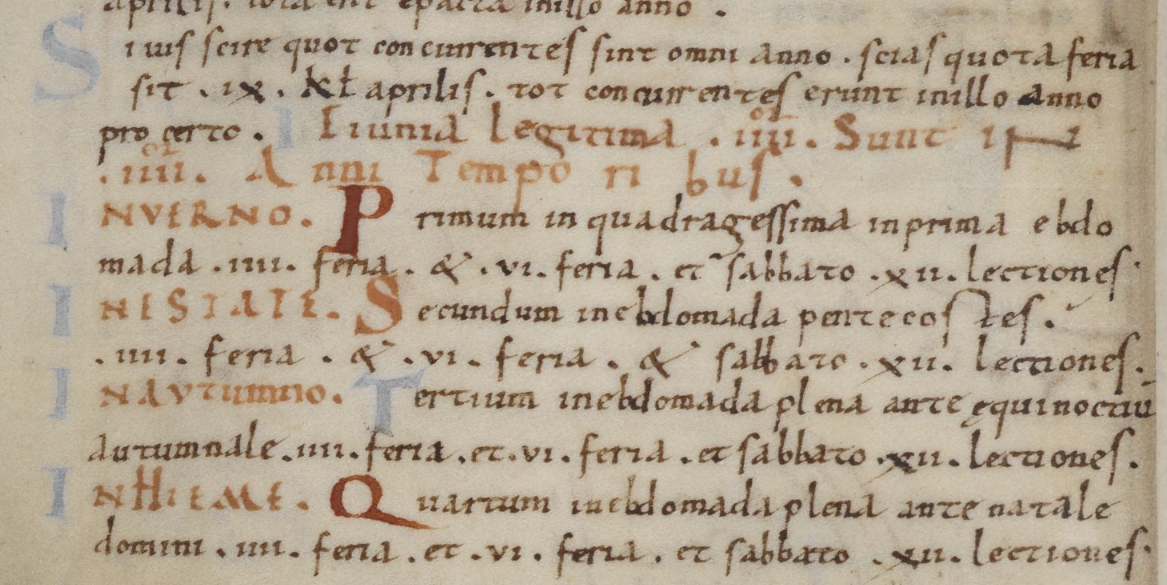
A diagram of the Ember Days in a manuscript made at Thorney Abbey, c. 1110

Wednesday, Friday and Saturday of this week are the harvest Ember Days, a three-day period of prayer and fasting which recurs four times over the course of the year. By ancient tradition there are four periods of Ember Days, corresponding with the four seasons: they fall in the weeks following the first Sunday in Lent, Whitsun, the Feast of the Exaltation of the Cross (September 14), and St Lucy's Day (December 13). The last two, being tied to fixed rather than moveable feasts, will always fall fairly close to the autumn equinox and the winter solstice, and so at the mid-point of these seasons (in traditional reckoning the solstices and equinoxes were usually understood to mark the middle or height of seasons rather than, as often today, the beginning).

The origins of the Ember Days are usually explained as lying in pagan Roman custom, petitioning the gods for aid at different points in the agricultural cycle, from the seed-time to the harvest, in the height of summer and the depth of winter. By the fifth century, and perhaps before, they had been adopted for Christian use by the church in Rome, and as they gradually spread further afield they were widely observed by the medieval church. Though not much noticed today, they are a reminder of how closely linked the medieval church was to the natural world, intently attuned to its seasons and cycles, and always ready to see human life not as separate from nature or from God but as part of one organic whole, in which the natural, the human, and the divine are interrelated at the most essential level.

(I've written about this many times, especially in reference to the Anglo-Saxon church - a collection of links can be found on this page.)

The Ember Days were observed in Anglo-Saxon England from at least the eighth century onwards; they are regularly prescribed in lawcodes and mentioned in standard learned works on computus (the calculation of time and church calendars - a very complicated science, which was an endless fascination to mathematically-minded early medieval scholars!). Most of the images in this post come from 11th and 12th-century English manuscripts which find different ways of representing the Ember Days in diagram form - divine science which is turned into art, too.


In Latin these days are called quatuor tempora, and tempora might perhaps be the origin of the Old English name, ymbren, from which we get 'Ember'. However, since ymb- is a very common Old English prefix, meaning 'around', a learned Anglo-Saxon might have perceived a (perhaps etymologically spurious, but nonetheless meaningful) connection between the word ymbrendæg and a large group of words relating to cycles and circles, such as ymbhweorfan 'to revolve, turn around', ymbhwyrft 'a ring, a circular course, an orbit', ymbhabban 'to surround, encircle', and so on.

The link between the Ember Days and the cycle of the year was made clearly visually in diagrams such as the one above (where the Ember Days are in the four corners of the circle), and in the works of scholars of computus, such as Byrhtferth of Ramsey, who links them to the numerous other patterns of four and its multiples which, to him, structure not just the year but everything in the world: four seasons, four solstices/equinoxes, twelve months, twelve astrological signs, the elements, the winds, the four cardinal virtues, and the four seasons of human life (childhood, youth, adulthood, old age). It's all connected...

Byrhtferth's diagram of interconnection (BL Harley 3667, f. 8)

Other scholars in Anglo-Saxon England were less interested in the calculation of the Ember Days than in their history and their moral purpose. There was a firm belief, mentioned in several late Anglo-Saxon sources, that they had been introduced into England by St Augustine of Canterbury himself when he was sent by Pope Gregory to evangelise the Anglo-Saxons at the end of the sixth century. (It's possible this is true, though it would be hard to prove either way.) A homily attributed to Wulfstan gives a memorably rhyming encapsulation of this detail: 'Ymbrenfæstena healde man rihte, swa swa Scs. Gregorius Angelcynne sylf hit gedihte' (roughly: 'Ember-fasting keep we ought, / as St Gregory the English taught'). To Anglo-Saxon Christians of this period, educated in the tradition of Bede's narrative of the English church, there was no greater earthly authority than that of St Gregory and Augustine; they were the founders and fathers of English Christianity, and a custom linked with them must be supremely venerable.

An Old English poem known as 'Seasons for Fasting', probably written in the eleventh century, describes the history and practice of the Ember Days in this light. It traces their history back to Moses and four fasts of the year described in the Old Testament, emphasising continuity between the Christian practice and the Jewish heritage of the church. It goes on:

Nu we herian sceolan her for life
deorne dædfruman, and him dogera gerim
ælmesdædum ure gefyllan,
and on fæstenum, swa se froda iu
Moyses mælde, and we þa mearce sceolan
heoldan higefæste mid Anglum,
swa hie gebrefde us beorn on Rome,
Gregorius, gumena papa.

Now we should praise here for life
the glorious Deed-doer, and for him complete
our tally of days with almsdeeds
and fasting, as the wise one, Moses,
taught long ago, and we should keep
the dates resolutely among the English,
as the princely man in Rome appointed for us,
Gregory, Pope of the people.

The poem describes the dating of each of the four periods of Ember Days, and then goes on to preach about the benefits of fasting in reconciling human beings to God. (At the time there was some dispute about the dating of the spring and summer Ember Days, and part of the poet's purpose is to urge people to keep the 'English' dates supposedly taught by Gregory rather than any continental alternatives; don't let any Bretons or Franks tell you differently, he says, these are the right days! The dates the poem recommends are the ones we keep now, since the controversy was settled later in the eleventh century.)

In the poem the discussion of the Ember Days and fasting in general is followed by a fervent denunciation of sinful priests, whose duty is to help the laity become closer to God, but who are themselves, it says, too often stained by sin: they 'daily offend the Lord by their neglect', misleading their people and caring more for drinking wine and eating oysters (!) than for their sacred duties. At this point the poem breaks off, before the poet can enumerate any further enormities of the contemporary clergy. The gluttony and self-indulgence for which the poem attacks priests are, of course, meant to be tamed by fasting and self-denial such as practised in the Ember Days.


Another and more widespread explanation of the Ember Days is provided by the Golden Legend, the hugely popular medieval compendium of saints' lives which originated in the thirteenth century and circulated for centuries in various different forms. This text offers no fewer than eight ways of understanding the four-fold pattern of the Ember Days and their relation to the four seasons of the year. Here's what it has to say (in Caxton's 15th-century translation):

The fasting of the Quatretemps, called in English Ember days, the Pope Calixtus ordained them. And this fast is kept four times in the year, and for divers reasons. For the first time [first season, i.e. spring], which is in March, is hot and moist. The second, in summer, is hot and dry. The third, in harvest, is cold and dry. The fourth in winter is cold and moist. Then let us fast in March which is printemps [spring], for to repress the heat of the flesh boiling, and to quench luxury or to temper it. In summer we ought to fast to the end that we chastise the burning and ardour of avarice. In harvest for to repress the drought of pride, and in winter for to chastise the coldness of untruth and of malice.

The second reason why we fast four times; for these fastings here begin in March in the first week of the Lent, to the end that vices wax dry in us, for they may not all be quenched; or because that we cast them away, and the boughs and herbs of virtues may grow in us. And in summer also, in the Whitsun week, for then cometh the Holy Ghost, and therefore we ought to be fervent and esprised in [inspired by] the love of the Holy Ghost. They be fasted also in September tofore Michaelmas, and these be the third fastings, because that in this time the fruits be gathered and we should render to God the fruits of good works. In December they be also, and they be the fourth fastings, and in this time the herbs die, and we ought to be mortified to the world.

The third reason is for to ensue [follow] the Jews. For the Jews fasted four times in the year, that is to wit, tofore Easter, tofore Whitsunside, tofore the setting of the tabernacle in the temple in September, and tofore the dedication of the temple in December.

The fourth reason is because the man is composed of four elements touching the body, and of three virtues or powers in his soul: that is to wit, the understanding, the will, and the mind. To this then that this fasting may attemper in us four times in the year, at each time we fast three days, to the end that the number of four may be reported to the body, and the number of three to the soul. These be the reasons of Master Beleth.

The fifth reason, as saith John Damascenus: in March and in printemps the blood groweth and augmenteth, and in summer choler, in September melancholy, and in winter phlegm. Then we fast in March for to attemper and depress the blood of concupiscence disordinate, for sanguine [blood] of his nature is full of fleshly concupiscence. In summer we fast because that choler should be lessened and refrained, of which cometh wrath. And then is he full naturally of ire. In harvest we fast for to refrain melancholy. The melancholious man naturally is cold, covetous and heavy. In winter we fast for to daunt and to make feeble the phlegm of lightness and forgetting, for such is he that is phlegmatic.

The sixth reason is for the printemps is likened to the air, the summer to fire, harvest to the earth, and the winter to water. Then we fast in March to the end that the air of pride be attempered to us. In summer the fire of concupiscence and of avarice. In September the earth of coldness and of the darkness of ignorance. In winter the water of lightness and inconstancy.

The seventh reason is because that March is reported to infancy, summer to youth, September to steadfast age and virtuous, and winter to ancienty or old age. We fast then in March that we may be in the infancy of innocency. In summer for to be young by virtue and constancy. In harvest that we may be ripe by attemperance. In winter that we may be ancient and old by prudence and honest life, or at least that we may be satisfied to God of that which in these four seasons we have offended him.

The eighth reason is of Master William of Auxerre. We fast, saith he, in these four times of the year to the end that we make amends for all that we have failed in all these four times, and they be done in three days each time, to the end that we satisfy in one day that which we have failed in a month; and that which is the fourth day, that is Wednesday, is the day in which our Lord was betrayed of Judas; and the Friday because our Lord was crucified; and the Saturday because he lay in the sepulchre, and the apostles were sore of heart and in great sorrow.
This traces eight different ways in which the Ember Days can related to patterns of human and natural cycles, encompassing interpretations moral, allegorical, seasonal, historical, scientific, and medical. Such an assortment of post-hoc explanations for the practice, provided by various authorities and supported by reference to the science of the four humours, might today raise a smile, but it's really rather beautiful in its own way; rather than simply explaining the history of the Ember Days, as a modern preacher might, this seeks to explore deeper correspondences between the four seasons, and the fasts which mark them, and cycles of growth and death which affect everything in the natural world, including the human body. (I particularly like that in autumn 'we fast in order to control melancholy'; that feels about right!) The various explanations are meant to complement each other, and they reflect a view of the world as essentially ordered, in which the cycles of human health, or human emotion, or natural growth and decay, are all connected to divinely-arranged patterns which shape the universe.

The Ember Days in Ælfwine's Prayerbook (Cotton MS Titus D XXVII, f. 13v)

Saturday, 8 September 2018

'Who walk in this world, like unto the sea'


The Nativity of the Virgin (BL Harley 7026, f. 17; England, c.1400)

8 September is 'Latter Lady Day', the feast of the Nativity of the Virgin, the second of the two Marian feasts to fall in the harvest season. One of the hymns sung on this day is 'Ave maris stella', so here's a simple but rather sweet poem/prayer inspired by that hymn; it comes from a 15th-century manuscript which was probably made in a Carthusian monastery in Yorkshire or northern Lincolnshire. Since the language is fairly straightforward this is in modern spelling; a proper edition can be found here.

Hail sea-star, God's Mother holy,
Pray thou thy sweet Son, save us from folly,
That walk in this world like unto the sea,
Ebbing and flowing, full of vanity.
For to all wretches that will forsake their sin,
Thou shines as a star them ready to win [rescue],
And evermore ready for us to pray
To get us forgiveness withouten delay
Of all sins our and great trespass
That we have done, both more and less.
Now sweet Lady, both meek and mild,
And mother of God, maiden undefiled,
Crowned above all angels Queen of Heaven,
Blessed art thou therefore evermore to neven [name, call upon].
Thou pray thy Son to give us grace our life to mend,
And his burning love into us send.
Think on, good Lady, thus for us to pray,
That we with thee may dwell for ever and aye. Amen.

In the last couplet, 'Think on, good Lady, for us to pray' means 'remember us in your prayers', but if you wanted to read it with a Yorkshire twang (given the provenance of the manuscript) I wouldn't like to discourage you ;)

The image of this world as a sea, 'ebbing and flowing' in its instability and changeableness, is a very ancient and widespread one, and yet somehow never loses its power, for all its ubiquity. Here's an image of the poem in the manuscript, with an illustration of a drowning man praying to Mary, who kneels before Christ - whether literally or figuratively drowning in the waters of this world, it's to Mary that he calls.

Thursday, 29 March 2018

Some Anglo-Saxon Easter Customs

A feast, heading a calendar page for April in an Anglo-Saxon manuscript
(BL Cotton Tiberius B V, f. 4v)

How was Easter celebrated in Anglo-Saxon England? There's a popular answer to that question, which goes like this: 'the Anglo-Saxons worshipped a goddess called Eostre, who was associated with spring and fertility, and whose symbols were eggs and hares. Around this time of year they had a festival in her honour, which the Christians came over and stole to use for their own feast, and that's why we now have Easter'. This story gets regularly dragged out around this time of year, and just as regularly and vigorously debunked. If you're interested in understanding how wobbly the evidence for this popular factoid is, and the history behind the development of the modern 'pagan Easter' myth, there are plenty of good sources: start with this article, and this, and then follow this series of posts - lots of righteous fun if you enjoy a good debunking! For the broader context, this is also very useful: 'How Pagan Were Medieval English Peasants?'

For the purposes of answering my opening question, we have to start by turning away from the popular answer almost entirely, because even the limited information we do have about Eostre tells us nothing about how the Anglo-Saxons might have celebrated her. Bede tells us that the pre-Christian Anglo-Saxons had a goddess named Eostre 'in whose honour feasts were celebrated', but this is all he tells us. He may be right (he often is) or he may be wrong (he's often that, too). If there was indeed such a goddess, whose name was transferred in England to the celebration of the Christian Paschal season, we know absolutely nothing about any symbols, customs, or rituals which may have been associated with her in Anglo-Saxon England. Bede mentions 'feasts', but nothing else, and very possibly he had no idea himself what those feasts might have consisted of. The idea that Eostre was the goddess of spring or fertility or dawn or whatever it might be is all later speculation, largely originating in nineteenth-century scholarship; the suggestion that she was associated with symbols such as eggs, hares or rabbits is similarly very recent. The Anglo-Saxons may well have had some kind of spring festival which gave its name (for English-speakers) to Easter, but we know nothing about what kind of customs or practices that might have involved. People who say otherwise are speculating, with a greater or lesser degree of plausibility. That's a shame, but it's not exactly unusual; we just don't know as much about pre-Christian Anglo-Saxon customs as we would like to know.

However, that doesn't mean we don't know how Easter was celebrated in Anglo-Saxon England. As I discussed when I wrote about Lammas, there's a very prevalent popular idea in these cases that the 'original' pagan festival (whatever it may have been) is somehow more 'real' or 'authentic' than all the other ways in which the festival has been celebrated in the hundreds of years which followed - even if the 'original' exists primarily in the imagination of modern enthusiasts, while the plentifully recorded later customs attest what real people actually did. Regardless of its etymology, Easter has been a Christian festival in England for over 1300 years, including the majority of the Anglo-Saxon period. Anglo-Saxon England was a predominantly Christian country for nearly 400 years, and the way people celebrated Easter in that period is no more or less 'the Anglo-Saxon Easter' than hypothetical pagan customs. (Just take a moment to think about that figure: 400 years!) If we're interested in learning about the culture of pre-Conquest England, early isn't more 'authentic' than late; pagan isn't more 'authentic' than Christian; and the culture of late, Christian Anglo-Saxon England has the advantage of being very well-recorded, which means less need to indulge in speculation.

So how did was Easter celebrated in Anglo-Saxon England? Here are a few examples.

The Trumpington Cross, from an early Anglo-Saxon Christian grave

First, a note on how the word 'Easter' was used in Old English (i.e. its usage and its connotations, as distinct from its origins). Unlike, say, Lammas, the word 'Easter' is very widely recorded in Anglo-Saxon sources. As far as I can tell, all of these instances - with the single exception of Bede, on the one occasion quoted above - use it to refer either to the Christian festival or the Jewish Passover, or both together. This reflects the belief in the close relationship between Easter and Passover which was central to the medieval church's understanding of the meaning of Easter: the belief that Christ had become the new Paschal sacrifice, the fulfilment of the prophesies and foreshadowing of the Old Testament. This link was also crucially important for the dating of Easter, and all the contingent dates dependent on it, both throughout history and in the yearly cycle of moveable feasts. (What that meant in practice was a long controversy, but the essential link between Passover and Easter was absolutely fundamental and very widely accepted.) As a result, there are many, many more instances in Old English of eastre meaning 'Passover' than there are of it referring to a pagan goddess. For example, here's an Anglo-Saxon translator glossing the phrase 'Iam est Christus nostrum pascha' ('Now Christ has become our Passover') as 'Nu is Crist ure eastran':

(from the hymn 'Ad cenam Agni providi', 'At the Lamb's high feast we sing')

It's clear that as far as we can judge from recorded usage of the term (which is a large body of evidence but not, of course, comprehensive), the word did not continue to have 'pagan' connotations for speakers of Old English after the conversion to Christianity. Bede notes its etymology as a kind of antiquarian curiosity, but doesn't seem to consider it a threat; no Anglo-Saxon writer mentions the worship of Eostre as a practice contemporary to their own day (as some do, for instance, when speaking of the worship of Thor and Odin by Scandinavian pagans). Again, a comparison with Lammas is useful. There, a preacher like Ælfric treats Lammas as a name which was apparently used by his congregation, but not one he would use himself (though not necessarily because he thought it 'pagan', as I suggested in that post). There's no such equivocation around the word 'Easter', which seems to have meant for Anglo-Saxon writers and readers pretty much what it has meant in the subsequent history of English: the chief Christian festival of the year and the equivalent of Latin Pasch - except in contexts where it refers to Passover.

The Old English translation of Luke 22, in which Jesus and his disciples discuss the preparations for Passover, 
calling it 'eastre' (BL Royal 1 A XIV, f.126v)

Today most European languages call Easter by some version of Pasch, and a form of that name appears later in medieval English, though it doesn't seem to have been in general use in the Anglo-Saxon period. In Middle English names based on pasch were in widespread use, in various forms (pase, paske, etc.), and these names for Easter survived for a long time in northern dialects. This is where the name 'pace-egg' comes from for the various customs associated with eggs at Easter in the north of England; 'pace-egg' simply means 'Easter egg', and until the nineteenth century the association between eggs and Easter was predominantly a northern tradition in England (it's also found outside Britain, of course). In the south other foods - tansy, cheesecakes - were much more strongly linked to Easter, and in their time were thought to be as inextricable from the festival as eggs are for us. One disadvantage of the 'pagan Eostre' myth is that it ignores that regional diversity of language and of custom, presenting an artificially homogeneous picture of the past. It's now popularly assumed that Easter has always had that name in English, and eggs have always been a symbol of Easter, but neither is true. It's also a common claim that the association with eggs is some kind of fertility symbol surviving from the cult of Eostre, but there's no Anglo-Saxon evidence for that; I don't know of anything suggesting that eggs had any particular associations at all in Anglo-Saxon England, and as I said above, we know nothing about symbols linked with Eostre. Just think - if by some accident of linguistic history Paske had become the dominant term for Easter in English, as could very easily have happened, we'd have been spared the yearly fuss about 'pagan Easter'...

Cnut and the cross in the New Minster Liber Vitae (BL Stowe 944)

Anyway, to return to Anglo-Saxon England and the various ways Easter was celebrated. To start with an easy one, it seems that - like other festivals of the church year - Easter was a time for royal assemblies, at which Anglo-Saxon kings gathered together their followers and advisors, issued charters, and transacted other kinds of business. (For some examples and discussion see this book.) Those gatherings might well have involved other events and celebrations too - very likely feasting, and collective attendance at Easter services. Baptisms and on one occasion a royal wedding seem to have taken place during the festivities of Easter, as well as other kinds of royal ceremony. An eleventh-century source says that on one occasion while celebrating Easter at Winchester, King Cnut took off his own crown and placed it on a figure of the crucified Christ, a gesture of kingly humility much easier to imagine than the more famous story of how he demonstrated his inability to control the waves!

The Anglo-Saxon Chronicle records that Edward the Confessor was crowned at Easter in 1043, which doubtless involved many festivities; and we know that Edward held a royal banquet on Easter Monday in 1053, because in the middle of the feast Earl Godwine was suddenly taken ill. For such occasions the Chronicle uses the word Easter (and variants thereof); it's interesting to note that a few decades later, the Peterborough Chronicle uses the word Pasch for a comparable occasion in 1122 when Henry I spent Easter at Northampton. This presumably reflects French influence; the Norman Conquest did not change the festival or the custom, but it did have some influence on the name.

A feast at the bottom of a calendar for April (BL Cotton Julius A VI, f. 4v)

It seems probable that feasting was a part of the celebration of Easter more widely, but we don't know of any particular customs or foods associated with it. In 877, a lawcode of Alfred the Great established that workers should be freed from labour for the whole week before and after Easter - the longest holiday in the year - so it was not just kings who were celebrating!

We don't know how people might have spent that holiday, but participation in church services would have been a huge part of the Easter weekend itself. There's plentiful evidence available for the kinds of religious observance which Anglo-Saxon congregations could participate in during the Easter season, especially in the later part of the period. Various sources provide a remarkable glimpse into how vividly early medieval liturgy brought the Easter story to life through the use of sound, light, space, and dramatic reenactment, and how powerful an experience it must have been to witness and participate in.

One of the most valuable sources for the customs of the late Anglo-Saxon church is the text known as Regularis Concordia, a tenth-century document which lays out recommended monastic practice on a variety of topics. This tells us, at least, what some churches might have been doing at Easter, and how their congregations might have imaginatively participated in the story of Christ's death and resurrection. Although some of these rituals were performed only by monks, it seems that lay people attended these services and witnessed many of them too; their participation in some of the rituals, such as the Adoration of the Cross on Good Friday, is specifically enjoined. For more detail, I recommend you to the classic The Dramatic Liturgy of Anglo-Saxon England by M. Bradford Bedingfield, which I'm drawing on here - sadly I can only give a few highlights!

On Palm Sunday, churchmen and lay people alike could participate in the reenactment of Christ's entry into Jerusalem, carrying aloft their 'palm-twigu' in procession (Ælfric gives us a nice picture of that). On Maundy Thursday, monks engaged in washing the feet of the poor and distributing money and clothes to those in need, acts of service in imitation of Christ's actions at the Last Supper. In a monastic community the abbot might wash the feet of his monks, and Regularis Concordia says that the abbot should also drink to the health of each of the brethren - which sounds like a nice custom! The image below from an 11th-century Psalter (BL Harley 603, f. 66v) shows monks washing feet and a king distributing alms to the poor, much as later monarchs were to do at the 'Royal Maundy', and the Queen still does today.


Later on Maundy Thursday this might be followed by the intensely dramatic nighttime service of Tenebrae, in which a sequence of candles are extinguished, one by one, until the church is left in darkness. Bedingfield, following the outline given in Regularis Concordia, describes it powerfully:
[It represents] the terror that covered the whole world at the time of the Passion. The ritual certainly might be terrifying. Left in a darkened church, after a ritual that is to be understood as extinguishing the light of Christ, the celebrants, kneeling, hear, from three sides, cries to the Lord from pairs of clear, young voices, and then resounding from the entire chorus, in effect, 'Christ is dead'.

That kind of utter darkness is almost unrecreatable in our world of electric light. Imagine how overpowering it must have been.


Good Friday seems to have been known in Anglo-Saxon England as 'Long Friday' (langa frigadæg), and it certainly involved some lengthy services. The Adoration of the Cross was central to the observance of the day, as it still is for many Christians today: the reading of the Gospel narrative of Christ's death, periods of prayer and prostration before the cross, the congregation taking it in turn to kiss the cross in veneration. One of the most powerful moments in the Good Friday ritual is the 'Reproaches', in which Christ is imagined speaking directly to mankind from the cross: 'My people, what have I done to you?' This text appealed to the imagination of several later medieval poets, and is referenced in a number of Anglo-Saxon sermons.

It's often been noted that the Old English poem The Dream of the Rood, a meditation on Christ's death as seen from the perspective of the cross, particularly resonates with the liturgy of Good Friday. It's a poem which could be read at any time of year, but its opening vision - the cross adorned with jewels and banners, as all creation bows before it in honour - might suggest how an Anglo-Saxon poet saw the cross lifted up for veneration on Good Friday.

Þuhte me þæt ic gesawe syllicre treow
on lyft lædan, leohte bewunden,
beama beorhtost. Eall þæt beacen wæs
begoten mid golde. Gimmas stodon
fægere æt foldan sceatum, swylce þær fife wæron
uppe on þam eaxlegespanne. Beheoldon þær engel dryhtnes ealle,
fægere þurh forðgesceaft. Ne wæs ðær huru fracodes gealga,
ac hine þær beheoldon halige gastas,
men ofer moldan, ond eall þeos mære gesceaft.
Syllic wæs se sigebeam, ic synnum fah,
forwunded mid wommum. Geseah ic wuldres treow
wædum geweorðod, wynnum scinan,
gegyred mid golde; gimmas hæfdon
bewrigen weorðlice wealdendes treow.

It seemed to me that I saw a wondrous tree
lifted up into the air, wrapped in light,
the brightest of beams. All that beacon was
covered with gold; gems stood
beautiful at the surface of the earth, and there were five
upon the shoulders of the cross. All those fair through eternity there beheld
the angel of the Lord. That was indeed no criminal’s gallows,
but there the holy spirits beheld him,
men throughout the world and all this glorious creation.
Wondrous was that victory-beam; I, stained with sins,
wounded with wickedness. I saw the tree of glory
adorned with drapery, shining with joys,
decked with gold; gems had
worthily wrapped the Ruler's tree.

Here angels, human beings and all created things 'behold' the cross, gaze upon it ('beheoldon þær...'). That meditative, absorbing gaze of adoration, wonder, and love well describes the kind of emotional experience the Good Friday liturgy might evoke in a congregation. I wrote in greater length here about the relationship between this poem and the artistry and exquisite craft of Anglo-Saxon images of the crucifix.

Anglo-Saxon crucifix, Romsey Abbey

The Dream of the Rood is the most famous example, but there are some other wonderful Anglo-Saxon poems inspired by the themes and stories of Easter. Moving from Good Friday to Holy Saturday, we might turn to the beautiful Old English poem about Christ's descent into hell, which movingly evokes both the pain and desolation of the women who mourned him and the sudden, heart-wrenching triumph of his rising from the tomb. The Harrowing of Hell is not a familiar story to many people today, even many Christians, but it was very popular in the Middle Ages and formed perhaps the most potent story of liberation in medieval poetry and art: a story telling how the king of justice stormed the prison of evil and set its captives free.

Woldan werigu wif wope bimænan
æþelinges deað ane hwile,
reone bereotan. Ræst wæs acolad,
heard wæs hinsið; hæleð wæron modge,
þe hy æt þam beorge bliðe fundon.
Cwom seo murnende Maria on dægred,
heht hy oþre mid eorles dohtor.
Sohton sarigu tu sigebearn godes
ænne in þæt eorðærn þær hi ær wiston
þæt hine gehyddan hæleð Iudea;
wendan þæt he on þam beorge bidan sceolde,
ana in þære easterniht. Huru þæs oþer þing
wiston þa wifmenn, þa hy on weg cyrdon!
Ac þær cwom on uhtan an engla þreat,
behæfde heapa wyn hælendes burg.
Open wæs þæt eorðærn, æþelinges lic
onfeng feores gæst, folde beofode,
hlogan helwaran; hagosteald onwoc
modig from moldan, mægenþrym aras
sigefæst ond snottor.

The sorrowful women wanted for a while
to mourn with weeping the prince's death,
to grieve with lamentation. The place of rest had grown cold,
bitter was the journey of death; but brave was the man
whom they would meet rejoicing at the tomb.
Mary came, mourning, at daybreak,
summoned with her a second daughter of man.
The two of them sought, sorrowful, the victorious Son of God,
alone in the earthen tomb where they knew
the men of the Jews had enclosed him.
They thought that he would have to lie in the grave
alone on that Easter night. But something very different
would those women know, when they returned on their way.
Before dawn there came a throng of angels,
the joy of the host surrounded the Saviour's tomb.
Open was the earthen vault. The prince's body
received the breath of life, the ground shook,
hell-dwellers laughed; the young warrior awoke,
dauntless from the dust, majesty arose,
victorious and wise.

Read more in this post. Note the use of 'Easter night' (easterniht) here, which is probably intended to mean 'Passover' too.

The women and the angel at the tomb, from the Benedictional of St Æthelwold 

The reenactment of this scene - the women and the angel at the empty tomb - forms one of the best-known elements of the early medieval Easter liturgy, famous because it is often said to be one of the oldest examples of liturgical drama. To quote from Regularis Concordia, as translated in this excellent blogpost at For the Wynn:

When the third reading [of Nocturns] is being read, let four brothers clothe themselves, one of whom, clothed in white and as if about to do something else, should go in and secretly be at the burial place, with his hand holding a palm, and let him sit quietly.  And while the third responsory is being sung, let the remaining three follow: all clothed with cloaks, carrying censers with incense in their hands, and with footsteps in the likeness of someone seeking something, let them come before the burial place. And let these things be done in imitation of the angel sitting on the tomb and of the women coming with spices, so that they might anoint the body of Jesus.

And when the one remaining has seen the three, wandering and seeking something, approach him, let him begin, with a moderate voice, to sing sweetly: ‘Whom are you seeking?’ When this has been sung to the end, let the three respond with one voice: ‘Jesus of Nazareth’. To whom he should say: ‘He is not here.  He has risen, as he said before.  Go, announce it, because he has risen from the dead.’ With this command, let those three turn around to the choir, saying, “Alleluia, the Lord has risen.’ When this has been said, let the one sitting turned back, as if calling them back, say this antiphon: ‘Come and see the place’.

Saying these things, let him rise and lift up the veil and show them the place devoid of the cross, but with the linens placed there which with the cross had been wrapped. When they have seen this, let them set down the censers which they were carrying in the same tomb, and let them take the linen and spread it out in front of the clergy, and, as if showing that the Lord has risen and is not wrapped in it, let them sing this antiphon, ‘The Lord has risen from the tomb’, and let them lay the linen upon the altar.

This is a dramatic replaying of the crucial moment in the Easter story, bringing it to life through the voices and bodies of the monks. Although presumably the primary audience for this liturgical play was the monastic community itself, it may also have been witnessed by lay people. That appears to be the implication of a miracle-story told by Eadmer, describing something which he saw take place as the ritual was being performed in Canterbury Cathedral in c.1066:
There was a certain man, who was almost completely paralysed from the waist down, and who used two crutches for walking. Coming to the tomb of the man of God [St Dunstan] on the Friday before Easter he prostrated himself on the ground and with firm resolve and tearful voice he asked the saint to have mercy upon him. Why do I delay telling this? On the night following, the Lord’s resurrection, when in the guise of three women a search was being conducted for the body of our Lord and Saviour in the tomb, the same lame man stretched himself so that his sinews resounded and he stood straight up on his feet, healthy and upright. Fear and awe overcame us as we witnessed this, and we gave fitting thanks to God as befitted such a great deed.

Eadmer of Canterbury, Lives and Miracles of Saints Oda, Dunstan and Oswald, ed. and trans. Andrew J. Turner and Bernard J. Muir (Oxford, 2006), p.177.


After the intensely emotional nature of the preceding days, Easter Day itself is for celebration. This is how that joy is expressed in the Anglo-Saxon poem the Menologium, describing the month of April:

Swylce emb feower and þreo
nihtgerimes, þætte nergend sent
Aprelis monað, on þam oftust cymð
seo mære tiid mannum to frofre,
drihtnes ærist; þænne dream gerist
wel wide gehwær, swa se witega sang:
"þis is se dæg þæne drihten us
wisfæst worhte, wera cneorissum,
eallum eorðwarum eadigum to blisse."
Ne magon we þa tide be getale healdan
dagena rimes, ne drihtnes stige
on heofenas up, forþan þe hwearfað aa
wisra gewyrdum, ac sceal wintrum frod
on circule cræfte findan
halige dagas.

So after the sum of four and three
nights, the Saviour sends
the month of April, in which most often comes
the glorious season for the comfort of men,
the rising of the Lord. Then joy is fitting
far and wide, as the prophet sang:
'This is the day which the Lord made
for us, the wise one, for the generations of men,
for all blessed earth-dwellers, with bliss.'
We cannot keep that season by tallying
the count of days, nor the Lord's ascension
into the heavens, because it always changes,
by calculations of the wise; but the venerable in winters
shall find with skill the holy days
in the cycle.

This translates into English poetry part of the liturgy of Easter Day, taken from Psalm 118: 'this is the day which the Lord hath made; we will rejoice and be glad in it'. In the phrase 'all blessed earth-dwellers', the poet has chosen a triple alliteration on words beginning e- - eallum eorðwarum eadigum, which with beautiful subtlety suggests to the ear a fourth, unspoken word to complete the pattern: Easter.

Prayers and music for Easter Sunday from the Leofric Collectar
(BL Harley 2961, f. 77) - just look at those runaway notes!

This final example fits Easter within the distinctive cadences of Old English poetry, but many of the practices described above - though attested in Anglo-Saxon sources - are not, of course, uniquely Anglo-Saxon. They arise from the much wider Christian culture of which Anglo-Saxon England formed part, from which its artists and poets and liturgists took their inspiration even as they adapted its themes and stories into their own language and idiom. It's an unfortunate side-effect of the Eostre factoid that it encourages the belief in an Anglo-Saxon England cut off from the rest of European culture - that is, until the Norman Conquest dragged them out of the Dark Ages and introduced those backward Saxons to the rest of the world. This is very far from the truth. In particular, I can't help thinking how disappointed Bede - who cared so much and thought so deeply about the relationship between his 'church of the English' and the rest of the Catholic world - would be, if he knew that one sentence of his work has been used to promote an image of Anglo-Saxon England he would not recognise: culturally homogeneous, stubbornly pagan, divided from the rest of Christian Europe.


Despite the spirited efforts of its debunkers, I fear the popular Eostre factoid is now probably too rooted to be shaken by arguments about its historical accuracy, or lack of it. That's fine, in a way; modern audiences are entitled to their myths too, and this has proved a pretty tenacious one. It's the epitome of fake news, but - to be generous - it's clear how the idea of a powerful female figure associated with positive things like spring, fertility, bunnies, etc. appeals to modern sensibilities, apparently much more so than the actual evidence for powerful women in Anglo-Saxon England. They, inconveniently, tend to be Christians - never mind that by her involvement in discussions about the dating of Easter, St Hilda of Whitby did more to influence the history of the festival than any maybe-invented goddess ever did.

To be honest, I don't think I would find this use of false history to make a polemical point so annoying if it were not for the smug and self-righteous tone in which the factoid is often delivered. (Especially by journalists - here's an example I saw on Twitter yesterday!) But there's an ugly arrogance about it in more ways than one - not only in the delivery, but in the idea itself. It is breathtakingly ignorant, arrogant and conceited to argue that a festival which long pre-dates the coming of Christianity to England has its origins in Anglo-Saxon custom. Easter was a well-established festival long before the Anglo-Saxons gave it that name, and it was celebrated throughout the international medieval church. The vast majority of medieval Christians were not English and did not speak English; the idea that the church would shape its chief festival of the year just to suit the wishes of a few English-speaking pagans out in the North Sea is utterly ridiculous. And they didn't, of course - which is why in most other European languages the word for Easter is a variant of the Latin Pasch, and doesn't bear any relationship to Eostre. The modern observance of Easter owes nothing to Anglo-Saxon paganism, except its English name, in any discernible or plausible way.

It seems to be impossible for some English-speakers today to grasp that Anglophone culture just hasn't always been as hugely important in the world as they perceive it to be now. As I said above, Anglo-Saxon England was in constant contact with the wider church, but within that church it just wasn't that important - it was marginal and peripheral, and where its influence did spread through individual thinkers or writers that influence came via Latin, not the English language. To claim that an English-only name like Eostre could have widespread influence across the early medieval church is to massively overstate the influence of England, and English, in this period. English-speaking culture is not the be-all and end-all of religious history, and to argue that just because modern British and American audiences link certain words or symbols to Easter - mostly as the result of commercial advertising, not ancient tradition - these must define and explain the entire festival is Anglo-centric beyond belief.

It's not surprising that this cultural arrogance becomes, at its worst, tied to both anti-Semitic and white nationalist ideologies, going along with an insistence on denying the link between Easter and Passover - which was very clear to early Christians in England, as elsewhere - and with a belief in a homogenous 'Germanic' culture shared by Britain, Scandinavia and Germany and untouched by the rest of Europe. This article of faith in 19th-century scholarship is the origin of much that's most dubious about the Eostre theory, and you don't need me to tell you where it can lead. The breathless polemic about 'the real origins of Easter!!!' shades very easily into ideas of cultural and racial purity - a fantasy of an Anglo-Saxon paganism 'untainted' by influences from elsewhere. Most people who trustingly share 'pagan Easter' factoids are probably unaware of these associations, but it's important not to let history be twisted for those ends.

So there are some serious reasons to keep harping on about the shakiness of the 'pagan Easter' meme, beyond the wish that history should be accurately represented. The customs I've discussed in this post represent some aspects of the early medieval celebration of Easter, but not by any means all; there is a variety and diversity here which should not be over-simplified. It’s reductionist to talk as if any culture, whether pagan or Christian, is a single monolithic entity with universal, unchanging traditions. The story of how different cultures develop customs which are meaningful to them is far richer than that.

Anglo-Saxon ivory carving of the Crucifixion (V&A)