Showing posts with label Epiphany. Show all posts

Wednesday, 6 January 2021

Earendel at Epiphany


For the Feast of the Epiphany, here's a curiosity for you. There are lots of medieval carols about the Epiphany ('Twelfth Day', as it was usually called in the Middle Ages) - I posted two last year, and you'll find more under this tag. This one, however, is a medieval pastiche - a carol written in a version of Middle English, with a bit of Old English thrown in, and published in 1899. 

'Eala Earendel
Engla beorhtast.'

I. They came three Kings who rode apace,
To Bethlem town by God's good grace:
Hail Earendel,
Brightest of Angels!

Pardie! It was a duteous thing,
Wise men to worship childë King:
Godlight be with us,
Hail Earendel!

II. They gave Him gifts of far-brought things,
Of Recells, Myrrh, and Gold of Kings.
Hail Earendel,
Brightest of Angels!

And setten there in strawy tent,
Their mystic signs of Orient:
Godlight be with us,
Hail Earendel!

III. The Gold and Frankincense and Myrrh
For King, for Priest, for digne Martyr.
Hail Earendel,
Brightest of Angels!

Upon the great Good Friday morn
Is't Crown of Gold or Crown of Thorn?
Godlight be with us,
Hail Earendel!

IV. From Calvary's Tree the Priestly hands
Are stretched in blessing o'er the lands:
Hail Earendel,
Brightest of Angels!

In Garden tomb His tired limbs sleep.
Bring Myrrh and Spices, Vigil keep:
Godlight be with us,
Hail Earendel!

V. O hymn we then these Orient Kings,
Who brought for Him their offerings:
Hail Earendel,
Brightest of Angels!

And grant in Holy Mystery
Ourselves His Sacrifice may be.
Godlight be with us,
Hail Earendel!

This poem is by Charles William Stubbs (1845-1912), who at the time it was published was Dean of Ely. The poem was included in his book Bryhtnoth's Prayer and Other Poems, which among other things features a number of poems inspired by medieval topics, especially relating to the Anglo-Saxon history of Ely. One is his 'Carol of King Canute', a Christmas carol based on a short verse which the 12th-century Liber Eliensis claims Cnut composed when visiting the abbey. Another poem on an Ely theme is inspired by the Old English poem The Battle of Maldon, whose fallen hero, Byrhtnoth, was buried at Ely. Here's a taste of Stubbs' take on that:

This was his death cry,
Bryhtnoth the Ealdorman,
When to the earth at last
Fell from his failing hand
Sword of the mighty hilt...

Could he no longer then
Fast on his feet stand,
Bryhtnoth the Ealdorman;
Looked he to Heaven's King,
Meter of meeds:
“Thanks be to Thee, God, Ruler of nations,
For all the joy of life
Winsome and wealthful-
Bairns' love and wife's love,
Heart-trust of comrades,
War-weal and hearth’s-gear -
All I have here below
Fared for or gotten.
Now, oh my Maker mild,
Most need have I that Thou
Good speed my ghost:
Yea, that my soul to Thee safely may journey,
Safe to Thy Kingdom, Lord of the angels.”

Died then Earl Bryhtnoth
There by the Panta stream,
Slain in the battle, by
Maldon Blackwater.
Monks of the minster,
Monks of Saint Ætheldryht,
Thanes of the White Christ,
Brought him to Ely
Rowed they the death barge,
Down the long water-street,
Shimmering in moonlight;
Cold blew the night wind,
O'er the wan water: 
Far in the sedge reeds
Boomed the wild bittern;
High on the wall tower
Blickered the beacon.

If you know The Battle of Maldon you'll recognise some echoes of the poem here, but it's much augmented by faux-medieval archaisms in fine Victorian style! Similarly, Stubbs' Epiphany poem makes use of a refrain from a real Old English poem, part of the Advent Lyrics based on the O Antiphons:

Eala earendel, engla beorhtast,
ofer middangeard monnum sended...

O Earendel, brightest of angels,
sent to mankind over middle-earth...

In that poem 'Earendel' is used as a title for Christ, equivalent to the Latin 'O Oriens' ('O Dayspring'), the antiphon sung on the day of the winter solstice. Stubbs, however, accompanies his poem with a note saying that Earendel is 'the mythical name of the Star of Bethlehem'. I couldn't say where he got that idea, but 'Earendel' is used of different kinds of light in Old English and related languages - of a star, but also of the radiance of the sun and the first gleam of the dawn. And engla beorhtast, 'brightest of angels', really means 'brightest of messengers' - which the Star of Bethlehem was, of course. If the idea is that the Star to which the carol appeals is also Christ himself, 'Godlight', it's not so far from the Old English poem.

Stubbs also includes a note on the word 'recells', an Old English word for 'incense', pointing out where you can find it in an Anglo-Saxon translation of the Gospels. Apart from these bits of Anglo-Saxondom, though, much of the poem is written in an imitation of Middle English - 'Pardie!', 'childë King', and so on.

'The Carol of King Canute' was set to music by T. Tertius Noble, who was organist of Ely Cathedral and also Stubbs' son-in-law. (Though it's through Benjamin Britten's setting that it's perhaps better-known.) Noble also set this 'Carol of the Star', in a slightly amended version. And look, it's even on Youtube:


I learn from this wonderful website that after Stubbs became Bishop of Truro, the carol was performed at his cathedral's 'Festival of Lessons and Carols' in 1911 - Truro being the place where services of 'Nine Lessons and Carols' first originated at the end of the 19th century.

That same winter, 1911, the young Tolkien had just finished his first term at Oxford. A year or two later, in the course of his studies, he stumbled across the Old English 'Earendel' poem, and its first lines had a remarkable effect on him:
I felt a curious thrill, as if something had stirred in me, half wakened by sleep. There was something very remote and strange and beautiful behind those words, if I could grasp it, far beyond ancient English.
Tolkien adopted Earendel into his own growing imaginative cosmos, as a mariner 'who launched his ship like a bright spark from the havens of the Sun... a herald star, and a sign of hope to men'. He later called the Old English poem 'rapturous words from which ultimately sprang the whole of my mythology'. His sense that there was something 'very remote and strange' about the words eala Earendel, engla beorhtast is one of those instincts no one can explain. Why these lines more than any other? What moved Stubbs to make them the basis of his Epiphany carol? No one really knows what 'Earendel' means, and yet perhaps it draws the imagination all the more for that, as the Star of Bethlehem drew the Magi on their long and weary way. Such is the magic of mystery, of words half-understood - of a glimpse of Godlight.

Sunday, 5 January 2020

'So glorious a gleam, over dale and down'

The Adoration of the Magi, British Library, Add. 18850, f. 24v

Two carols for Twelfth Night, the eve of the Epiphany. The visit of the Magi to the infant Jesus is a very popular subject in medieval carols, perhaps partly because of the appeal of the dramatic details of the Gospel narrative - the urgency of the questing kings, their tense interaction with Herod, the atmosphere of danger in which their search for the child takes place. But it might also be partly because Twelfth Night, as the culmination of the main period of Christmas festivities (though not the official end of the Christmas season, which was Candlemas), would have been a good time for singing carols. In the past I've posted a few examples of Epiphany carols out of the many which survive.

And here are two more which are roughly contemporary with each other, from manuscripts produced in the second half of the fifteenth century. They tell the same story, but in different ways; one makes effective use of dialogue and of melodious repetition, while the other is more interested in the symbolism of the tale, its fulfilment of prophecies, and the central image of the star - that gleam of unearthly brightness which guides the pilgrim-kings to their journey's end.

The beginning of this poem in Cambridge, St John's College, MS. S 54

The first poem comes from a scrappy little manuscript of carols, perhaps originally from East Anglia, which is now in St John's College, Cambridge. You can browse through it here, though it's not much to look at, and pretty difficult to decipher! It shows considerable signs of wear and was clearly more for use than for ornament, perhaps as an aide memoire to communal carol-singing. All the carols it contains were published in this edition, which I've relied on for the text which follows, though I've modernised the spelling and expanded abbreviations. There's no music in the manuscript, but the repeated lines give an unusually strong sense of how beautiful this text might be when sung (anyone fancy setting it to music?). The first verse is especially lovely, I think.

When Christ was born in Bethlehem,
There rose a star as bright as leme [fire, radiance]
That gave so glorious a gleam
Over dale and down,
Over dale and down it sprang and spread.
It made three kings to be adread [afraid]
Into an unchond land it them led [it led them to an unknown country]
Into a town;
They were three kings of great renown.

They came to seek Herod the king
And asked him of all that thing,
And spered after the child so ying [inquired after the child so young]
That should be king,
That should be king of all Jewry.
'We saw a star secyrly [certainly]
Therefore we worship him forthy [for that reason]
That child so ying
Here gold and homage we him bring.'

'Wend ye forth all three in fere, [all three of you go forth together]
And of that child if ye may hear,
That ye will come again in fere
I you beseech,
I you beseech that ye me say
As ye come homeward again in your way
That I myself him worship may,
That child so meek,
On my bare feet I would him seek.'

The kings no longer there abode
But forth to Bethlem then they rode,
And the star before them glode [glided]
Until they were,
Until they were where Jesu lay,
Wounden in a crib of hay;
Them thought it was a poor array.
[line missing]
Of prince of peace that hast no peer.

'Now kneel we down, all three in fere,
And offer to this darling dear
Gold for [aye?] and rekels clear [rekels is an old word for incense]
And myrrh also,
And myrrh also in tokening
That he is very man and king,
Suffering prince over all thing,
One and no mo [other/more]
For holy writ bears witnesses also.'

An angel warned them in their sleep
That they should them for Herod keep [beware of Herod]
They thanked God with devotion deep
And home they went,
And home they went on their journey.
When thereof Herod heard say,
He said 'Alas, and welaway,
For I am shent! [ruined]
This child, he will my kingdom hent!' [seize my royal power]

This Herod was both wode and wroth [mad and furious]
With mickle ire he made his oath
That all the land it should be loath [sorry]
That he was born,
That he was born that should be king.
He did to do a spiteful thing [he caused a spiteful thing to be done]
To slay children both old and ying
In Bethlem born
Within two winters there before.

The children sprongyld on the spears, [struggled]
The mothers wept full bitter tears,
That Herod did them guiltless derys [caused them, innocent, terrible harm]
That fiend so fell,
That fiend so fell, foul must him befall,
That thus these children martyred all.
Unto Mary we gye and call [turn and appeal]
To shield us from the pit of hell
There in bliss well.

My favourite thing about this carol is the first verse, with those lovely alliterative phrases describing the star. After that, I also like the easy shifts between narrative and speech, especially between Herod and the Magi. Herod gets a verse to himself, and a bit of angry expostulation, true to his usual presentation in medieval literature: he's often shown as a blusterer, full of angry words, and that's how he comes across on the stage of medieval mystery plays, where his storming and ranting became proverbial. (That's what Hamlet is referring to when he advises his actors not to overdo their storms of passion, like those who seek to 'out-Herod Herod' on the stage with furious gestures and shouting). He exclaims angrily here, and his words to the three kings briefly sketch a dishonest, insinuating character: his promise 'On my bare feet I would him seek' has the exaggerated touch of a confident liar. The carol seems about to end in a dark place, with his anger and cruelty - until that last turn, 'unto Mary'. Again, it recalls the effect sought in medieval mystery plays, which intercut scenes of Herod's pride, rage and tyranny with the exact opposite, the next stage in the story, at Candlemas: there the earthly power embodied by Herod is shown to be vain, while poverty, patience, innocent love and frail old age encounter a light hidden from the eyes of the powerful.

The Magi doused in starlight, BL Add. 18850, f. 75

Next, another carol from the 1492 collection of James Ryman, Franciscan friar of Canterbury. This too tells the story of the Magi's visit, but through its refrain, and the couplet which is repeated at the end of each stanza, it keeps drawing our attention back to the star, and the day of its appearance - this day.

A star shone bright on Twelfth Day
Over that place where Jesus lay.

On Twelfth Day this star so clear
Brought kings three out of the east
Unto that king, that hath no peer,
In Bethlehem Judah, where he did rest.
This star that day then went away
From that sweet place where Jesus lay.

Both gold, incense and sweet myrrh tho [then]
All three they gave unto that child,
The which is god and man also,
Born of a virgin undefiled.
This star that day then went away
From that sweet place where Jesus lay.

For he was king of majesty,
They gave him gold with great reverence.
For he was god in persons three,
Meekly to him they gave incense.
This star that day then went away
From that sweet place where Jesus lay.

For he was man, they gave him than [then]
Myrrh in token that he should die
And be buried for sinful man
And arise again and to bliss stye. [ascend]
This star that day then went away
From that sweet place where Jesus lay.

When their offering all three had made
To Christ, that king and lord of all,
Right soon the star away did fade,
That brightly shone over that hall.
This star that day then went away
From that sweet place where Jesus lay.

As they were going in their way,
They met Herod, that mody king. [proud king]
He bade them wit where that child lay, [told them to find out where the child lay]
And come by him and word him bring.
This star that day then went away
From that sweet place where Jesus lay.

King Herod fain would them have slain,
But they were warned on a night
They should not go by him again,
By an angel both fair and bright.
This star that day then went away
From that sweet place where Jesus lay.

They were full glad, and as he bad
They be gone home another way,
And King Herod was wroth and sad,
That he of them had lost his prey.
This star that day then went away
From that sweet place where Jesus lay.

Into Egypt Joseph then fled
With the mother and with the child,
Where they abode til he was dead, [they lived until Herod was dead]
And of his will he was beguiled. [and was thwarted of his will]
This star that day then went away
From that sweet place where Jesus lay.

King Herod then in his great wrath
Seeing of them his purpose lorn [seeing his plans for them lost]
Infants full young he put to death
Through all Bethlehem, that there were born.
This star that day then went away
From that sweet place where Jesus lay.

Then, as the prophet Ysay [Isaiah]
Had prophesied long time before,
A voice was heard in bliss on high
Of great weeping and wailing sore.
This star that day then went away
From that sweet place where Jesus lay.

Honour to Christ, that now was born,
As prophecy had said before,
To save mankind, that was forlorn,
And to his bliss for to restore.
This star that day then went away
From that sweet place where Jesus lay.

The events of the carol are explicitly set on 'Twelfth Day', and if you imagine this carol being sung at Twelfth Night festivities, there's a particular immediacy to the time reference - it was on this day that the star 'did fade' and 'went away / from that sweet place where Jesus lay'. (In a neat touch, the carol itself has twelve verses.) I like that emphasis on departure, as if to suggest that it's not only the star which takes its leave on Twelfth Day, having done its work; it's also the Christmas season itself, and there's a sense of an ending here, a culmination. Just as the star departs from the 'sweet place' of the birth, and the three kings take their departure, and Joseph and Mary flee into Egypt, so we as the readers of this carol are taking our leave of Christmas - with all its sweet joys - on Twelfth Day.

The Magi see the star, BL Add. 18850, f. 75

Tuesday, 6 January 2015

'Ða easternan tungelwitegan gesawon niwne steorran beorhtne'

Adoration of the Magi in the Benedictional of St Æthelwold (BL Additional 49598, f. 24v)

Some extracts from Ælfric's sermon on the Epiphany, which can be read in full here.
Ðes dæg is gehaten Epiphania Domini, þæt is Godes geswutelungdæg. On þysum dæge Crist wæs geswutelod þam ðrym cyningum, ðe fram eastdæle middangeardes hine mid þrimfealdum lacum gesohton. Eft embe geara ymbrynum he wearð on his fulluhte on þysum dæge middangearde geswutelod, ðaða se Halga Gast, on culfran hiwe, uppon him gereste, and þæs Fæder stemn of heofenum hlude swegde, þus cweðende, "Þes is min leofa Sunu, þe me wel licað; gehyrað him." Eac on ðisum dæge he awende wæter to æðelum wine, and mid þam geswutelode þæt he is se soða Scyppend, þe ða gesceafta awendan mihte. For ðisum þrym ðingum is ðes freolsdæg Godes swutelung gecweden.

On ðam forman dæge his gebyrdtide he wearð æteowed þrym hyrdum on Iudeiscum earde, þurh ðæs engles bodunge. On ðam ylcum dæge he wearð gecydd þam ðrym tungelwitegum on eastdæle, þurh ðone beorhtan steorran; ac on þysum dæge hi comon mid heora lacum... Ða easternan tungelwitegan gesawon niwne steorran beorhtne, na on heofenum betwux oðrum tunglum, ac wæs angenga betwux heofenum and eorðan. Ða undergeaton hi þæt se seldcuða tungel gebicnode þæs soðan Cyninges acennednysse, on ðam earde ðe he oferglad; and forði comon to Iudea rice, and þone arleasan cyning Herodem mid heora bodunge ðearle afærdon; forðan ðe buton tweon seo eorðlice arleasnys wearð gescynd, þaða seo heofenlice healicnyss wearð geopenod.
As he often does, Ælfric begins his sermon by translating into English the name of the feast on which he is preaching: in this case Epiphania Domini becomes 'Godes geswutelungdæg', 'the day of God's manifestation'. It is a day of 'making clear', related to OE sweotol.
This day is called the Epiphany of the Lord, that is, 'the day of God's manifestation'. On this day Christ was manifested to the three kings, who from the eastern part of the world sought him with threefold offerings. Again, after the passage of years, he was manifested to the world on this day at his baptism, when the Holy Ghost, in the form of a dove, rested upon him, and the Father's voice sounded loudly from heaven, saying, "This is my dear Son, who is well pleasing to me; listen to him." On this day also he turned water into noble wine, and thereby manifested that he is the true Creator who could change created things. For these three reasons this feast is called God's Manifestation.

On the first day of his birth he was revealed to three shepherds in the land of Judea, through the announcement of the angel. On the same day he was made known to the three astronomers in the east, through the bright star, but it was on this day they came with their offerings... The eastern astronomers saw a new bright star, not in heaven among other stars, but a lone wanderer between heaven and earth. Then they understood that the wondrous star indicated the birth of the true King in the country over which it glided; and they therefore came to the kingdom of Judea, and sorely frightened the wicked king Herod by their announcement; for without doubt earthly wickedness was confounded, when the heavenly greatness was disclosed.
Ælfric calls the star an angenga, a 'lone wanderer', which alone follows its unique course through the heavens. This is an intriguing choice of descriptor, a rare and rather poetic word, which is used only a handful of times in the corpus of Old English literature - twice in Beowulf, where it refers to a wandering wolf and to the monster Grendel, who travels alone by night. But although rare, it parallels two evocative compounds famous in Old English poetry: the anhaga 'lone thinker' of The Wanderer, the solitary exile who journeys and meditates alone, and the anfloga 'lone flier' of The Seafarer, the wandering soul which cries like a wheeling seabird and urges the restless heart to travel and pilgrimage. Following the angenga puts the Magi, whether Ælfric intended it or not, into the company of Anglo-Saxon poetry's seekers, those who journey far from their homeland in search of another and a better home.

For Ælfric angenga was, perhaps, an unusual word appropriate for an unusual occurrence - echoing the amazement of the 'watcher of the skies, when a new planet swims into his ken'. Although he begins by talking about the three cyningas, he mostly calls the travellers from 'the eastern part of the world' tungelwitegan, a word which literally means the 'star-wise'. I've translated it in this case as 'astronomers' - although what we would think of as astronomy and astrology were not, of course, separate fields of study in this period - because Ælfric goes on to condemn, at some length, what we would call astrology, the idea 'that every man is born according to the position of the stars, and that by their course his destiny befalls him'. He objects strongly to this, because Nis se man for steorrum gesceapen, ac ða steorran sint mannum to nihtlicere lihtinge gesceapene, 'Man is not made for the stars, but the stars are made to be a light by night for men'. This prompts a lengthy discourse be ðan leasan wenan, þe ydele men gewyrd hatað ('about that false idea, which foolish men call wyrd', i.e. fate) - a topic which much preoccupies the solitary wanderers of Old English poetry. But let's keep to the Epiphany today; if you're interested in his thoughts on the subject, read them here. He's following the arguments laid out by Gregory the Great in the homily for Epiphany which is his main source for this sermon.

Uton nu fon on þæs godspelles trahtnunge, þær we hit ær forleton. Þa tungelwitegan eodon into ðæs cildes gesthuse, and hine gemetton mid þære meder. Hi ða mid astrehtum lichaman hi to Criste gebædon, and geopenodon heora hordfatu, and him geoffrodon þryfealde lac, gold, and recels, and myrran. Gold gedafenað cyninge; stor gebyrað to Godes ðenunge; mid myrran man behwyrfð deadra manna lic, þæt hi late rotian. Ðas ðry tungelwitegan hi to Criste gebædon, and him getacnigendlice lac offrodon. Þæt gold getacnode þæt he is soð Cyning. Se stor þæt he is soð God. Seo myrre þæt he wæs ða deadlic; ac he þurhwunað nu undeadlic on ecnysse...

Mine gebroðra, uton we geoffrian urum Drihtne gold, þæt we andettan þæt he soð Cyning sy, and æghwær rixige. Uton him offrian stor, þæt we gelyfon þæt he æfre God wæs, seðe on þære tide man æteowde. Uton him bringan myrran, þæt we gelyfan þæt he wæs deadlic on urum flæsce, seðe is unðrowigendlic on his godcundnysse. He wæs deadlic on menniscnysse ær his ðrowunge, ac he bið heononforð undeadlic, swa swa we ealle beoð æfter ðam gemænelicum æriste.

We habbað gesæd embe ðas þryfealdan lac, hu hi to Criste belimpað: we willað eac secgan hu hi to us belimpað æfter ðeawlicum andgite. Mid golde witodlice bið wisdom getacnod, swa swa Salomon cwæð, "Gewilnigendlic goldhord lið on ðæs witan muðe." Mid store bið geswutelod halig gebed, be ðam sang se sealmscop, "Drihten, sy min gebed asend swa swa byrnende stor on ðinre gesihðe." Þurh myrran is gehiwod cwelmbærnys ures flæsces; be ðam cweð seo halige gelaðung, "Mine handa drypton myrran." Þam acennedan Cyninge we bringað gold, gif we on his gesihðe mid beorhtnysse þæs upplican wisdomes scinende beoð. Stor we him bringað, gif we ure geðohtas ðurh gecnyrdnysse haligra gebeda on weofode ure heortan onælað, þæt we magon hwæthwega wynsumlice ðurh heofenlice gewilnunge stincan. Myrran we him offriað, gif we ða flæsclican lustas þurh forhæfednysse cwylmiað. Myrra deð, swa we ær cwædon, þæt þæt deade flæsc eaðelice ne rotað. Witodlice þæt deade flæsc rotað leahtorlice, þonne se deadlica lichama ðeowað þære flowendan galnysse, swa swa se wítega be sumum cwæð, "Ða nytenu forrotedon on heora meoxe." Þonne forrotiað þa nytenu on heora meoxe, þonne flæsclice men on stence heora galnysse geendiað heora dagas. Ac gif we ða myrran Gode gastlice geoffriað, þonne bið ure deadlica lichama fram galnysse stencum ðurh forhæfednysse gehealden.

Sum ðing miccles gebicnodon þa tungelwitegan us mid þam þæt hi ðurh oðerne weg to heora earde gecyrdon. Ure eard soðlice is neorxnawang, to ðam we ne magon gecyrran þæs weges ðe we comon. Se frumsceapena man and eall his ofspring wearð adræfed of neorxenawanges myrhðe, þurh ungehyrsumnysse, and for ðigene þæs forbodenan bigleofan, and ðurh modignysse, ðaða he wolde beon betera ðonne hine se Ælmihtiga Scyppend gesceop. Ac us is micel neod þæt we ðurh oðerne weg þone swicolan deofol forbugan, þæt we moton gesæliglice to urum eðele becuman, þe we to gesceapene wæron.

Matthew 2 in the Grimbald Gospels (BL Additional 34890, f. 12)
Let us now return to the exposition of the Gospel, where we previously left it. The astronomers went into the place where the child was staying, and found him with his mother. Then with prostrate bodies they worshipped Christ, and opened their coffers, and offered to him threefold gifts, gold, and incense, and myrrh. Gold is fitting for a king; incense belongs to God's service; with myrrh the bodies of the dead are prepared that they may not soon rot. These three astronomers worshipped Christ, and offered to him symbolic gifts. The gold betokened that he is true King; the incense that he is true God; the myrrh that he was then mortal, though now he continues immortal in eternity...

My brothers, let us offer to our Lord gold, for we confess that he is true King, and rules everywhere. Let us offer to him incense, for we believe that he was always God, who at that time appeared as a man. Let us bring him myrrh, for we believe that he was mortal in our flesh, who is incapable of suffering in his divine nature. He was mortal in human nature before his Passion, but he is henceforth immortal, as we all shall be after the universal resurrection.

We have spoken of these threefold gifts, how they apply to Christ. We also wish to say how they apply to us in a figurative sense. Truly gold betokens wisdom; as Solomon said, "A goldhoard much to be desired lies in the mouth of a wise man." Incense represents holy prayer, of which the psalmist sang, "Lord, let my prayer be sent forth like burning incense in thy sight." By myrrh is shown the mortality of our flesh, of which Holy Church says, "My hands dropped myrrh." To the born King we bring gold, if we are shining in his sight with the brightness of heavenly wisdom. Incense we bring him, if we set fire to our thoughts on the altar of our heart with the eagerness of holy prayers, so that through heavenly desire we may give forth something of a sweet smell. Myrrh we offer him if we quell the lusts of the flesh by self-restraint. Myrrh, as we have already said, works to keep dead flesh from rotting quickly. Truly dead flesh rots shamefully when the mortal body serves overflowing lust, as the prophet said of a certain one, "The beasts rotted in their dung." The beasts rot in their dung when fleshly men end their days in the stench of their lust. But if we offer myrrh to God spiritually, then will our mortal body be preserved through self-restraint from the stenches of lust.
This rather gruesome last section arises a bit more logically in Old English, where there's an obvious semantic link between flæsc and flæsclic (i.e. carnal) lusts, and between dead flesh and the deadlic (i.e. mortal) body. But my favourite line here is Gewilnigendlic goldhord lið on ðæs witan muðe: "a goldhoard much to be desired lies in the mouth of a wise man," Ælfric says, making the words of King Solomon sound for a moment like a line from Beowulf.

A great thing the astronomers showed to us by returning another way to their country. Truly, our country is Paradise, to which we cannot return by the way we came. The first-created man and all his offspring were driven from the joy of Paradise, through disobedience, and for eating the forbidden food, and through pride, when he wanted to be better than the Almighty Creator had created him. But there is great need for us 'by another way' to avoid the treacherous devil, that we may come in joy to our homeland, for which we were created.

An eðel, 'homeland', is what all the wanderers and exiles of Anglo-Saxon poetry are seeking. As the 'lone wanderer' the star leads the wise men, so the 'lone flier' the soul urges the Seafarer to leave his homeland in search of another, and to exhort:

Uton we hycgan hwær we ham agen
ond þonne geþencan hu we þider cumen.

Let us consider where we have a home,
and then think how we may come thither.

Hwæt is ðis deadlice lif buton weg? ('what is this mortal life but a journey'?) we heard Ælfric ask a few weeks ago in his Advent sermon, and that journey presses ever onward; 'we cannot return by the way we came', but must go another way.

The Adoration of the Magi (r) and a scene from the legend of Weland, on the Franks Casket

For some later medieval English writing on the Epiphany, have a look at William Herebert's translation of 'Hostis Herodis impie', and the following lovely Middle English carols:

'Now is the twelfth day come'
'Out of the east a star shone bright'
'There is a blossom sprung of a thorn'
'Come, love we God'

And also this carol for the end of the Christmas season: 'I am Christmas, and now I go my way'. Even 'Sir Christmas' has a journey to undertake in the year ahead!

Sunday, 5 January 2014

'Now is the Twelfth Day come'

Reges de Saba venient;
Aurum, tus, myrram offerent;

Alleluia.


1. Now is the Twelfth Day come,
The Father and Son together are come,
The Holy Ghost, as they were one
In fere; [together]
God send us a good New Year!

2. I will you sing with all my might
Of a child so fair in sight,
A maid him bore the other night,
So still,
As it was his will.

3. Three kings out of Galilee
Came to Bethlehem, that city,
For to go into that see [city]
By night;
It was a full fair sight.

4. As they came forth with their offering,
They met with Herod, that proud king;
He asked about their coming
That tide,
And thus to them he said:

5. "From whence come ye, kings three?"
"Out of the East, as thou mayst see,
To seek Him that ever shall be,
Through right,
Lord and King of might."

6. "When ye have with that king been,
Come again this way by me,
And tell me the sights that ye have seen;
I pray
Ye go no other way."

7. Of Herod, that proud king,
They took their leave, of old and young;
And forth they went with their offering
In sight,
And there they came by night.

8. Into Bethlehem they did pass;
The star shone upon their face
Brighter than ever shone sun in glass
In land;
Jesu with Mary there they found.

9. When they came into the place
Where Jesu with His mother was,
They made offering with great solace, [joy]
Not fear,
With gold, incense and myrrh.

10. When they were homeward went,
The Father of heaven an angel sent
To those three kings that made presents,
Ere day,
And thus to them did say:

11. "My Lord hath warned you of your foe,
By King Herod that ye not go;
For if ye do, he will you slay,
And betray;
Go ye another way."

12. When they came home to their country,
Blithe and glad they were all three
Of the sights that they had seen,
By night,
Jesu and Mary bright.

13. With treason Herod began to say,
He thought Jesu to have slain;
Into Egypt they went full plain;
Beside,
Joseph was their guide.

14. King Herod he made his vow,
Great plenty of children he slew,
He thought they must have been Jesu;
I say,
He failed of his prey.

15. Herod was wrath in royalty;
He slew children right great plenty
In Bethlehem, that fair city,
With strife;
Nor left he none alive.

16. The children of Israel cried, "Wa, wa!"
The mothers of Bethlehem cried, "Ba, ba!"
Herod laughed and said, "A-ha!"
And said,
"The King of Jews is dead!"

17. Almighty God in majesty,
In one God persons three,
Bring us to the bliss that is so free,
In fere;
And send us a good New Year!

This is a lively Epiphany carol, full of drama and dialogue. It comes from a fifteenth-century manuscript of carols, BL Sloane 2593, and I've modernised the spelling from this text; the refrain means "Kings shall come from Sheba, offering gold, frankincense and myrrh" (a quotation from a Christmas hymn).  One of my favourite things about it is the moustache-twirling villain Herod in verse 16: "Herod laughed and said, "A-ha!"  But really the whole thing is wonderful.

Let's take a lot at the same story as it appears, illustrated in exhaustive detail, in the splendid manuscript BL Yates Thompson 13. This fourteenth-century English Book of Hours has exquisite illustrations on a whole range of subjects but also depicts the entire narrative of the Magi and King Herod, in a series of pictures running across the bottom of ff. 90-95v.  So this is the Visit of the Magi: Medieval Graphic Novel Version.

We begin with one king:


Plus two kings:


Equals three kings:

This depicts them meeting and gathering their servants, I suppose, but it calls to mind Illuminare Jerusalem's description of the Magi as a 'lusty rout'!

The Magi encounter the shepherds, who point the way to Bethlehem:


(Their pointing fingers also seem to say 'Turn the page!')

When we turn the page, they are arriving at Herod's castle:


They tell Herod the purpose of their quest:


Troubled by what the Magi have told him, Herod sends letters gathering the 'chief priests and scribes of the people':


And they point out to him the prophecies which tell that Christ is to be born in Bethlehem:


Meanwhile, the Magi find the child and present their gifts, but are quickly warned by an angel (while sleeping in their crowns!) to flee:


'They departed into their own country by another way', and that's the last we see of them.  But Joseph is also warned by an angel:


And takes his family to Egypt:


The manuscript now moves into apocryphal legend, which tells what happened when Herod pursued the Holy Family into Egypt. According to the legend, as they travel along Christ and his parents pass a farmer sowing his corn, and the infant Christ makes the corn to ripen miraculously all at once. When Herod subsequently passes by and asks if the farmer has seen Christ, the farmer is able to honestly say that they had passed by 'when his seed was sown' - and Herod, seeing him harvesting the corn, concludes this must have been a long time ago. Foiled! This story survived in the folk ballad 'The Miraculous Harvest', also known by the title 'King Pharoah'.


Legend also said that as Christ passed by pagan idols shattered and devils flew out of them, as we see here:


Learning that the Magi set sail from Tarsus, Herod orders the ships there to be burnt:


Having failed in his pursuit, he sends out his knights to kill children under two years old:


And we see the massacre of the children, their mothers struggling against the soldiers:


Wednesday, 9 January 2013

Hostis Herodes impie: 'Thou cruel Herod, thou mortal enemy'


Two years ago I posted a medieval English translation of the Epiphany hymn 'Hostis Herodes impie' by the Franciscan friar William Herebert, and today I have another one to share. This is anonymous, and from the fifteenth century; it appears in British Library, MS. Additional 34193, the manuscript of English hymn translations from which I posted back in Advent.  You can read the text of the hymn and a useful list of later translations here.  This version is a bit more wordy than Herebert's translation, but the first verse is wonderfully dramatic.  I particularly like the lines 'The water clere that erst was cristallyne / As ruby red is changed in to wyne' - crystalline being one of those new-fangled Latinate words which fifteenth-century English poets loved so very much. And there's some interesting enjambment too, especially in the first and third verses.

Thow cruell herode, thow mortall enemye,
Of criste whi art þow ferd? whi dost thow drede
That he wyll put the frome thi regallye?
The hevynly kynge to thyng terrene no nede
May have; he yevyth hevinly mede;
He settyth not be þi mortall Empyre;
What eylyth the ayenst þis lord Conspire?

The kinges iii out of þo orient
In theyr iorney to gydyn and conveye
A ster aperyd, Ryght in the firmament;
Non soo bryght a for that tyme was seye,
So lyght by lyght deyvowtly sekyn they,
And madyn knolege in theyr offerynge
To mortall man, prest and heyvyne kynge.

The lawly lambe of hvmbyll innocence
To be baptized in the Streme fontall,
And purgen vs frome gylt & greet offence
Inclynyd hym; to no synne was he thralle;
Bot vs to wasshe and vs to clensyne all,
That with synne ne schuld be supprisyde,
Of Jon Baptyste in iordan was baptizede.

A novelty gestys for to glade
By power and mervelows myghte diuine
Of verry water verry wynne was made
The water clere that erst was cristallyne
As ruby reed is changed in to wyne;
Thys kyng of myght may byd hys creature
Aftyr hys wyll to changene hys natur.

To the lord that þis day apere,
Be yeuen lawde wyth praysyng and glorie,
In tymes reuolute frome yere to yere;
Thys solempe fest, thys blessyd Epyphany,
Off thyne aperance makyng memory;
We wyrshyp the fadyr of myghtes most,
Criste hys sone and eke the holy gost. Amen.


More readable:


Thou cruel Herod, thou mortal enemy,
Why art thou afraid of Christ? why dost thou dread
That he will put thee from thy royalty? [i.e. royal place]
The heavenly king for earthly thing no need
May have; he giveth heavenly mede; [reward]
He careth not for thy mortal empire;
Why trouble thee against this lord to conspire?

The kings three out of the orient
In their journey to guide and to convey
A star appeared, right in the firmament;
None so bright a path at any time saw they!
So light by light devoutly seek they,
And made acknowledgement in their offering
To mortal man, priest and heavenly king.

The lowly lamb of humble innocence
To be baptised in the stream fontal,
And purge us from guilt & great offence
Inclined himself; to no sin was he thrall;
But us to wash and us to cleanse all,
That we with sin should never be supprisyde, [overcome]
By John Baptist in Jordan he was baptised.

A new deed to inspire a tale,
By power and marvellous might divine
Of true water true wine was made:
The water clear which first was crystalline,
Now ruby red is changed into wine;
This king of power can bid his creature
According to his will to change its nature.

To the lord who this day doth appear,
Be given laud with praise and glory,
In proper time, from year to year;
This solemn feast, this blessed Epiphany,
Of thine appearance making memory; [i.e. recalling]
We worship the Father of mights most, [greatest in power]
Christ his son, and eke the Holy Ghost. Amen.

Sunday, 6 January 2013

'Now lords and ladies in rich array, lift up your hearts upon this day'


Be merry, all that be present:
Omnes de Saba venient.

1. Out of the east a star shone bright,
For to show three kinges light,
Who had far travelled by day and night
To seek that Lord that all hath sent.

2. Thereof heard King Herod anon,
That three kings should come through his region,
To seek a child that peer had none,
And after them soon he sent.

3. King Herod cried to them on high,
‘Ye go to seek a child truly;
Go forth and come again me by,
And tell me where that he is lent.’ [laid]

4. Forth they went by the star's gleam,
Till they came to merry Bethlehem;
There they found that sweet barn-teme, [infant]
That since for us his blood hath spent.

5. Balthasar kneeled first adown
And said: 'Hail, King, most of renown!
And of all kings thou bearest the crown;
Therefore with gold I thee present.’

6. Melchoir kneeled down in that stede [place]
And said, ‘Hail, Lord, in thy priesthood!
Receive incense for thy manhood,
I bring it with a good entent.’

7. Jasper kneeled down in that stede
And said, ‘Hail, Lord, in thy knighthood,
I offer thee myrrh to thy Godhead,
For thou art he that all hath sent.’

8. Now lords and ladies in rich array,
Lift up your hearts upon this day,
And ever to God let us pray,
That on the rood was rent.


This carol is from the sixteenth-century manuscript Balliol College, Oxford MS. 354 (the commonplace book of Richard Hill); the burden, 'Omnes de Saba venient' comes from a Versicle in Vespers for the Eve of Epiphany.


Be mery, all that be present:
Omnes de Saba venient.

1. Owt of the est a sterre shon bright,
For to shew thre kinges light,
Which had ferre traveled by day and nyght
To seke that Lord that all hath sent.

2. Thereof hard King Herode anon,
That iii kynges shuld cum thorow his regyon,
To seke a child that pere had non,
And after them sone he sent.

3. Kyng Herode cried to them on hye,
‘Ye go to seke a child truly;
Go forth and cum agayn me by,
And tell me wher that he is lent.’

4. Forth they went by the sterres leme,
Till they com to mery Bethlehem;
There they fond that swet barn-teme,
That sith for vs his blode hath spent.

5. Balthasar kneled first adown
And said: ‘Hayll, Kyng, most of renown!
And of all kynges thou berist the crown;
Therefor with gold I the present.’

6. Melchoir kneled down in that stede
And said, ‘Hayll, Lord, in thy pryesthede!
Receyve encence to thy manhede,
I brynge it with a good entent.’

7. Jasper kneled down in that stede
And said, ‘Hayll, Lord, in thy knyghthede,
I offer the myrre to thy Godhede,
For thow art he that all hath sent.’

8. Now lords and ladys in riche aray,
Lyfte vp your hartes vpon this day,
And ever to God lett vs pray,
That on the rode was rent.

Sunday, 22 January 2012

O sola magnarum urbium: Various Translations

Lambent light in Canterbury Cathedral


'O sola magnarum urbium' is a Latin hymn by Prudentius (384-c.413), sung at Lauds during the Epiphany season. It's best known in English in the translation by Edward Caswall, 'Bethlehem of noblest cities', but there are lots of other translations; this ever-helpful site lists a number of them, and from that list and elsewhere I've compiled a group. I find it interesting to compare translations of the same hymn, almost all of which, in this case, date from the nineteenth century; you see a number of different styles and approaches to translation, especially to the challenge of rendering the original's compact imagery into the narrow confines of a four-line stanza.


First here's the Latin (from here):

1. O sola magnarum urbium
maior Bethlehem, cui contigit
ducem salutis caelitus
incorporatum gignere.

2. Haec stella, quae solis rotam
vincit decore ac lumine,
venisse terris nuntiat
cum carne terrestri Deum.

3. Videre postquam illum Magi,
eoa promunt munera:
stratique votis offerunt
thus, myrrham, et aurum regium.

4. Regem Deumque annuntiant
thesaurus, et fragrans odor
thuris Sabaei, ac myrrheus
pulvis sepulchrum praedocet.

5. Iesu, tibi sit gloria,
qui apparuisti gentibus,
cum Patre, et almo Spiritu,
in sempiterna saecula.


Here's my stab at a literal unpoetic translation:

1. O uniquely-honoured Bethlehem, greater than the great cities, to whom it was given to bring forth from heaven the Lord of salvation in incarnate form.

2. This star, which surpasses the wheel of the sun in beauty and brightness, announces to the nations that God has come, in earthly flesh.

3. The Magi, seeing him, bring forth their Eastern gifts and, kneeling, offer their prayers, incense, myrrh, and royal gold.

4. Gold announces him to be King; the fragrant odour of the incense of Saba, to be God; myrrh foreshadows the dust of the grave.

5. Jesus, who appeared to the Gentiles, glory to Thee, with the Father and the Spirit, world without end.


The basics established, we can move on to something more poetic! Let's start with Caswall, as the most famous rendering:

1. Bethlehem! of noblest cities
None can once with thee compare;
Thou alone the Lord from heaven
Didst for us Incarnate bear.

2. Fairer than the sun at morning
Was the star that told His birth;
To the lands their God announcing,
Hid beneath a form of earth.

3. By its lambent beauty guided,
See the eastern kings appear;
See them bend, their gifts to offer-
Gifts of incense, gold, and myrrh.

4. Solemn things of mystic meaning!-
Incense doth the God disclose;
Gold a royal Child proclaimeth;
Myrrh a future tomb foreshows.

5. Holy Jesu, in Thy brightness
To the Gentile world displayed,
With the Father and the Spirit,
Endless praise to Thee be paid.


My favourite thing about this version is the word 'lambent', which (from the Latin lambere, 'to lick') means 'playing lightly upon or gliding over a surface without burning it, like a ‘tongue of fire’; shining with a soft clear light and without fierce heat' (in the OED's words) and thus, of a star, 'emitting, or suffused with, a soft clear light; softly radiant.' A lovely choice of word!


Another version of Caswall's translation exists, lacking in lambency:

1. Earth has many a noble city;
Bethlehem, thou dost all excel;
Out of thee the Lord from heaven
Came to rule His Israel.

2. Fairer than the sun at morning
Was the star that told His birth,
To the world its God announcing
Seen in fleshly form on earth.

3. Eastern sages at His cradle
Make oblations rich and rare;
See them give, in deep devotion,
Gold and frankincense and myrrh.

4. Sacred gifts of mystic meaning:
Incense doth their God disclose,
Gold the King of kings proclaimeth,
Myrrh His sepulchre foreshows.

5. Jesu, whom the Gentiles worshipped
At Thy glad Epiphany,
Unto Thee, with God the Father
And the Spirit, glory be.


Here's another version by the hymnwriter Elizabeth Charles (Mrs Rundle Charles), from her book of hymn translations, Te Deum Laudamus: Christian Life in Song, first published in 1858, p.111:

1. Small among cities, Bethlehem,
Yet far in greatness passing them;
He who shall King and Saviour be,
The Infinite, is born in thee.

2. That radiant star, which hath the sun
In beauty and in light outshone,
Proclaims that God has come to earth
In mortal flesh, of human birth.

3. The Magi, guided by that star,
Their Eastern offerings bring from far,
Prostrate, with vows, their gifts unfold,
Myrrh, frankincense, and royal gold.

4. Treasures and perfumes rich they bring,
Meet tributes for the God and King;
Embalming frankincense and myrrh
Foretell the mortal sepulchre.


(Prudentius' original has only four verses, without a doxology, which is why this and some other translations only have four). I like this translation; verse 2's "In beauty and in light outshone" nicely preserves the Latin "vincit decore ac lumine", which Caswall does not attempt.


Here's an earlier translation, from this book, The Catholic Harp: containing the morning and evening service of the Catholic Church, embracing a choice collection of masses, litanies, psalms, sacred hymns, anthems, versicles, and motifs, ed. Philip A. Kirk (New York, 1830), p.78:

1. Let other cities strive, which most
Can of their strength or heroes boast;
Beth'lem alone is chosen to be
The seat of heav'n-born majesty.

2. Led by the star, the sages ran
To own their King both God and Man;
And with their incense, myrrh and gold
The mysteries of their vows unfold.

3. To God the censer's smoke ascends;
The gold the sov'reign King attends;
In myrrh the bitter type we see
Of suff''ring and mortality.

4. To Christ who did the Gentiles call,
Be endless glory giv'n by all;
To God the Father we repeat
The same, and to the Paraclete.


The first verse is nice - a less literal but more poetic translation than some of the other examples.


The next translation is by Henry Trend, published in Lyra Messianica: Hymns and Verses on the Life of Christ, Ancient and Modern, with Other Poems, ed. Orby Shipley (London, 1864), pp.161-2:

1. The noblest cities upon earth
Must yield, O Bethlehem, to thee;
'Twas thine to give mysterious Birth
To Christ, the Incarnate Deity.

2. More glorious than the Sun at morn,
Thy Herald-Star its rays unfurled,
Proclaiming that the Babe was born
Whose Power should save a dying world.

3. Drawn by its guiding light from far,
The Sages at His Cradle meet,
With Gold, and Frankincense, and Myrrh
To worship at His sacred Feet.

4. Nor vain their mystic Offering -
The Incense owned the Child as God;
The Gold did homage to the King;
The Myrrh His Death and Burial showed.


I'm not convinced that a star can 'unfurl' its rays, nor exactly sure about the sacred feet...


Here's a good one, by C. E. Maiden and W. Quennell:

1. Earth hath many a mighty city;
Bethlehem, mightier thy renown,
Where the Captain of Salvation,
Christ, the Incarnate Lord, came down.

2. Brighter than the noon-day splendour
Rose the star that shewed His birth,
To the world its God announcing
Came in human flesh to earth.

3. Wise men from the east behold Him,
And their treasured gifts unfold,
Offering Him, in deep devotion,
Frankincense, and myrrh, and gold.

4. For their God the fragrant incense;
Gold, the tribute for a King;
Myrrh, His precious death foreshadowing,
For His sepulchre they bring.

5. Jesu, Lord, Who then to Gentiles
Didst Thy presence manifest,
With the Father and the Spirit,
Glory be to Thee addressed. Amen.


I like the phrase 'Captain of Salvation', an unusual touch.


The next translation is distinguished by the super-classical pre-modern use of 'car' - guaranteed to confuse a modern congregation! - and by the word 'Magians', which is an unusual term for 'magi' but which does date back to at least the Book of Common Prayer (according to the OED). This version is by Richard Mant, Bishop of Down and Connor, in Ancient Hymns, from the Roman Breviary, for Domestick Use (London, 1837), p.42:

1. First of cities, Bethlehem,
Hail, most favour'd! When he came,
Saviour of the human race,
Thee the Godhead deign'd to grace.

2. Brighter than the sun's bright car,
And more glorious was the star,
Which in Thee new-born from high
Told the incarnate Deity.

3. Him what time the Magians saw,
Forth their orient gifts they draw;
Prostrate they with vows unfold
Myrrh, and frankincense, and gold.

4. Frankincense and gold they bring
To announce their God and King;
Spice of aromatic myrrh
To announce his sepulchre.

5. Jesus, let thy name be blest,
To the Gentiles manifest;
To the Father glory be,
With the Spirit, and with Thee!


The final translation is one which especially appeals to me, and not only because it can be sung to that wonderful tune 'The Truth from Above'. Internet sources say that it's a composite translation and credit no single author, which is a shame. Though not very literal, it has some nice features, especially the first verse and the phrase 'conscious skies' - what a lovely way to put it!

1. O chief of cities, Bethlehem,
Of David’s crown the fairest gem,
But more to us than David’s name,
In you, as man, the Saviour came.

2. Beyond the sun in splendour bright,
Above you stands a wondrous light
Proclaiming from the conscious skies
That here, in flesh, the Godhead lies.

3. The wise men, seeing Him so fair,
Bow low before Him, and with prayer
Their treasured eastern gifts unfold
Of incense, myrrh, and royal gold.

4. The golden tribute owns Him King,
But frankincense to God they bring,
And last, prophetic sign, with myrrh,
They shadow forth His sepulchre.

5. O Jesus, whom the Gentiles see,
With Father, Spirit, One in Three:
To You, O God, be glory giv’n
By saints on earth and saints in Heav’n.

Saturday, 21 January 2012

Where they need no star to guide,/ Where no clouds Thy glory hide


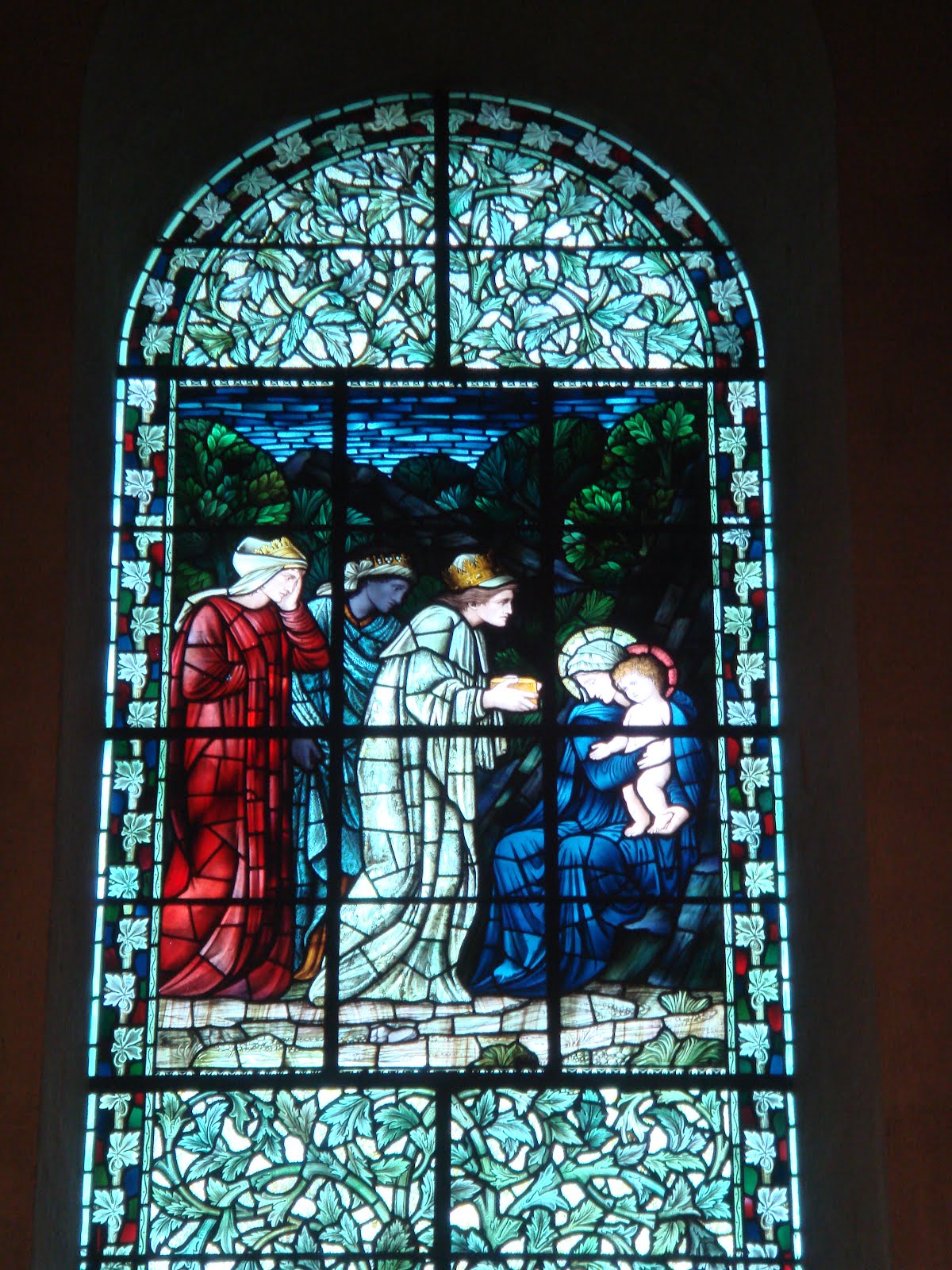
Epiphany window by Burne-Jones in Winchester Cathedral


Catching up on this week's Choral Evensong from Winchester Cathedral reminded me that it's still Epiphanytide, of course. So here's an Epiphany hymn - I think my favourite (competing only with this). Apparently some people find it boring (fools!), but to my taste the parallelism of the 'as... so...' clauses in verses 1-3 is supremely elegant, understated, and beautiful; and verse 4 and 5 are superb. It's poetry, not 'just' a hymn. You don't even notice the demanding rhyme scheme, he makes it look so easy.

The author of this hymn is William Chatterton Dix, who also wrote 'What child is this?', 'Alleluia, sing to Jesus', 'Come unto me, ye weary', and this harvest hymn. That's a pretty good list. According to the unquestionable authority of a cursory google search, he seems to have written many of his hymns in his twenties, while confined to his bed with a severe illness and serious depression. I wonder if you can see any of that reflected in the last line of verse 4.

The tune adds substantially to this hymn's charms.


1. As with gladness men of old
Did the guiding star behold,
As with joy they hailed its light
Leading onward, beaming bright,
So, most gracious Lord, may we
Evermore be led to Thee.

2. As with joyful steps they sped
To that lowly manger bed,
There to bend the knee before
Him whom heaven and earth adore,
So may we with willing feet
Ever seek Thy mercy seat.

3. As they offered gifts most rare
At that manger rude and bare,
So may we with holy joy,
Pure and free from sin's alloy,
All our costliest treasures bring,
Christ, to Thee, our heavenly King.

4. Holy Jesus, every day
Keep us in the narrow way;
And, when earthly things are past,
Bring our ransomed souls at last
Where they need no star to guide,
Where no clouds Thy glory hide.

5. In the heavenly country bright,
Need they no created light;
Thou its light, its joy, its crown,
Thou its sun which goes not down;
There forever may we sing
Alleluias to our King.

The introduction to Choral Evensong welcomed the listener to Winchester Cathedral thus: "in this place where the mortal remains of many of our Saxon kings rest. Epiphany in Winchester reminds us of the Christian inspiration of monarchy that built our nation". I liked that, of course; and it makes a nice excuse to post this Winchester picture of 'kings [and one or two queens] coming to the brightness of thy rising'.

Sunday, 8 January 2012

'There is a blossom sprung of a thorn'


In poetry about the Epiphany, you sometimes find depictions of the three kings representing the three ages of man - one young, one in the prime of life, and one aged. A modern example is Dorothy L. Sayers' poem 'The Three Kings', in which they are distinguished by the gifts they bring: the sorrowful youngest king brings myrrh, the middle-aged priest brings incense, and the oldest king brings golden baubles as baby toys. A similar idea is found in this sixteenth-century English carol called 'There is a blossom sprung of a thorn', but here the three kings apparently each see a different aspect of Christ as they present their gifts to him: the oldest king sees a judge; the middle king sees a baby; the youngest king sees Christ the Redeemer of mankind.

The carol comes from Balliol College MS. 354, the commonplace book of a London grocer named Richard Hill, which you can see here.

1. There is a blossom sprung of a thorn,
To save mankind that was forlorn,
As the prophets said before,
Deo Patri sit gloria.

2. There sprang a well at Mary's foot,
That turned all this world to bote; [redemption]
Of her took Jesu flesh and blood,
Deo Patri sit gloria.

3. From that well there stretched a stream,
Out of Egypt into Bethlehem;
God through his highness turned it again,
Deo Patri sit gloria.

4. There were three kings of divers lands,
They thought a thought that was strong,
Him to seek and thank among.
Deo Patri sit gloria.

5. They came richly with their presents,
With gold, myrrh and frankincense,
As clerks read in their sequence,
Deo Patri sit gloria.

6. The eldest king of the three,
He went foremost, for he would see
What doomsman that this should be,
Deo Patri sit gloria.

7. The middlemost king up he rose,
He saw a babe in arms close;
In middle age he thought he was.
Deo Patri sit gloria.

8. The youngest king up he stood,
He made his offering rich and good,
To Jesus Christ, that shed his blood.
Deo Patri sit gloria.

9. There shone a star out of heaven bright,
That men of earth should deem aright
That this was Jesu, full of might.
Deo Patri sit gloria.


Over the centuries, the significant number three has been a spur to allegorise the Magi's gifts into various different forms of threefold meaning. One traditional version, which many people now encounter in childhood, is the allegorical schema popularised by 'We three kings of Orient are': gold for kingship, frankincense for divinity, myrrh for mortality. But there are other possibilities, of course! Here's a short reflection on the kings' gifts from Piers Plowman, Passus 19: 'All the wit of the world was in those three kings,' Langland says, and he interprets the gifts as reflecting three aspects of Christ's own kingship, 'Reason and Righteousness and Ruth', i.e. wisdom, justice and compassion.

Kynges come after, knelede and offrede sense,
Mirre and muche gold withouten mercy askynge
Or any kynnes catel, but knoweliched[en] hym sovereyn
Both of sond, sonne and see, and sithenes thei wente
Into hir kyngene kith by counseil of aungeles.
And there was that word fulfilled the which thow of speke -
Omnia celestia, terrestria, flectantur in hoc nomine Iesu.
For alle the aungeles of hevene at his burthe knelede,
And al the wit of the world was in tho thre kynges.
Reson and Rightwisnesse and Ruthe thei offrede,
Wherfore and why wise men that tyme
Maistres and lettred men, Magi hem callede.
That o kyng cam with Reson, covered under sense.
The seconde kyng siththe soothliche offrede
Rightwisnesse under reed gold, Resones felawe.
Gold is likned to Leautee that laste shal evere,
And Reson to riche[ls] - to right and to truthe.
The thridde kyng tho kam, and knelede to Jesu,
And presented hym with Pitee, apperynge by mirre;
For mirre is mercy to mene, and mylde speche of tonge.
Ertheliche honeste thynges was offred thus at ones
Thorugh thre kynne kynges knelynge to Jesu.

Kings came after, kneeled and offered incense,
Myrrh, and much gold, not asking for mercy
Or for any kind of reward, but acknowledging him sovereign
Of land, sun, and sea; and afterwards they went
Into their royal domains by an angel's counsel.
And there was that word fulfilled which you spoke of earlier:
'All things in heaven and earth will bow down at the name of Jesus'.
For all the angels of heaven at his birth kneeled,
And all the wit of the world was in those three kings.
Reason and Righteousness and Ruth they offered,
And because of that wise men at that time,
Masters and lettered men, called them 'Magi'.*
The first king came with Reason, in the form of incense.
The second king afterwards truly offered
Righteousness as red gold, Reason's companion.
Gold is likened to Justice, which shall endure for ever,
And Reason to incense, which is right and true.
The third king came then, and kneeled to Jesu,
And presented him with Pity, appearing as myrrh;
For myrrh means mercy, and gentle speech of tongue.
All honest things of earth were offered thus at once
Through three kinds of kings kneeling to Jesu.


*Incidentally, this is only the second occurrence of the word 'Magi' recorded in English in the OED; in Middle English 'three kings' was the more common and familiar term.

Friday, 6 January 2012

A Twelfth Night Carol

An Epiphany scene from Munich


I'm never really sure if Twelfth Night is properly the 5th or the 6th of January, but today certainly is the feast of the Epiphany (technically not for the Catholics of England, alas, but I'm afraid I just can't accept this one as a moveable feast) - and so there's time to squeeze in this carol. It's yet another from the fifteenth-century Sloane MS. 2593, and it's a pretty long one, but worth reading at least as far as the lovely verse 8, and the rather odd verse 16 (!), which in its depiction of a ranting Herod echoes the presentation of that king in the mystery plays (it made me think of this).

Traditionally, today is the end of one stage of the Christmas season but not by any means the end of the whole thing - the medieval Church gave forty days to Christmas, until the Feast of the Purification (Candlemas) on February 2nd. We give forty days to Lent, so why not to Christmas? As it says in The Liturgical Year, at Christmas "Heaven sends us a present of its own joy: we need joy, and forty days are not too many for us to get it well into our hearts". The refrain of one medieval carol proclaims, "Make we mirth/in Christ's birth/and sing from Yule till Candlemas!" We may have taken the Christmas decorations down, but I don't see any reason to stop singing, at least - and that means I'll probably post a few more carols between now and February 2.


Anyway, on to the Twelfth Night Carol. I've modernised the spelling (from this text); the refrain means "Kings shall come from Sheba, offering gold, frankincense and myrrh" (a quotation from a Latin Christmas hymn). In the original Herod is not proud but moody, a word I've written about before; in its early history this Old English word (modig) was a term of praise, meaning 'brave, bold, passionate', like a fierce and fearsome warrior. But even then it had overtones of 'proud, arrogant' and of 'angry, wrathful', both of which are part of the meaning here in reference to Herod. (One is tempted to say that the pagan's fierce hero is the church's proud sinner, but perhaps that's a bit simplistic). From this it came to mean (in the words of the OED) "indulging in moods of ill humour or depression; melancholy, gloomy; (now chiefly) given to unpredictable changes of mood, esp. sudden spells of gloominess or irritable sullenness". And now it applies mostly to sullen teenagers...


Reges de Saba venient;

Aurum, tus, myrram offerent;

Alleluia.


1. Now is the Twelfth Day come,
The Father and Son together are come,
The Holy Ghost, as they were one
Together.
God send us a good New Year!

2. I will you sing with all my might,
Of a Child so fair in sight,
A maiden him bore the other night,
So still;
As it was his will.

3. Three kings out of Galilee
Came to Bethlehem, that city,
For to go into that see
By night;
It was a full fair sight.

4. As they came forth with their offering,
They met with Herod, that proud king;
He asked about their coming
That tide,
And thus to them he said:

5. "From whence come ye, kings three?"
"Out of the East, as thou mayst see,
To seek Him that ever shall be,
Through right,
Lord and King of might."

6. "When ye have with that king been,
Come again this way by me,
And tell me the sights that ye have seen;
I pray
Ye go no other way."

7. Of Herod, that proud king,
They took their leave, of old and young;
And forth they went with their offering
In sight,
And there they came by night.

8. Into Bethlehem they did pass;
The star shone upon their face
Brighter than ever shone sun in glass
In land;
Jesu with Mary there they found.

9. When they came into the place
Where Jesu with His mother was,
They made offering with great solace,
Not fear,
With gold, incense and myrrh.

10. When they were homeward went,
The Father of heaven an angel sent
To those three kings that made presents,
Ere day,
And thus to them did say:

11. "My Lord hath warned you of your foe,
By King Herod that ye not go;
For if ye do, he will you slay,
And betray,
Go ye another way."

12. When they came home to their country,
Blithe and glad they were all three
Of the sights that they had seen,
By night,
Jesu and Mary bright.

13. With treason Herod began to say,
He thought Jesu to have slain;
Into Egypt they went full plain,
By side,
Joseph was their guide.

14. King Herod he made his vow,
Great plenty of children he slew,
He thought they would have been Jesu;
I say,
He failed of his prey.

15. Herod was wrath in royalty;
He slew children right great plenty
In Bethlehem, that fair city,
With strife;
Nor left he none alive.

16. The children of Israel cried, "Wa, wa!"
The mothers of Bethlehem cried, "Ba, ba!"
Herod laughed and said, "A-ha!"
And said,
"The King of Jews is dead!"

17. Almighty God in majesty,
In one God persons three,
Bring us to the bliss that is so free,
Together;
And send us a good New Year!