Tuesday, 6 November 2012

Sunlight at Stanton Harcourt

I went to the most wonderful church yesterday.  It was the first really sunny day we've had in a while, and I was itching to be abroad in the autumnal countryside, so I studied various websites in search of a destination, and caught sight of the key words 'medieval painted screen' and 'shrine of St Edburg' - at the church of St Michael in Stanton Harcourt, a village 6 miles west of Oxford.  You can get there easily by bus, and a website said the church was open, so off I went.

The bus ride through the Oxfordshire countryshire was impossibly beautiful; early in the afternoon, the low sun was already casting long shadows, and brightening the leaves to red and gold.  To get to Stanton Harcourt the bus goes through the village of Eynsham, which once had an abbey where Ælfric was abbot, a thousand years ago; now he has a road named after him, which it made me happy to see.  In his time Stanton Harcourt was just 'Stanton'; the Harcourt family came over at the Norman Conquest, and gave their name to the manor when they acquired it at the end of the twelfth century.  It still belongs to the family, and many of them lie in the church, as we will see.  The village is a delightful little place, the chief street a quiet row of thatched houses like mushrooms dropped from above:


The church is just off the main road, down a leaf-strewn lane, sitting among some cottages and next to the ancient manor house.  I was too interested in getting inside to think about how beautiful the situation was, so we'll come to that in a moment; my first impression was only that the exterior was very plain:


But the church was open!  After my experience at Wantage I was half-expecting it to be locked even as I walked up to the door with a friendly 'Open' sign hanging on it; but no, the gate was open, the door was unlocked, and the church was all mine to explore.  The village was deserted and there was absolute stillness all around, not even traffic noise - only a 'bright litter of birdcalls' from time to time, so loud in the silence that it startled me.  There is no stillness like the stillness of an empty country church; you hardly want to breathe lest you disturb it.


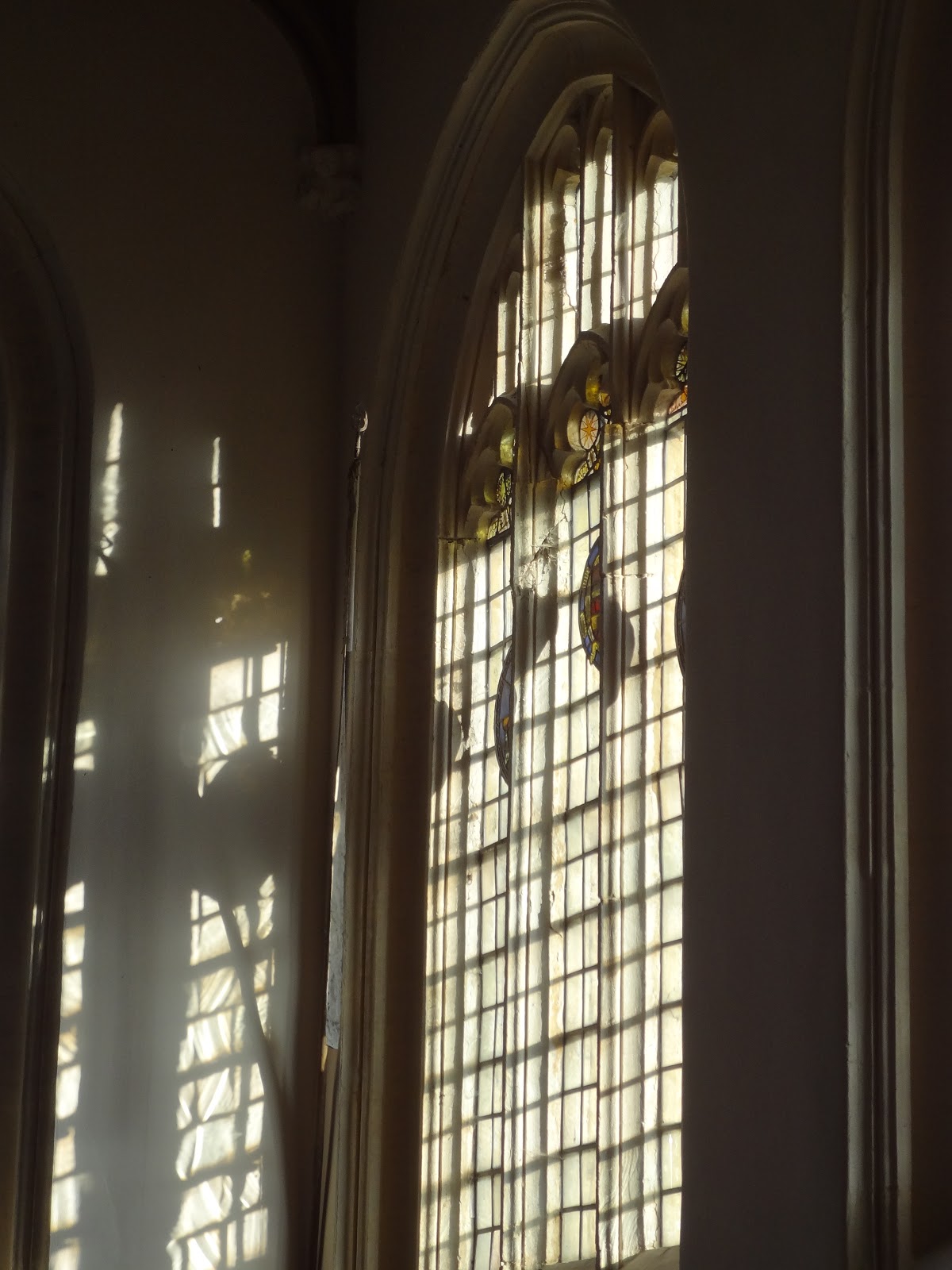
The nave is very plain, with clear glass in the Norman windows, and only one or two memorials; but there were autumnal flowers, lovingly arranged, and the best decoration of all - sunlight.


This window was so simple in shape, you would have thought nothing could make it worth looking at - but the light through the panes made the stone shimmer like water.

The other thing about an empty church is that although you think you are alone, you are confronted by the incidental reminders of other visitors, other eyes, other hands - the names in the book for prayers; condolence cards on the windowsill; and this touch of whimsy, left over from harvest festival, a collection of vegetables nestling on an ancient pillar:


If you're wondering 'where's the medieval screen', so was I - but I promise we'll get to it, and it will be worth the wait.  The real inhabitants of this church, when the living parishoners are away about their business, are the Harcourt family, countless generations of them.  The first ones you spot, as you go up the nave, are two life-size Victorian Harcourts, or rather plaster casts of statues of them, of which the originals (statues, not men!) stand in the lobby in the Houses of Parliament.


I said the Harcourts came over with William the Conqueror, but they trace their lineage back to the very first Normans, before they were Normans at all but only piratical 'north men' from Denmark - in this case to the Viking Bernard the Dane, who was already an old man when Cnut's grandfather was on the Danish throne.  They have their own chantry chapel in the south-east corner of the church, and behind its altar is a plaque listing the generations of Harcourts after Bernard - from the Viking Turketils and Thorths of the tenth century, through the Norman Williams and Roberts of the twelfth, all the way down to the Aubreys and Augustuses of the Victorian age:


The Harcourt chapel is kept locked, but with patience and a good zoom on your camera you can see a fair bit of it:


I wonder if this is ancestral piety; if I knew where my fourteenth-century ancestors were buried, or who they were, I'm sure I'd always be leaving dried flowers upon their tombs.  It reminded me strikingly of the knight at Ickham.  This is the tomb of Robert Harcourt, who bore the standard at the Battle of Bosworth - for the winning side, in case you were wondering.


The glass in the chantry chapel includes a fifteenth-century depiction of the Harcourt arms:


And a bishop and a king, reset from elsewhere in the church, dating to the thirteenth century:


The king refused to photograph well but I do recommend you click to enlarge the bishop, and zoom in; he has the most wonderful face and mitre.

I still had not located what I came for, distracted by all this splendour, and just outside the chantry chapel I was distracted again by the sunlight falling on this Baroque monument to Sir Philip Harcourt, who died in 1688:


So much white and gold!  Another Harcourt of a different century, in a tomb chest below all this exuberance, brings us closer to the purpose of our visit.  This is the tomb of Sir Simon Harcourt, who died in 1547:


I couldn't resist the heraldry:


The sun was my favourite; he looks so bemused.  Simon is the most interesting of the Harcourts from my point of view, because some time around the year 1537, during the Dissolution of the Monastries, he rescued the shrine of St Edburg from Bicester Priory (at the risk of his life, the church guide said, though it didn't elaborate).  St Edburg was a Saxon saint, daughter of the famous King Penda of Mercia, and thanks to Simon Harcourt we have here that very rare thing, a surviving shrine from c.1300:


It's the top part which is the shrine, made of Purbeck marble; the bottom part is also medieval, but not original to the shrine.  The top part has a flat top, where a chest with St Edburg's relics would have stood - the relics themselves have not survived, but at least we have this much.  The marble is carved, painted and gilded:


The shrine's identity was unknown for centuries, perhaps deliberately concealed to save it from destruction; it was only as recently as the 1930s that an enterprising scholar studied the shields on the shrine, and realised that they tallied with the patrons and benefactors of Bicester Priory.  The carving is of such high quality that it's been suggested it was the work of Alexander of Abingdon, the master sculptor who carved the images on the Eleanor Crosses.  It's a treasure of medieval art and a precious glimpse of the pre-Reformation world of saints and shrines - here, in this silent country church.

Even the carving on the base, though not quite as special, is nicely recognisable as late-medieval Instruments of the Passion; it may have been part of an Easter sepulchre, which is what St Edburg's shrine was thought to be until its true history was discovered.


How plaintive those pierced hands are.

And now I must talk about the screen, or I will have run out of energy before we get to this treasure.  This was what I had come to see; after Westhall, I'd go a lot further than six miles to see a medieval painted screen.  But when I first saw the screen, I was puzzled and a little disappointed.  Where on earth was the painting?  I knew it was only two panels - the only ones which had survived the Reformation - but surely it couldn't have disappeared before my visit.  I walked through the screen into the chancel, took a look on that side, and then came back again.  Nothing.


And then I saw her:


Cast into shadow by the pillar, a painted princess-nun quietly sits and reads.


She has a crown and a staff of office, and one hand is turning the page of her book.  Her face is sweetly thoughtful, as if an idea has occurred to her in her reading, and she is looking up to contemplate it; it reminds me of the medieval depictions of the Annunciation in which the Virgin is depicted as reading alone when the Angel appears to her (at Gisleham, for instance).  There are different theories as to this lady's identity: the guidebook favours Queen Adeliza, second wife of Henry I, who retired to a nunnery at the end of her life and was patron of Reading Abbey, which was the patron of this church.  Other suggestions include St Edburg, Oxford's St Frideswide, and Ely's St Etheldreda, nuns and princesses all; but there's no clear evidence either way.


We do know that the painting dates to the fifteenth century, and was added to a wooden screen of the mid-thirteenth.  The screen has a variety of shapes cut into it, the purpose of which remains a mystery.  However, I like how in this panel the piercing looks like a window in the nun's cell - almost like the 'squint' through which anchoresses would gaze on the altar.


The temptation to take pictures of the church through these oddly-shaped holes was just too much to resist!


Quid plura?  Ah yes, the remnants of paint in the chancel:


The bare walls of the nave were once covered with paintings too, though none are now visible - a description of the church from 1845 talks of scenes including Christ before Pilate, the Last Supper, the Entombment, and the Descent into Hell.  Then the walls were replastered.  What survives beneath?

 A few more assorted photographs:


St Michael, in a statue given by All Souls College, Oxford - All Souls received the property in the village which belonged to Reading Abbey before the Reformation.  The church guide informed me there's a house in the village known as the 'Pest House', because those who leased it were required to accommodate fellows of the college there if an outbreak of plague made it prudent to flee Oxford for a time.


The lacy shadow cast by these flowers was extraordinarily delicate; as soon as I had taken this picture I looked away for a moment and when I looked back it had gone, as the sun moved.  I was very conscious, as on the day I went to Iffley, of the movement of the sun; I spent nearly two hours in the church, entirely undisturbed, the only breathing thing among the statues and effigies, and the only kind of change that I saw in this changeless place was the silent passage of the light.  The brightest gleam slipped from window to window, sweeping noiselessly across the nave, illuminating different corners and casting different shadows from moment to moment.  I waited for it to reach the nameless nun, but it never did; this must be why her colours remain so unfaded after five hundred years.

At last I remembered I had a bus to catch, and went to have a look at the outside of the church.


The sun was sinking, but the sky was still a fathomless blue.  This is the Norman doorway:


There's a memorial on the wall of the church, to a young couple struck by lightning; Alexander Pope was visiting the Harcourts at the time, and wrote some lines for the tablet:


Adjacent to the church are the manor house and its chapel, which has its own tower, almost as grand as the church:


The lacy stonework on the right here belongs, you will not be surprised to learn, to the Harcourt chapel.


It was difficult to tear myself away to go and catch the bus; I couldn't help feeling that if I stayed longer, more and different lights would reveal themselves, each more beautiful than the last.  I would not have been surprised by a flash of Pope's 'celestial fire'; it could not have been more bright than the glow of the sinking sun.  But it was hometime, and as I left the church, the place was no longer deserted: the village primary school had just finished for the day, and the road was full of children in their uniforms, parents chatting, and dogs barking.  The sound came as a shock, a sudden reminder of life after spending so long among the silent Harcourts.

When I got home, someone had posted on Facebook an extract from T. S. Eliot's 'The Rock'; it seemed almost absurdly appropriate for the afternoon I had just spent.  It seems a fitting way to end:

O Light Invisible, we praise Thee!
Too bright for mortal vision.

O Greater Light, we praise Thee for the less;
The eastern light our spires touch at morning,
The light that slants upon our western doors at evening,
The twilight over stagnant pools at batflight,
Moon light and star light, owl and moth light,
Glow-worm glowlight on a grassblade.
O Light Invisible, we worship Thee!

We thank Thee for the light that we have kindled,
The light of altar and of sanctuary;
Small lights of those who meditate at midnight
And lights directed through the coloured panes of windows
And light reflected from the polished stone,
The gilded carven wood, the coloured fresco.
Our gaze is submarine, our eyes look upward
And see the light that fractures through unquiet water.
We see the light but see not whence it comes.
O Light Invisible, we glorify Thee!

Monday, 5 November 2012

Pope Benedict on Julian of Norwich

So, I see today that Julian of Norwich - and those who study her - have been added to the list of things Catholic bloggers don't approve of.  That list just keeps on growing, doesn't it?  I can hardly keep up.  Poor Julian, to be blamed for the opinions of those who love her!  It's true she's a darling of 'liberal' Christians, but that's hardly her fault; no one could object to her theology of the Trinity, of the Passion, of anything.  It's just as well the Pope has more wisdom, and has spoken warmly of her work; I hate to hear her sneered at, and was heartened to re-read his words on Julian, given at an audience in December 2010:


Dear Brothers and Sisters,

I still remember with great joy the Apostolic Journey I made in the United Kingdom last September. England is a land that has given birth to a great many distinguished figures who enhanced Church history with their testimony and their teaching. One of them, venerated both in the Catholic Church and in the Anglican Communion, is the mystic Julian of Norwich, of whom I wish to speak this morning.

The - very scant - information on her life in our possession comes mainly from her Revelations of Divine Love in Sixteen Showings, the book in which this kindly and devout woman set down the content of her visions.

It is known that she lived from 1342 until about 1430, turbulent years both for the Church, torn by the schism that followed the Pope’s return to Rome from Avignon, and for the life of the people who were suffering the consequences of a long drawn-out war between the Kingdoms of England and of France. God, however, even in periods of tribulation, does not cease to inspire figures such as Julian of Norwich, to recall people to peace, love and joy.

As Julian herself recounts, in May 1373, most likely on the 13th of that month, she was suddenly stricken with a very serious illness that in three days seemed to be carrying her to the grave. After the priest, who hastened to her bedside, had shown her the Crucified One not only did Julian rapidly recover her health but she received the 16 revelations that she subsequently wrote down and commented on in her book, Revelations of Divine Love.

And it was the Lord himself, 15 years after these extraordinary events, who revealed to her the meaning of those visions.

“‘Would you learn to see clearly your Lord’s meaning in this thing? Learn it well: Love was his meaning. Who showed it to you? Love.... Why did he show it to you? For Love’.... Thus I was taught that Love was our Lord’s meaning” (Julian of Norwich, Revelations of Divine Love, Chapter 86).

Inspired by divine love, Julian made a radical decision. Like an ancient anchoress, she decided to live in a cell located near the church called after St Julian, in the city of Norwich - in her time an important urban centre not far from London.

She may have taken the name of Julian precisely from that Saint to whom was dedicated the church in whose vicinity she lived for so many years, until her death.

This decision to live as a “recluse”, the term in her day, might surprise or even perplex us. But she was not the only one to make such a choice. In those centuries a considerable number of women opted for this form of life, adopting rules specially drawn up, for them, such as the rule compiled by St Aelred of Rievaulx.

The anchoresses or “recluses”, in their cells, devoted themselves to prayer, meditation and study. In this way they developed a highly refined human and religious sensitivity which earned them the veneration of the people. Men and women of every age and condition in need of advice and comfort, would devoutly seek them. It was not, therefore, an individualistic choice; precisely with this closeness to the Lord, Julian developed the ability to be a counsellor to a great many people and to help those who were going through difficulties in this life.

We also know that Julian too received frequent visitors, as is attested by the autobiography of another fervent Christian of her time, Margery Kempe, who went to Norwich in 1413 to receive advice on her spiritual life. This is why, in her lifetime, Julian was called “Dame Julian”, as is engraved on the funeral monument that contains her remains. She had become a mother to many.

Men and women who withdraw to live in God’s company acquire by making this decision a great sense of compassion for the suffering and weakness of others. As friends of God, they have at their disposal a wisdom that the world - from which they have distanced themselves - does not possess and they amiably share it with those who knock at their door.

I therefore recall with admiration and gratitude the women and men's cloistered monasteries. Today more than ever they are oases of peace and hope, a precious treasure for the whole Church, especially since they recall the primacy of God and the importance, for the journey of faith, of constant and intense prayer.

It was precisely in the solitude infused with God that Julian of Norwich wrote her Revelations of Divine Love. Two versions have come down to us, one that is shorter, probably the older, and one that is longer. This book contains a message of optimism based on the certainty of being loved by God and of being protected by his Providence.

In this book we read the following wonderful words: “And I saw full surely that ere God made us he loved us; which love was never lacking nor ever shall be. And in this love he has made all his works; and in this love he has made all things profitable to us; and in this love our life is everlasting... in which love we have our beginning. And all this shall we see in God, without end” (Revelations of Divine Love, Chapter 86).

The theme of divine love recurs frequently in the visions of Julian of Norwich who, with a certain daring, did not hesitate to compare them also to motherly love. This is one of the most characteristic messages of her mystical theology.

The tenderness, concern and gentleness of God’s kindness to us are so great that they remind us, pilgrims on earth, of a mother’s love for her children. In fact the biblical prophets also sometimes used this language that calls to mind the tenderness, intensity and totality of God’s love, which is manifested in creation and in the whole history of salvation that is crowned by the Incarnation of the Son.

God, however, always excels all human love, as the Prophet Isaiah says: “Can a woman forget her sucking child, that she should have no compassion on the son of her womb? Even these may forget, yet I will never forget you” (Is 49:15).

Julian of Norwich understood the central message for spiritual life: God is love and it is only if one opens oneself to this love, totally and with total trust, and lets it become one's sole guide in life, that all things are transfigured, true peace and true joy found and one is able to radiate it.

I would like to emphasize another point. The Catechism of the Catholic Church cites the words of Julian of Norwich when it explains the viewpoint of the Catholic faith on an argument that never ceases to be a provocation to all believers (cf. nn. 304-313, 314).

If God is supremely good and wise, why do evil and the suffering of innocents exist? And the Saints themselves asked this very question. Illumined by faith, they give an answer that opens our hearts to trust and hope: in the mysterious designs of Providence, God can draw a greater good even from evil, as Julian of Norwich wrote: “Here I was taught by the grace of God that I should steadfastly hold me in the Faith ... and that ... I should take my stand on and earnestly believe in ... that ‘all manner of thing shall be well”’ (The Revelations of Divine Love, Chapter 32).

Yes, dear brothers and sisters, God’s promises are ever greater than our expectations. If we present to God, to his immense love, the purest and deepest desires of our heart, we shall never be disappointed. “And all will be well”, “all manner of things shall be well”: this is the final message that Julian of Norwich transmits to us and that I am also proposing to you today. Many thanks.

Sunday, 4 November 2012

'Sweet Jesu, king of bliss'

This is a charming fourteenth-century poem, one of the Harley lyrics.  I quoted it in my post on medieval terms of endearment, because it's packed to bursting with adoring epithets for Christ: 'my heart's love, my heart's delight', 'my heart's light', 'my soul's food', 'my heart's cure', 'my heart's gleam, brighter than the sun's beam' - you get the idea.  One rhyme per stanza makes the poem nice and pacy, and the effect is really very sweet (and sweet is one of this poet's favourite words - probably inspired by the popularity of 'Jesu dulcis memoria'.)

Adoring Christ, from Haddon Hall


Suete Jhesu, king of blysse,
Myn huerte love, min huerte lisse,
Thou art suete myd y-wisse,
Wo is him that the shal misse!

[Sweet Jesu, king of bliss, my heart's love, my heart's delight! Thou are indeed sweet; alas for him who loses thee!]

Suete Jhesu, min huerte lyht,
Thou art day with-oute nyht,
Thou yeve me streinthe ant eke myht,
Forte lovien the a-ryht.

[Sweet Jesu, my heart's light, thou art day without a night! Thou givest me strength, and also the might to love thee as I ought rightly to do.]

Suete Jhesu, min huerte bote,
In myn huerte thou sete a rote
Of thi love, that is so swote,
Ant lene that hit springe mote.

[Sweet Jesu, my heart's remedy! In my heart set thou a root of thy love, which is so sweet, and grant that it may grow.]

Suete Jhesu, min huerte gleem,
Bryhtore then the sonne beem,
Y-bore thou were in Bedleheem,
Thou make me here thi suete dreem.

[Sweet Jesu, my heart's gleam, brighter than the sunbeam! Thou wast born in Bethlehem; make me to hear thy sweet melody.]

Suete Jhesu, thi love is suete,
Wo is him that the shall lete!
Tharefore me shulden ofte the grete,
With salte teres ant eye wepe.

[Sweet Jesu, thy love is sweet; alas for him who keeps thee away! Therefore we ought often to cry to thee, with salt tears and weeping eyes.]

Suete Jhesu, kyng of londe,
Thou make me fer understonde,
That min herte mote fonde,
Hou suete bueth thi love bonde.

[Sweet Jesu, king of all lands, make me to understand deeply, so that my heart may prove how sweet are the bonds of thy love.]

Swete Jhesu, loverd myn,
My lyf, myn huerte, al is thin,
Undo myn herte ant liht ther-yn,
Ant wite me from fendes engyn.

[Sweet Jesu, my lord, my life, my heart, all is thine! Unlock my heart and alight within, and save me from the fiends' attacks.]

Suete Jhesu, my soule fode,
Thin werkes bueth bo suete ant gode,
Thou bohtest me upon the rode.
For me thou sheddest thi blode.

[Sweet Jesu, my soul's food, thy works are both sweet and good. Thou hast bought me upon the rood; for me thou hast shed thy blood.]

Suete Jhesu, me reoweth sore,
Gultes that y ha wrotht yore;
Tharefore y bidde thin mylse ant ore,
Merci, lord, ynul na more!

[Sweet Jesu, it grieves me sorely to think of all the sins I have committed, and so I pray for thy clemency and pardon. Have mercy, Lord, I will never do so again!]

Suete Jhesu, loverd God,
Thou me bohtest with thi blod,
Out of thin huerte orn the flod,
Thi moder hit seh that the by stod.

[Sweet Jesu, Lord God, thou hast bought me with thy blood: out from thy heart ran the flood, and thy mother saw it who beside thee stood.]

Suete Jhesu, bryht ant shene,
Y preye the thou here my bene,
Thourh ernding of the hevene quene,
That my bone be nou sene.

[Sweet Jesu, bright and clear, I pray that thou hear my prayer; through the intercession of the Queen of Heaven may my petition now be granted.]

Suete Jhesu, berne best,
With ich hope habbe rest,
Whether y be south other west,
The help of the be me nest!

[Sweet Jesu, best of men, with thee I hope to have rest. Wherever I may be, south or west, may thy help be ever nearest to me!]

Suete Jhesu, wel may him be,
That the may in blisse se!
After mi soule let aungles te,
For me ne gladieth gome ne gle.

[Sweet Jesu, well is it for him who may contemplate thee in bliss. May angels come for my soul, for neither game nor glee delights me now.]

Suete Jhesu, hevene kyng,
Feir ant best of alle thyng.
Thou bring me of this longyng,
Ant come to the at myn endyng.

[Sweet Jesu, king of heaven, fairest and best of all things, bring me out of this longing desire, so that I may come to thee at my ending.]

Suete Jhesu, al folkes reed,
Graunte ous er we buen ded
The under-fonge in fourme of bred,
Ant seththe to heovene thou us led.

[Sweet Jesu, guider of all people, grant to us, before we die, to receive thee in the form of bread, and afterwards lead us to heaven.]

Thursday, 1 November 2012

Music for All Saints' Day


One of the lovely things about All Saints' Day is that its imagery and music are so deeply familiar; it's a little like Christmas, in that as the feast approaches you already know what you're going to encounter, and can look forward to it.  But unlike Christmas, with its never-ending wealth of poetry and hymns, All Saints' Day has a fairly small range of material - almost all of it wonderful, but all very familiar.  And so this introduction is by way of apology (but not really) for posting such famous hymns today; they're just so good, and I like them so much that I could sing them every day without getting tired.  And we only get to sing them in one season of the year, so I have to make the most of it!

And thus:


Who are these like stars appearing,
These, before God’s throne who stand?
Each a golden crown is wearing;
Who are all this glorious band?
Alleluia! Hark, they sing,
Praising loud their heavenly King.

Who are these of dazzling brightness,
These in God’s own truth arrayed,
Clad in robes of purest whiteness,
Robes whose lustre ne’er shall fade,
Ne’er be touched by time’s rude hand?
Whence come all this glorious band?

These are they who have contended
For their Saviour’s honour long,
Wrestling on till life was ended,
Following not the sinful throng;
These who well the fight sustained,
Triumph through the Lamb have gained.

These are they whose hearts were riven,
Sore with woe and anguish tried,
Who in prayer full oft have striven
With the God they glorified;
Now, their painful conflict o’er,
God has bid them weep no more.

These, like priests, have watched and waited,
Offering up to Christ their will;
Soul and body consecrated,
Day and night to serve Him still:
Now in God’s most holy place
Blest they stand before His face.


This is Frances Cox's translation of a German hymn, 'Wer sind die vor Gott­es Throne'; if this is indeed the German text, her version is quite a free one. Frances Cox was born in 1812 and lived all her life in Oxford; I just had some fun looking up her different addresses in the city, and found that she lived at one point in a house which is now part of St Hilda's College, and at another time in the Iffley Road; in 1861 she was living here, and is mentioned in that link as one of the 'three spinster daughters' of George Valentine Cox.  Surely Frances deserves to be named, for this hymn if nothing else...


And then there's this:


Give us the wings of faith to rise
within the veil, and see
the saints above, how great their joys,
how bright their glories be.

We asked them whence their victory came:
they, with one united breath,
ascribe their conquest to the Lamb,
their triumph to his death.

They marked the footsteps that he trod,
his zeal inspired their breast;
and, following their incarnate God,
they reached the promised rest.


This is Ernest Bullock's setting of words by Isaac Watts.  When sung as a hymn, I usually hear 'Give us the wings of faith to rise' to the beautiful tune 'Song 67'.  Bullock's version omits verses 2 and 5:

Once they were mourning here below,
and wet their couch with tears:
they wrestled hard, as we do now,
with sins, and doubts, and fears.

Our glorious Leader claims our praise
for his own pattern given;
while the long cloud of witnesses
show the same path to heaven.


It's a shame to lose verse 2; that idea is an important component of All Saints' Day, or at least it is to me, though I may be wrong in this.  I heard a sermon on Sunday which talked about how saints are too perfect for us to identify with - I've heard lots of sermons about that, and I always find it odd.  Maybe the medieval saints I love the most are unusual, but I've never thought them too perfect for me to identify with - from St Anselm playfully remembering his youthful arrogance to St Guthlac quaking with fear at the thought of his death, from the little vanities of St Edith and St Etheldreda to the many flaws of poor Edward the Confessor, I find their struggles deeply comforting.  These are people we remember, who strove and wrestled and wept through their lives, but survived it all somehow, and lived to be great and holy.


In which spirit, here's Vaughan Williams...


These words are taken from Ecclesiasticus 44:

Let us now praise famous men, and our fathers that begat us;
Such as did bear rule in their kingdoms, men renowned for their power;
Leaders of the people by their counsels, and by their knowledge;
Such as found out musical tunes, and recited verses in writing;
All these were honoured in their generations, and were the glory of their times.
And some there be, which have no memorial; who are perished, as though they had never been. Their bodies are buried in peace; but their name liveth evermore.


And RVW brings us to:


I'm sure you know the words, but nonetheless:


1. For all the saints, who from their labours rest,
Who thee by faith before the world confessed,
Thy name, O Jesus, be forever blest.
Alleluia, Alleluia!

2. Thou wast their rock, their fortress and their might;
Thou, Lord, their captain in the well-fought fight;
Thou, in the darkness drear, their one true light.
Alleluia, Alleluia!

3. O may thy soldiers, faithful, true and bold,
Fight as the saints who nobly fought of old,
And win with them the victor’s crown of gold.
Alleluia, Alleluia!

4. O blest communion, fellowship divine!
We feebly struggle, they in glory shine;
Yet all are one in thee, for all are thine.
Alleluia, Alleluia!

5. And when the strife is fierce, the warfare long,
Steals on the ear the distant triumph song,
And hearts are brave again and arms are strong.
Alleluia, Alleluia!

6. The golden evening brightens in the west;
Soon, soon to faithful warriors cometh rest;
Sweet is the calm of Paradise the blest.
Alleluia, Alleluia!

7. But lo, there breaks a yet more glorious day;
The saints triumphant rise in bright array;
The King of Glory passes on his way.
Alleluia, Alleluia!

11. From earth’s wide bounds, from ocean’s farthest coast,
Through gates of pearl streams in the countless host,
Singing to Father, Son and Holy Ghost:
Alleluia, Alleluia!


The words are by William Walsham How, a Wadham man, who also wrote the slightly sentimental but nonetheless lovely 'Summer suns are glowing'.  I have a soft spot for singing 'For all the saints' to Stanford's Engelberg, which you don't hear so often because the Vaughan Williams version is so dearly loved; but I do like Stanford's 'Alleluias'.