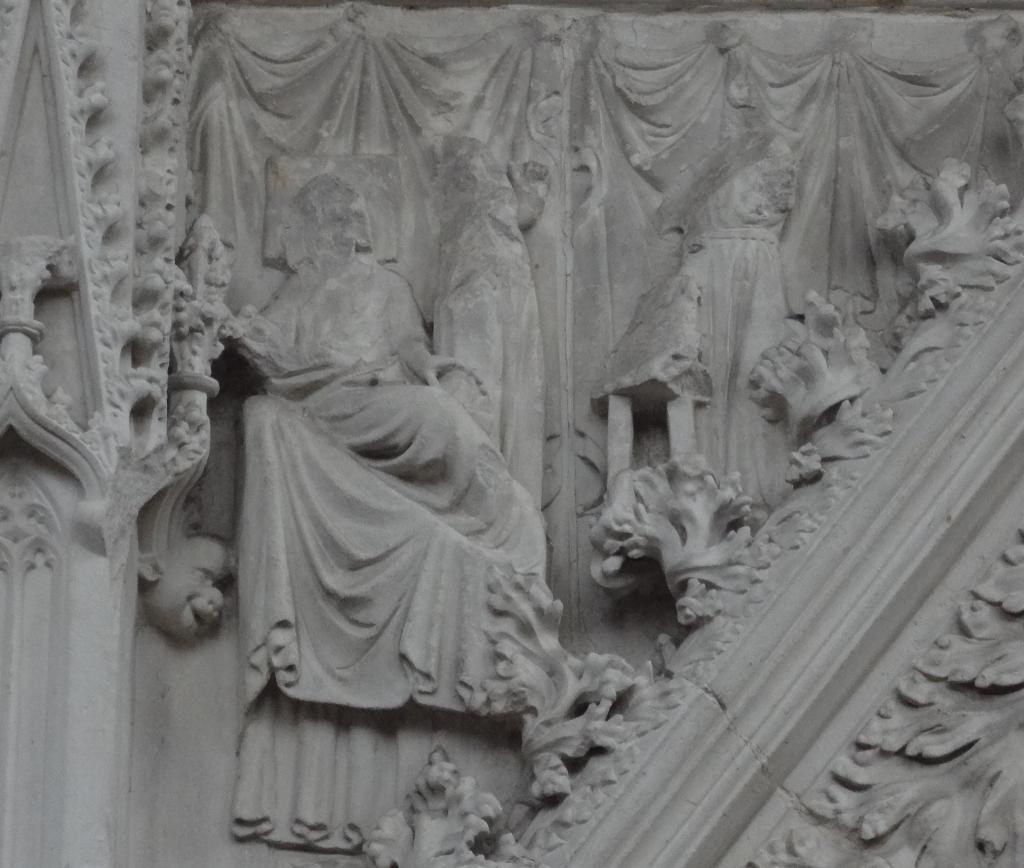
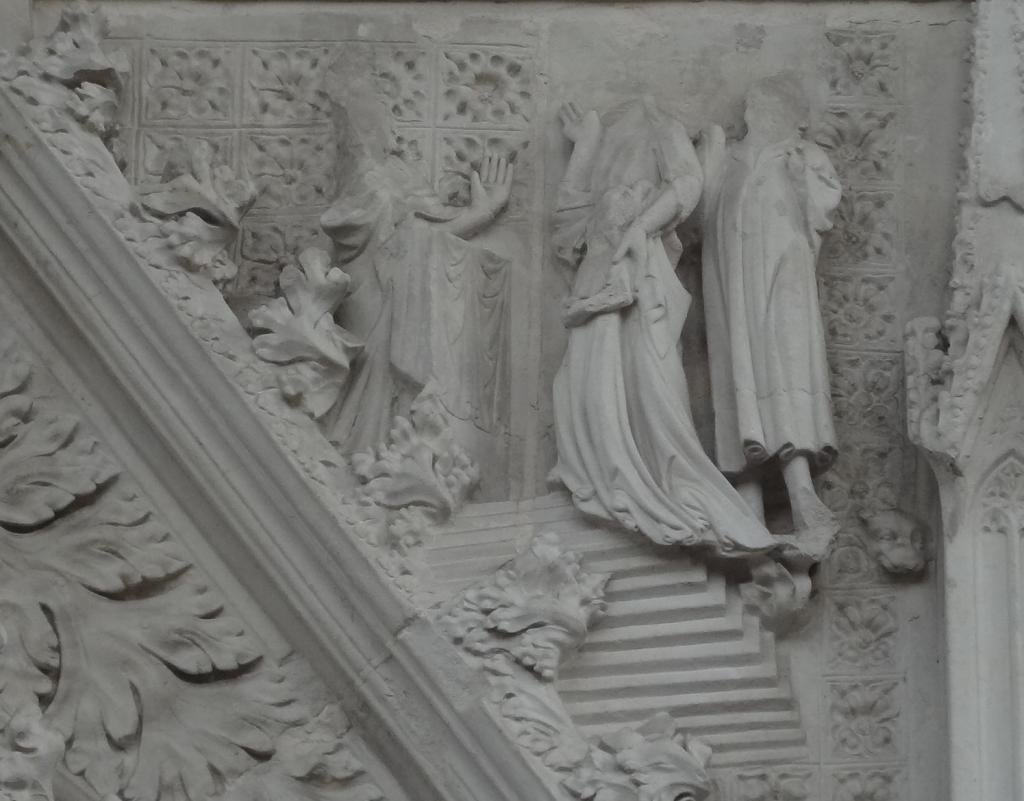
At the end of September I visited Ramsey, a small Fenland town which was once the site of a great medieval abbey. It's about thirty miles north-west of modern-day Cambridge, but 250 years before a university was founded there Ramsey was a centre of Anglo-Saxon learning, home to some extraordinary scholars and a famous library. In this post I'll show you some of the things I saw at Ramsey this autumn, interspersed with stories about the early history of the abbey.

The nickname 'Ramsey the rich' comes from a traditional little rhyme about the Fenland abbeys:
Ramsey, the rich of gold and of fee;
Thorney, the flower of the fen country,
Crowland, so courteous of meat and of drink,
Peterborough the proud, as all men do think.
And Sawtrey by the way that old abbey
Gave more alms in one day than all they.
Ramsey was indeed wealthy - at the time of the Dissolution it was the eighth richest abbey in England. There's little to show for that now. All that survives to visit of the abbey is the fifteenth-century gatehouse, which is in the care of the National Trust; apparently there are also some fragments built into the school which now occupies the site, and there's the parish church, which was originally built as the infirmary or guesthouse of the abbey. You can find out more about the buildings and the history of the abbey on this excellent website; I'll be concentrating mostly on Ramsey's tenth- and eleventh-century history, because that's what interests me.

Ramsey is a relatively modern foundation in Anglo-Saxon terms - by that I mean it was founded in the tenth century, which makes it a baby compared to the other Fenland abbeys. We know a great deal about its early history, because its founder was an especially interesting and prominent person: St Oswald, bishop of Worcester, Archbishop of York, and a member of the most intriguing Anglo-Danish family of tenth-century England. Oswald died in 992, and within ten years of his death a Vita S. Oswaldi had been composed, probably by Byrhtferth, a monk of Ramsey who was one of Anglo-Saxon England's greatest scholars. Byrhtferth's Vita gives a wealth of detail about Oswald's life, including the foundation of Ramsey, in which the saint took a close personal interest.
According to his hagiographer, Oswald was the grandson of a Danish Viking who had come to England in the ninth century in the army of Ivar and Ubbe, sons of Ragnar, most famous (in this part of England, anyway) as the killers of St Edmund of East Anglia. Oswald's grandfather was apparently one of the Danes who settled down in what became the Danelaw, and the interest Oswald took in this part of the country might suggest they had a connection to this region of eastern England. The first convert in the family - so the story goes - was the Viking's son, Oda. Against the opposition of his pagan father, Oda was given a Christian education and rose to become Archbishop of Canterbury under King Athelstan. (This is such a truth-is-stranger-than-fiction moment; who needs that pretty-boy semi-Dane in The Last Kingdom, when the real story of the Danes in England is so interesting!) Oda was at the king's side at the Battle of Brunanburh and miraculously repaired his broken sword; he was known as 'Oda se goda', Oda the Good, and after his death in 958 was venerated as a saint.

Oda undertook the education of his nephew, Oswald, and gave him a very good start in life: Oswald was educated at Fleury, a beacon of Benedictine monasticism and a great centre of learning. Byrhtferth says 'even if I had the eloquence of Homer, I could not record all the benefits Oda's kindness left to Oswald, both in his lifetime and after his death'. On his return to England, Oswald was swiftly appointed Bishop of Worcester, helped by the patronage of St Dunstan and his illustrious family connections (not just Oda but also another kinsman, with the Danish name Oscytel, who was Archbishop of York). This was in 961.
Oswald soon decided he wanted to found a monastery, and Byrhtferth says that King Edgar gave him three locations to choose from: St Albans, Ely, or Benfleet in Essex. Oswald went to inspect them, but couldn't make up his mind. Then Fate or Providence took a hand: in 965 he attended the funeral of an ealdorman and got talking with a man named Æthelwine, a member of a prominent East Anglian family. Æthelwine liked the idea of the monastery, but suggested that Oswald should found it on land belonging to him at Ramsey, an island in the Fens. And so he did.

He dedicated it to St Benedict - an unusual dedication for an English monastery at the time, and a clear legacy of his Fleury education. This was a time when many English monasteries were being refounded on stricter Benedictine lines (nearby Ely was refounded by St Æthelwold in 970), and it almost feels like the new foundation at Ramsey was intended to be Oswald's model monastery. He and Æthelwine endowed it with lands and books, and in 985-7 brought the scholar Abbo of Fleury to stay at Ramsey, where he occupied his time teaching the monks and writing (among other things) the first Passio of St Edmund. Byrhtferth was educated at Ramsey, and his extensive learning is a good testament to the kind of education available at the abbey; to judge from references in his works, it had apparently accumulated one of the largest libraries in England within a few decades of its foundation.
There's a reason I chose to post about Ramsey today, because 8 November is one of the abbey's birthdays. There are several significant dates in the early history of the abbey: 29 August, the day Oswald first visited Ramsey (the feast of the beheading of John the Baptist); 18 March, when the first stone was laid (the first day of the creation of the world); and the dedication of the church on 8 November 974. I don't know if there was a reason why 8 November was chosen, but the anniversary was remembered: a few years later, after a tower of the church had had to be rebuilt, it was rededicated on 8 November 991. So today is a good day to celebrate Ramsey, and its clever computistically-minded monks who shared my fondness for historical anniversaries ;)
Both Oswald and Æthelwine maintained a close relationship with Ramsey, and were regular visitors. Both died in the same year, 992; before their deaths a monk of Ramsey had a vision of the two towers of the church collapsing, a premonition of the loss of the abbey's chief supporters. Oswald died on 29 February and was buried at Worcester; Æthelwine was with the monks at Ramsey (just finishing Compline) when he heard the news. Æthelwine followed him on 24 April, and was buried here at Ramsey.

Since Byrhtferth was writing so soon after Oswald's death, he doesn't tell us what happened after c.1002. But he remained at Ramsey, teaching in the monastic school, and writing his own works of history and hagiography in famously ornate Latin. In February 1011 (as the dating in the text tells us) he was here writing his extraordinary Enchiridion. The Enchiridion, or 'Handboc', as he calls it, is a scientific manual written in English, which explains such learned matters as the construction of the calendar, poetry, metre, rhetoric, and the significance of numbers, and it contains some stunning diagrams. I love the thought of Byrhtferth working away at this, designing his diagrams and gathering materials from his sources, on a chilly February day on this little island in the Fens - this in a year when, as the Anglo-Saxon Chronicle tells us, a Danish army had overrun all the counties between East Anglia and Oxford, as well as much of the land south of the Thames.

Apart from Byrhtferth's works, we have some wonderful narrative sources for the early history of Ramsey - bless those learned monks and their love of writing things down! There's the Chronicon Abbatiæ Rameseiensis, a history of the abbey compiled towards the end of the twelfth century and incorporating a great wealth of earlier material about the abbey's founders and benefactors. Written in part to defend the abbey's claims to its various lands, the Chronicle also tells stories about its abbots and monks, its patrons and its enemies, giving a vivid insight into the life of the abbey in this period. I encountered them first in a charming volume of Victorian scholarship called Ramsey Abbey, Its Rise and Fall, taken from the ‘Ramsey History or Chronicle’, and other reliable sources; also, an Account of the Manor and Parish since the ‘Dissolution’, compiled by John Wise and W. Mackreth Noble in 1882. This book is one of those beautifully old-fashioned, monumental works of local history which records every tradition going, whether plausible or not, and it's an absorbing read (if you like that sort of thing, which I do). Reading through these stories, their world becomes so entirely real and alive that it's a shock - even when you're prepared for it - to come to Ramsey, and find there's nothing left of it all but this:

The gatehouse is a fine ruin, with well-preserved stone-carving, but I don't have much to say about it; so let me just tell you some stories about the community who used to live here.

Rivalry with nearby Ely was a consistent feature of Ramsey's history in the medieval period. (You can imagine that Ely, which was three centuries older than Ramsey, just loved having a rival monastery founded on its doorstep.) The histories of both abbeys tell stories about contests between the monks - the most famous is perhaps the story (from Ely) that in 991, when the ealdorman Byrhtnoth and his men were on their way to fight the Danes at Maldon, they stopped at Ramsey and asked for hospitality. The monks offered Byrhtnoth food for himself and only seven of his men, but in reply, the Ely writer claims, "he is said to have made the elegantly phrased response: 'Let the lord Abbot know that I will not dine alone without the men you refer to, because I cannot fight alone without them'." So he went on to Ely, where they not only fed Byrhtnoth and his men but buried him in their church after he was killed in the battle which inspired one of the greatest Old English poems. The date of Ramsey's rededication on 8 November 991 stuck in my memory because I once encountered someone suggesting that The Battle of Maldon might have been composed or performed for that occasion, three months after the date of the battle, when many abbots and noblemen were gathered here for a feast. Well, you never know.

Certainly as the Danish Conquest got underway in 1013-16, the monks of Ramsey (along with other Fenland abbeys) put up some resistance to the invaders. Oswald was titular abbot of Ramsey until his death, and after him the community elected Eadnoth, a relative of Oswald's. Eadnoth became bishop of Dorchester in 1009, but was killed in battle against Cnut at Assandun in 1016, and Ramsey lost a lot of its friends that day - not only Eadnoth but also his successor as abbot, Wulfsige, and Æthelwine’s son, Æthelweard. The bodies of Æthelweard and Wulfsige were recovered by the monks of Ramsey and brought here for burial. They wanted to do the same for Eadnoth, but as they were returning to Ramsey with his body they stopped overnight at Ely. The monks of Ely insisted on keeping Eadnoth's body, and there were too few Ramsey monks to resist them - so Eadnoth was buried at Ely, where he still lies.

When Cnut became king shortly after Assandun, Ramsey must have looked to him like a hotbed of opposition. Tradition says that he planned to suppress the monastery altogether, but the abbot of Peterborough talked him out of it; instead he imposed an abbot of his choice, one Wythmann. The Ramsey monks were not pleased, and opposed Wythmann so vehemently that he resigned and left the country. Clearly the years 1016-20 were a stressful time for the monks of Ramsey. But after Wythmann's departure in 1020, Ramsey seems to have made it up with Cnut. It had a defender again: Æthelric, bishop of Dorchester, who had been educated at Ramsey and managed to get on well with the new king.
The Ramsey Chronicle has some lively stories about Æthelric's history with the abbey. One tells how when he was a child in the school at Ramsey, he and some other boys decided to try and ring the bells in the tower of the abbey church. They got into the tower and rang the bells so enthusiastically that they cracked one, and got into big trouble with the schoolmaster (it would be nice to think their master was Byrhtferth!).
The naughty boy grew up to be an influential bishop, and a good friend to his old school. It was Æthelric who persuaded Cnut to grant the relics of St Felix to Ramsey - a valuable possession, since Felix was the missionary saint who had converted East Anglia to Christianity in the seventh century, and was the first bishop of the East Angles. Felix's relics were preserved at Soham, but the shrine and community there had been destroyed in the ninth century, so the king gave permission for them to be removed to Ramsey. The Ramsey Chronicle memorably claims that when the Ramsey monks were sailing home with Felix's relics through the Fens they were pursued by the monks of Ely, also in a boat, eager to have the precious relics themselves. A miraculous fog descended, in which the Ely monks lost their way, and our Ramsey heroes were able to escape with the relics. (Since Soham is closer to Ely than it is to Ramsey you can see why the Ely monks might feel a little aggrieved! But perhaps it was revenge for Eadnoth.) Even the Ramsey chronicler who records this story expresses some doubts about its veracity - with engaging frankness, he says 'the reader is not required to believe the story, provided that he feels it to be certain that every part of the relics of St Felix were translated to the Church of Ramsey, and honourably deposited there'. Fair enough.
Another much later (and much more unlikely) story connects Cnut and Ramsey: local tradition in the sixteenth century claimed that Cnut kept a place near Ramsey at Bodsey for fishing, and that his children went from there to school at Peterborough. On one occasion the king’s children and servants were travelling by boat across Whittlesey Mere back to Ramsey, amusing themselves by singing on the voyage, when they were caught up in a sudden storm. The boat sank, and many were killed, including two of Cnut's sons. When Cnut heard of it, he decided to prevent such events in future, and had a ditch cut on the border between Huntingdonshire and Cambridgeshire, known as ‘Swordes-delf’ and ‘Knouts-delf’ or ‘Kings-delf’. Tradition said that his unfortunate sons were buried at Bodsey and 'their tomb-stone still exists in the south-east corner of the dining room of Bodsey House'. (So says Ramsey Abbey, Its Rise and Fall! I hardly need say there is no other record of these sons...)

There are also good stories in the Ramsey Chronicle which supposedly took place in Cnut's time, about how Bishop Æthelric acquired various lands for Ramsey. Two stories tell how Æthelric managed to barter estates from Danes who had settled in the area, who were leaving England because they were afraid the local people would kill them. (If true, very interesting.) Another tells how on one occasion, Cnut was travelling through the kingdom and Æthelric was accompanying him. They stopped in a certain place where there wasn't room for everyone to stay with the king, so Æthelric lodged with a Danish man. The Danish man got very drunk and made a bet with Æthelric: he said that he'd sell his estate to Æthelric, if the bishop could raise the purchase money by the very next morning. So Æthelric waited for his drunken host to fall asleep, and sent a messenger to Cnut. Cnut was interrupted in the middle of a game of chess, but he agreed to loan Æthelric the money, and he was able to buy the estate for Ramsey.

But the most memorable story concerns an estate obtained from a Danish man named Thurkill. It goes like this: Thurkill's wife died, leaving him with one son. He remarried, but his new wife was jealous of her husband's love for her stepson. She called in the services of a witch to made the father stop loving his child (as you do). The witch's spells were so successful that Thurkill rejected the boy, but this didn't satisfy the wife, who wanted her own children to be her husband's own heirs; so while Thurkill was away she murdered her stepson, and buried him in a meadow with the witch's help. When Thurkill returned, she told him the boy had just disappeared and couldn't be found. Thurkill believed her, and over time grew reconciled to the loss.
But after a while the witch grew very poor, and came asking Thurkill's wife for help. The woman refused her and drove her from the door (big mistake!), so the witch went to Bishop Æthelric and told him about the murder of the boy and concealment of the body. The bishop decided to investigate and summoned Thurkill and his wife to come to him, but Thurkill refused three times. At last the king had to order him to come, and to bring witnesses to a trial at the place where the child's body had been buried. The abbot of Ramsey was there, with some of his monks, and they brought with them some saints' relics. The bishop told the abbot and monks to place the relics on the child's grave.
In front of the whole crowd, Thurkill declared that he was entirely innocent - he had known nothing of the child's murder. And he was so sure of his wife's innocence that he swore an oath: he wrapped his hand in his long beard and said, 'O Bishop, as God permits me to glory in this beard, so my wife is clear and innocent of the crime imputed to her.' After saying this he took his hand away from his face, and the beard came away with it!
Everyone was amazed, and realised the wife must be guilty. Thurkill himself was dumbfounded. But his wife still denied the crime, so Æthelric ordered that the grave should be opened. The child's bones were brought out, and at the sight the wife broke down and confessed her guilt. Thurkill was so grateful to the bishop that he gave him part of the estate of Ellesworth, which Æthelric promptly bestowed on Ramsey Abbey. Which is why we know this story.

So... that happened. Busy times at Ramsey in the eleventh century, what with Danes and witches everywhere. Another highlight from this period concerns Ælfweard, a monk of Ramsey who was appointed Abbot of Evesham. He was a kinsman of Cnut's, and in 1040 (after the succession crisis which followed Cnut's death) he was entrusted with the mission of fetching Harthacnut and his mother Emma back from Flanders to rule in England. (On the journey there was a storm, but Ælfweard prayed to St Egwin of Evesham and was miraculously saved). He was an assiduous collector of relics, a praiseworthy but rather a dangerous occupation - he went too far when he purloined some relics from the shrine of St Osyth, and was punished with leprosy. He tried to go home to Evesham, but the monks there refused to let him in. So he came to Ramsey, where he was looked after until his death. In gratitude to Ramsey he bestowed on them his collection of relics, including the jawbone of St Egwin and the blood-stained cowl of St Ælfheah.

Oh, and one of the abbots in the eleventh century was murdered by his own servant, an Irish man he had rescued from a life of begging and brought to eat at his own table: one day, for some reason, he told the man to eat outside, and the man stabbed him. Personal as well as national tragedies form part of history at such a place as this.

I could tell more of these stories, but the last eleventh-century abbot who need concern us today is Æthelsige. (I'm really sorry they all have such similar names!) Æthelsige was a close associate of Harold Godwineson, and at the time of the Norman Conquest he was abbot of St Augustine's in Canterbury. Legend says that in 1066 Æthelsige had a vision telling him to warn Harold of a threatened invasion - and he was right to be worried, of course. He held on to his position in Canterbury for four years after the Conquest, but it must have been sticky. In 1070 Æthelsige left St Augustine’s and sailed for Denmark. Accounts differ as to the cause of his journey; some say he was sent on an embassy by William the Conqueror, others that he was forced to flee England because of his opposition to the Norman regime. In any case, Æthelsige didn't return to England until 1080, and then he went not to Canterbury but to Ramsey, where he became abbot. One story says that as he was returning he was caught in a terrible storm at sea (yes, another one). As all hope was vanishing, he had a vision of a bishop promising him he would return safely if he would introduce the celebration of the Feast of the Conception of the Virgin on December 8th. It had been celebrated on that date in late Anglo-Saxon England, but apparently suppressed after the Norman Conquest. Æthelsige said he would, and the storm was calmed. When he came to Ramsey, he introduced the feast on that date, and from Ramsey it spread to the rest of England. (So the story goes.)

I'd better not get onto the twelfth century, or we'll be here all day. But Ramsey's twelfth-century history was pretty stormy: in 1144 Geoffrey de Mandeville seized the abbey, turfed out the monks, and turned it into a castle during his rebellion against King Stephen. This so disturbed the peace of the abbey that blood poured from the walls of the church and cloister as a sign of God's anger. (The chronicler Henry of Huntingdon, a tenant of Ramsey, says he witnessed this himself.)

But it's very peaceful now. These heads on the gatehouse saw the abbey seized and destroyed in the sixteenth century, its stones carted off to build Cambridge colleges, its famous library scattered to the winds; but now they gaze down on a quiet green, a little apart from the busy town.

The tower of the parish church was built in the seventeenth century with stone taken from the abbey. The Ramsey Chronicle says the abbey church, which would have been on a much larger scale than this, had two towers.

Of course this is nothing compared to what the abbey would have been, but it's a nice church, and, importantly, open ('Open for Discovery', in fact!).

This was, as I said earlier, built in the twelfth century as an infirmary or guesthouse for the abbey, and converted into a parish church a century or so later. Apparently it would originally have been a hall with a chapel at the end (now the chancel) but it looks perfectly church-like now.
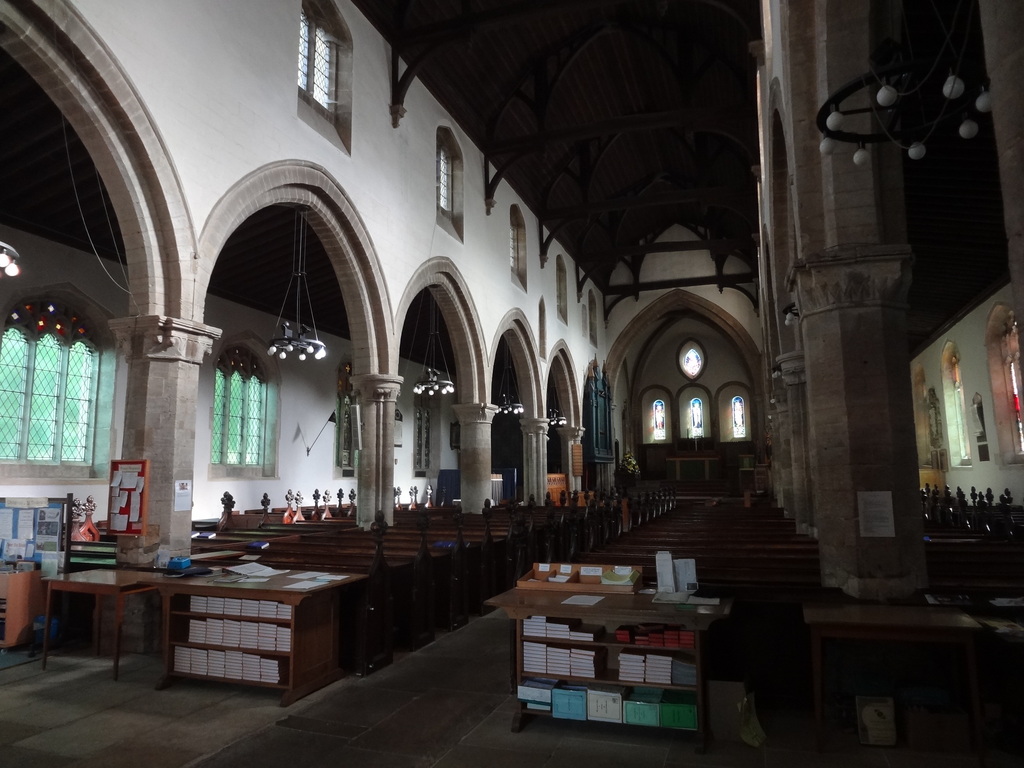
It's quite plain inside, but it has these elegant arches with restrained but lovely carving.


On that September morning it was full of light and shadow, and I had plenty of time to study the windows.

Long-term readers of this blog will know that I like finding depictions of medieval people in modern stained glass, and there are some good examples at Ramsey. I was surprised and pleased to find one of the founders, Æthelwine himself, here appearing under the name 'Duke Ailwyn'.


Elsewhere is a window with three more figures of local importance:

The lady is Ely's St Etheldreda, of course:

Ely Cathedral is looking lovely behind her - apparently the old rivalry has passed away!

And St Felix:

I'd like to think this window shows the relics arriving at Ramsey after that race through the Fenland fogs...

The central figure is St Thomas Becket, to whom this church is dedicated:

A little bit of Canterbury in the Cambridgeshire fens.

Elsewhere in the church, there was this sweet little snapshot of Thomas' life!

Other medieval people to be seen here include Edward the Confessor, shown as part of a window on the theme of 'kings building temples'.

He's building Westminster Abbey, of course. If only some of his successors on the English throne had been more fond of building abbeys than of despoiling them!

Nice detail on the building in the background:

No sign of St Oswald, though.

The other windows are pleasing too, in a very different way - they are, unmistakeably, Morris & Co.


So some of the most beautiful things here are medievalism, if not medieval.

It's a lovely little church, complete in itself and well worth a visit; but it's impossible to be here and not feel a powerful sense of loss. 'Ramsey the rich' would have had such a splendid church - it would have been a rival (literally) to nearby Ely, which has one of the most breathtaking of England's medieval cathedrals. Ely's beauty is marked but not marred by the scars of Reformation violence; Ramsey's is just gone. What happened to all those books gathered by St Oswald and Abbo, or the library of Hebrew texts which Ramsey possessed in the later Middle Ages? One source says that in the fourteenth century Ramsey possessed 100 psalters; three survive. (Here's one.) I think it's time for your regularly-scheduled reminder: Ely Cathedral, with its stunning feats of art and engineering, and Ramsey Abbey, with its tradition of learning and scholarship, are medieval. So please don't use that word to mean 'barbaric'. It wasn't anyone 'medieval' who destroyed Ramsey's great library and smashed up Ely's exquisite carvings in the name of religion.

For various reasons, in the past few years I've visited several sites of what were once great abbey complexes, and they all have their own stories to tell about the way modern Britain manages to accommodate the traces (tangible and intangible) of the past. I've been to St Augustine's Abbey in Canterbury, now an English Heritage site with an entrance fee and guidebooks and the footprint of the abbey painstakingly marked out; Crowland, a dream of a ruin; Bury St Edmunds, a large and well-kept public park where children play on the graves of the abbots; Abingdon, where the stones of St Æthelwold's abbey are rearranged into tasteful Victorian follies; Peterborough, where the town has largely eaten up whatever remained of the monastery; and Reading, where the abbey's former precincts now contain modern skyscrapers more ghostly in their glittering emptiness, on the Saturday I was there, than any medieval ruin could be.

At all these places (and a few more) it's been pleasing to observe the signs of modern communities willing to take pride in, and take care of, a monastic heritage which can be challenging for 21st-century people to understand, let alone admire. I like medieval monks and find them infinitely sympathetic, but I understand why other people don't; it's easy for me to say 'the Anglo-Saxon monks who founded your church were amazing and you should be proud of that', much harder for the people who actually have to deal with crumbling stones, confusing sources, and competing demands on space and money. And yet more often than not you encounter at these places respect and fondness for the medieval monastic past, a willingness to take an imaginative leap of sympathy towards people whose lives were so different from our own. There are exceptions - another day I'll tell you what the information boards at Peterborough Cathedral, which I visited on the same day as Ramsey, assert about medieval relics and that dread word 'superstition'... But in general these places have given me hope. We don't have to idealise medieval monks, or denigrate them for their 'superstition' (a code-word for 'Catholicism', of course); they were just human beings, and Ramsey's history more than any other reminds me of that. These stories, from the touching to the tasteless to the absurd, are just the histories of human institutions, with all the good and bad that entails; and there's so much to learn about them from the stories they told. You can lose the buildings, but the stories remain; if Ramsey's rich in anything now, it's rich in people.