So, I see today that Julian of Norwich - and those who study her - have been added to the list of things Catholic bloggers don't approve of. That list just keeps on growing, doesn't it? I can hardly keep up. Poor Julian, to be blamed for the opinions of those who love her! It's true she's a darling of 'liberal' Christians, but that's hardly her fault; no one could object to her theology of the Trinity, of the Passion, of anything. It's just as well the Pope has more wisdom, and has spoken warmly of her work; I hate to hear her sneered at, and was heartened to re-read his words on Julian, given at an audience in December 2010:
Dear Brothers and Sisters,
I still remember with great joy the Apostolic Journey I made in the United Kingdom last September. England is a land that has given birth to a great many distinguished figures who enhanced Church history with their testimony and their teaching. One of them, venerated both in the Catholic Church and in the Anglican Communion, is the mystic Julian of Norwich, of whom I wish to speak this morning.
The - very scant - information on her life in our possession comes mainly from her Revelations of Divine Love in Sixteen Showings, the book in which this kindly and devout woman set down the content of her visions.
It is known that she lived from 1342 until about 1430, turbulent years both for the Church, torn by the schism that followed the Pope’s return to Rome from Avignon, and for the life of the people who were suffering the consequences of a long drawn-out war between the Kingdoms of England and of France. God, however, even in periods of tribulation, does not cease to inspire figures such as Julian of Norwich, to recall people to peace, love and joy.
As Julian herself recounts, in May 1373, most likely on the 13th of that month, she was suddenly stricken with a very serious illness that in three days seemed to be carrying her to the grave. After the priest, who hastened to her bedside, had shown her the Crucified One not only did Julian rapidly recover her health but she received the 16 revelations that she subsequently wrote down and commented on in her book, Revelations of Divine Love.
And it was the Lord himself, 15 years after these extraordinary events, who revealed to her the meaning of those visions.
“‘Would you learn to see clearly your Lord’s meaning in this thing? Learn it well: Love was his meaning. Who showed it to you? Love.... Why did he show it to you? For Love’.... Thus I was taught that Love was our Lord’s meaning” (Julian of Norwich, Revelations of Divine Love, Chapter 86).
Inspired by divine love, Julian made a radical decision. Like an ancient anchoress, she decided to live in a cell located near the church called after St Julian, in the city of Norwich - in her time an important urban centre not far from London.
She may have taken the name of Julian precisely from that Saint to whom was dedicated the church in whose vicinity she lived for so many years, until her death.
This decision to live as a “recluse”, the term in her day, might surprise or even perplex us. But she was not the only one to make such a choice. In those centuries a considerable number of women opted for this form of life, adopting rules specially drawn up, for them, such as the rule compiled by St Aelred of Rievaulx.
The anchoresses or “recluses”, in their cells, devoted themselves to prayer, meditation and study. In this way they developed a highly refined human and religious sensitivity which earned them the veneration of the people. Men and women of every age and condition in need of advice and comfort, would devoutly seek them. It was not, therefore, an individualistic choice; precisely with this closeness to the Lord, Julian developed the ability to be a counsellor to a great many people and to help those who were going through difficulties in this life.
We also know that Julian too received frequent visitors, as is attested by the autobiography of another fervent Christian of her time, Margery Kempe, who went to Norwich in 1413 to receive advice on her spiritual life. This is why, in her lifetime, Julian was called “Dame Julian”, as is engraved on the funeral monument that contains her remains. She had become a mother to many.
Men and women who withdraw to live in God’s company acquire by making this decision a great sense of compassion for the suffering and weakness of others. As friends of God, they have at their disposal a wisdom that the world - from which they have distanced themselves - does not possess and they amiably share it with those who knock at their door.
I therefore recall with admiration and gratitude the women and men's cloistered monasteries. Today more than ever they are oases of peace and hope, a precious treasure for the whole Church, especially since they recall the primacy of God and the importance, for the journey of faith, of constant and intense prayer.
It was precisely in the solitude infused with God that Julian of Norwich wrote her Revelations of Divine Love. Two versions have come down to us, one that is shorter, probably the older, and one that is longer. This book contains a message of optimism based on the certainty of being loved by God and of being protected by his Providence.
In this book we read the following wonderful words: “And I saw full surely that ere God made us he loved us; which love was never lacking nor ever shall be. And in this love he has made all his works; and in this love he has made all things profitable to us; and in this love our life is everlasting... in which love we have our beginning. And all this shall we see in God, without end” (Revelations of Divine Love, Chapter 86).
The theme of divine love recurs frequently in the visions of Julian of Norwich who, with a certain daring, did not hesitate to compare them also to motherly love. This is one of the most characteristic messages of her mystical theology.
The tenderness, concern and gentleness of God’s kindness to us are so great that they remind us, pilgrims on earth, of a mother’s love for her children. In fact the biblical prophets also sometimes used this language that calls to mind the tenderness, intensity and totality of God’s love, which is manifested in creation and in the whole history of salvation that is crowned by the Incarnation of the Son.
God, however, always excels all human love, as the Prophet Isaiah says: “Can a woman forget her sucking child, that she should have no compassion on the son of her womb? Even these may forget, yet I will never forget you” (Is 49:15).
Julian of Norwich understood the central message for spiritual life: God is love and it is only if one opens oneself to this love, totally and with total trust, and lets it become one's sole guide in life, that all things are transfigured, true peace and true joy found and one is able to radiate it.
I would like to emphasize another point. The Catechism of the Catholic Church cites the words of Julian of Norwich when it explains the viewpoint of the Catholic faith on an argument that never ceases to be a provocation to all believers (cf. nn. 304-313, 314).
If God is supremely good and wise, why do evil and the suffering of innocents exist? And the Saints themselves asked this very question. Illumined by faith, they give an answer that opens our hearts to trust and hope: in the mysterious designs of Providence, God can draw a greater good even from evil, as Julian of Norwich wrote: “Here I was taught by the grace of God that I should steadfastly hold me in the Faith ... and that ... I should take my stand on and earnestly believe in ... that ‘all manner of thing shall be well”’ (The Revelations of Divine Love, Chapter 32).
Yes, dear brothers and sisters, God’s promises are ever greater than our expectations. If we present to God, to his immense love, the purest and deepest desires of our heart, we shall never be disappointed. “And all will be well”, “all manner of things shall be well”: this is the final message that Julian of Norwich transmits to us and that I am also proposing to you today. Many thanks.
Monday, 5 November 2012


Sunday, 4 November 2012
'Sweet Jesu, king of bliss'
This is a charming fourteenth-century poem, one of the Harley lyrics. I quoted it in my post on medieval terms of endearment, because it's packed to bursting with adoring epithets for Christ: 'my heart's love, my heart's delight', 'my heart's light', 'my soul's food', 'my heart's cure', 'my heart's gleam, brighter than the sun's beam' - you get the idea. One rhyme per stanza makes the poem nice and pacy, and the effect is really very sweet (and sweet is one of this poet's favourite words - probably inspired by the popularity of 'Jesu dulcis memoria'.)

Suete Jhesu, king of blysse,
Myn huerte love, min huerte lisse,
Thou art suete myd y-wisse,
Wo is him that the shal misse!
[Sweet Jesu, king of bliss, my heart's love, my heart's delight! Thou are indeed sweet; alas for him who loses thee!]
Suete Jhesu, min huerte lyht,
Thou art day with-oute nyht,
Thou yeve me streinthe ant eke myht,
Forte lovien the a-ryht.
[Sweet Jesu, my heart's light, thou art day without a night! Thou givest me strength, and also the might to love thee as I ought rightly to do.]
Suete Jhesu, min huerte bote,
In myn huerte thou sete a rote
Of thi love, that is so swote,
Ant lene that hit springe mote.
[Sweet Jesu, my heart's remedy! In my heart set thou a root of thy love, which is so sweet, and grant that it may grow.]
Suete Jhesu, min huerte gleem,
Bryhtore then the sonne beem,
Y-bore thou were in Bedleheem,
Thou make me here thi suete dreem.
[Sweet Jesu, my heart's gleam, brighter than the sunbeam! Thou wast born in Bethlehem; make me to hear thy sweet melody.]
Suete Jhesu, thi love is suete,
Wo is him that the shall lete!
Tharefore me shulden ofte the grete,
With salte teres ant eye wepe.
[Sweet Jesu, thy love is sweet; alas for him who keeps thee away! Therefore we ought often to cry to thee, with salt tears and weeping eyes.]
Suete Jhesu, kyng of londe,
Thou make me fer understonde,
That min herte mote fonde,
Hou suete bueth thi love bonde.
[Sweet Jesu, king of all lands, make me to understand deeply, so that my heart may prove how sweet are the bonds of thy love.]
Swete Jhesu, loverd myn,
My lyf, myn huerte, al is thin,
Undo myn herte ant liht ther-yn,
Ant wite me from fendes engyn.
[Sweet Jesu, my lord, my life, my heart, all is thine! Unlock my heart and alight within, and save me from the fiends' attacks.]
Suete Jhesu, my soule fode,
Thin werkes bueth bo suete ant gode,
Thou bohtest me upon the rode.
For me thou sheddest thi blode.
[Sweet Jesu, my soul's food, thy works are both sweet and good. Thou hast bought me upon the rood; for me thou hast shed thy blood.]
Suete Jhesu, me reoweth sore,
Gultes that y ha wrotht yore;
Tharefore y bidde thin mylse ant ore,
Merci, lord, ynul na more!
[Sweet Jesu, it grieves me sorely to think of all the sins I have committed, and so I pray for thy clemency and pardon. Have mercy, Lord, I will never do so again!]
Suete Jhesu, loverd God,
Thou me bohtest with thi blod,
Out of thin huerte orn the flod,
Thi moder hit seh that the by stod.
[Sweet Jesu, Lord God, thou hast bought me with thy blood: out from thy heart ran the flood, and thy mother saw it who beside thee stood.]
Suete Jhesu, bryht ant shene,
Y preye the thou here my bene,
Thourh ernding of the hevene quene,
That my bone be nou sene.
[Sweet Jesu, bright and clear, I pray that thou hear my prayer; through the intercession of the Queen of Heaven may my petition now be granted.]
Suete Jhesu, berne best,
With ich hope habbe rest,
Whether y be south other west,
The help of the be me nest!
[Sweet Jesu, best of men, with thee I hope to have rest. Wherever I may be, south or west, may thy help be ever nearest to me!]
Suete Jhesu, wel may him be,
That the may in blisse se!
After mi soule let aungles te,
For me ne gladieth gome ne gle.
[Sweet Jesu, well is it for him who may contemplate thee in bliss. May angels come for my soul, for neither game nor glee delights me now.]
Suete Jhesu, hevene kyng,
Feir ant best of alle thyng.
Thou bring me of this longyng,
Ant come to the at myn endyng.
[Sweet Jesu, king of heaven, fairest and best of all things, bring me out of this longing desire, so that I may come to thee at my ending.]
Suete Jhesu, al folkes reed,
Graunte ous er we buen ded
The under-fonge in fourme of bred,
Ant seththe to heovene thou us led.
[Sweet Jesu, guider of all people, grant to us, before we die, to receive thee in the form of bread, and afterwards lead us to heaven.]

Adoring Christ, from Haddon Hall
Suete Jhesu, king of blysse,
Myn huerte love, min huerte lisse,
Thou art suete myd y-wisse,
Wo is him that the shal misse!
[Sweet Jesu, king of bliss, my heart's love, my heart's delight! Thou are indeed sweet; alas for him who loses thee!]
Suete Jhesu, min huerte lyht,
Thou art day with-oute nyht,
Thou yeve me streinthe ant eke myht,
Forte lovien the a-ryht.
[Sweet Jesu, my heart's light, thou art day without a night! Thou givest me strength, and also the might to love thee as I ought rightly to do.]
Suete Jhesu, min huerte bote,
In myn huerte thou sete a rote
Of thi love, that is so swote,
Ant lene that hit springe mote.
[Sweet Jesu, my heart's remedy! In my heart set thou a root of thy love, which is so sweet, and grant that it may grow.]
Suete Jhesu, min huerte gleem,
Bryhtore then the sonne beem,
Y-bore thou were in Bedleheem,
Thou make me here thi suete dreem.
[Sweet Jesu, my heart's gleam, brighter than the sunbeam! Thou wast born in Bethlehem; make me to hear thy sweet melody.]
Suete Jhesu, thi love is suete,
Wo is him that the shall lete!
Tharefore me shulden ofte the grete,
With salte teres ant eye wepe.
[Sweet Jesu, thy love is sweet; alas for him who keeps thee away! Therefore we ought often to cry to thee, with salt tears and weeping eyes.]
Suete Jhesu, kyng of londe,
Thou make me fer understonde,
That min herte mote fonde,
Hou suete bueth thi love bonde.
[Sweet Jesu, king of all lands, make me to understand deeply, so that my heart may prove how sweet are the bonds of thy love.]
Swete Jhesu, loverd myn,
My lyf, myn huerte, al is thin,
Undo myn herte ant liht ther-yn,
Ant wite me from fendes engyn.
[Sweet Jesu, my lord, my life, my heart, all is thine! Unlock my heart and alight within, and save me from the fiends' attacks.]
Suete Jhesu, my soule fode,
Thin werkes bueth bo suete ant gode,
Thou bohtest me upon the rode.
For me thou sheddest thi blode.
[Sweet Jesu, my soul's food, thy works are both sweet and good. Thou hast bought me upon the rood; for me thou hast shed thy blood.]
Suete Jhesu, me reoweth sore,
Gultes that y ha wrotht yore;
Tharefore y bidde thin mylse ant ore,
Merci, lord, ynul na more!
[Sweet Jesu, it grieves me sorely to think of all the sins I have committed, and so I pray for thy clemency and pardon. Have mercy, Lord, I will never do so again!]
Suete Jhesu, loverd God,
Thou me bohtest with thi blod,
Out of thin huerte orn the flod,
Thi moder hit seh that the by stod.
[Sweet Jesu, Lord God, thou hast bought me with thy blood: out from thy heart ran the flood, and thy mother saw it who beside thee stood.]
Suete Jhesu, bryht ant shene,
Y preye the thou here my bene,
Thourh ernding of the hevene quene,
That my bone be nou sene.
[Sweet Jesu, bright and clear, I pray that thou hear my prayer; through the intercession of the Queen of Heaven may my petition now be granted.]
Suete Jhesu, berne best,
With ich hope habbe rest,
Whether y be south other west,
The help of the be me nest!
[Sweet Jesu, best of men, with thee I hope to have rest. Wherever I may be, south or west, may thy help be ever nearest to me!]
Suete Jhesu, wel may him be,
That the may in blisse se!
After mi soule let aungles te,
For me ne gladieth gome ne gle.
[Sweet Jesu, well is it for him who may contemplate thee in bliss. May angels come for my soul, for neither game nor glee delights me now.]
Suete Jhesu, hevene kyng,
Feir ant best of alle thyng.
Thou bring me of this longyng,
Ant come to the at myn endyng.
[Sweet Jesu, king of heaven, fairest and best of all things, bring me out of this longing desire, so that I may come to thee at my ending.]
Suete Jhesu, al folkes reed,
Graunte ous er we buen ded
The under-fonge in fourme of bred,
Ant seththe to heovene thou us led.
[Sweet Jesu, guider of all people, grant to us, before we die, to receive thee in the form of bread, and afterwards lead us to heaven.]
Thursday, 1 November 2012
Music for All Saints' Day

One of the lovely things about All Saints' Day is that its imagery and music are so deeply familiar; it's a little like Christmas, in that as the feast approaches you already know what you're going to encounter, and can look forward to it. But unlike Christmas, with its never-ending wealth of poetry and hymns, All Saints' Day has a fairly small range of material - almost all of it wonderful, but all very familiar. And so this introduction is by way of apology (but not really) for posting such famous hymns today; they're just so good, and I like them so much that I could sing them every day without getting tired. And we only get to sing them in one season of the year, so I have to make the most of it!
And thus:
Who are these like stars appearing,
These, before God’s throne who stand?
Each a golden crown is wearing;
Who are all this glorious band?
Alleluia! Hark, they sing,
Praising loud their heavenly King.
Who are these of dazzling brightness,
These in God’s own truth arrayed,
Clad in robes of purest whiteness,
Robes whose lustre ne’er shall fade,
Ne’er be touched by time’s rude hand?
Whence come all this glorious band?
These are they who have contended
For their Saviour’s honour long,
Wrestling on till life was ended,
Following not the sinful throng;
These who well the fight sustained,
Triumph through the Lamb have gained.
These are they whose hearts were riven,
Sore with woe and anguish tried,
Who in prayer full oft have striven
With the God they glorified;
Now, their painful conflict o’er,
God has bid them weep no more.
These, like priests, have watched and waited,
Offering up to Christ their will;
Soul and body consecrated,
Day and night to serve Him still:
Now in God’s most holy place
Blest they stand before His face.
This is Frances Cox's translation of a German hymn, 'Wer sind die vor Gottes Throne'; if this is indeed the German text, her version is quite a free one. Frances Cox was born in 1812 and lived all her life in Oxford; I just had some fun looking up her different addresses in the city, and found that she lived at one point in a house which is now part of St Hilda's College, and at another time in the Iffley Road; in 1861 she was living here, and is mentioned in that link as one of the 'three spinster daughters' of George Valentine Cox. Surely Frances deserves to be named, for this hymn if nothing else...

And then there's this:
Give us the wings of faith to rise
within the veil, and see
the saints above, how great their joys,
how bright their glories be.
We asked them whence their victory came:
they, with one united breath,
ascribe their conquest to the Lamb,
their triumph to his death.
They marked the footsteps that he trod,
his zeal inspired their breast;
and, following their incarnate God,
they reached the promised rest.
This is Ernest Bullock's setting of words by Isaac Watts. When sung as a hymn, I usually hear 'Give us the wings of faith to rise' to the beautiful tune 'Song 67'. Bullock's version omits verses 2 and 5:
Once they were mourning here below,
and wet their couch with tears:
they wrestled hard, as we do now,
with sins, and doubts, and fears.
Our glorious Leader claims our praise
for his own pattern given;
while the long cloud of witnesses
show the same path to heaven.
It's a shame to lose verse 2; that idea is an important component of All Saints' Day, or at least it is to me, though I may be wrong in this. I heard a sermon on Sunday which talked about how saints are too perfect for us to identify with - I've heard lots of sermons about that, and I always find it odd. Maybe the medieval saints I love the most are unusual, but I've never thought them too perfect for me to identify with - from St Anselm playfully remembering his youthful arrogance to St Guthlac quaking with fear at the thought of his death, from the little vanities of St Edith and St Etheldreda to the many flaws of poor Edward the Confessor, I find their struggles deeply comforting. These are people we remember, who strove and wrestled and wept through their lives, but survived it all somehow, and lived to be great and holy.

In which spirit, here's Vaughan Williams...
These words are taken from Ecclesiasticus 44:
Let us now praise famous men, and our fathers that begat us;
Such as did bear rule in their kingdoms, men renowned for their power;
Leaders of the people by their counsels, and by their knowledge;
Such as found out musical tunes, and recited verses in writing;
All these were honoured in their generations, and were the glory of their times.
And some there be, which have no memorial; who are perished, as though they had never been. Their bodies are buried in peace; but their name liveth evermore.
And RVW brings us to:
I'm sure you know the words, but nonetheless:
1. For all the saints, who from their labours rest,
Who thee by faith before the world confessed,
Thy name, O Jesus, be forever blest.
Alleluia, Alleluia!
2. Thou wast their rock, their fortress and their might;
Thou, Lord, their captain in the well-fought fight;
Thou, in the darkness drear, their one true light.
Alleluia, Alleluia!
3. O may thy soldiers, faithful, true and bold,
Fight as the saints who nobly fought of old,
And win with them the victor’s crown of gold.
Alleluia, Alleluia!
4. O blest communion, fellowship divine!
We feebly struggle, they in glory shine;
Yet all are one in thee, for all are thine.
Alleluia, Alleluia!
5. And when the strife is fierce, the warfare long,
Steals on the ear the distant triumph song,
And hearts are brave again and arms are strong.
Alleluia, Alleluia!
6. The golden evening brightens in the west;
Soon, soon to faithful warriors cometh rest;
Sweet is the calm of Paradise the blest.
Alleluia, Alleluia!
7. But lo, there breaks a yet more glorious day;
The saints triumphant rise in bright array;
The King of Glory passes on his way.
Alleluia, Alleluia!
11. From earth’s wide bounds, from ocean’s farthest coast,
Through gates of pearl streams in the countless host,
Singing to Father, Son and Holy Ghost:
Alleluia, Alleluia!
The words are by William Walsham How, a Wadham man, who also wrote the slightly sentimental but nonetheless lovely 'Summer suns are glowing'. I have a soft spot for singing 'For all the saints' to Stanford's Engelberg, which you don't hear so often because the Vaughan Williams version is so dearly loved; but I do like Stanford's 'Alleluias'.
Wednesday, 31 October 2012
A Viking Ghost Story
Halloween is one of the few 'holidays' I don't really get; it was never a part of my childhood, and while I enjoy a good seasonal ritual as much as anyone, Halloween in its modern form does nothing for me. I don't tend to enjoy ghost stories unless they involve the ghosts of Saxon archbishops or supremely spooky ballads ('The Wife of Usher's Well' and 'The Unquiet Grave' are my favourites.) However, I do make an exception for the ghosts of Old Norse literature, because they're just so awesome, and the stories have a certain dazzling glamour all of their own. And so (breaking all my own rules about not co-opting medieval literature for modern holidays) can I take this opportunity to interest you in an Old Norse ghost story anyway? Yes? Excellent.
There are several varieties of ghost in Old Norse literature, but one common type is the dead person who goes on living within their burial-mound, sometimes wandering out to cause trouble for the neighbourhood, but mostly just dwelling there and doing whatever it is ghosts do (often, singing). In one particularly unforgettable scene in Njáls saga, two characters are walking past the burial-mound of Gunnar, one of the saga's heroes; the moon is shining brightly, with clouds blowing across it now and then, and all of a sudden they see the mound is open, and the dead man Gunnar has turned onto his side and is looking at the moon. He looks very joyful, the saga says, but he sings a verse which persuades the other characters they have to avenge his death...
Anyway, that's not today's ghost story. This one appears in a text called Hervarar saga ok Heiðreks, and is the story of a fearless young woman who dresses up as a man and goes into her own father's burial-mound to retrieve the magical sword which was buried with him. She rouses her father's ghost, and they have a conversation in verse, and it's all deliciously eerie.
The story begins with the magical sword, which is named Tyrfing. The saga tells us that Tyrfing was made by dwarves, and every time it was drawn a light shone from it that was like a ray of the sun. This sword could never be held unsheathed without causing the death of a man, and it always had to be sheathed with the blood still warm upon it. Whatever the sword wounded would certainly die, and the man who carried it in battle would always be victorious if he struck a blow with it. This sword belonged to a viking named Angantýr, who inherited it from his father; but he and his eleven brothers, all berserkers and warriors of great power and strength, were killed together in battle and buried in a mound on the island of Samsey.
And then begins the story of Angantýr's daughter Hervör, born after her father's death, who grows up to be a warrior, Viking, and fearless grave-plunderer. The following is my rather loose translation of the saga, but a closer one can be found in The Saga of King Heidrek the Wise, trans. Christopher Tolkien (London, 1960), downloadable here. In the Old Norse almost all the dialogue is in verse, so it's set out like that here.


Norse legend had it that ghostly treasure-fire burned inside and around burial-mounds, showing where gold was hidden.

'There is no fire burning by night that can make me fear your corpse-flames; this girl's courage will not falter, though she see a ghost stand at the grave-door...' 'I seemed to myself to be set between worlds, when all about me the grave-fires burned...' Now there's a ghost story for you! The fearlessness of Hervör makes it somehow more eerie than if she were frightened; there's a sense that in her determination to pass beyond this world she has been transformed into something other than human, a creature even the ghost fears. Her willingness to curse the ghosts of her slain father and uncles if they won't give her the sword is... impressively dedicated. But it will not surprise you to learn that the ghost's prediction of disaster for Hervör and her sons comes to pass; you can read about what happens next here.
Entering burial-mounds to gain their treasure is a fairly common motif in both Scandinavian and Anglo-Saxon literature (think of Beowulf); barrows and burial-mounds are features of the landscape which are both visible reminders of the dead and portals to another world, the abode of ghosts and dragons. As well as appearing in stories like Hervarar saga, they also feature in legends told about historical figures, including one which connects the terrifying Viking Ivar the Boneless to the Norman Conquest of England (which I wrote about here).

Inexplicably, few artists seem to have depicted the story of Hervör, so the illustrations in this post are Arthur Rackham's Brynhildr (another awakened inhabitant of a fiery earth-mound), and then mist after sunset on Oxford's own version of the Barrow-downs, Port Meadow. And finally, of course, one of the burial mounds at Sutton Hoo, which more than anywhere else I've ever been conveys the atmospheric power of this kind of landscape. Legend has it that the owner of the estate at Sutton Hoo decided to excavate the land after being told of a sighting of ghostly warriors riding around the mounds. That was in 1939; people have not stopped telling ghost stories about burial-mounds, or entering them in search of treasure.
There are several varieties of ghost in Old Norse literature, but one common type is the dead person who goes on living within their burial-mound, sometimes wandering out to cause trouble for the neighbourhood, but mostly just dwelling there and doing whatever it is ghosts do (often, singing). In one particularly unforgettable scene in Njáls saga, two characters are walking past the burial-mound of Gunnar, one of the saga's heroes; the moon is shining brightly, with clouds blowing across it now and then, and all of a sudden they see the mound is open, and the dead man Gunnar has turned onto his side and is looking at the moon. He looks very joyful, the saga says, but he sings a verse which persuades the other characters they have to avenge his death...
Anyway, that's not today's ghost story. This one appears in a text called Hervarar saga ok Heiðreks, and is the story of a fearless young woman who dresses up as a man and goes into her own father's burial-mound to retrieve the magical sword which was buried with him. She rouses her father's ghost, and they have a conversation in verse, and it's all deliciously eerie.
The story begins with the magical sword, which is named Tyrfing. The saga tells us that Tyrfing was made by dwarves, and every time it was drawn a light shone from it that was like a ray of the sun. This sword could never be held unsheathed without causing the death of a man, and it always had to be sheathed with the blood still warm upon it. Whatever the sword wounded would certainly die, and the man who carried it in battle would always be victorious if he struck a blow with it. This sword belonged to a viking named Angantýr, who inherited it from his father; but he and his eleven brothers, all berserkers and warriors of great power and strength, were killed together in battle and buried in a mound on the island of Samsey.
And then begins the story of Angantýr's daughter Hervör, born after her father's death, who grows up to be a warrior, Viking, and fearless grave-plunderer. The following is my rather loose translation of the saga, but a closer one can be found in The Saga of King Heidrek the Wise, trans. Christopher Tolkien (London, 1960), downloadable here. In the Old Norse almost all the dialogue is in verse, so it's set out like that here.

[Angantýr's wife] was pregnant, and gave birth to a very beautiful girl. She was sprinkled with water and named Hervör. She was brought up by the jarl [her grandfather], and she had the strength of a man; as soon as she could do anything for herself she trained herself with the bow and shield and sword more than with sewing and weaving. She more often caused trouble than good, and when that was forbidden to her she ran away to the woods and attacked people to rob them. When the jarl heard about this highwayman he went with his men and seized Hervör and brought her home with him. After that she lived in his house for a while.
It happened one day that Hervör was standing outside near a group of slaves, and she treated them badly, as she did everyone. Then one of them said to her, "All you ever want is to cause trouble, Hervör, and trouble's all that can be expected from you. The jarl forbids everyone from telling you about your parentage, because he's ashamed that you should know it - the lowest slave slept with his daughter, and you're their child."
Hervör was furious at these words, and she went at once to the jarl, and said:
I can take no pride in our famous name,
though my mother found favour with Fródmar.
I thought I had a hero for a father;
now I'm told he tended the pigs!
The jarl answered:
A lie has been told to you, with no truth:
your father was counted glorious among men.
The hall of Angantýr, covered with earth, [i.e. his burial-mound]
stands on Sámsey’s southern border.
Hervör said:
I am eager to go, foster-father,
to seek my departed kinsmen;
they must have great riches,
which I shall gain for myself, if I survive.
I will swiftly wrap around my hair
a linen cloth before I depart;
much rests on this, that by the morning
a shirt and cloak be prepared for me.
Hervör spoke to her mother, and said:
Wisest of women, as quickly as you can
equip me in all ways as you would your son.
The truth is brought to me in dreams alone;
I can have no rest here now.
After that she made preparations to go away by herself. She took the equipment and weapons of a man and went to a place where there were some vikings, and she travelled with them for a while, calling herself Hervarðr. After a short time she became leader of the group, and when they came to Sámsey she demanded to go up onto the island, saying that there would be treasure in the burial-mounds. All the sailors argued against it, saying that such evil creatures walked there by day that it was worse in the daytime than other places were at night. But she got her way, and the anchor was dropped. Hervarðr got into a boat and rowed to the shore. She landed in Munarvág as the sun was setting, and met a man who was tending his flock. He said:
Who is coming all alone to the island?
Quickly, go and find lodgings!
She answered:
I will not go and find lodgings,
since I know none of the island-dwellers;
but swiftly tell me before we part,
where is the mound named for Hjörvarðr? [one of her father's brothers]
Then the shepherd said:
Do not ask that; you are not wise!
Friend of vikings, you are in danger.
Let us go as fast as our feet can carry us;
out in the open lies terror for men.
She answered:
Let us not fear the roar of the grave-fires,
though all the island be burning with flame.
We should not be afraid of such men;
let us talk further.
He said:
I think him a fool who goes onward,
a man all alone in the darkening night;
fires are flickering, mounds are opening,
field and fen are burning – run faster!
He ran off home to the farm, and so they parted. Now she saw where on the island the treasure-fires were burning, and she went in that direction without fear, though all the mounds stood in her path. She walked through the fires as if they were no more than mist, until she came to the berserkers' barrow-mound.
Norse legend had it that ghostly treasure-fire burned inside and around burial-mounds, showing where gold was hidden.
Then she spoke:
Wake, Angantýr, Hervör wakes you,
child of Sváfa, your only daughter!
Give me from the barrow the sharp-edged blade
forged by the dwarves for Sigrlami.
Hervarðr, Hjörvarðr, Hrani, Angantýr!
I waken you all from the roots of the tree,
with helm and mailcoat, sharp-edged sword,
shield and war-gear and blood-stained spear.
Almost to dust are Arngrím’s sons,
men eager for evil, turned in the mound,
if not one of Eyfura’s sons
will speak to me in Munarvág.
Hervarðr, Hjörvarðr, Hrani, Angantýr!
May it seem to you all inside your ribs
as if you mouldered away in mounds of ants,
unless you fetch the sword which Dvalin forged!
It is not fitting for ghosts to bear precious weapons.
Then Angantýr answered her:
Hervör, daughter, why are you calling?
You are going to a fate full of evils.
You have gone mad and senseless,
wild in your wits; you awaken dead men!
It was no father or kinsman laid me in the grave;
they kept Tyrfing, the two who survived;
and only one wielded it after.
Hervör answered:
You are not telling the truth!
May the gods let you rest safe in your barrow
if you do not have Tyrfing with you;
but you are unwilling to give the heirloom
to your only child.
Then the barrow-mound opened, and it was as if the whole mound were fire and flame. Angantýr spoke again:
Hel’s gate is lifted, the mounds are opening,
all the isle is on fire before you;
now it is terrible to look around you –
flee, girl, to your ships, if you can!
She answered:
There is no fire burning by night
that can make me fear your corpse-flames;
this girl's courage will not falter,
though she see a ghost stand at the grave-door.
Then Angantýr said:
I tell you, Hervör, what will happen:
- hear what I say, prince’s daughter -
you may believe that Tyrfing, girl,
will be the ruin of all your family.
You will have a son who in later days
will bear Tyrfing and trust his strength;
he will be known to his people as Heiðrek,
born the strongest beneath the sun’s curtain. [i.e. the sky]
Then Hervör said:
I thought myself a mortal
before I came seeking your hall;
give me from the mound the piercer of mailcoats,
destroyer of shields, Hjálmar's bane.
Angantýr answered:
Hjálmar's bane lies beneath my shoulders,
encircled all around with fire;
I know no woman alive in the world
who would dare hold this sword in her hand.
Hervör said:
I will hold and take in my hand
the sharp-edged sword, if I may obtain it.
I have no fear of the burning fire;
the flame grows less as I look at it.
Angantýr answered:
You are foolish, Hervör, in your brave spirit,
to rush into the fire with open eyes!
Instead I will give you the sword from the barrow;
young girl, I cannot refuse you.
Hervör answered:
You do well in this, son of vikings,
to give to me the sword from the barrow.
Prince, I count it better to have this
than to hold all Norway beneath my hand.
Angantýr spoke:
You are wretched in your words, miserable woman!
You do not see that you should not rejoice:
you may believe that Tyrfing, girl,
will be the ruin of all your family.
Hervör spoke:
I will take my way to the wave-horses, [i.e. ships]
a prince’s daughter now happy in heart;
I do not care, companion of kings,
how my sons may fare hereafter.
Angantýr spoke:
For a long time you shall hold and keep
Hjálmar's bane safe in the sheath.
Do not touch the edges: poison is in both,
worse than evil and bringer of doom to men.
Fare well, daughter! Gladly would I give you
twelve men’s lives – believe what I tell you! –
the great strength and endurance
the sons of Arngrím left behind them.
And Hervör said:
May you all lie unharmed in the barrow!
I am eager to be away.
I seemed to myself to be set between worlds,
when all about me the grave-fires burned.
Hervör went down to the shore, and when the dawn came she saw that the ships had gone; the vikings had taken fright when they heard the thunder and saw the fires on the island.
'There is no fire burning by night that can make me fear your corpse-flames; this girl's courage will not falter, though she see a ghost stand at the grave-door...' 'I seemed to myself to be set between worlds, when all about me the grave-fires burned...' Now there's a ghost story for you! The fearlessness of Hervör makes it somehow more eerie than if she were frightened; there's a sense that in her determination to pass beyond this world she has been transformed into something other than human, a creature even the ghost fears. Her willingness to curse the ghosts of her slain father and uncles if they won't give her the sword is... impressively dedicated. But it will not surprise you to learn that the ghost's prediction of disaster for Hervör and her sons comes to pass; you can read about what happens next here.
Entering burial-mounds to gain their treasure is a fairly common motif in both Scandinavian and Anglo-Saxon literature (think of Beowulf); barrows and burial-mounds are features of the landscape which are both visible reminders of the dead and portals to another world, the abode of ghosts and dragons. As well as appearing in stories like Hervarar saga, they also feature in legends told about historical figures, including one which connects the terrifying Viking Ivar the Boneless to the Norman Conquest of England (which I wrote about here).
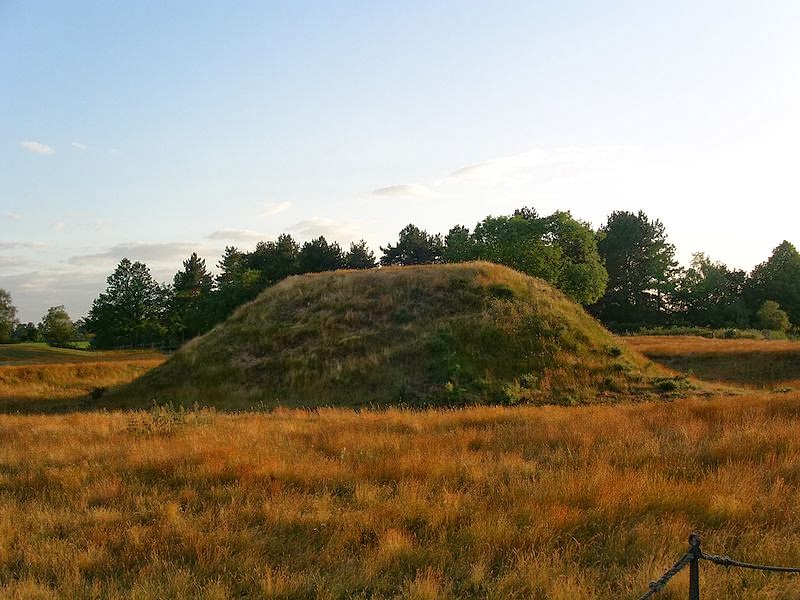
Burial mound at Sutton Hoo, from wikipedia

Inexplicably, few artists seem to have depicted the story of Hervör, so the illustrations in this post are Arthur Rackham's Brynhildr (another awakened inhabitant of a fiery earth-mound), and then mist after sunset on Oxford's own version of the Barrow-downs, Port Meadow. And finally, of course, one of the burial mounds at Sutton Hoo, which more than anywhere else I've ever been conveys the atmospheric power of this kind of landscape. Legend has it that the owner of the estate at Sutton Hoo decided to excavate the land after being told of a sighting of ghostly warriors riding around the mounds. That was in 1939; people have not stopped telling ghost stories about burial-mounds, or entering them in search of treasure.
Monday, 29 October 2012
'Page after page of jewels of mystical literature glow with this intimate and impassioned love...'
This morning I've been admiring the work of someone who is uploading the entirety of the Cloud of Unknowing on youtube - quite an undertaking! The text is Evelyn Underhill's 1922 'translation' of the Cloud, which is not really a translation at all - it's very close indeed to the Middle English (a strategy I thoroughly approve of). Find it here, and enjoy.
While we're on the subject of medieval mystics, I don't think I've yet linked here to my own reading of a short extract from Julian of Norwich - which is definitely in Middle English, or as close as I could manage... It's not brilliant, but somebody might find it interesting.
And this related video is good too: 'The mystic is "in love with the Absolute" not in any idle or sentimental manner, but in that deep and vital sense which presses forward at all costs and through all dangers towards union with the object beloved...'
While we're on the subject of medieval mystics, I don't think I've yet linked here to my own reading of a short extract from Julian of Norwich - which is definitely in Middle English, or as close as I could manage... It's not brilliant, but somebody might find it interesting.
And this related video is good too: 'The mystic is "in love with the Absolute" not in any idle or sentimental manner, but in that deep and vital sense which presses forward at all costs and through all dangers towards union with the object beloved...'
Sunday, 28 October 2012
'O dull cold northern sky'
Robert Louis Stevenson, in autumnal mood.

O dull cold northern sky,
O brawling sabbath bells,
O feebly twittering Autumn bird that tells
The year is like to die!
O still, spoiled trees, O city ways,
O sun desired in vain,
O dread presentiment of coming rain
That cloys the sullen days!
Thee, heart of mine, I greet.
In what hard mountain pass
Striv'st thou? In what importunate morass
Sink now thy weary feet?
Thou run'st a hopeless race
To win despair. No crown
Awaits success, but leaden gods look down
On thee, with evil face.
And those that would befriend
And cherish thy defeat,
With angry welcome shall turn sour the sweet
Home-coming of the end.
Yea, those that offer praise
To idleness, shall yet
Insult thee, coming glorious in the sweat
Of honourable ways.

O dull cold northern sky,
O brawling sabbath bells,
O feebly twittering Autumn bird that tells
The year is like to die!
O still, spoiled trees, O city ways,
O sun desired in vain,
O dread presentiment of coming rain
That cloys the sullen days!
Thee, heart of mine, I greet.
In what hard mountain pass
Striv'st thou? In what importunate morass
Sink now thy weary feet?
Thou run'st a hopeless race
To win despair. No crown
Awaits success, but leaden gods look down
On thee, with evil face.
And those that would befriend
And cherish thy defeat,
With angry welcome shall turn sour the sweet
Home-coming of the end.
Yea, those that offer praise
To idleness, shall yet
Insult thee, coming glorious in the sweat
Of honourable ways.
Sunday Music
I was charmed to come across this video yesterday:
I posted about Sam Lee's version of 'Puck's Song' a while ago, and you can now hear it on youtube here. Do read the Guardian article which accompanies the video, too, if only to be reminded of the tantalising strangeness of 'The Bitter Withy' - a folk song based on a medieval legend based on apocryphal gospels about the childhood of Christ (did you follow that? It's explained better here).
Gypsy songs are close to my heart, because my father's father (whom I never met) was from a Romany family. He was born in a caravan in a field in Buckinghamshire, as all his family were, as far as I can trace; he settled down in a house for a while when he married my grandmother, but disappeared into the night when his youngest child was four years old, never to return. Thus, all I know about his family comes from my own research with birth certificates and census records - although they did their best to avoid such things! - rather than personal knowledge. I can't think very kindly of him for the way he left his wife and children, but nonetheless there's a part of me that yearns after all things gypsy, and wonders what in me would be different without that genetic strain. In almost every way my life couldn't be more different from my grandfather's: just about the only thing I know about his character is that although he was illiterate, he used to carry a newspaper around under his arm; and now here's me, a creature of books and libraries, essentially a professional reader. His family had been travelling around the Oxfordshire/Buckinghamshire countryside for generations - how bizarre it would have seemed to them that their grandchildren should be studying at Oxford University, not camping at the gates but inside the walls.
Anyway, that video reminded me about this:
The singer is Sheila Smith, a gypsy girl who was seven years old when this was recorded in 1952. It's just extraordinary.
I posted about Sam Lee's version of 'Puck's Song' a while ago, and you can now hear it on youtube here. Do read the Guardian article which accompanies the video, too, if only to be reminded of the tantalising strangeness of 'The Bitter Withy' - a folk song based on a medieval legend based on apocryphal gospels about the childhood of Christ (did you follow that? It's explained better here).
Gypsy songs are close to my heart, because my father's father (whom I never met) was from a Romany family. He was born in a caravan in a field in Buckinghamshire, as all his family were, as far as I can trace; he settled down in a house for a while when he married my grandmother, but disappeared into the night when his youngest child was four years old, never to return. Thus, all I know about his family comes from my own research with birth certificates and census records - although they did their best to avoid such things! - rather than personal knowledge. I can't think very kindly of him for the way he left his wife and children, but nonetheless there's a part of me that yearns after all things gypsy, and wonders what in me would be different without that genetic strain. In almost every way my life couldn't be more different from my grandfather's: just about the only thing I know about his character is that although he was illiterate, he used to carry a newspaper around under his arm; and now here's me, a creature of books and libraries, essentially a professional reader. His family had been travelling around the Oxfordshire/Buckinghamshire countryside for generations - how bizarre it would have seemed to them that their grandchildren should be studying at Oxford University, not camping at the gates but inside the walls.
Anyway, that video reminded me about this:
The singer is Sheila Smith, a gypsy girl who was seven years old when this was recorded in 1952. It's just extraordinary.
Subscribe to:
Posts (Atom)