I went to Winchester recently, which as the capital of Anglo-Saxon Wessex and one-time capital of England is, unsurprisingly, full to bursting with memorials to medieval people. This was fun for me. I took lots of pictures, and here is a wander through some of them.
We can't start without the most famous memorial:

Good old Alfred the Great. Winchester was his capital, and he is naturally very prominent here (this statue is in the marketplace, in the middle of a traffic island). I am totally onboard with this, because who doesn't love Alfred the Great?

Here he is in the cathedral, just above one of the doors on the west side. His palace was about twenty feet away, though in Alfred's time there was no cathedral: there was instead the great
Old Minster, and a little way away
Nunnaminster, which was founded by Alfred and his wife Ealhswith. Alfred's son Edward the Elder founded the
New Minster, which was later to move outside the city and become
Hyde Abbey (more on that in a little while). The religious houses of Winchester, not to mention the royal palace, were thus packed as tightly together within the city as Oxford colleges or the buildings of Westminster today; and this was the Anglo-Saxon equivalent, a hub of political and religious power.
The Old and New Minsters were supposedly so close together that the competing singing of the two groups of monks made a discordant racket; but then
the Normans pulled down the Old Minster and built the Cathedral on top, so it's quiet enough today...

Just across from Alfred and his turquoise stockings is Ethelbert, equally colourful in yellow and blue, and carrying a formidable sword. There were some other Saxon kings between them, but the doorway covered up their names/ruined my pictures.

Right at the other end of the cathedral is this splendid chapel. The reredos is a memorial to Charlotte Yonge (hurrah!) and very nice it is too - an Annunciation scene, which I'll post about another time. Above it is a window which shows a number of kings, queens, bishops and assorted benefactors of Winchester.


This is
Cynegils, one of the very earliest kings of Wessex, wearing perhaps the least likely regalia one could possibly dream up for a seventh-century king, but with a good resolute kind of face. One of the things Cynegils is famous for (at least in my part of the world) is being baptised by St Birinus in the River Thame, near Dorchester, in c.635. However, the bishop shown with him here is not Birinus (we'll come to him in a bit) but
Thomas Langton, who was bishop of Winchester before he became Archbishop of Canterbury (for five days), and who lived nearly a thousand years after Cynegils.

Next to him is Alfred again, of course, carrying a book which I think is supposed to be some representation of the phrase 'England's darling' (it looks like 'Leofs Angliae', which is neither Latin nor Old English as far as I can see!). Alfred is first called 'England's darling' in the twelfth-century
Proverbs of Alfred, whose misattribution to Alfred is itself testimony to his lasting reputation in England. He is here keeping company with Bishop
William of Wykeham, founder of Winchester College and of New College, Oxford. I think he and Alfred the educator probably would have found some common ground.

These two, perhaps not so much! On the right is Edward the Confessor, whom we have encounted before in stained glass many times; but on the left is Cnut, looking less like a Viking than anyone I have ever seen. I wonder if this is the only stained glass Cnut in the country (we might compare it to
this depiction of his Norwegian rival Olaf Haraldson over in Suffolk. I googled 'stained glass Cnut' but most of the results were from this blog, so I guess I've cornered the market on this one). Winchester was Cnut's capital too - the capital of a pan-Scandinavian empire - and he was lavishly generous to the churches of Winchester (as well as many other places in England);
this famous and beautiful depiction of his generosity was produced at the New Minster, a stone's throw away from this spot. He was of course Edward the Confessor's stepfather, though they probably never met; here they have matching beards, which gives them, in posterity, more in common than they ever had in life.

On the other side of Cnut is Queen Victoria - a splendid depiction, but equally odd company for him!
Most English churches bear witness to some horrible acts of desecration, at various periods; and Winchester is no exception. Due to its political importance, it was almost a 'royal mausoleum' in the late Anglo-Saxon and early Norman period; besides Cynegils and other early kings of Wessex, Cnut, his wife Emma and their son Harthacnut were all buried here, as was William Rufus after the Conquest, as well as numerous saintly bishops (the most famous being St Swithun, and poor
Stigand) and non-royal luminaries like Earl Godwin. But on 14th December, 1642, Parliamentarian soldiers marched into the cathedral, broke open these tombs, and scattered their contents across the floor of the quire. The bones, mixed up together, were gathered up and are now in mortuary chests like this one:

This is the one with Cnut's name on it, but who knows whose body it contains. I've spent this whole term and a good part of the past three years with Cnut, so I am very fond of him, and this makes me sad. I know they're only bones, but still... However, it is a little better than what happened to Alfred the Great, who was buried at the New Minster: after his body was transferred to Hyde Abbey when the house was refounded, the site of his grave was lost at the Reformation.

This is what remains of Hyde Abbey - the gatehouse.
Another casualty of the Reformation (we really should stop calling it that) was the great reredos of the cathedral, above the high altar. It was repopulated with statues in the nineteenth century, which are very nicely done. I couldn't get many decent photographs of them - too dark and far away - but that's never stopped me posting my photos before, so here are the least bad/my favourites.

Here's Cnut, with a bit of a swagger.

This is Queen Emma, wife to Ethelred and Cnut, mother of Edward the Confessor and Harthacnut, patron of the invaluable
Encomium Emmae Reginae, etc. She lived in Winchester after Cnut's death, right up until the 1050s, and she was a generous benefactor of religious houses (she gave the head of St Valentine to the New Minster!); so she certainly deserves her place here.

This is her son Edward the Confessor. You'd think they wouldn't like him much at Winchester, since it was mostly because of him that the capital of England moved, eventually, to London, but perhaps they've got over it in the past 1000 years. I like this depiction of him - not too old, as he sometimes is, and somehow elegant.

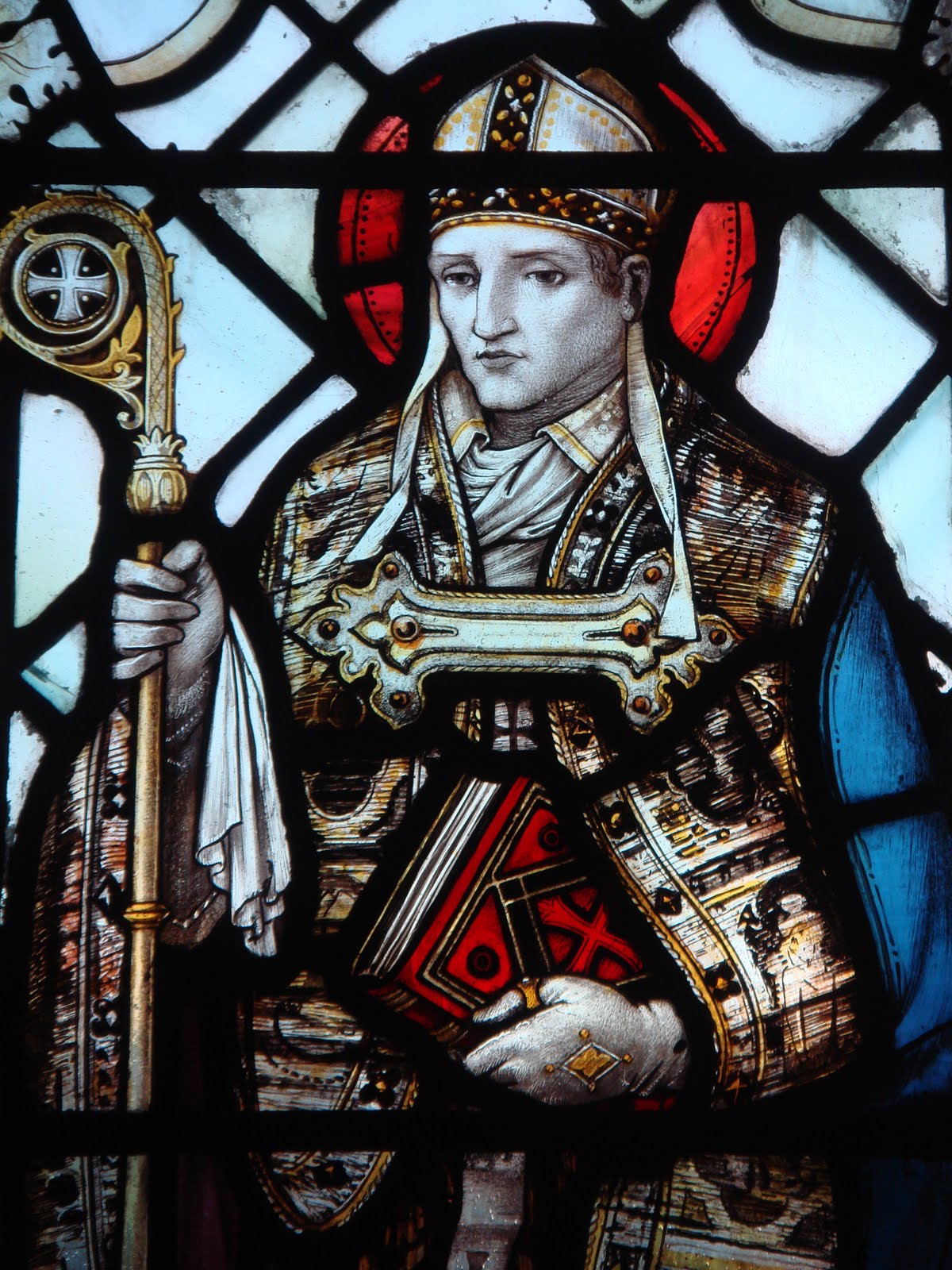
This is St
Birinus - I said we'd get to him. I missed his feast-day this year but he's an important saint to Oxfordshire and important to me personally; I must post about him properly some day.

And I had to include this, because it's Godwin, who choked to death (maybe) at Winchester in 1053 after (maybe)
lying about his part in the murder of Edward the Confessor's brother. He was buried at Winchester but doesn't even seem to have made it into the mortuary chests - "perished as though he had never been", for all his greatness. No wonder he looks pensive.

This is St Edmund of East Anglia, deserving of a place of honour anywhere (compare
these depictions). He is also to be found in stained glass elsewhere in the cathedral, not far from the grave of Jane Austen (hurrah!):

Those are some scary-looking arrows! Next to him is King Oswald of Northumbria, with a very odd beard but a beautiful cross:

Oswald, the English Constantine, played an important role in Cynegils agreeing to be baptised by Birinus, and the coming of Christianity to Wessex (he stood godfather to Cynegils), so he deserves some credit in Wessex's great cathedral.

And another Northumbrian features in the window commemorating Isaac Walton -
St Wilfrid.
That's all for the cathedral. Having now exhausted the patience of even my most loyal readers, I shall proceed entirely for my own amusement ;)

Here's St Swithun, from the tiny, delightful church of
St-Swithun-upon-Kingsgate, which is literally a room above a gate in the city wall.

And next to him in the same window is the great Bishop of Winchester,
Æthelwold, one of the leaders of the tenth-century Benedictine Revival.
One more Alfred the Great:

This is from the church of St Bartholomew, near the site of Hyde Abbey, part of which was built using stone from the abbey. It's a pretty church:

And here's a larger view of this Alfred, so you can see his rather striking cross-gartered stockings, not to mention that Saxon child's plaits.

I have no idea whether Anglo-Saxon kings really did wear cross-garters, but modern artists always have them dressed that way (I note that Cnut isn't wearing them in the New Minster
Liber Vitae picture linked above, but then, he was a Dane, and their fashion sense is often remarked upon disdainfully by medieval English writers...).
Either way, they certainly didn't have heraldic shields, and so the 19th-century refurbishers of Winchester's Great Hall invented some for them. This is Alfred's:

Tasteful, but a little dull, compared to what Harthacnut gets:

I guess that's almost a raven banner...

Cnut has some mythical beasts (four for his four kingdoms, perhaps?) and Edward the Confessor of course has these birds:

Godwin's is pretty cool, like a lot of Rubik's cubes:

And Harold Godwinson has some lionheads:

Probably could have done with those at Hastings, Harold.
Even
Waltheof has a crest:

He was executed in Winchester in 1076, though this was the only reference to him I could find anywhere in the city. Poor Waltheof - at least he got a crest.
From Waltheof, historical but the stuff of legend, we pass to the, er, legendary:

Guy of Warwick is
not real, but that didn't stop the Victorian medievalists. Neither is Bevis of Hamtoun, and yet:

I suppose he was a local man, from Southampton - and Guy did some great deeds in Winchester, though himself an Oxfordshire boy. But if I were going to design a crest for Bevis, I'd at least put his awesome super-horse on it, not lions and a nightcap. Sheesh. And Guy could have his dragon, and the Danish giant he supposedly slew out on Hyde Meadow, where the leisure centre now is.
The Great Hall really is medieval, but it sort of feels like medieval fantasy due to the Victorian stained glass and this:

By most standards this replica of the Round Table would be very old (it dates to c.1275!) but somehow in this context, and in the light of all Winchester's Anglo-Saxon and Anglo-Danish history, it felt very modern indeed.


 Jane Austen's father George was also buried in the churchyard in 1805. The church was rebuilt in 1777, and in 1828 my own great-great-great-great-grandparents were married there.