Saturday, 19 January 2013

Wulfstan's Worcester

For the past two years on this date I've written at some length about Wulfstan of Worcester, the Anglo-Saxon bishop who survived the Norman Conquest and whose feast is today.  He's an intriguing figure: there are lots of delightful stories about him, and I collected my favourites here.

I have no more stories to share right now, but I do have pictures, from a visit a few days ago to Wulfstan's cathedral at Worcester. Worcester is full of interesting things (it describes itself as "possibly the most interesting of all England's Cathedrals", a claim which made me raise an eyebrow before I went there - there's such a lot of competition! - but I may now have been convinced...) Not the least of its charms is that Wulfstan and its other Anglo-Saxon saints are highly honoured pretty much all over the cathedral - from the guidebooks to the stained glass. This always makes me happy - it makes a visit like a game of 'spot the Anglo-Saxon', and regular readers will know how much I enjoy that.

It was a misty day when I arrived at Worcester, but the sun was beginning to shine:


That brooding statue is Edward Elgar, and we'll get to him in a minute. Let's have a few more photographs of the cathedral in the morning mist:


By the time St Wulfstan came to Worcester there had already been a cathedral here for several centuries. The see was established in 679 or 680, in the days when Worcester was part of the kingdom of the Hwicce. This is a little less than a hundred years after the arrival of St Augustine in Kent, and about twenty years after the Synod of Whitby; from the first, both Canterbury and Whitby were involved in the new diocese at Worcester. The first man chosen as bishop, Tatfrith, had been a pupil of Abbess Hilda at Whitby, but he died before he could be consecrated; he was replaced by Bosel, who was bishop for ten years or so before ill-health forced him to step down, and he was replaced by Oftfor, another former pupil of Hilda's and of the learned Theodore of Tarsus, eighth Archbishop of Canterbury.

And after Oftfor, we get to Egwin - the one with the fish. (The fish story, short version: in penance Egwin shackled himself and threw the key in the river; then he walked in chains to Rome, and when he got there he was brought a fish which had been caught in the Tiber - with the key to his chains miraculously inside it. This makes Egwin particularly memorable, and I talked about him in my post about Evesham.)

After St Egwin, who died in 717, the next famous bishops of Worcester came along in the second half of the tenth century, beginning with St Dunstan. Dunstan was only Bishop of Worcester for two years (from 957-959); he became Archbishop of Canterbury in 960. But his successor, Oswald (the grandson of a Viking), held the see for thirty years, part of the time while also being Archbishop of York. Oswald and Dunstan, with Bishop Æthelwold of Winchester, were the three great churchmen of tenth-century England. They founded or reformed a large number of monasteries, including Worcester - under Oswald, Worcester became a community of Benedictine monks rather than secular clergy, and it remained so until the Reformation. (Wikipedia tells me the monks of Worcester were driven out on 18 January 1540 - the eve of St Wulfstan's day. What a day for it all to come to an end!)

Among other things, Oswald was famous for his custom of washing the feet of the poor every day during Lent (as is now done on Maundy Thursday). He died on February 29 in the year 992, having just arisen from this foot-washing. From the first he was regarded as a saint, and a number of early lives were written about him. That he was well-remembered at Worcester is suggested by Wulfstan's reaction when he was responsible for knocking down the church Oswald had built for his monks:
When the bigger church, which he had himself started from the foundations, had grown large enough for the monks to move across to it, the word was given for the old church, the work of St Oswald, to be stripped of its roof and demolished. Wulfstan stood there in the open air to watch, and could not keep back his tears. His friends mildly reproved him: he should rather rejoice that in his lifetime so much honour had accrued to the church that the increased number of monks made larger dwellings necessary. He replied: “My view is quite different. We unfortunates are destroying the works of saints in order to win praise for ourselves. In that happy age men were incapable of building for display; their way was to sacrifice themselves to God under any sort of roof, and to encourage their subjects to follow their example. But we strive to pile up stones while neglecting souls."
William of Malmesbury, Gesta Pontificum Anglorum, ed. and trans. Michael Winterbottom and R. M. Thomson, Oxford Medieval Texts (Oxford, 2007), vol.1, pp.437-9.

St Oswald is almost as prominent at Worcester as Wulfstan is, and we'll see lots of him in this post.

Inside the cathedral:


Before I say anything else, I want to show you this window:


It's just the most wonderful thing, and I would love it even if it didn't contain so many of my favourite medieval people. It dates to 1937, and was designed by Geoffrey Webb and given by Frederick Goodman, 'a Worcester native and for many years Archdeacon of Arctic Alaska'. The design is based on the idea of Christ as the true vine, growing out of the Annunciation at the bottom, and with two 'garden' scenes on either side - the expulsion from Eden and Christ meeting Mary Magdalen after the Resurrection. It's worth looking at every part individually. Here are the three lowest scenes, beginning with the expulsion from Eden (look at the angel's wings!):


The Annunciation:


The text at the bottom is from the Song of Songs, 4:16: 'perfla hortum meum, et fluant aromata illius', '[Awake, O north wind, and come, thou south,] blow upon my garden, that the spices thereof may flow out'. The thick trunk of the vine emerges from the delicate lily, and there are little snowdrops too, and a trinity of purple flowers.

And Christ with Mary Magdalen (note the birds swooping around him):


Then in the centre of the window, Christ:


To his right:


In keeping with the tree theme, there are birds and squirrels and other things running all over this window, as here:


St Peter has a squirrel:


(Compare to the squirrel at Evesham!) Bosel's cathedral was dedicated to St Peter, and Oswald's to the Virgin, which is why the two saints are combined here.

The upper part of the window contains the saints who were particularly important in the medieval history of Worcester. Thus, the vine grows through St Benedict, for the sake of Oswald and his Benedictine monks:


Benedict's raven, though one of his regular attributes, fits well with the bird theme here.


That blue is just so beautiful.

Next to Benedict is Theodore of Tarsus (though he doesn't look very Greek!), holding a book to remind us of his famous learning, and determinedly ignoring whatever animal is gnawing at his part of the vine.


On the other side of Benedict is St Hilda, also with a book:


And a full-length shot so you can see how lovely her robes are:


Above Hilda is St Egwin, with two birds (but no fish!):


This very much reminded me of Evesham, with the rounded flowers and gold-trimmed mitre, though he looks so young here!

Oswald, with his church, and a squirrel:


And Dunstan, with his tongs and devil!:


(The story of Dunstan and the devil can be found here).

And finally, right at the top, in pride of place, is Wulfstan:


The glorious thing about this window is that it's so colourful that its lights flood all the space around.


Directly opposite the window is the chantry chapel where young Prince Arthur, the eldest son of Henry VII, was buried in 1502, after his death at the age of fifteen. If you are up on your English monarchs, you will know that Arthur's early death changed the whole course of British history; if he had not died, Henry VIII might never have become king, and the Reformation might never have happened (or at least, have happened differently). There's something very poignant about the figures of these Saxon saints casting their bright lights over Arthur's tomb, when it was his death which brought about the greatest gap between our world and theirs:


This is inside the chantry chapel, which is a miracle of carved stone:


But much of it is as battered as this altarpiece:


This is the window reflected in the top of Prince Arthur's tomb. Below, it is reflected even more brightly in the brasses atop the tomb of one of Arthur's household, who was buried near the prince:


Arthur's is not the only royal tomb in the cathedral. Here, in front of the high altar, is where King John is buried, because he wanted to be near to (what were then) the tombs of Wulfstan and Oswald:


The tombs of medieval kings survived where medieval saints did not; but after the destruction of their tombs at the Reformation Wulfstan and Oswald were buried nearby, so they may still be around here somewhere.

A longer view:


Apart from the Goodman window, there are numerous other depictions of Wulfstan within his cathedral. Here he is in a thirteenth-century carving, in the north choir aisle, presenting his church to God:


I can't resist also posting these two carvings which were in the same place - the Annunciation and a wonderful Nativity:


The animals are keeping the baby warm, not trying to eat him...

Not far away there's another window which depicts Oswald and Wulfstan - I'd guess a nineteenth-century one:


Each has one scene below to illustrate his life - or rather, in Oswald's case, his death, with the ewer on one side for washing the feet of the poor:


The people behind him go on eating, oblivious to his sudden fall.


Wulfstan's scene depicts a remarkable moment from his legend: that after the Norman Conquest, when he was asked to resign as bishop, he stuck his staff into the tomb of Edward the Confessor. No one else could remove it, and by this miracle Wulfstan, like King Arthur, proved that he was the only man for the job.


The stained-glass Wulfstan casting his colourful light on Prince Arthur's tomb seems almost like a gentler manifestation of this story.

The Worcester saints also appear in this window, which is a memorial to Edward Elgar:


It's based on Newman's 'Dream of Gerontius'; the angels at the top are singing 'Praise to the Holiest in the Height'. And below are Worcester's saints and some musical people, Cecilia and Gregory (holding a bit of Gregorian chant):


And Egwin has a fish!

Finally, elsewhere, these must also be our two Saxon bishops too, though without any really distinguishing features:


Much as I enjoy spotting Anglo-Saxons in stained glass, the real place to find Wulfstan at Worcester is in the crypt. This is the most evocative remnant of the cathedral he built; almost everything above ground is later than Wulfstan, but this was begun with his new building in 1084, and the columns and their capitals date to his time:


Here, you are standing in an eleventh-century monastery. It was here when John of Worcester was writing his history, when Orderic Vitalis and William of Malmesbury came to visit Worcester's great library, when King John came to venerate Wulfstan, when Prince Arthur was buried; and now.


Not much later is the chapter house, begun in the early twelfth century, with its central column like a sinuous palm-tree:


So this is Worcester, Wulfstan's work.


And I'll close with more little stained-glass scenes from the cloisters, which look like this:


Look away now if you don't care about 'medieval people in stained glass'! For there are many. These windows are full of people and scenes from the history of English Christianity, arranged chronologically and loosely themed; this for instance depicts Northumbrian Christianity:


I like Lindisfarne in the bottom left-hand corner. Among other highlights of Anglo-Saxon history, there's Bede:


Here are Bosel, Egwin, and the kings who supported them:


(The kings are Æthelred of Mercia and Osric, king of the Hwicce.) And Oftfor preaching to some Saxon children, I assume:


Click to enlarge and see the rather lovely crucifix...

In my second post on Evesham's stained glass we saw a variety of depictions of the vision of the swineherd Eof, which led to the founding of Evesham, and there was one here too:


A pleasingly ghostly vision, but not quite as nice as the version in St Lawrence's, Evesham.

There's a whole series about Alfred the Great, but I'll just show you the scene which depicts the Treaty of Wedmore, the peace-treaty Alfred made with the Danish army in 878. Thus, it shows a Viking (Guthrum), complete with horned helmet - always a fun thing to come across in a stained-glass window:
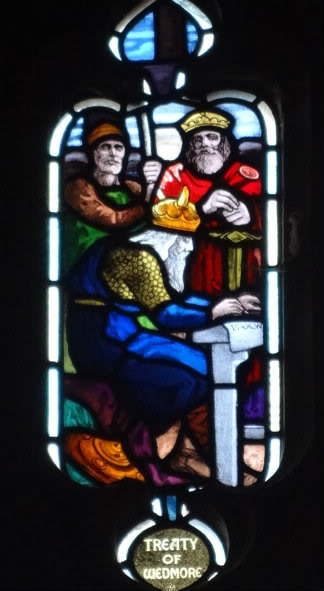

Guthrum appears to be signing the treaty, which is historically dubious, but then so are Vikings in horned helmets...

Dunstan and Oswald:


Scenes from the life of Oswald - first his early visit to Fleury, where he learned about monasticism, and with his supporter Æthelwine:


The architecture of Fleury is particularly nice in the background.

This is Oswald installing Winsin as first prior of Worcester, i.e. the establishment of the monastery, and the coronation of King Edgar:


Dunstan and King Edmund at Glastonbury (Dunstan's monastery), and Oswald building at Worcester:


And Oswald's death, while washing feet:


King Edgar and a rather scary-looking Bishop Æthelwold:


Oswald and Wulfstan, both holding their churches:


With this we move on the eleventh century - Edward the Confessor, looking unusually youthful, and William the Conqueror looking, well, like a conquering hero:


Wulfstan with Lanfranc (there was no sign of Anselm, which is a shame - he, not Lanfranc, was the one who respected Wulfstan and sought his opinion as "the one sole survivor of the old fathers of the English people", according to Eadmer):


Wulfstan building Worcester Cathedral, and the incident with Edward the Confessor's tomb:


(Turquoise vestments, Wulfstan?)

Wulfstan doing general saintly things:


Wulfstan with Harold Godwinson, who was a friend of his:


I don't know why Harold looks so cheerful; he didn't have much cause to be that happy at any time in his short reign!  Some time after Harold's death at Hastings, Wulfstan healed his (fascinatingly rebellious) daughter Gunnhild of a tumour, out of his old affection for her father.

And here's Wulfstan with Lady Godiva (Godgifu), a pious and perfectly respectable Saxon noblewoman, who was a benefactor of Evesham and another of Wulfstan's friends:


Moving on a little, we have the canonisation of Wulfstan in 1203 (William of Malmesbury thought his canonisation shockingly delayed) and King John at Wulfstan's tomb:


Henry II and Thomas Becket:


Thomas Becket's murder, and Henry II receiving his penance for it:


This doesn't have anything to do with Worcester as far as I know, but I'm always interested in depictions of Becket.

Edward I at Wulfstan's tomb:


And some literary figures, just for fun - Chaucer and Wycliffe:


I've never seen an image of Chaucer where he doesn't look vaguely sceptical, and so it is here...

Langland (who was a Worcestershire man, and so deserves his place):


William Caxton:


I liked this depiction of the cathedral:


And this tribute to the Book of Common Prayer:


Then there were various 17th- and 18th-century people, until we come to Reginald Heber:


He doesn't have any Worcestershire connections, as far as I know, but I like his hymns, so I took a photo.

The last window (we've now reached the third side of the cloisters) turns to the Victorians, with Queen Victoria and Prince Albert:


And Charles Dickens, who appears to be acting out a scene from Oliver Twist:


I didn't really mean to end with Charles Dickens, who again has nothing to do with Worcester.  So here's the last I saw of the cathedral, sunset over the town, from a train:

Tuesday, 15 January 2013

'To all that love the far and blue'

To all that love the far and blue:
Whether, from dawn to eve, on foot
The fleeing corners ye pursue,
Nor weary of the vain pursuit;
Or whether down the singing stream,
Paddle in hand, jocund ye shoot,
To splash beside the splashing bream
Or anchor by the willow root:

Or, bolder, from the narrow shore
Put forth, that cedar ark to steer,
Among the seabirds and the roar
Of the great sea, profound and clear;
Or, lastly if in heart ye roam,
Not caring to do else, and hear,
Safe sitting by the fire at home,
Footfalls in Utah or Pamere:

Though long the way, though hard to bear
The sun and rain, the dust and dew;
Though still attainment and despair
Inter the old, despoil the new;
There shall at length, be sure, O friends,
Howe'er ye steer, whate'er ye do -
At length, and at the end of ends,
The golden city come in view.


My favourite thing about this poem is its evocative first line - Robert Louis Stevenson did write wonderful opening lines, as a quick perusal of this list will demonstrate!  I think it would be fair to say that this poem is in his most 'rare and fair romantic strain' (on which see 'In Praise of Story').  The last verse reminds me quite a bit of John Masefield's poem 'The Seekers', which also features a golden city and 'sun and rain, dust and dew' - but this poem is certain where Masefield's is only hopeful.  (Wikipedia tells me that Masefield was a admirer of Stevenson, so perhaps this is a case of direct influence, conscious or unconscious; exploration via Google could not provide me with exact dates for the publication of either poem).

Oh, and I don't know if I have any readers in Utah, but if so, I hope you appreciate it being namechecked here as an archetypal distant, exotic place...

Wednesday, 9 January 2013

Hostis Herodes impie: 'Thou cruel Herod, thou mortal enemy'


Two years ago I posted a medieval English translation of the Epiphany hymn 'Hostis Herodes impie' by the Franciscan friar William Herebert, and today I have another one to share. This is anonymous, and from the fifteenth century; it appears in British Library, MS. Additional 34193, the manuscript of English hymn translations from which I posted back in Advent.  You can read the text of the hymn and a useful list of later translations here.  This version is a bit more wordy than Herebert's translation, but the first verse is wonderfully dramatic.  I particularly like the lines 'The water clere that erst was cristallyne / As ruby red is changed in to wyne' - crystalline being one of those new-fangled Latinate words which fifteenth-century English poets loved so very much. And there's some interesting enjambment too, especially in the first and third verses.

Thow cruell herode, thow mortall enemye,
Of criste whi art þow ferd? whi dost thow drede
That he wyll put the frome thi regallye?
The hevynly kynge to thyng terrene no nede
May have; he yevyth hevinly mede;
He settyth not be þi mortall Empyre;
What eylyth the ayenst þis lord Conspire?

The kinges iii out of þo orient
In theyr iorney to gydyn and conveye
A ster aperyd, Ryght in the firmament;
Non soo bryght a for that tyme was seye,
So lyght by lyght deyvowtly sekyn they,
And madyn knolege in theyr offerynge
To mortall man, prest and heyvyne kynge.

The lawly lambe of hvmbyll innocence
To be baptized in the Streme fontall,
And purgen vs frome gylt & greet offence
Inclynyd hym; to no synne was he thralle;
Bot vs to wasshe and vs to clensyne all,
That with synne ne schuld be supprisyde,
Of Jon Baptyste in iordan was baptizede.

A novelty gestys for to glade
By power and mervelows myghte diuine
Of verry water verry wynne was made
The water clere that erst was cristallyne
As ruby reed is changed in to wyne;
Thys kyng of myght may byd hys creature
Aftyr hys wyll to changene hys natur.

To the lord that þis day apere,
Be yeuen lawde wyth praysyng and glorie,
In tymes reuolute frome yere to yere;
Thys solempe fest, thys blessyd Epyphany,
Off thyne aperance makyng memory;
We wyrshyp the fadyr of myghtes most,
Criste hys sone and eke the holy gost. Amen.


More readable:


Thou cruel Herod, thou mortal enemy,
Why art thou afraid of Christ? why dost thou dread
That he will put thee from thy royalty? [i.e. royal place]
The heavenly king for earthly thing no need
May have; he giveth heavenly mede; [reward]
He careth not for thy mortal empire;
Why trouble thee against this lord to conspire?

The kings three out of the orient
In their journey to guide and to convey
A star appeared, right in the firmament;
None so bright a path at any time saw they!
So light by light devoutly seek they,
And made acknowledgement in their offering
To mortal man, priest and heavenly king.

The lowly lamb of humble innocence
To be baptised in the stream fontal,
And purge us from guilt & great offence
Inclined himself; to no sin was he thrall;
But us to wash and us to cleanse all,
That we with sin should never be supprisyde, [overcome]
By John Baptist in Jordan he was baptised.

A new deed to inspire a tale,
By power and marvellous might divine
Of true water true wine was made:
The water clear which first was crystalline,
Now ruby red is changed into wine;
This king of power can bid his creature
According to his will to change its nature.

To the lord who this day doth appear,
Be given laud with praise and glory,
In proper time, from year to year;
This solemn feast, this blessed Epiphany,
Of thine appearance making memory; [i.e. recalling]
We worship the Father of mights most, [greatest in power]
Christ his son, and eke the Holy Ghost. Amen.

Sunday, 6 January 2013

'Now lords and ladies in rich array, lift up your hearts upon this day'


Be merry, all that be present:
Omnes de Saba venient.

1. Out of the east a star shone bright,
For to show three kinges light,
Who had far travelled by day and night
To seek that Lord that all hath sent.

2. Thereof heard King Herod anon,
That three kings should come through his region,
To seek a child that peer had none,
And after them soon he sent.

3. King Herod cried to them on high,
‘Ye go to seek a child truly;
Go forth and come again me by,
And tell me where that he is lent.’ [laid]

4. Forth they went by the star's gleam,
Till they came to merry Bethlehem;
There they found that sweet barn-teme, [infant]
That since for us his blood hath spent.

5. Balthasar kneeled first adown
And said: 'Hail, King, most of renown!
And of all kings thou bearest the crown;
Therefore with gold I thee present.’

6. Melchoir kneeled down in that stede [place]
And said, ‘Hail, Lord, in thy priesthood!
Receive incense for thy manhood,
I bring it with a good entent.’

7. Jasper kneeled down in that stede
And said, ‘Hail, Lord, in thy knighthood,
I offer thee myrrh to thy Godhead,
For thou art he that all hath sent.’

8. Now lords and ladies in rich array,
Lift up your hearts upon this day,
And ever to God let us pray,
That on the rood was rent.


This carol is from the sixteenth-century manuscript Balliol College, Oxford MS. 354 (the commonplace book of Richard Hill); the burden, 'Omnes de Saba venient' comes from a Versicle in Vespers for the Eve of Epiphany.


Be mery, all that be present:
Omnes de Saba venient.

1. Owt of the est a sterre shon bright,
For to shew thre kinges light,
Which had ferre traveled by day and nyght
To seke that Lord that all hath sent.

2. Thereof hard King Herode anon,
That iii kynges shuld cum thorow his regyon,
To seke a child that pere had non,
And after them sone he sent.

3. Kyng Herode cried to them on hye,
‘Ye go to seke a child truly;
Go forth and cum agayn me by,
And tell me wher that he is lent.’

4. Forth they went by the sterres leme,
Till they com to mery Bethlehem;
There they fond that swet barn-teme,
That sith for vs his blode hath spent.

5. Balthasar kneled first adown
And said: ‘Hayll, Kyng, most of renown!
And of all kynges thou berist the crown;
Therefor with gold I the present.’

6. Melchoir kneled down in that stede
And said, ‘Hayll, Lord, in thy pryesthede!
Receyve encence to thy manhede,
I brynge it with a good entent.’

7. Jasper kneled down in that stede
And said, ‘Hayll, Lord, in thy knyghthede,
I offer the myrre to thy Godhede,
For thow art he that all hath sent.’

8. Now lords and ladys in riche aray,
Lyfte vp your hartes vpon this day,
And ever to God lett vs pray,
That on the rode was rent.

Saturday, 5 January 2013

King Herod and the Cock

I've posted before about some of the fascinating legends about the childhood of Christ which from the early days of Christianity have existed side-by-side with the Biblical narratives - and here's an Epiphany-themed one. This is a carol about the visit of the Magi to Herod, which features a miracle story also found in medieval legend: a roasted bird on the dinner-table comes back to life to crow, proving the truth of the wise men's story.

Resurrecting cooked animals is an unexpected but not uncommon power among medieval holy people; compare St Werburgh of Chester and her goose, and, well, Thor...

'King Herod and the Cock' was collected by Cecil Sharp from a lady called Mrs Ellen Plumb, at Armscote in Worcestershire, on 13 April 1911.  Isn't it extraordinary to think of this ancient carol still being sung on the eve of the First World War?  In the video below, it's sung by Belshazzar's Feast (beginning at 1:20):


1. There was a star in David's land,
So bright it did appear
Into King Herod's chamber,
And brightly it shined there.

2. The Wise Men soon espied it,
And told the king on high
A princely babe was born that night,
No king could e'er destroy.

3. 'If this be true,' King Herod said,
'As thou hast told to me,
This roasted cock that lies in the dish
Shall crow full fences three.'

4. O the cock soon thrustened and feathered well,
By the work of God's own hand,
And he did crow full fences three
In the dish where he did stand.

'My hill was further'

This season, towards Epiphany, makes me think about poems of journeying and pilgrimage, such as John Masefield's 'The Seekers', or Rupert Brooke's 'The Song of the Pilgrims'. So this is George Herbert's poem 'The Pilgrimage'.


I travell'd on, seeing the hill, where lay
My expectation.
A long it was and weary way.
The gloomy cave of Desperation
I left on th'one, and on the other side
The rock of Pride.

And so I came to Phansies medow strow'd
With many a flower:
Fair would I here have made abode,
But I was quicken'd by my houre.
So to Cares cops I came, and there got through
With much ado.

That led me to the wilde of Passion, which
Some call the wold;
A wasted place, but sometimes rich.
Here I was robb'd of all my gold,
Save one good Angell, which a friend had ti'd
Close to my side.

At length I got unto the gladsome hill,
Where lay my hope,
Where lay my heart; and climbing still,
When I had gain'd the brow and top,
A lake of brackish waters on the ground
Was all I found.

With that abash'd and struck with many a sting
Of swarming fears,
I fell, and cry'd, Alas my King;
Can both the way and end be tears?
Yet taking heart I rose, and then perceiv'd
I was deceiv'd:

My hill was further: so I flung away,
Yet heard a crie
Just as I went, None goes that way
And lives: If that be all, said I,
After so foul a journey death is fair,
And but a chair.

Friday, 4 January 2013

Twelve Days of Carols, 10: The Anselm Carol

I appear to have fallen down rather badly on my planned twelve days of carols, but let's just move swiftly on and pretend we haven't noticed. This carol is by James Ryman, a Franciscan who lived in Canterbury in the late fifteenth century; he wrote a number of carols, including 'Farewell Advent'. That's a light-hearted, playful carol; today's is more learned, but this Christmas season I've come to appreciate just how interesting it is that no subject seems to have been thought too solemn or too arcane to be made into a carol (cf. the O Antiphons).


Ecce quod natura
mutat sua iura:
Virgo parit pura
Dei filium.


Behold and see how that nature
Changeth her law: a maiden pure
Shall bear a child (thus saith scripture),
Jesus, our Saviour.

Behold, the fleece of Gideon
Waxed wet, that no dew fell upon;
Behold, the rod of Aaron
Unmoisted bore a flower.

The prophet Isaiah saith thus:
"A maid shall bear a child to us
Whose name shall be called Jesus,
Our help and our succour.

A rod shall grow out of Jesse root
Whereof a flower shall ascend full sweet."
This flower is Christ, our health and bote,
This rod, Mary, his bower.

Saint Matthew saith in the gospel,
"A maid shall bear Emmanuel,
That is to say, God with us to dwell,
That lovely paramour."

Forsooth, to us is born a child;
A son is given to us full mild,
Of virgin Mary undefiled
To ease our great langour.

This is the stone cut of the hill,
Christ born of Mary us until, [unto]
Without sin in thought, deed, and will
To save us from dolour.

This child shall be the Prince of Peace,
Whose kingdom shall ever increase,
Whereof the peace shall never cease
But increase day and hour.

Saint Anselm saith, "So Christ did pass
Through Mary mild, as his will was,
As the sun-beam goeth through the glass,
That maid full of honour."

Ecce quod natura
mutat sua iura:
Virgo parit pura
Dei filium.


The Latin refrain is from a hymn, Ecce quod natura, but the verses aren't based on the hymn but on very common ideas and imagery about the incarnation - the Virgin as the fleece of Gideon and rod of Aaron, and the root of Jesse, of course. The image in the last verse, of Christ as the sunbeam passing through the glass, is also a very common simile, and one that I love (compare this carol, and this poem, and I posted about the idea in romance here), so I was delighted to see it attributed here to my beloved St Anselm. The attribution is not strictly accurate, in that the image doesn't appear in Anselm's works, but it was 'a simile much used in the school of Anselm', according to R. W. Southern; in the Middle Ages Anselm's name was strongly associated with arguments for the Immaculate Conception and the sinlessness of the Virgin (although mostly because of works wrongly attributed to him rather than his own writings, and particularly a treatise which was actually written by his English biographer Eadmer. The Immaculate Conception was in some ways a particularly Anglo-Saxon feast, celebrated in English monasteries before the Norman Conquest and subsequently suppressed for several generations; it was Eadmer's treatise and a Saxon abbot (Æthelsige) who were partly responsible for reinstating it.  You can read about it all at the Catholic Encyclopedia article.)

And so I can't help thinking of this as the 'Anselm Carol', though it really isn't at all.


The sun shining through the glass in the chapel where Anselm is buried, Canterbury Cathedral, December 2012


This is the unmodernised version of the carol, as found in Cambridge University Library MS. Ee 1.12, via Richard Greene, The Early English Carols, no.66:

Ecce quod natura
mutat sua iura:
Virgo parit pura
Dei filium.


Beholde and see how that nature
Chaungith here lawe: a mayden pure
Shalle bere a chielde (thus seith scripture),
Jhesus, oure savyour.

Beholde, the flease of Gedeon
Wexed wete, that no dewe fel on;
Beholde, the yerde of Aaron
Unmoysted bare a floure.

The prophete Isay seith thus:
"A mayde shall bere a childe to us
Whose name shall be called Jhesus,
Oure helpe and our socour.

"A yerde shall goo oute of Jesse rote
Wherof a floure shall ascende full soote."
This floure is Crist, oure helth and boote,
This yerde, Mary, his boure.

Seynt Mathew seith in the gospell,
"A mayde shall bere Emanuell,
That is to sey, God with us to dwell,
That lovely paramour."

Forsoth, to us is borne a chielde;
A sonne is yeven to us full myelde
Of virgyne Marie undefielde
To cease oure grete langoure.

This is the stone cutte of the hille,
Criste borne of Marie us untille
Without synne in thought, dede, and wille
To save us fro dolour.

This chielde shall be the Prince of Peas,
Whose kingdome shall ever encrease,
Wherof the peas shall nevir ceas
But encreace day and houre.

Seint Anselme seith, "So Criste did pas
Thurgh Marie myelde, as his wille was,
As the sonne beame goth thurgh the glas,
That mayde full of honoure."