Friday, 24 April 2009

Elham Valley 1


 I spent part of the Easter vacation seeking out medieval joys among the churches of the Elham valley. The week after Easter is the best time to visit churches, in my opinion, because they always smell of lilies.

The Elham valley is part of the North Downs, running some of the way between Canterbury and Folkestone. This makes the following altarpiece, in a side chapel in the church at Elham, particularly appropriate:


It's fifteenth-century, alabaster, and both the side panels shows scenes from the life of St Thomas Becket.


On the left, the dispute between Becket and Henry II (at the council in Northampton in 1164, I believe)...


...and on the right, Becket's murder.

Not many such pieces survive (I should say, not enough!) because so much was destroyed at the Reformation, but this escaped somehow.

Now I think about it, St Thomas Becket would make another excellent candidate for patron saint of England...


Anyway, Elham also has some medieval glass:


John the Baptist, obviously enough, with an inappropriately cute little lamb.

It also has some surprising Oxford glass:


Apparently Merton College was a benefactor, or something.

Another medieval... feature:


This is Elham church from the outside:


And one from the list of 'church joys' - an interesting porch:

Thursday, 23 April 2009

Rupert Brooke - more than just 'The Soldier'

Rupert Brooke died on this day in 1915.

Sonnet

Not with vain tears, when we're beyond the sun,

We'll beat on the substantial doors, nor tread
Those dusty high-roads of the aimless dead
Plaintive for Earth; but rather turn and run
Down some close-covered by-way of the air,
Some low sweet alley between wind and wind,
Stoop under faint gleams, thread the shadows, find
Some whispering ghost-forsaken nook, and there

Spend in pure converse our eternal day;
Think each in each, immediately wise;
Learn all we lacked before; hear, know and say
What this tumultuous body now denies;
And feel, who have laid our groping hands away;
And see, no longer blinded by our eyes.

Wednesday, 22 April 2009

An Anglo-Saxon Story of St George

Tomorrow is St George's Day. There are alternative claimants for the position of patron saint of England, and with my general preference for Anglo-Saxon saints, I have to admit I would rather see Edmund of East Anglia or Edward the Confessor as my country's patron; they both have prior claim, they were both really rather wonderful, and they definitely existed, too. Their only disadvantage is that their feastdays are in October and November, rather than sunny April. However, St George is what we have.

Ælfric included a life of St George in his Lives of Saints collection, a good three centuries before George became the patron saint of England. There are no dragons in his story; even if dragon-slaying had been part of the George legend in the late tenth century (which it wasn't) Ælfric doesn't generally go in for monsters. His version is a conventional passio, telling how George, a nobleman in Cappadocia, was persecuted for his faith and martyred for refusing to worship idols (Apollo, in fact, as Ælfric tells it). There is one excellent episode in the story, though, which stands out. When George remains unharmed by torture, the emperor thinks it must be magic, so he finds a sorceror who promises to defeat George's magic ('drycræft' - the 'dry' bit is somehow related to 'druid', I believe). Athanasius is the sorceror:

Athanasius ða ardlice genam
ænne mycelne bollan mid bealuwe afylled
and deoflum betæhte ðone drenc ealne
and sealde him drincan ac hit him ne derode

Athanasius then quickly took a large bowl, filled with deadly liquid, and dedicated all that drink to the devils, and gave it to [George] to drink, but it did not harm him.The sorceror tries again:

He genam ða ane cuppan mid cwealm-berum drence
and clypode swyðe to sweartum deoflum
and to ðam fyrmestum deoflum and to ðam ful strangum
and on heora naman begol þone gramlican drenc
sealde ða drincan þam drihtnes halgan
ac him naht ne derode se deofollica wæta

He took a cup filled with death-bearing drink and cried out to the black devils, and to the foremost devils, and to the powerful ones, and in their name he enchanted the terrible drink and gave it to the Lord's holy one to drink; but the devillish liquid did not harm him in the least.

Ælfric really gives those lines the sound of an incantation; it would be interesting to compare them to Old English charms. Is there meant to be a distinction between the black/foremost/powerful devils, or is it merely poetic variation? Either way, it has a resounding rhetorical flourish, and it's not like Ælfric to give the devil the best tunes.

The sorceror ends up converting to Christianity, by the way.

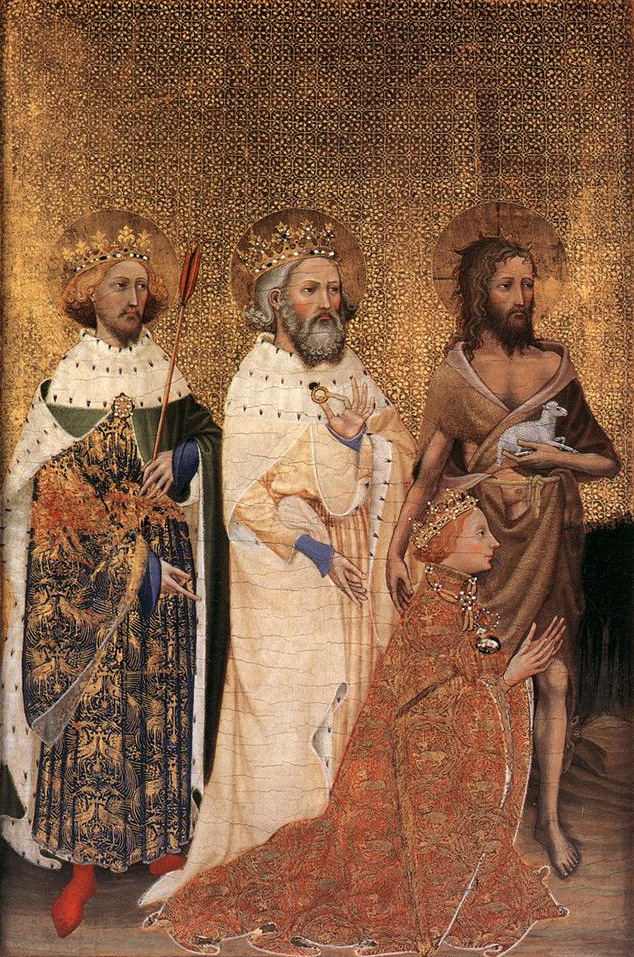
So St George... well, that's a pretty good story. And I'll admit that St George and the Dragon makes for excellent mummers' plays. But just look at these saints:

(Um, not Richard II, obviously).

More Memorials

Some more memorials from Elmsted church. If the window to Arthur Honywood which I wrote about a few days ago is a perfect example of Victorian idealism (and I mean that in the most genuine and admiring way possible) - a young man killed fighting bravely for Queen and Empire - the Honywood below is a paragon of an earlier century:

I like to believe that every word of a tribute like this one is true - because someone wanted it to be true, at least, and that means something. Just because a description is expressed in language which is resonant of its time, just because we might choose different words to praise a well-loved man, doesn't mean that such a memorial is not genuinely felt. "At a time when hospitality and simplicity of manners were giving way to fashion and refinement..." The opposition between 'hospitality' and 'fashion' is interesting. The contrast between 'simplicity' vs. 'refinement' is obvious enough, but that hospitality should be considered an old-fashioned, dying virtue strikes me as interesting.

"Others may have moved in a higher sphere, but no man ever contributed more to the advantage, comfort and happiness of the circle around him". Who wouldn't want such a lovely tribute?

The spelling and the lack of commas are also delightful. 'Experiened' must be a stone-carving example of eye-skip, I assume, caused by the similar shapes of 'c', 'e' and 'd' so close together?

Going back even further in time, this memorial to a daughter of a Honywood tells us a lot about family life in the seventeenth century, something about an ideal of womanhood ("in all hir actions grave and provident..."), and even a little about Early Modern spelling:
"in memory of home"is particularly interesting. But apart from all that, of course, there was a real woman and children and a loving husband, and without this we might not know... I think these things deserve to be read.

Monday, 20 April 2009

Blossom


This joyful little poem has been jangling around my head for the past few weeks:

'Loveliest of Trees'
A.E. Housman (St John's, 1877)

Loveliest of trees, the cherry now
Is hung with bloom along the bough,
And stands about the woodland ride
Wearing white for Eastertide.


Now, of my threescore years and ten,
Twenty will not come again,
And take from seventy years a score,
It only leaves me fifty more.


And since to look at things in bloom
Fifty springs are little room,
About the woodlands I will go
To see the cherry hung with snow.


The pictures were all taken on Easter Monday at Mount Ephraim Gardens in Kent. They're not all cherry trees but they are, like everything else in England this month, things in bloom.

Saturday, 18 April 2009

Joys of Churches

I love churches. Churches of all kinds, really, but especially little village churches which no one would think to visit, which have no special architectural or historical distinction in the grand sense. The closer you look, the more history you find, and the more it begins to seem important. Every stone speaks the soul of the place where it has stood for centuries, and yet there are always similarities and echoes of other places and other times; each church is individual, local, and at the same time belongs to everywhere.

There's probably a poem which expresses all that rather better, but I don't have one to hand at the moment. Instead, I have photographs. These are the fruits of a recent visit to the church of St James the Great in Elmsted, Kent. It's on the North Downs, between Canterbury and Folkestone. What are the joys of pretty churches?

Firstly, a view over the Downs - sheep and blossom:


Asymmetry:

Look at those windows! Apparently this three-part east end is typical of Kent churches (I can read guide books, you see) though I don't know if it's usual for it to be quite so mismatched...

What else? Churchyards, of course, have yew trees, hundreds of years old:


And dinky porches with little lamps, diamond windows, flint walls (now that is typical of Kent) and rather wonky wooden beams inside:


So much for the outside. Inside?

Light, stained golden:


The church is full of memorials to the Honywood family. The window below is in memory of Arthur Honywood, who died in 1880, aged 19, in Afghanistan while bearing the Queen's colours. The plaque underneath the window records that "When already badly wounded, he held the colours above his head and called on his men to rally with the words 'What shall we do to save these?'. The next moment the fatal shot came."


History, you see.

Friday, 17 April 2009

Spring

There comes a time when you just can't put any more pictures of Christ Church Meadow on facebook, lest your friends start to think you're obsessed, and stop reading your witty captions and clever anthropomorphic tags. This distressed me, for it seemed the end of all opportunity to share my photographic self-indulgence. Then I remembered that I had a blog (bear with me, I'm slow; I spend most of my time in the fourteenth century) where no one will see or care how many photos I post. And thus - look, daffodils!:


The Botanical Gardens:


Holywell Cemetery, my second favourite place to take the same photo over and over again (it's right next to the English Faculty! The temptation is just too much for me):


Lastly... well, I like this picture, because it made me think of medieval carvings of Eve and the Tree of Knowledge (note the long hair) - or perhaps it's Yggdrasil...


It would be better if the tree had, like, apples on it or something, or there were some deer around, but never mind.