Thursday, 7 April 2011

Stained Glass of Norwich

More modern memorials to medieval people, this time from Norwich.

There, as you would expect, they are very keen on Julian of Norwich. As she is my Lenten reading at the moment, I was totally on board with this. Here she is in a modern window from the rebuilt church of St Julian, on the site of the medieval church where she was an anchoress and from which she took her name, but which was sadly bombed in World War Two:

This window looks from the small side-chapel on the site of her anchorite's cell, through to the chancel. Anchorites used to have small windows looking in from their cells to the church so they could see Mass being said at the altar, and I suppose this window is roughly where Julian's would have been (though much bigger, I should think!). The text says, like everything else at this church which has become a shrine to her, 'All shall be well'.

She is also commemorated in a (very) modern life-size statue on the front of Norwich Cathedral, commissioned to celebrate the millennium. She and St Benedict together flank the west door, which probably would have horrified humble Julian.
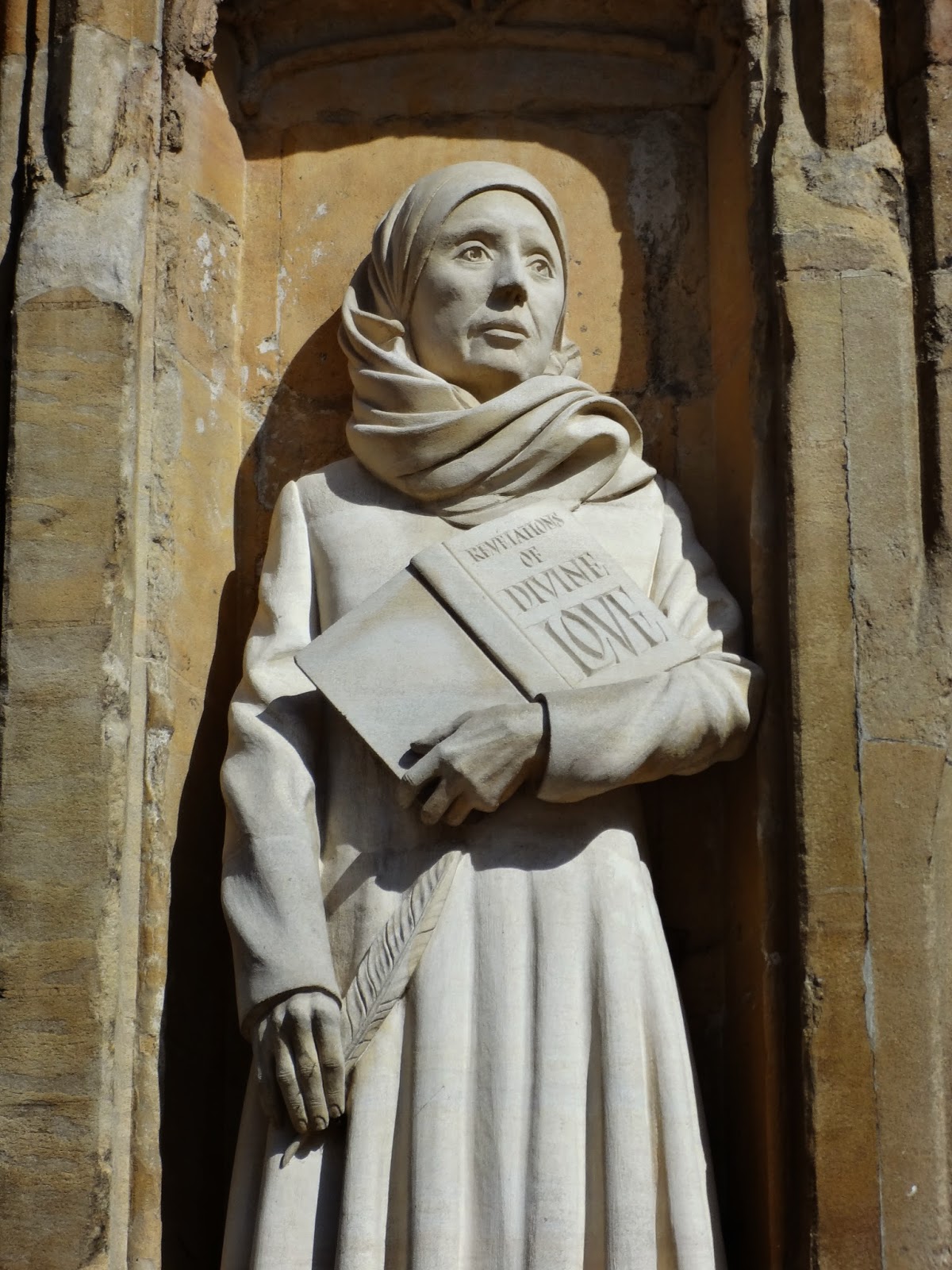


Here she is again, next to St Edmund, and complete with cat:


On the premise that some anchoresses had cats (it's in Ancrene Wisse, if I remember rightly).

Next to Edmund and Julian are two saints who brought Christianity to East Anglia, St Felix of Burgundy and St Fursey:

Fursey was an Irish monk who famously had visions of the afterlife; Felix the first bishop in East Anglia. After the monastery he founded was destroyed by the Vikings, Felix's relics were transferred (during the reign of Cnut, patron of the Fenland abbeys) to Ramsey Abbey.

The rest of the pictures are from one window in Norwich Cathedral, a tribute to the cathedral's Benedictine history, installed in 1963. This is what the whole thing looks like:


In chronological order, we have St Benedict:


And Gregory sending Augustine to convert the English:


Here's Augustine arriving in Kent (last seen in glass here), and meeting King Æthelbert - under a tree, note, because Æthelbert insisted on meeting Augustine in the open air lest the Christians put spells on him:

And then the founder of Bede's monastery at Wearmouth-Jarrow, Benedict 'Biscop', who also, appropriately, was the first to introduce glass-makers into England, from France. So without him this whole post wouldn't exist...


I like the glass window he's holding in his hand. And next Bede himself (looking rather younger than usual!):


Skipping on a few centuries, we have Dunstan, Oswald and Æthelwold, leaders of the tenth-century Benedictine Revival which reinvigorated monasticism in England:


And passing swiftly over the Norman Conquest we have St Anselm, and as a bonus Henry I, who seems to get himself into these windows despite not being very saintly at all (there's a similar one at Canterbury in which he also appears):


I choose to imagine that the window depicts them having this conversation.

And we will end, as seems appropriate, with Julian again:


"And after thys oure Lorde brought to my mynde the longyng that I had to hym before. And I saw nothyng lettyd my but synne, and so I behelde generally in us alle. And me thought yf synne had nott be, we shulde alle have be clene and lyke to our Lorde as he made us. And thus in my foly before thys tyme often I wondryd why, by the grete forseyng wysdom of God, the begynnyng of synne was nott lettyd. For then thought me that alle shulde have be wele.

Thys steryng was moch to be forsaken. And, nevyrthelesse, mornyg and sorow I made therfore withoute reson and dyscrecion. But Jesu, that in this vysyon enformed me of alle that me nedyd, answeryd by thys worde and seyde, Synne is behovely, but alle shalle be wele, and alle shalle be wele, and alle maner of thynge shalle be wele."

The Showings of Julian of Norwich, ch.27.

Wednesday, 6 April 2011

A Suffolk Superstition, and St Edmund

As an addendum to yesterday's post about Edmund of East Anglia, here is a strange bit of local superstition recorded from Hoxne, Suffolk (traditionally the site of Edmund's martyrdom):

After being beaten by the Danes at Thetford [it was said], Edmund fled, and, being closely pursued, hid beneath a bridge which spanned the river Dove. A newly-married couple, crossing the river, saw the image of the king’s golden spurs reflected in the water. They went and betrayed him to the Danes. When he was caught, Edmund cursed the place. Until a very late date, young people intent on matrimony used to go miles around to avoid the bridge.
Noted in Grant Loomis, ‘The Growth of the Saint Edmund Legend’, Harvard Studies and Notes in Philology and Literature 14 (1932), 83-115.

Tuesday, 5 April 2011

St Edmund in East Anglia

I recently spent some time in East Anglia, on the border between Suffolk and Norfolk, where there are a large number of beautiful churches. They're naturally very keen on one of my favourite Anglo-Saxons, Edmund of East Anglia, in that part of the world, so I was able to expand my collection of 'medieval people in stained glass windows' (see further: here, here, and here) with lots of St Edmund. They're not all stained glass, actually; there's a bit of stone too.

First, logically enough, the church dedicated to St Edmund in Southwold. We have a variety of things here. Exhibit one, Victorian Edmund, complete with moustache:

Please note the arrows, which will become a recurring theme.

Exhibit two, a modern statue of Edmund above the porch:


He looks kind of squished and miserable. No wonder he wanted his revenge on Svein.

Exhibit three, an interesting modern example:

The placement of the sword and arrows in mid-air make it look a bit like a Viking grave.

And exhibit four, the east window, by Sir Ninian Comper:


As far as I can tell, the narrative of this window is based on the late medieval legend that Edmund was of German origin, born in Nuremberg, and that his father 'Alcmund' was an Old Saxon king. This almost certainly isn't true; it's based on a misunderstanding of a phrase in the earliest Life of the saint. However, I assume the first two pictures are meant to be Edmund in his father's court, and Alcmund on his throne. Legend said (again, wrongly) that Edmund inherited the kingdom of East Anglia from his 'uncle', Offa of Mercia (despite the 70 years that separated their lives, so, whatever), and travelled from Saxony to England on Offa's death. The text under the throne is from John Lydgate's life of St Edmund, describing this journey, from MS. Harley 2278 (see this page):


It says:

Expert the shipmen off ther loodmanage
Knowyng the coostis off ech sond
And Eolus fortuned ther passage
And god by grace heeld ouer them his hond
Conueied ther shipp toward Estynglond
And at a place pleynly to descryue
Callyd Maydenburuh in haste they dide aryue

('The sailors were expert in navigation, knowing the coasts of every sea; Eolus favoured their passage, and God by his grace held his hand over them and conveyed their ship to East Anglia; they soon arrived, to say simply, at a place called Maidenborough.')

And then we'll gloss over what happened next, some Vikings or something, but this was the result:

More arrows, you see. The final panel, showing Edmund in the glory of martyrdom, seems to be an illustration of a prophecy about him which was made before his birth to his father by a wise widow of Rome. It's told by Lydgate thus:

With a widwe he [i.e. Alcmund] took his herbergage, [lodging]
A parfit lady, ful holy of leuyng.
Which bi miracle out of his brest shynyng
Sawh a cleer sonne with a ful heuenly lyht,
That to foure parties shadde his beemys bryht.
Wherupon she cauhte a fantasie
And in hirself gan gostly ymagyne,
With a sperit fulfillid of prophecie
Sadly seide: "the sonne that I se shyne
Shewith in his stremys gostly and deuyne
A pronostik as I conceyue in deede:
Out of his brest a sonne shal out spreede
That shal enlumyne with his bemys cleer
The foure parties of the firmament,
Shyne in vertu as Phebus in his speer
Whan he his wayn hath from Aurora sent,
Voidyng alle cloudis with which the soil was blent,
Makyng his stedis thoruh ther fery leemys
Glade thorison of many sondry reemys.
For ilk a sonne, this world tenlumyne,
From kyng Alkmond a branche shal out spreede,
Which to al uertu his corage shal enclyne,
As in his story heeraftir men shal reede."

Whoever knew there was a church window anywhere in the world which quotes Lydgate? There are few enough books which quote Lydgate, let alone a window! However. That's Southwold.

Here's a colourful Edmund at Norwich cathedral:

The person next to him, with the cat, is Julian of Norwich, but I'll post her and the other medieval people of Norwich another day. Note the little animal just under Edmund's crest of the three crowns, which presumably represents the wolf who guarded his severed head in the forest.

That's all the windows, but it gets better now - we have some actual Vikings! Here's Edmund at the Roman Catholic church in Bungay, a Victorian building dedicated, in case you couldn't guess, to St Edmund:


This was a lovely church, inside and out, and when I went there both open and completely deserted (the best state for church-visiting!). So I was able to take lots of pictures of the depiction of the martyrdom of St Edmund, in three scenes, right above the front door:

Here we have some aggressive Vikings, and Edmund kneeling:

Edmund tied to the tree:

(I love the proud Viking on the left, holding the arrow. That's definitely Ubbe.)

And finally the discovery of Edmund's head, guarded by the wolf:

Good stuff.

I've saved the best to last - this was my favourite church, little Fritton. It's also dedicated to St Edmund, and has a superb Saxon chancel, off-centre and down a few steps from the rest of the church:

As you can just about see in this picture, the church has some fragments of twelfth-century (!) wall paintings. The one in the curved end of the chancel is of St Edmund:


(The modern stained glass is Edmund too, but I couldn't get a good picture of it). I like how the painting seems to use the shape of the rounded wall, giving it a kind of three-dimensional tableau effect. Edmund is in the middle; you can make out a crown and the tree he's presumably tied to, but not much of his body:

And look - Vikings!:

And more Vikings! with bows (and St Peter underneath):


And finally here's the church from the outside. Glorious.

Monday, 4 April 2011

If you like folk music...

... or England, or history, or really anything that's good and true, go and listen to this awesome setting of Kipling's poem 'Puck's Song', from Puck of Pook's Hill. It's just so wonderful, there are no words to describe it. Just go and listen.


Puck's Song

See you the ferny ride that steals
Into the oak-woods far?
O that was whence they hewed the keels
That rolled to Trafalgar.

And mark you where the ivy clings
To Bayham's mouldering walls?
O there we cast the stout railings
That stand around St. Paul's.

See you the dimpled track that runs
All hollow through the wheat?
O that was where they hauled the guns
That smote King Philip's fleet.

Out of the Weald, the secret Weald,
Men sent in ancient years,
The horse-shoes red at Flodden Field,
The arrows at Poitiers.

See you our little mill that clacks,
So busy by the brook?
She has ground her corn and paid her tax
Ever since Domesday Book.

See you our stilly woods of oak?
And the dread ditch beside?
O that was where the Saxons broke
On the day that Harold died.

See you the windy levels spread
About the gates of Rye?
O that was where the Northmen fled,
When Alfred's ships came by.

See you our pastures wide and lone,
Where the red oxen browse?
O there was a City thronged and known.
Ere London boasted a house.

And see you, after rain, the trace
Of mound and ditch and wall?
O that was a Legion's camping-place,
When Caesar sailed from Gaul.

And see you marks that show and fade,
Like shadows on the Downs?
O they are the lines the Flint Men made,
To guard their wondrous towns.

Trackway and Camp and City lost,
Salt Marsh where now is corn;
Old Wars, old Peace, old Arts that cease,
And so was England born!

She is not any common Earth,
Water or wood or air,
But Merlin's Isle of Gramarye,
Where you and I will fare.

Picture: One of the gates of Rye ;)

On Publishers

From a letter written on February 14th, 1634, from one antiquarian (the English Sir Henry Spelman) to another (the Danish Ole Worm):

"As for the second part of the Archæologia [Glossary], which the Danish ambassador Rosencrantz drove to my house to inquire about, it cleaves to the shelves, a prey to the moths and worms, and I have not bestowed so much as a thought or an effort on the printing of it. The fact is, our printers and booksellers are a bad lot. Through their devices the first part, which was printed at my own expense, has been a wreck and a failure, as far as I am concerned."

"From the above letter," comments the author in whose book I read this, writing in 1880, "we see that the booksellers of the days when Charles the First was king enjoyed quite as evil a report among authors as they do now."

Worm sympathised with Spelman, and replied: "In Belgium I have no doubt you will meet with more willing publishers than in England, where they seem to be pretty nearly as slow-paced as here in Denmark, and fonder of books that are likely to be popular and profitable to themselves than of what is rare and useful".

A perennial problem.

Sunday, 3 April 2011

What the Normans Did For Us...

...Part Two.
People with Norman names wealthier than other Britons

People with "Norman" surnames like Darcy and Mandeville are still wealthier than the general population 1,000 years after their descendants conquered Britain, according to a study into social progress.

Research shows that the descendants of people who in 1858 had "rich" surnames such as Percy and Glanville, indicating they were descended from the French nobility, are still substantially wealthier in 2011 than those with traditionally "poor" or artisanal surnames. Artisans are defined as skilled manual workers.

Drawing on data culled from official records that go back as far as the Domesday Book as well as university admissions and probate archives, Gregory Clark, a professor of economics at the University of California, has tracked what became of people whose surnames indicated their ancestors had come from either the aristocratic or artisanal classes.

By studying the probate records of those with “rich” and “poor” surnames every decade since the 1850s, he found that the extreme differences in accumulated wealth narrowed over time.

But the value of the estates left by those belonging to the “rich” surname group, immortalised in the character of Fitzwilliam Darcy, in Jane Austen's Pride and Prejudice, were above the national average by at least 10 per cent.

In addition, today the holders of "rich" surnames live three years longer than average. Life expectancy is a strong indicator of socio-economic status.

Popular names of the medieval elite who were descended from Norman families include Balliol, Baskerville, Bruce, Darcy, Glanville, Lacy, Mandeville, and Venables.

Popular artisanal names that emerged in the 14th century include Smith, Carpenter, Mason, Shepherd, Cooper and Baker.


I'm not even slightly surprised.

Friday, 1 April 2011

Some medieval riddles


From The Demaundes Joyous ('Amusing Questions'), published by Wynkyn de Worde in 1511:

Demaunde: Which is the brodest water, and leest jeopardye to passe over?
A[nswer]: The dewe.

[Which is the largest body of water, and the least dangerous to cross?
The dew.]

Demaunde: What thynge is it that never was nor never shall be?
A: Never mouse made her neste in a catte's ere.

[What thing has never happened and never will happen?
A mouse never made her nest in a cat's ear.]


Demaunde: Why dooth a dogge tourne him thryes aboute or that he lyeth hym doune?
A: Bycause he knoweth not his beddes hede from the fete.

[Why does a dog turn round three times before he lies down?
Because he doesn't know the head of his bed from the foot.]


Demaunde: Why dryve men dogges out of the chyrche?
A: Because they come not up to offre.

[Why do men drive dogs out of church?
Because they don't bring up offerings - or 'they don't put money in the collection plate'...]


Demaunde: Why come dogges often to the chyrche?
A: Because whan they see the aulter covered, they wene theyr maysters goo thydere to dyner.

[Why do dogs come into church so often?
Because when they see the altar covered with a cloth, they think their masters are about to have dinner.]


Demaunde: Whiche ben the moost profytable sayntes in the chyrche?
A: They that stande in the glasse wyndowes, for they kepe out the wynde for wastynge of the lyghte.

[Which saints in the church do the most good?
The ones in the glass windows, because they keep out the wind which blows the candles out.]


Demaunde: What people be tho that getethe theyr lywynge moost merylyest?
A: Tho be prestes and fullers, for one syngeth and the other daunceth.

[What kind of people get their living with most enjoyment?
Priests and fowlers, because one sings and the other dances.]


And some more from here:

D: How many calves' tails would it take to reach from the earth to the sky?
A: No more than one, if it be long enough.

D: What is the distance from the surface of the sea to the deepest part thereof?
A: Only a stone's throw.

D: Why do men make an oven in a town?
A: Because they cannot make a town in an oven.

D: How may a man discern a cow in a flock of sheep?
A: By his eyesight.

D: Why doth a cow lie down?
A: Because it cannot sit.

D: What is the worst bestowed charity that one can give?
A: Alms to a blind man: for he would be glad to see the person hanged that gave it to him.