Friday, 7 November 2014

'After that comes Winter's Day'


I'm sorry to break this to you, but it's now officially winter. At least, it is according to the Old English calendar poem The Menologium, which calls 7 November 'winter's day' - the first day of winter:

And þy ylcan dæge ealra we healdað
sancta symbel þara þe sið oððe ær
worhtan in worulde willan drihtnes.
Syþþan wintres dæg wide gangeð
on syx nihtum, sigelbeortne genimð
hærfest mid herige hrimes and snawes,
forste gefeterad, be frean hæse,
þæt us wunian ne moton wangas grene,
foldan frætuwe.

And on the same day [November 1] we keep
the feast of All Saints, of those who recently or long ago
worked in the world the will of the Lord.
After that comes Winter’s Day, far and wide,
after six nights, and seizes sun-bright autumn
with its army of ice and snow,
fettered with frost by the Lord's command,
so that the green fields may no longer stay with us,
the ornaments of the earth.

The phrase 'Winter's Day' doesn't occur elsewhere with this precise meaning, but November 7 is dated as the first day of winter by the best Anglo-Saxon authorities on the calendar: Bede in his De Temporum Ratione and Byrhtferth in his Enchiridion. According to their reckoning winter has 92 days and runs from 7 November to 6 February, which means that midwinter falls around the time of the solstice - as you would expect, the turn of the year occurs at the midpoint of the season. (In recent years it has become popular to say that winter begins on the winter solstice; Bede would not be impressed...) There are of course lots of ways of dating such changes, and early medieval practice varied; but Bede took his dating from Roman authorities and explored its theological significance, and in this, as in many other matters, his opinion was very influential. As a result, many later Anglo-Saxon calendars mark the beginning of spring, summer, autumn and winter on 7 February, 9 May, 7 August and 7 November. These are cross-quarter days, which fall halfway between the solstices and equinoxes.

In its description of 'Winter's Day' the Menologium is following in this learned, scientific tradition, but it's also drawing on a conventional topos of Old English poetry: the threat of winter. This is a poem which finds beauty in almost everything about the turning year; in its formulaic phrases, every month is ‘ornamented’ or ‘adorned’ or ‘distinguished’ by the features and feasts it contains, and in past posts on this poem we’ve seen the exuberance of spring, the brightness of summer, the plenty of autumn. But there’s no such lingering on the beauty of winter; all the beauty belongs to what's lost when winter takes hold. We have a last glimpse of the loveliness of the abundant harvest, sigelbeortne hærfest, 'sun-bright autumn'. Then winter seizes it (the verb is a violent one, genimð ‘plucks, snatches’) with its army of frost and snow, and captures the earth for another year. Winter comes in like an invading warrior and puts autumn in chains, and the green fields which decorate the earth are permitted to stay with us no longer. There's a melancholy contrast between the two similar-sounding words frætuwe and gefeterad – between the green summer fields adorned (‘fretted’) with beauty, and the winter fetters of frost.

11th-century calendar from Christ Church, Canterbury (BL Arundel 155, f.7) 
with the beginning of winter marked on 7 November

This idea of winter imprisoning and chaining the earth will be familiar to anyone who's read a little Old English poetry. There are many, many examples of winter as danger and sorrow: The Seafarer lamenting his cold feet and his burning heart as he sails on the icy ocean, the speaker in The Wife's Lament imagining her lover alone and grieving beneath a storm-dashed cliff, Weland in chains in Deor suffering 'wintercealde wræce', 'winter-cold exile'. But perhaps the most famous - and my favourite - instance is The Wanderer, in which an exile, mourning the loss of home, lord and friends, is trapped in a winter which is his own grief:

Oft ic sceolde ana uhtna gehwylce
mine ceare cwiþan. Nis nu cwicra nan
þe ic him modsefan minne durre
sweotule asecgan. Ic to soþe wat
þæt biþ in eorle indryhten þeaw,
þæt he his ferðlocan fæste binde,
healde his hordcofan, hycge swa he wille.
Ne mæg werig mod wyrde wiðstondan,
ne se hreo hyge helpe gefremman.
Forðon domgeorne dreorigne oft
in hyra breostcofan bindað fæste;
swa ic modsefan minne sceolde,
oft earmcearig, eðle bidæled,
freomægum feor, feterum sælan,
siþþan geara iu goldwine minne
hrusan heolstre biwrah, ond ic hean þonan
wod wintercearig ofer waþema gebind...
Wat se þe cunnað, hu sliþen bið sorg to geferan,
þam þe him lyt hafað leofra geholena.
Warað hine wræclast, nales wunden gold,
ferðloca freorig, nalæs foldan blæd...

Often I must alone, every day before dawn,
lament my sorrow. There is now none living
to whom I dare openly speak
the thoughts of my mind. I truly know
that it is a noble virtue among warriors
for a man to bind his spirit-chest fast,
conceal his heart, whatever he may think.
The weary mind cannot withstand fate,
nor the troubled heart provide help.
And so those eager for glory often
bind fast sorrowful thoughts in their breasts;
so I have had to keep my mind –
often wretched, deprived of homeland,
far from kinsmen – fastened in fetters,
since long ago I buried my lord
in the darkness of the earth, and I from there
journeyed, winter-sorrowful, over the binding waves...
He who has experienced it knows
how cruel sorrow is as a companion
for him who has few beloved friends.
The path of exile holds him, not twisted gold;
a frozen spirit, not the glory of the earth.

In this poem winter infects you, it gets into your heart: the speaker describes himself as wintercearig, 'winter-sorrowful', perhaps 'as desolate as winter', and he has a 'frozen spirit', ferðloca freorig. This is a painful, claustrophobic kind of enclosure; the earth is trapped beneath its winter covering like the aching heart concealed in the grieving warrior’s breast, which strains at its enforced silence. But this is not only a personal but a universal sorrow, the fate of all human society, as if the future of the world could be summed up in one phrase: winter's coming.

Ongietan sceal gleaw hæle hu gæstlic bið,
þonne ealre þisse worulde wela weste stondeð,
swa nu missenlice geond þisne middangeard
winde biwaune weallas stondaþ,
hrime bihrorene, hryðge þa ederas.
Eorlas fornoman asca þryþe,

wæpen wælgifru, wyrd seo mære,
ond þas stanhleoþu stormas cnyssað,
hrið hreosende hrusan bindeð,
wintres woma, þonne won cymeð,
nipeð nihtscua, norþan onsendeð
hreo hæglfare hæleþum on andan.
Eall is earfoðlic eorþan rice,
onwendeð wyrda gesceaft weoruld under heofonum.
Her bið feoh læne, her bið freond læne,
her bið mon læne, her bið mæg læne,
eal þis eorþan gesteal idel weorþeð.


The wise hero must perceive how terrible it will be
when all this world's wealth lies waste,
as now in various places throughout this earth
walls stand blown by the wind,
covered with frost, the buildings snow-swept...
The warriors were taken away by the power of spears,
weapons greedy for slaughter, fate the famous;
and storms batter those rocky cliffs,
snow falling fetters the earth,
the tumult of winter. Then dark comes,
night-shadows deepen; from the north comes
a fierce hailstorm hostile to men.
All is full of hardship in this earthly realm,
the course of events changes the world under the heavens.
Here wealth is fleeting, here friend is fleeting,
here man is fleeting, here kinsman is fleeting,
all the foundation of this world turns to waste.


Ac forhwon fealleð se snaw, foldan behydeð,
bewrihð wyrta cið, wæstmas getigeð,
geðyð hie and geðreatað, ðæt hie ðrage beoð
cealde geclungne?

But why does snow fall, cover the ground,
conceal the shoots of plants, bind up fruits,
crush and repress them, so that they are for a time
shrivelled with cold?

So asks the pagan prince Saturn in The Dialogue of Solomon and Saturn, as he seeks answers from Solomon about the nature of the world; but the answer wise Solomon would have given to this question is lost (on a missing leaf in the manuscript). So we don't know.

But another poem, Maxims I, has a promise of something better:

Forst sceal freosan, fyr wudu meltan,
eorðe growan, is brycgian,
wæter helm wegan, wundrum lucan
eorðan ciðas. An sceal onbindan
forstes fetera, felamihtig God;
winter sceal geweorpan, weder eft cuman,
sumor swegle hat.

Frost must freeze, fire burn up wood,
the earth grow, ice form bridges,
water wear a covering, wondrously locking up
shoots in the earth. One alone shall unbind
the frost’s fetters: God most mighty.
Winter must turn, good weather come again,
summer bright and hot.

This is a more positive image of winter: it not only promises that the season will end, will turn again as everything in the year turns, but it actually finds something marvellous in winter itself, in the 'bridges' miraculously formed by the ice. 'Water wears a covering' is like the beginning of a riddle - and in fact there is a one-line riddle in the Exeter Book which reads:

Wundor wearð on wege; wæter wearð to bane.
There was a wonder on the waves: water turned to bone.

'Ice' seems the most likely solution; winter has its wonders, too. And Maxims I asserts that, inexplicable as may be the oppression of winter and the sorrow of human life, God has power to unlock the chains; just as in Beowulf, when the monster's blood melts the hero's sword,

þæt wæs wundra sum,
þæt hit eal gemealt ise gelicost,
ðonne forstes bend Fæder onlæteð,
onwindeð wælrapas, se geweald hafað
sæla ond mæla.


That was a great wonder:
it all melted, just like ice
when the Father loosens the bonds of frost,
unwinds the water's chains, he who has power
over times and seasons.
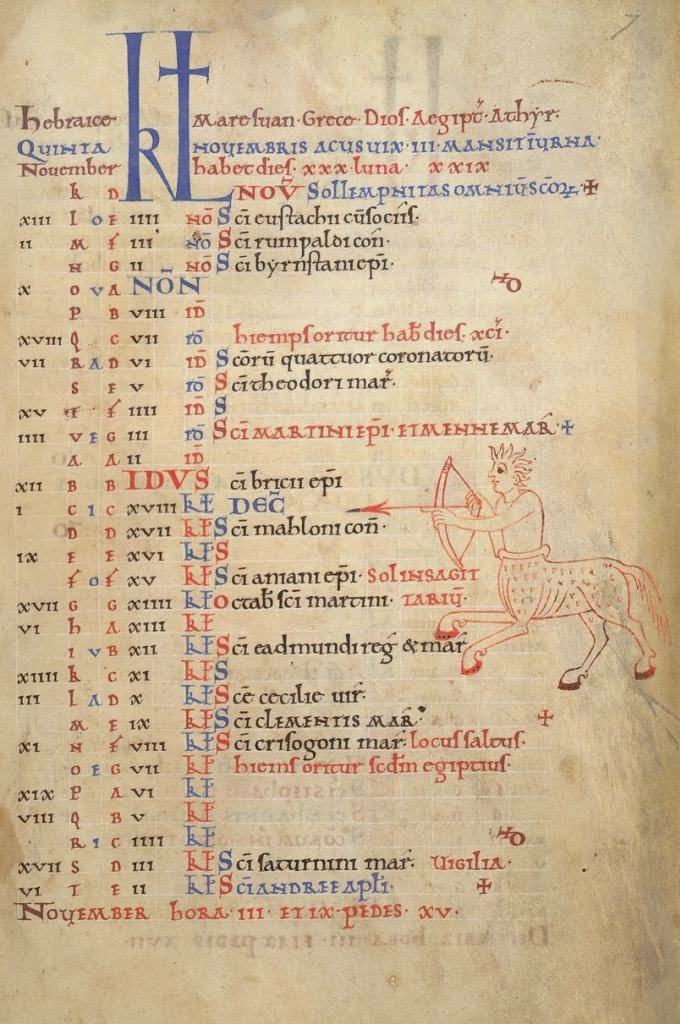
11th-century calendar from Winchester, 
noting the beginning of winter on 7 November (BL Arundel 60, f. 7)

I could go on listing examples all day, but that's probably enough for now to welcome winter. I'm aware that many of my readers live in more fortunate climates, where it's not winter yet (or where summer is just beginning), but here in the south of England it does suddenly feel like winter: a few unusually warm days at the end of October were suddenly laid waste by cold and fog, though not yet by ice and snow. So I'm happy to agree with the Anglo-Saxon calendars that this really is the beginning of winter; in this respect, as in many others, you can't wrong following Bede. It's Bede, of course, who in the voice of a counsellor to King Edwin gives us perhaps the most famous use of winter in Anglo-Saxon literature, which I quoted here recently but will unashamedly quote again, in the Old English translation:

Þyslic me is gesewen, þu cyning, þis andwearde lif manna on eorðan, to wiðmetenesse þære tide þe us uncuð is, swylc swa þu æt swæsendum sitte mid þinum ealdormannum 7 þegnum on wintertide, 7 sie fyr onælæd 7 þin heall gewyrmed, 7 hit rine 7 sniwe 7 styrme ute; cume an spearwa 7 hrædlice þæt hus þurhfleo, cume þurh oþre duru in, þurh oþre ut gewite. Hwæt he on þa tid, þe he inne bið, ne bið hrinen mid þy storme þæs wintres; ac þæt bið an eagan bryhtm 7 þæt læsste fæc, ac he sona of wintra on þone winter eft cymeð. Swa þonne þis monna lif to medmiclum fæce ætyweð; hwæt þær foregange, oððe hwæt þær æfterfylige, we ne cunnun.

"O king, it seems to me that this present life of man on earth, in comparison to that time which is unknown to us, is as if you were sitting at a feast in the winter with your ealdormen and thegns, and a fire was kindled and the hall warmed, while it rained and snowed and stormed outside. A sparrow came in, and swiftly flew through the hall; it came in at one door, and went out at the other. Now during the time when he is inside, he is not touched by the winter's storms; but that is the twinkling of an eye and the briefest of moments, and at once he comes again from winter into winter. In such a way the life of man appears for a brief moment; what comes before, and what will follow after, we do not know."

Dark and cold the winter may be, but this vignette also conjures up one of its best features: feasting in good company, 'the fire kindled and the hall warmed, while it rained and stormed and snowed outside'. Something to look forward to in the 92 days ahead.


This image is from BL Harley 5431 (f.38v), a copy of the Rule of St Benedict made in Canterbury at the end of the tenth century. St Benedict's Rule divides the monastic year into two seasons, summer and winter, which had their different timetables and schedules of prayer; winter began in November, and this section describes the schedule hiemis tempore 'in the time of winter'. Its big initial H is formed from spiky lines which always look to me like brambles, or like bare branches black against the winter sky.

Sunday, 2 November 2014

A Selection of Saints' Legends

One day. One day, I will hear a sermon on All Saints' Day which doesn't start off by making a joke about how silly medieval saints' legends are. In Oxford, of all places, you might think a preacher could come up with something a bit more interesting to say on this feast than 'aren't there lots of silly stories about medieval saints? Just as well we know better!' I'd like to think that somewhere out there in the world there must be a member of the clergy who has actually read a medieval saint's legend, or is at least prepared to expend some imagination to understand why saints in the Middle Ages attracted so much love and devotion, such a wealth of literary, artistic, intellectual and emotional investment, and the kind of creativity which made their legends lively, funny and memorable.

Well, not today. This morning's sermon was a classic of the genre, and it was annoying, though not particularly surprising. To do something productive with my annoyance, here are a few links to stories from some of my favourite medieval saints' legends. I'm using the word 'medieval' here in its technical sense and not, as today's preacher was, as a synonym for 'primitive' or 'stupid'.

St Guthlac finds his vocation while musing on his ancestors.

St Ethelburga's nuns are joyfully reunited with her in death.

St Oda saves the day at the Battle of Brunanburh by reforging the king's broken sword.

St Anselm recalls his first childhood vision of God, his youthful anxieties about his vocation, and his longing to escape the busy world and live in peace.

St Wihtburh builds a sandcastle, in a story which is a little silly, but also very sweet.

St Dunstan nips the devil by the nose. A legend which is comic because it's meant to be comic, not because people in the Middle Ages were idiots.

St Gilbert of Sempringham's friends mistake him for a dancer because he's up and down in prayer all night.

St Wulfstan of Worcester in tender and in playful mood.

St Edmund sacrifices himself to save his people.

St Eormenhild defends a little boy who has been cruelly beaten.

St Alphege stands fast in the face of a Viking army.

Edward the Confessor heals a blind man.

St Margaret of Scotland makes the best of life in exile.

Earl Waltheof, humiliated on earth, is honoured as a saint in heaven.

St Etheldreda defends her monks from unjust Norman rulers.

Gundulf of Rochester creeps away to a cowshed to pray in peace.

Julian of Norwich is comforted by St John of Beverley, her friendly 'neighbour', a homely saint glorified by God 'to made us glad and merry in love'.

This is a small selection, limited by nothing more scientific than my own interests - these stories are all from English sources (though the saints include people of Italian, Norman and Danish heritage), and most come from the Anglo-Saxon period and the eleventh and twelfth centuries. Are they all true? No. Maybe none of them are true. It doesn't matter. Though some of them are intentionally or unintentionally funny - more often intentionally, I think - they encompass a wide range of human experience: injustices small and great; battles to save a kingdom, extraordinary courage in time of disaster, and children playing on the seashore; friends teasing each other, expressing their love, and sharing personal memories; bullied children, young people worrying about their futures, old men trying to find peace in the midst of their busy lives; generosity, wisdom, humour, grief, illness, joy, love. Are there absurdities in the legends of medieval saints? Yes, of course; I wouldn't claim otherwise. But there is much, much more of beauty, value and truth.

Saturday, 1 November 2014

'þisne dæg eallum halgum': An Anglo-Saxon Sermon for All Hallows

Litany of saints in an Anglo-Saxon manuscript (BL Arundel 60, f. 131)
Holy teachers have instructed that the faithful church should celebrate and worthily keep this day to the honour of All Saints, because they could not appoint a feast for each of them separately, nor are all their names known to any man in this life; as John the Evangelist wrote in his divine vision, saying, "I saw so great a multitude as no man may number, of all nations and of every tribe, standing before the throne of God, all dressed in white garments, holding palm-branches in their hands, and they sang with a loud voice, Salvation be to our God who sits upon his throne. And all the angels stood around his throne, and bowed down to God, saying, To our God be blessing and brightness, wisdom and thanksgiving, honour and strength, for ever and ever. Amen."
This is the opening of a sermon for All Saints' Day, written in the tenth century by the Anglo-Saxon homilist Ælfric. Here it is in Old English (the text is from here):
Halige lareowas ræddon þæt seo geleaffulle gelaðung þisne dæg eallum halgum to wurþmynte mærsige and arwurðlice freolsige; forðan ðe hi ne mihton heora ælcum synderlice freolstide gesettan, ne nanum menn on andweardum life nis heora eallra nama cuð, swa swa Iohannes se Godspellere on his gastlican gesihðe awrat, þus cweðende, "Ic geseah swa micele menigu, swa nan man geryman ne mæg, of eallum ðeodum and of ælcere mægðe, standende ætforan Godes þrymsetle, ealle mid hwitum gyrlum gescrydde, healdende palmtwigu on heora handum, and sungon mid hluddre stemne, Sy hælu urum Gode þe sitt ofer his þrymsetle. And ealle englas stodon on ymbhwyrfte his ðrymsetles, and aluton to Gode, þus cweðende, Sy urum Gode bletsung and beorhtnys, wisdom and þancung, wurðmynt and strengð, on ealra worulda woruld. Amen."

þisne dæg eallum halgum to wurþmynte mærsige... I couldn't resist calling this post 'a sermon for All Hallows', since that's what Ælfric himself calls it. When he talks about consecrating this day to the honour of eallum halgum 'all hallows' it's hard to tell whether that's meant to be the name of the feast or simply a description, but elsewhere he calls it ealra halgena mæssedæg, and other versions like ealra haligra tid ('All Hallows' tide') are also recorded. The name and phrase 'All Saints' came late into English, not being recorded, according to the OED, before the end of the fourteenth century; but the Old English Menologium calls today ealra sancta symbel 'the feast of all saints':

And þy ylcan dæge ealra we healdað
sancta symbel þara þe sið oððe ær
worhtan in worulde willan drihtnes.


And on the same day we keep
the feast of all saints, of those who early or late [i.e. at any time]
worked in the world the will of the Lord.

In his sermon Ælfric goes on to describe the different categories of saints, beginning with angels and moving on to the prophets, apostles, martyrs, confessors, desert fathers, and anything else you can think of. The whole text can be found at this link, but here are some extracts I particularly like.

Godes halgan sind englas and menn. Englas sind gastas butan lichaman. Þa gesceop se Ælmihtiga Wealdend on micelre fægernysse, him sylfum to lofe, and to wuldre and wurðmynte his mægenþrymme on ecnysse... Nu is þes dæg þisum englum arwurðlice gehalgod, and eac þam halgum mannum, þe þurh miccle geðincða fram frymðe middangeardes Gode geþugon. Of þisum wæron ærest heahfæderas, eawfæste and wuldorfulle weras on heora life, witegena fæderas, þæra gemynd ne bið forgiten, and heora nama þurhwunað on ecnysse; forðan ðe hi wæron Gode gecweme þurh geleafan, and rihtwisnysse, and gehyrsumnysse. Þisum fyligð þæra witegena gecorennys: hi wæron Godes gesprecan, and þam he æteowde his digelnysse, and hi onlihte mid gife þæs Halgan Gastes, swa þæt hi wiston þa towerdan ðing, and mid witigendlicere gyddunge bododon. Witodlice þa gecorenan witegan mid manegum tacnum and forebicnungum on heora life scinende wæron. Hi gehældon manna untrumnysse, and deaddra manna lic to life arærdon...

Æfter þam apostolican werode we wurðiað þone gefæstan heap Godes cyðera, þe ðurh mislice tintrega Cristes ðrowunge werlice geefenlæhton, and ðurh martyrdom þæt upplice rice geferdon. Sume hi wæron mid wæpnum ofslagene, sume on lige forswælede, oðre mid swipum ofbeatene, oþre mid stengum þurhðyde, sume on hengene gecwylmede, sume on widdre sæ besencte, oðre cuce behylde, oðre mid isenum clawum totorene, sume mid stanum ofhrorene, sume mid winterlicum cyle geswencte, sume mid hungre gecwylmede, sume handum and fotum forcorfene, folce to wæfersyne, for geleafan and halgum naman Hælendes Cristes. Þas sind þa sigefæstan Godes frynd, þe ðæra forscyldgodra ealdormanna hæsa forsawon, and nu hi sind gewuldor-beagode mid sige heora þrowunga on ecere myrhðe. Hi mihton beon lichamlice acwealde, ac hi ne mihton fram Gode þurh nane tintregunga beon gebigede. Heora hiht wæs mid undeadlicnysse afylled, þeah ðe hi ætforan mannum getintregode wæron. Hi wæron sceortlice gedrehte, and langlice gefrefrode; forðan ðe God heora afandode swa swa gold on ofne, and he afunde hi him wyrðe, and swa swa halige offrunga, hi underfeng to his heofonlican rice.

Æfter ablunnenre ehtnysse reðra cynega and ealdormanna, on siblicere drohtnunge Godes gelaðunge, wæron halige sacerdas Gode ðeonde, þa mid soðre lare and mid halgum gebysnungum folces menn to Gode symle gebígdon. Heora mod wæs hluttor, and mid clænnysse afylled, and hi mid clænum handum Gode Ælmihtigum æt his weofode ðenodon, mærsigende þa halgan gerynu Cristes lichaman and his blodes. Eac hi offrodon hi sylfe Gode liflice onsægednysse butan womme, oþþe gemencgednysse þwyrlices weorces. Hi befæston Godes lare heora underþeoddum, to unateorigendlicum gafele, and heora mod mid þreatunge, and bene, and micelre gymene to lifes wege gebigdon, and for nanum woruldlicum ege Godes riht ne forsuwodon; and ðeah ðe hi swurdes ecge ne gefreddon, þeah ðurh heora lifes geearnunga hi ne beoð martyrdomes bedælede, forðan þe martyrdom bið gefremmed na on blodes gyte anum, ac eac swylce on synna forhæfednysse, and on biggenge Godes beboda...

Eala ðu, eadige Godes cennestre, symle mæden Maria, tempel ðæs Halgan Gastes, mæden ær geeacnunge, mæden on geeacnunge, mæden æfter geeacnunge, micel is ðin mærð on ðisum freolsdæge betwux þam foresædum halgum; forðan ðe ðurh þine clænan cenninge him eallum becom halignyss and ða heofonlican geðincðu. We sprecað be ðære heofonlican cwene endebyrdlice æfter wifhade, þeahhwæðere eal seo geleaffulle gelaðung getreowfullice be hire singð, þæt heo is geuferod and ahafen ofer engla werod to þam wuldorfullan heahsetle. Nis be nanum oðrum halgan gecweden, þæt heora ænig ofer engla werod ahafen sy, buton be Marian anre. Heo æteowde mid hire gebysnungum þæt heofonlice lif on eorðan, forðan þe mægðhad is ealra mægna cwen and gefera heofonlicra engla. Ðyses mædenes gebysnungum and fotswaðum fyligde ungerim heap mægðhades manna on clænnysse þurhwunigende, forlætenum giftum, to ðam heofonlicum brydguman Criste geþeodende mid anrædum mode, and haligre drohtnunge, and sidefullum gyrlan, to þan swiðe, þæt heora for wel menige for mæigðhade martyrdom geðrowodon, and swa mid twyfealdum sige to heofonlicum eardung-stowum wuldorfulle becomon.

Eallum ðisum foresædum halgum, þæt is, englum and Godes gecorenum mannum, is þyses dæges wurðmynt gemærsod on geleaffulre gelaðunge, him to wurðmynte and us to fultume, þæt we ðurh heora þingrædene him geferlæhte beon moton. Þæs us getiðige se mildheorta Drihten, þe hi ealle and us mid his deorwurðan blode fram deofles hæftnedum alysde. We sceolon on ðyssere mærlican freolstide mid halgum gebedum and lofsangum us geinnian, swa hwæt swa we on oðrum freols-dagum ealles geares ymbrynes, þurh mennisce tyddernysse hwonlicor gefyldon, and carfullice hogian þæt we to ðære ecan freolstide becumon.

Crowned saints (BL Add MS 49598, f.1v)
God's saints are angels and human beings. Angels are spirits without body; the Almighty Ruler created them in great beauty, for his own praise and to the honour and glory of his majesty in eternity... Now this day is worthily consecrated to these angels, and also to the holy people who through great virtues have flourished for God from the beginning of the world. First of these were the patriarchs, righteous and glorious men in their lives, the fathers of the prophets, whose memory shall not be forgotten, and their names shall last for ever, because they were pleasing to God through faith, and righteousness, and obedience. These were followed by the chosen company of prophets: they spoke with God, and to them he made known his secrets, and enlightened them with the grace of the Holy Ghost, so that they knew the things to come and proclaimed them in prophetic song. Truly the chosen prophets by many signs and tokens shone forth in their lives. They healed the sick, and the bodies of the dead they raised to life...

After the company of the apostles we honour the steadfast band of God's martyrs, who through various torments bravely imitated the passion of Christ, and through martyrdom passed to the kingdom on high. Some of them were slain with weapons, some burned by fire, others beaten with whips, others pierced with stakes, some slain on a cross, some sunk in the wide sea, others flayed alive, others torn with iron claws, some overwhelmed with stones, some afflicted by the winter's cold, some slain by hunger, some with hands and feet cut off, as a spectacle to people, for their faith and the holy name of Jesus Christ. These are the victorious friends of God, who scorned the commands of wicked rulers, and are now crowned with glory by the triumph of their sufferings in eternal joy. They could be killed in body, but they could not by any torments be turned away from God. Their hope was filled with immortality, though before men they were tormented. They were afflicted for a short time, and comforted for a long time; because God tested them as gold in a furnace, and he found them worthy of him, and as holy offerings received them into his heavenly kingdom.
This list of torments is, I take it, an elaboration on Hebrews 11.32-12.2 - but I can't help noting that the addition of martyrs 'afflicted by the winter's cold' (mid winterlicum cyle geswencte) is very characteristically Anglo-Saxon! Such a list can be compared to the 'fates of men' trope in Old English wisdom poetry, which is the subject of a whole poem as well as in briefer passages in The Wanderer and other poems.

A group of saints (BL Add MS 49598, f.1)

After the persecution of the cruel kings and rulers had ceased, in the peaceful condition of God's church, there were holy priests flourishing in God, who with true teaching and holy examples constantly guided people to God. Their minds were spotless and filled with purity, and with pure hands they served God Almighty at his altar, celebrating the holy mystery of Christ's body and his blood. They likewise offered themselves as a living sacrifice to God, without blemish or taint of wicked deeds. They established God's teaching in their followers as an unfailing treasure, and with chastisement and prayer and great care guided them in the way of life, and did not remain silent about God's law for any fear of the world. And though they did not feel the sword's edge, yet because of the merits of their lives they are not deprived of martyrdom; for martyrdom is not accomplished by bloodshed alone, but also by refraining from sins and keeping God's commandments...

Female saints (BL Add MS 49598, f.2)
O thou, blessed mother of God, ever virgin Mary, temple of the Holy Ghost, virgin before conceiving, virgin in conceiving, virgin after conceiving, great is your glory in this feast among the saints of whom we speak! For through your pure child-bearing holiness and heavenly honour came to them all. We speak about the queen of heaven last because she is a woman, although all the faithful church confidently sing of her that she is exalted and raised up above the hosts of angels to the throne of glory. Of none of the other saints is it said that any of them are raised up above the hosts of angels, except for Mary alone. She made visible by her example the life of heaven on earth, because chastity is queen of all virtues and companion of the heavenly angels. This virgin's example and footsteps were followed by an uncountable number of celibate people living in purity, renouncing marriage, uniting themselves to the heavenly bridegroom Christ with a steadfast mind and holy conduct and the clothing of virtue, so much so that many of them suffered martyrdom to preserve their virginity, and so with a twofold virtue gloriously came to the heavenly dwelling-place.

To the honour of all these aforesaid saints, that is, angels and God's chosen people, this day is celebrated in the faithful church, for their honour and for our support, so that through their intercession we may be united with them. May the merciful Lord grant us this, who with his precious blood redeemed them all and us from the captivity of the devil. On this glorious festival we should complete, with holy prayers and hymns, whatever we have performed less perfectly through human weakness at other festivals through the course of the year; and seriously reflect, that we may come to the eternal festival.

There is some lovely phrasing in this final paragraph, carefully balancing the two groups of us and them (the saints): this festival is appointed him to wurðmynte and us to fultume, þæt we ðurh heora þingrædene him geferlæhte beon moton 'for their honour and for our support, so that through their intercession we may be united with them'. The word I've translated as 'united' is geferlæhte, which has at its root the noun gefera 'companion, friend'; the prayer is that we should be brought into their happy company, led to the 'eternal festival' by the earthly festival of All Hallows.

St Peter welcomes the dead into heaven (BL Stowe 944, f. 7)

Friday, 31 October 2014

'An earthy flavour'

Rochester in the rain
Not only is the day waning, but the year.  The low sun is fiery and yet cold behind the monastery ruin, and the Virginia creeper on the Cathedral wall has showered half its deep-red leaves down on the pavement.  There has been rain this afternoon, and a wintry shudder goes among the little pools on the cracked, uneven flag-stones, and through the giant elm-trees as they shed a gust of tears.  Their fallen leaves lie strewn thickly about.  Some of these leaves, in a timid rush, seek sanctuary within the low arched Cathedral door; but two men coming out resist them, and cast them forth again with their feet. 

In the waning days of October, I've been re-reading Charles Dickens' final, unfinished novel, The Mystery of Edwin Drood. I first read it nearly two years ago, at a particularly impressionable period, and it hit me hard, the way novels sometimes can. It strikes some personal chords, since it's set in the kind of place where my imagination often wanders (and my work often takes me), within a cathedral community burdened by a half-remembered past.

For sufficient reasons, which this narrative will itself unfold as it advances, a fictitious name must be bestowed upon the old Cathedral town. Let it stand in these pages as Cloisterham. It was once possibly known to the Druids by another name, and certainly to the Romans by another, and to the Saxons by another, and to the Normans by another; and a name more or less in the course of many centuries can be of little moment to its dusty chronicles.

An ancient city, Cloisterham, and no meet dwelling-place for any one with hankerings after the noisy world. A monotonous, silent city, deriving an earthy flavour throughout from its Cathedral crypt, and so abounding in vestiges of monastic graves, that the Cloisterham children grow small salad in the dust of abbots and abbesses, and make dirt-pies of nuns and friars; while every ploughman in its outlying fields renders to once puissant Lord Treasurers, Archbishops, Bishops, and such-like, the attention which the Ogre in the story-book desired to render to his unbidden visitor, and grinds their bones to make his bread.

A drowsy city, Cloisterham, whose inhabitants seem to suppose, with an inconsistency more strange than rare, that all its changes lie behind it, and that there are no more to come. A queer moral to derive from antiquity, yet older than any traceable antiquity. So silent are the streets of Cloisterham (though prone to echo on the smallest provocation), that of a summer-day the sunblinds of its shops scarce dare to flap in the south wind; while the sun-browned tramps, who pass along and stare, quicken their limp a little, that they may the sooner get beyond the confines of its oppressive respectability. This is a feat not difficult of achievement, seeing that the streets of Cloisterham city are little more than one narrow street by which you get into it and get out of it: the rest being mostly disappointing yards with pumps in them and no thoroughfare—exception made of the Cathedral-close, and a paved Quaker settlement, in colour and general confirmation very like a Quakeress’s bonnet, up in a shady corner.

In a word, a city of another and a bygone time is Cloisterham, with its hoarse Cathedral-bell, its hoarse rooks hovering about the Cathedral tower, its hoarser and less distinct rooks in the stalls far beneath. Fragments of old wall, saint’s chapel, chapter-house, convent and monastery, have got incongruously or obstructively built into many of its houses and gardens, much as kindred jumbled notions have become incorporated into many of its citizens’ minds. All things in it are of the past.

This description is recognisably Rochester in Kent, which Dickens knew very well, but it could apply to many ancient cities. The setting of the novel is cathedral crypt and churchyard, amid the dust of graves and masonry, and the whole novel is obsessed with death; it is, after all, a murder mystery, of sorts, and Dickens died before it was completed. In the description above, it is (you won't be surprised to learn) the monastic graves which most appeal to me. As a lover of medieval monks, I'm always very aware when visiting cathedrals and monastery ruins that the dust of their former inhabitants is mingled with the ground you walk on and the air you breathe. Cathedrals are full of the tombs of kings and late-medieval archbishops, but the early medieval monks who mean the most to me rarely have anything to show where they were buried; at Rochester I tread unaware on the graves of Gundulf and Paulinus, at Canterbury I breathe the dust of Dunstan and Anselm, Eadmer and Osbern. (For some reason I always associate the latter with The Mystery of Edwin Drood, since it's the story of a troubled young cathedral precentor!) This is not an unpleasant or a morbid thought - actually I find it comforting. I have far more attachments among the dead than among the living, and am sometimes more at home there, too.


Durdles is a stonemason; chiefly in the gravestone, tomb, and monument way, and wholly of their colour from head to foot.  No man is better known in Cloisterham.  He is the chartered libertine of the place.  Fame trumpets him a wonderful workman—which, for aught that anybody knows, he may be (as he never works); and a wonderful sot—which everybody knows he is.  With the Cathedral crypt he is better acquainted than any living authority; it may even be than any dead one.  It is said that the intimacy of this acquaintance began in his habitually resorting to that secret place, to lock-out the Cloisterham boy-populace, and sleep off fumes of liquor: he having ready access to the Cathedral, as contractor for rough repairs.  Be this as it may, he does know much about it, and, in the demolition of impedimental fragments of wall, buttress, and pavement, has seen strange sights.  He often speaks of himself in the third person; perhaps, being a little misty as to his own identity, when he narrates; perhaps impartially adopting the Cloisterham nomenclature in reference to a character of acknowledged distinction.  Thus he will say, touching his strange sights: ‘Durdles come upon the old chap,’ in reference to a buried magnate of ancient time and high degree, ‘by striking right into the coffin with his pick.  The old chap gave Durdles a look with his open eyes, as much as to say, “Is your name Durdles?  Why, my man, I’ve been waiting for you a devil of a time!”  And then he turned to powder.’  With a two-foot rule always in his pocket, and a mason’s hammer all but always in his hand, Durdles goes continually sounding and tapping all about and about the Cathedral...

He lives in a little antiquated hole of a house that was never finished: supposed to be built, so far, of stones stolen from the city wall. To this abode there is an approach, ankle-deep in stone chips, resembling a petrified grove of tombstones, urns, draperies, and broken columns, in all stages of sculpture. Herein two journeymen incessantly chip, while other two journeymen, who face each other, incessantly saw stone; dipping as regularly in and out of their sheltering sentry-boxes, as if they were mechanical figures emblematical of Time and Death.

Erthe oute of erthe is wondirly wroghte,
Erthe has geten one erthe a dignite of noghte,
Erthe appon erthe hase sett alle his thoghte
How that erthe upon erthe may be heghe broghte.

Erthe upon erthe wolde be a kinge
Bot how erthe to erthe sall, thinkes he no thinge.
When erthe bredes erthe and his rentes home bringe
Thane shall erthe of erthe have full harde parting.

Erthe upon erthe winnes castells and towrres;
Thane sayse erthe unto erthe, "This es al ourres!"
When erthe upon erthe has bigged up his bourres
Thane shall erthe for erthe suffere sharpe scourres.

Erthe gos upon erthe as molde upon molde
He that gose upon erthe, gleterande as golde,
Like as erthe never more go to erthe scholde
And yitt schall erthe unto erthe ga rathere than he wolde

Now why that erthe luffes erthe, wondere me thinke
Or why erthe for erthe sholde other swete or swinke
For when erthe appon erthe has broughte within brinke
Thane shall erthe of erthe have a foul stinke.

(For more on this poem, see this post.)


You might mistake this for a Halloween post, but it's not; as I think I've said before, I'm not a big fan of Halloween. I do like winter rituals of the kind described in this article (East Kent's hoodening tradition is wonderfully scary) and I have happy childhood memories of Bonfire Night, but when I was growing up Halloween was only celebrated by teenagers who had seen it on American TV and wanted an excuse to intimidate the neighbours. Consequently I'm one of those people who dislikes and slightly resents it, or at least the social pressure that comes with it. Over the past few months I've been thinking a lot about the seasons as they are represented in medieval literature - witness, for instance, this growing series of posts on the Anglo-Saxon year - and the more I do this, the more I object to the media forcing their shallow, ersatz constructions of seasonal ritual upon us, in their own version of trick-or-treat intimidation. Festivals of light and darkness, and seasons for remembering the dead, are too important and too beautiful to be monopolised in this way, or reduced to one homogeneous holiday which pushes aside the rich diversity of other traditions and practices. Nothing will ever stop the media doing this, but we don't have to pretend to like it, or go along with it ourselves.

As a medievalist, I'm particularly uncomfortable with co-opting medieval art and literature into the day as it's now celebrated, as if the grinning skeletons of medieval art had anything to do with plastic pumpkins and kids dressed up as Disney characters. Almost every feature of modern Halloween is later than the medieval period, and pretending there's any such thing as 'medieval Halloween', even just in fun, is pretty misleading - one of those occasions where we remake the past in our own image, for our own entertainment, rather than making an imaginative effort to perceive the ways in which the medieval world was different from our own. There's been a lot of this circulating on Twitter this week, and it makes me squirm. I don't care what people do with manuscript images of black cats and spiders, but I have to demur at the grinning skeletons, and especially at co-opting The Three Living and the Three Dead, which has nothing whatsoever to do with Halloween. In medieval literature there is no season more appropriate than any other for a memento mori; you get them in season and out of season, in spring as much as in November, and the whole point of an image like the Three Living and the Three Dead is that at any moment you are close to death - not just on 31 October. If anything, it's an anti-Halloween image; yet I've seen one particular version (Arundel MS 83, f. 127v) posted by five different people today, without context but with some jokey comment about how it's 'seasonal'. This is a distortion. To a modern audience such images may seem strange and comic - and grim humour forms part of their power, as it does in 'Erthe upon erthe' (and the works of Dickens, for that matter) - but I don't like the idea of laughing at them; they are supposed to be strange, and disquieting, and they deserve to be taken seriously. Allow them to scare you. We're all children in the face of death, 'growing small salad in the dust of abbots and abbesses', but the purpose of such images is to teach us to be wiser, to remind us what we are:

'Quid est homo?'
Man is dethys underlyng
Man is a gest in hys dwellyng
Man is a pylgrym in his pasyng.

It's nice that there are people happy and secure enough to make a joke of this, who are so full of life that they find it easy to giggle at other cultures' representations of death; but I'll never be one of them, I think.

Thursday, 30 October 2014

'Æthelnoth the Good', Cnut's Archbishop


Æthelnoth, Archbishop of Canterbury, died in the last days of October in the year 1038, and in some places (Canterbury, mostly) they commemorate him on October 30. Æthelnoth is a fascinating figure to me, because he embodies some of the most intriguing questions about cultural and national identities in eleventh-century England: how and why did this English churchman, so thoroughly a product of Anglo-Saxon society at its confident best, become someone who could work closely with the Danish conqueror Cnut, aligning himself with the interests of a new Anglo-Danish regime?

Æthelnoth was born, some time in the second half of the tenth century, into a noble Anglo-Saxon family based in the south-west of England. He was connected to some very illustrious people: he was descended from one of the brothers of Alfred the Great, his grandfather was the chronicler and cultured ealdorman Æthelweard, and his father Æthelmær was the founder of Eynsham Abbey and patron of the homilist Ælfric. This was a powerful and pious family which cherished its roots far back in the royal line of the kings of Wessex, well-connected players in contemporary politics but with sophisticated literary and spiritual interests too. According to tradition Æthelnoth was baptised by no less a person than St Dunstan himself, and at the baptism raised his hand in a gesture of blessing, which Dunstan interpreted to mean that the baby would be an archbishop one day. In time Æthelnoth became a monk at Glastonbury, where Dunstan had been abbot before his elevation to Canterbury.

Although he was born into a time of relative peace, Æthelnoth's life was to be shaped by the troubled period leading up to Cnut's conquest of England in 1016: more than two decades of Viking attacks from without and internal political chaos splitting the kingdom from within. As ealdorman of the western shires (I love that title!) it was Æthelnoth's father who led the west's submission to Svein Forkbeard in 1013, and a few years later Æthelnoth himself seems to have participated in some kind of ceremony which bestowed legitimacy on Cnut as victorious conqueror and king of England: either a confirmation ceremony in 1016, or a coronation in 1017. (Thanks to the Canterbury writer Osbern we know Æthelnoth 'bestowed chrism' on the king, but we don't know exactly what ceremony this refers to.) It would be fascinating to know whether Æthelnoth had much choice in this: in 1017 Cnut had Æthelnoth's brother killed, as part of a last purge of the English aristocracy.

BL Additional 34890, f. 115

In 1020 Æthelnoth was appointed Archbishop of Canterbury, presumably in part because he was already a trusted supporter of the new Danish regime. How did that come about? If only we knew... He was consecrated archbishop in the year of the foundation of the church at Assandun, about which I wrote recently, and after he became archbishop Æthelnoth and Cnut seemed to have worked well together, improbable though such a pairing may appear. Æthelnoth was the impetus behind the ceremonial return to Canterbury in 1023 of the body of St Ælfheah, the archbishop one before Æthelnoth, who had been murdered by a Danish army in 1012. The return of the martyr's body to Canterbury was a large-scale public spectacle, involving the body being taken by ship from St Paul's, where the archbishop had first been buried, down the Thames to Kent. Cnut, Emma and their little heir Harthacnut were all in attendance, and this grand occasion - masterminded, presumably, by Æthelnoth - was an effective piece of political theatre, righting one of the cruellest wrongs of the Danish Conquest, the murder of the elderly, saintly archbishop. Osbern, in his account of this event, paints an attractive picture of Cnut and Æthelnoth cheerfully working together as they retrieve the martyr's body from its tomb and take it down to the royal dragon-ship. This is mostly a product of Osbern's ever-vivid imagination, but something about it rings true.

BL Additional 34890, f. 115

This is only one of the occasions on which Æthelnoth aligned himself closely with Cnut and Emma, and consequently he gets a rave review in the Encomium Emmae Reginae (written a few years after his death) which calls him "a man gifted with high courage and wisdom" because after Cnut's death he refused to crown Cnut's 'illegitimate' son Harold Harefoot - saying that no one should be king but Emma's son Harthacnut. Harthacnut did indeed become king in 1040, but Æthelnoth didn't live to crown him; he died in the middle of Harold's reign, in 1038. One version of the Anglo-Saxon Chronicle (D) records his death as follows:

Her forðferde Æðelnoð arcebiscop se goda, 7 Æþælric biscop on Suðsexan, se gewilnode to Gode þæt he hine ne lete lybban nane hwile æfter his leofan fæder Æðelnoðe, 7 he eac binnan seofon nihton þæs gewat.

'In this year died Archbishop Æthelnoth the Good, and Æthelric, bishop in Sussex, who had prayed to God that he should not be permitted to live a long time after his dear father Æthelnoth, and he died too within a week.'

The title 'Æthelnoth the Good' and this little note about the bishop's answered prayer suggest there were some people inclined to consider Æthelnoth a saint, but this never really came to fruition. In the years after his death the Anglo-Danish regime which Æthelnoth had so staunchly supported collapsed with the early death of Harthacnut. Canterbury was a troubled place in the reign of Edward the Confessor and directly after, and it's not surprising that a cult of Æthelnoth did not take hold; by this point it was no longer a good thing to have been closely aligned with Cnut. But I can't help wondering if things had gone differently, if Harthacnut had lived, whether 'Æthelnoth the Good' might have acquired a reputation somewhat like that other survivor of conquest, St Wulfstan of Worcester: a unifying figure, a promoter of peace and reconciliation, and a saint.

BL Additional 34890, f. 115

The illustrations in this post come from the 'Grimbald Gospels' (BL Additional 34890), a gorgeous manuscript produced at Canterbury around the time Æthelnoth went there. It's one of several lavish manuscripts made at Canterbury in the years 1012-23 - books of breathtaking beauty, created in the middle of wartime and the first years of uneasy peace.

Tuesday, 21 October 2014

'Books are Glorious'

Re-reading the Old English poem known as 'The Dialogue of Solomon and Saturn' (which I wrote about this time last year), I was reminded of a lovely passage on the value of books. This poem is a debate between the wise king Solomon and a pagan prince named Saturn, who exchange questions and answers about the nature of the world - and on the subject of books, they agree. Solomon says:

Bec sindon breme, bodiað geneahhe
weotodne willan ðam ðe wiht hygeð.
Gestrangað hie and gestaðeliað staðolfæstne geðoht,
amyrgað modsefan manna gehwylces
of ðreaniedlan ðisses lifes.
Saturnus cwæð:  
Bald bið se ðe onbyregeð boca cræftes;
symle bið ðe wisra ðe hira geweald hafað.
Salomon cuæð:  
Sige hie onsendað soðfæstra gehwam,
hælo hyðe, ðam ðe hie lufað.

'Books are glorious. They abundantly proclaim 
the appointed purpose to anyone who thinks at all.
They strengthen and made stable the steadfast thought,
gladden the heart of every man
amid the pressing miseries of this life.
Saturn says:
Bold is he who tastes the skill of books;
he will ever be the wiser who has command of them.
Solomon says:
Victory they send to each of the true-hearted,
the haven of healing for those who love them.'

The value to be found in books, and in learning and wisdom generally, is a common theme in Anglo-Saxon poetry - although the most famous bookworm in Old English gets nothing by the books he devours! The 'Solomon and Saturn' example is particularly nice because it doesn't just talk about the value but the pleasure of books: they amyrgað 'make merry, gladden' the heart in the midst of the troubles of the world. Don't they, indeed?

This image shows one of my favourite medieval bibliophiles, St Dunstan (in BL Royal 10 A XIII, f. 2v), of whom we are told "Many were the meadows of sacred and divine volumes which, like some bee of genius, he flew over on the swift wings of his able nature." Something for every reader to aspire to! Dunstan has been proposed as a possible author of 'Solomon and Saturn'. In twelfth-century Canterbury, today (21 October) was celebrated as the feast of St Dunstan's ordination.

Sunday, 19 October 2014

Walking to St Frideswide's Well

Today is the feast of Oxford's patron St Frideswide, our very own Anglo-Saxon saint. According to legend Frideswide was the daughter of a Mercian king, who fled marriage to become a nun in Oxford on the site where Christ Church now stands. Besides Christ Church, the place in Oxford most associated with St Frideswide is Binsey, where legend says the saint took refuge from the king who wanted to marry her. While there she discovered a well which can still be seen in the churchyard at Binsey - a 'treacle well' of healing water (and inspiration for Alice in Wonderland's treacle well). This morning, it being a bright October day, I took a walk to Binsey.

I wasn't planning another photo-post after yesterday's mammoth effort, but I never can help taking pictures when I go to Binsey, so here they are for your enjoyment (or not, I suppose). For me, Binsey and Frideswide are a bottomless well of associations, literary, historical and personal, but I said pretty much all I want to say about that in this post about Binsey and this post about Frideswide. So today I'll try not to say more than is necessary.


I walked to Binsey by way of Port Meadow, which probably looks much as it did in Frideswide's time. This large area of common land has never been ploughed (so they say) and its history goes back long before Frideswide, to Bronze Age barrows and Iron Age settlement, and by comparison Frideswide's Oxford seems like a thing of yesterday.


In the fourteenth-century Middle English Life of St Frideswide (which I posted here) it says that when she learned she was in danger from the pursuing King Algar, she fled down to the Thames and found a boat, miraculously ready for her, and an angel to guide her from Oxford to Binsey.

To Temese heo yede and fonde a bote al preste, thorw Godes sonde,
And therin heo fonde an angel that broght hem to the londe.


I didn't have an angel, but you can't get lost going to Binsey; the road doesn't go anywhere else.

Binsey is not really big enough to be a village - I'm not even sure it qualifies as a hamlet. It's a row of houses and a pub; even the pub is picturesque.


The road to the church and the well goes past the houses and out among fields, touched today by autumn colour and lit by fitful sunshine.


The church is at the end of this road, concealed by the trees.

In a wode that Benesy yclyped ys al day
Thre wynter in an hole woned, that seylde me hure say...


Binsey church has many charms, especially when you have it all to yourself on a Sunday morning, but it's very dark and very damp. Everything was clammy to the touch - stone, wood, paper left on the pews. Even the light is murky, like being underwater.


It was a relief to get back outside, though the churchyard too is damp and dark, overshadowed by huge trees. It's as if the whole place has been washed in Frideswide's healing water, and never dried out again.


There was the occasional bird chirping in the trees, as if it hadn't noticed it's October and not May.


And this is St Frideswide's well. It's actually dedicated to St Margaret of Antioch (as is the church), but since St Margaret never came here and Frideswide did, I can't help thinking of it as Frideswide's well.


A mayde that seve yere ne myght nothing yse
Cam to hure in the wode, and felle adoun a kne.
Hure eyghen that holy mayde wysche with water of hure honde,
And as hole as any fysche that maide gan up stonde.


I had all these things swimming around in my mind as I stood beside St Frideswide's well: Langland and Hopkins and Edward Thomas and 'Balm in Gilead', and the holy stone and the dear ground of Draper's hymn. They are poems, and memories, which make me melancholy, but it's the kind of sadness which is not painful, either to experience or to recall; if you come 'with springing tears to the spring of mercy', even if there's no mercy to be found, the tears can bring their own healing.