Wednesday, 25 June 2014

The Danish Conquest, 1000 Years: Part 6

This post is the last - for the moment - in my series commemorating the 1000th anniversary of the Danish Conquest of England. It marks a cessation in hostilities, because in the late spring or summer of 1014 Cnut's army left England, successfully driven away by King Æthelred, and did not return until August 1015. In the last post in this series, in February, we saw how the leading counsellors in England made a bargain with the exiled Æthelred, inviting him to return as king if he behaved himself better than he had done previously. After this point, the Anglo-Saxon Chronicle (D) tells us:

Þa syþþan Swegen dead wæs, sæt Cnut mid his here on Gæignesburuh oð ða Eastron, 7 gewearð him 7 þæt folc on Lindesige anes þæt he hine horsian sceoldon, 7 wið þan ealle ætgædere faran 7 hergian. Ða com se cyning æþelred mid fulre fyrde þyder ær hi gearwe wæron to Lindesige, 7 man þa hergode 7 bærnde 7 sloh eall þæt mancynn þæt man geræcan mihte. 7 se Cnut gewende him ut mid his flotan, 7 wearð þæt earme folc þus beswicen þurh hine, 7 wende þa suðweard oð he com to Sandwic, 7 læt man þær up þa gislas þe his fæder gesealde wæron, 7 cearf of heora handa 7 earan 7 nosa. 7 buton eallum þissum yfelum se cyng het gyldan þam here þe on Grenewic læg .xxi. þusend punda.

[Then after Svein was dead, Cnut stayed with his army at Gainsborough until Easter, and there was an agreement between him and the people of Lindsey that they should provide horses for him, and after that they would all go together and raid. Then King Æthelred came to Lindsey before they were ready, with the whole army, and there was raiding and burning and all the people who could be reached were killed. And Cnut went away out with his fleet, and thus the wretched people were betrayed through him. He went southwards until he came to Sandwich, and there the hostages which had been given to his father were put ashore, and [he?] cut off their hands and ears and noses. And despite all these troubles, the king ordered that the army which lay at Greenwich should be paid 21,000 pounds.]

The English king's actions here are effective, though not exactly heroic: he's raiding his own land and killing his own people in punishment for their support of the Danes. The Chronicle, perhaps troubled by this, carefully gives no opinion, taking refuge in some very politic grammar. One of the notable features of the Chronicle's narrative of these years is that although it tells us clearly enough what happened, it often doesn't say who was responsible for it, and there are some extremely slippery instances of the passive voice in this entry, a distinct reluctance to say who was giving which orders. When we are told man þa hergode 7 bærnde 7 sloh eall þæt mancynn þæt man geræcan mihte we are left to assume that this is Æthelred's army doing at least some of the raiding and burning and killing in Lincolnshire, but the text doesn't explicitly say so.

The Chronicle is ready enough to condemn Cnut, however, for breaking the agreement he had made with the people of Lindsey. As we saw last summer, the Danish army had been based in Lincolnshire since their arrival in England in July 1013, when the leaders of Lindsey had been among the first to welcome Svein. Æthelred's actions here are presumably punishment for that decision as much as an effort to drive Cnut out of England. The Chronicle sympathises with the people of Lindsey and blames Cnut for abandoning them, but one can't help wondering whom they would have thought most at fault. Not that Cnut wasn't behaving badly too, of course - that mutilation of the hostages ranks among the worst things he ever did (against some stiff competition). It feels like the petulance of a young man who has found things don't always go his way, but whatever his motive, it's a horribly cruel thing to do. No one comes out of 1014 looking admirable.

As you might expect, the Encomium Emmae Reginae tells the story of Cnut's retreat rather differently:

After the death of his father, Knutr attempted to retain the sceptre of the kingdom, but he was quite unequal to so doing, for the number of his followers was insufficient. The English, being mindful that his father had unjustly invaded their country, collected all the forces of the kingdom in order to expel him, inasmuch as he was a youth. When this became known, the king, whose faithful friends had found a plan to preserve his honour, ordered a fleet to be got ready for him, not because he was fleeing afraid of the harsh outcome of war, but in order to consult his brother Haraldr, the king of the Danes, about so weighty a matter. Accordingly, having returned to his father's fleet and re-manned it, he spread the royal sails to the wind and sea, but nevertheless he did not lead back with him the whole force which had entered the country with his father and himself. For Thorkell, whom we have already mentioned as a military commander, observed that the land was most excellent, and chose to take up his residence in so fertile a country, and make peace with the natives, rather than to return home like one who had, in the end, been expelled. And according to some, he did not do this because he despised his lord, but in order that when Knutr returned with renewed forces and his brother's help to subdue the kingdom, he might either incline the chief men of the kingdom to surrender by his counsel, or if this plan were not a success, attack the incautious enemy from behind as they fought against his lord. And the truth of this is apparent from the fact that he kept with him a very great part of the soldiers, and that the king did not let more than sixty ships depart in company with himself.
Encomium Emmae Reginae, ed. and trans. Alistair Campbell (London: Royal Historical Society, 1949), pp. 15-17.

I love it when the Encomium says 'according to some'; it's always a sign of something interesting going on. ('The truth of this is apparent' might as well be code for 'what I'm saying is highly implausible'). Here, the author is trying to reconcile alternative interpretations of the conduct of Earl Thorkell. He doesn't really succeed - for, despite recording the claim of 'some' that Thorkell was staying behind in England to help Cnut, he goes on to tells us that Cnut thought Thorkell had deserted him, and that Thorkell had remained without Cnut's consent. Cnut never had much control over Thorkell, an older and much more experienced warrior who had been fighting battles since before Cnut was born; in English eyes, Thorkell was at this point a more familiar figure, and more of a threat, than young Cnut (who wasn't even king of Denmark - as the Encomium notes, his brother Harald was ruling there - but had been chosen as his father's successor by the Danish army at that time in England). The remnant of the fleet which Thorkell kept in England, much depleting Cnut's forces, is presumably that which the Chronicle mentions as being paid 21,000 pounds by the English king.

The Encomium goes on:
And so, after a prosperous voyage, the king (reached) his native land. When all the people, his father's former subjects, were wondering at his return, which was, for a king, unaccompanied, a swiftly-spreading rumour suddenly filled the palace of King Haraldr, saying that his elder brother, Knutr, had reached his shores. The king and also the whole army wondered, and though they did not yet know anything, they felt a presentiment that he had met with adverse fortune. Accordingly, chosen soldiers were sent from attendance on the king, and horses ready for use were dispatched to meet him, for brotherly love prompted the king to regard the dignity of his brother. When at length Knutr, exhibiting the respect due to a king, entered his brother's doors, his brother himself met him at the very entrance, and they, with their bodies mutually locked in an embrace, impressed tender kisses upon each other many times. Tears shed partly for love, and partly for their father's death moistened the neck of each, and when these were scarcely dry, the exchange of words brought on more. When each was describing his own fortune and asking about that of his brother, Knutr, who was the elder, addressed his brother thus: "I have come, oh brother, partly out of my love for you, and partly to avoid the unforeseen audacity of barbarous fury, not however because I feared war, which to my glory I will seek again, but in order that instructed by a pronouncement from you and supported by your protection I may go back certain of victory. But there is one thing which you will first do for me, if you begrudge me not the glory which is mine, that is to divide with me the kingdom of the Danes, my heritage, which you hold alone, and afterwards we will add the kingdom of the English to our heritage, if we can do so by our joint efforts. Keep one of these, whichever you choose, and enjoy your success; I similarly will keep the other. To the end that there may be sufficient time for you to take counsel, I will winter with you, and also in order that the ships and army may be renewed, as is expedient, so that our requirements may not be wanting when the hour of battle is upon us. Thorkell, our compatriot, deserting us as he did our father, has settled in the country, keeping with him a large part of our ships, and I believe that he will be against us, but nevertheless he will not prevail."

King Haraldr, having heard these unwelcome remarks, answered his brother in these words: "I rejoice, brother, at your arrival, and I thank you for visiting me, but what you say about the division of the kingdom is a serious thing to hear. It is my part to rule the heritage which our father gave me with your approval; as for you, if you have lost a greater one, I regret it, but though prepared to help you, I will not endure that my kingdom be divided." When Knutr had heard this, and had silently weighed his brother's reasonable words, he said: "Let us be silent concerning this for the moment, for God alone may perchance arrange the matter more equitably." Communing in such words and in other discussions of various kinds, and feasting at kingly banquets, they remained together for some time, and while mending the ships, they re-established the army. They also, in fact, went to the land of the Slavs, and brought back their mother, who resided there.
Encomium Emmae Reginae, trans. Campbell, pp. 17-19.

We can't be sure how much to believe of this view of the relationship between Cnut and his brother, but as the Encomium is just about the only source which gives any information on the subject - Harald died not long afterwards, and was largely forgotten to history - it's worth noting. (Brotherly co-rule was very topical at the time when the Encomium was written, in the reign of Harthacnut, and this probably influences the presentation of Cnut and Harald here.) The last sentence of this extract is also almost the only reference anywhere to Cnut's mother, whose name we don't even know for sure.

And what about Cnut's English wife, Ælfgifu? The Chronicle and the Encomium don't name her, but the Encomium tells us about 'a certain English matron' entrusted with the task of returning King Svein's body to Denmark:

In the meantime, a certain English matron had a ship prepared for her, and taking the body of Svein, who had been buried in her country, and having embalmed it and covered it with palls, she went to the sea, and making a successful voyage, arrived at the ports of the Danes. Sending a messenger to the two brothers [Cnut and Harald], she indicated that the body of their father was there, in order that they might hasten to receive it, and place it in the tomb which he had prepared for himself. They came gladly, and received the body with honour, and with yet more honour placed it in the monastery which the same king had built in honour of the Holy Trinity, in the sepulchre which he had prepared for himself.
Encomium Emmae Reginae, ed. Campbell, p. 19.

The Encomium is written for Cnut's second wife, and so largely ignores the existence of his first one, but this 'English matron' can hardly be anyone else but Ælfgifu of Northampton.

As it turned out, going back to Denmark for a year was about the best thing Cnut could have done for himself, because in the meantime Æthelred's court imploded. Æthelred's oldest son and heir, Æthelstan, was taken ill in the summer of 1014 and died on 25 June. The provisions of his will (a fascinating document you can read here) suggest there was already some tension in the royal family at this stage; Æthelred's adult sons by his first wife may have had little love for their father's second wife and her sons, and the will suggests that the prince was particularly close to his brother Edmund Ironside and to two powerful thegns, Sigeferth and Morcar, who the year before had supported Svein's invasion. The year after Æthelstan's death these two men were treacherously murdered by Eadric Streona, apparently with the support of King Æthelred. This caused Edmund Ironside, heir to the kingdom after his brother's death, to break with his father and build up a powerbase of his own in the Midlands. So while Cnut and his brother, mother and wife were the picture of family harmony in Denmark (that is, if you believe the Encomium), the English royal family was tearing itself apart.


Anyway, those poor mutilated hostages bring us back to the place where we started a year ago, at Sandwich in Kent, where Svein Forkbeard first arrived with his fleet in July 1013. No longer the busy port it was in the eleventh century, Sandwich is now a quiet little place, rejoicing in all kinds of quirky civic traditions, where every other building is an architectural delight. It's a beautifully unspoiled medieval town, in which it's not difficult to think yourselves back into the fifteenth century; but to take another step back to Cnut's day is more difficult. There's not much sign that the Vikings ever came there - except for one, and it's not what you might expect.
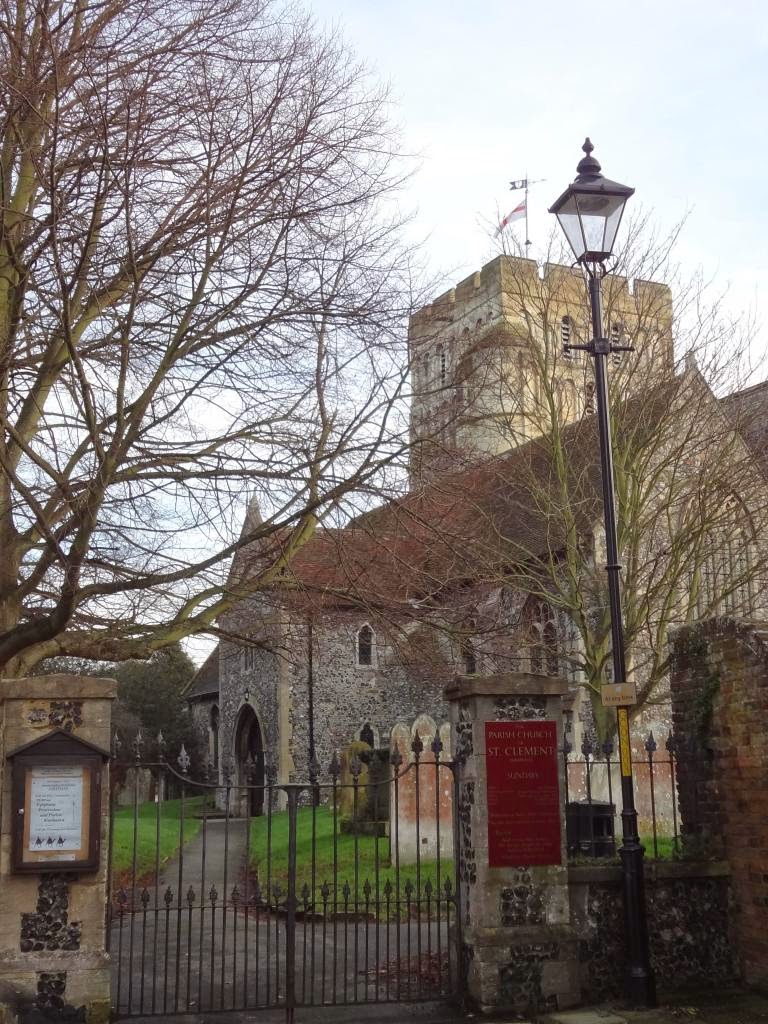
This is the church of St Clement, a large church with an impressive Norman tower. It's first recorded in the mid-eleventh century, and its dedication to the patron saint of seafarers - a saint especially popular with Vikings - suggests it was founded in the reign of Cnut. Cnut, in his later incarnation as Christian king of England, patron of churches and friend of monasteries, presented the port of Sandwich to the monks of Christ Church, Canterbury, and it's likely that this church was founded around the same time. Cnut's church patronage was guided in part by the commemoration of key events in the Danish Conquest - the most prominent example is the church he founded at the site of the Battle of Assandun - and I wonder whether the role of Sandwich as first point of arrival (for Svein in 1013 and again for Cnut himself when he returned in 1015) gave it a similar kind of symbolic importance later in his reign.

The reference to St Clement's in the middle of the century concerns an occasion when Edward the Confessor, staying with his fleet in the harbour, attended mass in the church; it's not difficult to imagine Cnut doing the same thing on the way to or from one of his many voyages abroad. So although this is only speculation, perhaps he came to visit the church which stood on the site of this building, and followed this path from St Clement's down to the harbour:


If he did, I wonder whether he gave any thought to those hostages.

Saturday, 21 June 2014

'Se lengsta dæg': The Anglo-Saxon Solstice

The sun on Midsummer Eve
On xii kalendas Iulius byð sunstede, þæt ys on Lyden solstitium and on Englisc midsumor.
On 20 June is the sunstead, which in Latin is called solstice and in English midsummer.
Today is the summer solstice, which in Old English - as the quotation above from Byrhtferth tells us - was called either midsummer or sunstede - stede meaning something like 'fixed place, point of standing still'. (It's the same element stead as in homestead, or Hampstead). Since this year I've been blogging on and off about Anglo-Saxon seasons, from autumn to Advent to spring, I thought today I'd post two Old English descriptions of the summer solstice.

The first comes from the Menologium, a poem composed probably in the second half of the tenth century. The Menologium catalogues the cycle of the year and the saints' feasts which occur in each month, but it's much more than just a functional list; it combines useful knowledge and Christian learning with the traditional images and language of Anglo-Saxon poetry. I translated part of the section about May, full of flowering meadows and noisy birds, in this post. The section quoted below (lines 106-119) describes the month of June - ærra Liða is the Old English name - as far as June 24th, the feast of John the Baptist and the traditional date of Midsummer Day. It follows on from the section on May - naturally! - and so begins by dating the first of June as the sixth day after the feast of St Augustine of Canterbury, May 26th.

Þænne monað bringð
ymb twa and feower tiida lange
ærra Liða us to tune,
Iunius on geard, on þam gim astihð
on heofenas up hyhst on geare,
tungla torhtust, and of tille agrynt,
to sete sigeð. Wyle syððan leng
grund behealdan and gangan lator
ofer foldan wang fægerust leohta,
woruldgesceafta. Þænne wuldres þegn
ymb þreotyne, þeodnes dyrling,
Iohannes in geardagan wearð acenned,
tyn nihtum eac; we þa tiid healdað
on midne sumor mycles on æþelum.

Then after two and four long days
the month brings ærra Liða to town for us,
June into the dwellings, in which the jewel climbs up
highest in the year into the heavens,
brightest of stars, and descends from its place,
sinking to its setting. It likes then
to gaze longer upon the earth, the fairest of lights
to move more slowly across the fields of the world,
the created globe. Then after thirteen and ten nights [i.e. on 24th June]
the thegn of glory, the Prince's darling,
John, was born in days of old;
we keep that feast at Midsummer, with great honour.

This is just beautiful. We don't get a word for the solstice here but that's clearly what's being described: the sun climbs to its highest point in the year (hyhst on geare) and from that station (till) sinks again to its setting. gim, 'gem, jewel' is a common poetic name for the sun in Old English - in other poems it is called gimma gladost 'loveliest of jewels', heofenes gim 'the jewel of the heavens', wuldorgim 'glory-jewel'. Here the sun is personified; the verb wyle must imply desire on the part of the sun, who wants and likes 'to gaze longer upon the earth' (wyle... leng grund behealdan). It's almost as if the days are longer at the solstice because the sun is lingering above the earth, unwilling to depart, lovingly beholding the world and wanting to travel more slowly across the beautiful summer fields (gangan lator ofer foldan wang).

The Sun in an eleventh-century English manuscript (BL Arundel 60, f.12v)

A less poetic but no less interesting description of the solstice is provided by the tenth-century homilist Ælfric in his De Temporibus Anni, which you can read in translation online here. I'll only quote the bit which is relevant for today, but do go and read the whole thing: it's not very long, and it's fascinating to see how he describes the seasons of the year and the reckoning of time, the nature of the sun, moon and stars, and the operation of the winds and the weather. This text may be intended as a brief and accessible (and vernacular) introduction to the principles of medieval science and calendar-reckoning, based largely on Bede. Of the solstice Ælfric says:
Feower tida sind getealde on anum geare, þæt sind Ver, Estas, Autumnus, Hiemps. Uer is lenctentid, seo hæfð emnihte; Estas is sumor, se hæfð sunstede; Autumnus is hærfest, se hæfð oðre emnihte; Hiemps is winter, se hæfð oðerne sunstede. On ðisum feower tidum yrnð seo sunne geond mislice dælas bufon ðisum ymbhwyrfte 7 þas eorðan getemprað. Soðlice þurh Godes foresceawunge þæt heo symle on anre stowe ne wunige, 7 mid hire hætan middaneardlice wæstmas forbærne; ac heo gæð geond stowa, 7 temprað þa eorðlican wæstmas ægðer ge on wæstme ge on ripunge.

þonne se dæg langað þonne gæð seo sunne norðweard oð þæt heo becymð to ðam tacne þe is gehaten cancer. þær is se sumerlica sunstede, forðan þe heo cyrð þær ongean eft suðweard 7 se dæg ðonne sceortað, oð þæt seo sunne cymð eft suð to ðam winterlicum sunstede, 7 þær ætstent. ðonne heo norðweard bið, þonne macað heo lenctenlice emnihte on middeweardum hire ryne; eft ðonne heo suðor bið, þonne macað heo hærfestlice emnihte. Swa heo suðor bið swa hit swiðor winterlæcð, 7 gæð se winterlica cyle æfter hire; ac ðonne heo eft gewent ongean, ðonne todræfð heo þone winterlican cyle mid hire hatum leoman.

[Four seasons are reckoned in a year, that is, Ver, Estas, Autumnus, Hiems. Ver is spring (lenctentid), which has an equinox; Estas is summer (sumor), which has a solstice; Autumn is autumn (hærfest), which has the other equinox; Hiems is winter (winter), which has the other solstice. In these four seasons the sun runs through various regions around the globe, and makes the earth temperate. Truly it is by God's providence that it does not always remain in one place and burn up the fruits of the earth with its heat; it moves through different places, and tempers the fruits of the earth both in growing and in ripening.

When the day grows longer, the sun goes northwards until it comes to the sign which is called Cancer. The summer solstice is there, because there it turns back again southwards, and then the day grows shorter until the sun comes again south to the winter solstice, and there stands still. When it is moving northwards, it makes the spring equinox in the middle of its course; and when it is moving south, it makes the autumnal equinox. The further south it goes, the closer winter is, and the winter chill follows after it. But when it turns again, then it drives away the winter chill with its hot rays.]


Later he explains how the solstice has different lengths in different parts of the world, from Italy to Iceland, and of England he says:

On Engla lande hæfð se lengsta dæg seofontyne tida. On ðam ylcan earde norðeweardan beoð leohte nihta on sumera, swilce hit ealle niht dagige, swa swa we sylfe foroft gesawon.

[In England the longest day has seventeen hours. In the northern part of that land, the nights in summer are as light as if it were day all night long, as we ourselves have very often seen.]

The sun in an Anglo-Saxon psalter (BL Harley 603, f.33v)

Related: Ælfric's description of the sun in his homily on Rogationtide, and 'O Earendel', the Old English version of the antiphon 'O Oriens', which falls on the winter solstice. The solstices and equinoxes were intimately connected with the medieval understanding of the church year: the spring equinox was crucial for the dating of Easter (as discussed here and here), and the solstices for celebrating the birth of Christ and of his herald, þeodnes dyrling, John the Baptist. Bede explains the symbolic relationship between the two solstices in his De temporum ratione:

very many of the Church’s teachers recount... that our Lord was conceived and suffered on the 8th kalends of April [25 March], at the spring equinox, and that he was born at the winter solstice on the 8th kalends of January [25 December]. And again, that the Lord’s blessed precursor and Baptist was conceived at the autumn equinox on the 8th kalends of October [24 September] and born at the summer solstice on the 8th kalends of July [24 June]. To this they add the explanation that it was fitting that the Creator of eternal light should be conceived and born along with the increase of temporal light, and that the herald of penance, who must decrease, should be engendered and born at a time when the light is diminishing.
Bede, The Reckoning of Time, trans. Faith Wallis (Liverpool, 2004), p. 87.

Friday, 20 June 2014

Midsummer Night


Midsummer Night
John Masefield

Midsummer night had fallen at full moon,
So, being weary of my ancient tale,
I turned into the night,
Up the old trackway leading from the vale.
The downland dimmed before me, dune on dune,
Pale dogrose buds about me shed their scent;
The startled peewits glimmered as they went,
The moonlight made the earth and heaven white;
The heaven and earth together uttered June.

So perfect was the beauty, that the air
Was like immortal presence thrilling all
The downland with deep life:
Presences communed in the white owl's call;
The rampart of the hill-top stood up bare,
High on the windy hill a brightness shone --
I wondered whose, since shepherd-men had gone
Homeward a long time since to food and wife;
Yet brightness shone, as from a lantern there.

Then, as the valley belfries chimed the hour,
I thought: "On summer nights King Arthur's door,
By yonder sarsens shut,
Is said to open to a corridor
Hewn far within the hill to Arthur's bower,
Where he and Gwenivere, with all the tale
Of captains toughened by the weight of mail,
Bide in a hall within the limestone cut:
That is the doorway, this is Arthur's hour."

So, pressing near, behold, a door was wide
Flung open on the steepness of the hill,
Showing a lighted shaft.
A footlift fox was paused upon the sill;
Eyes gleaming green, he fled. I stepped inside.
The passage led within all brightly lit,
Deft limestone hewers' hands had fashioned it.
Behind me (as I thought) the white owl laught.
The lighted way before me was my guide.

Till deep within the hill, I reacht a hall
Lit, but so vast that all aloft was dim.
The chivalry below
Sat at their table stirring not a limb.
Even as frost arrests the waterfall,
So had a power frozen that array,
There at the banquet of the holy day,
Into such stillness that I could not know
If they were dead, or carved, or living all.

Then, entering in, accustomed to the light,
I marked them well: King Arthur, black and keen,
Pale, eager, wise, intense;
Lime-blossom Gwenivere, the red-gold queen;
Ban's son, the kingly, Lancelot the bright;
Gawaine, Bors, Hector; all whom trumpets drew
Up Badon at the falling of the dew:
And over them there brooded the immense
Helper or Spirit with immortal sight.

All was most silent in that carven nave
Save a far water dripping, drop by drop,
In some dark way of time.
Power had brought that Knighthood to a stop,
Not even their ragged banners seemed to wave,
No whisper stirred the muscle of a cheek,
Yet all seemed waiting for the King to speak.
Far, far below I heard the midnight chime,
The valley bells that buried silence clave.

Then at that distant music Arthur stirred;
His scarlet mantle quivered like a wing.
Each, in his golden stall,
Smiling a little, turned towards the King,
Who from his throne of glory spoke this word:--
"Midsummer Night permits us to declare
How Nature's sickle cut us from the air
And made the splendour of our summer fall."
Then one by one they answered as I heard.

KING ARTHUR:
"I was the cause of the disastrous end . . .
I in my early manhood sowed the seed
That made the Kingdom rend.
I begot Modred in my young man's greed.
When the hot blood betrays us, who gives heed?
Morgause and I were lovers for a night,
Not knowing how the fates had made us kin.
So came the sword to smite,
So was the weapon whetted that made bleed:
That young man's loving let the ruin in.

GWENIVERE:
I, Gwenivere the Queen, destroyed the realm;
I, by my love of Lancelot the Bright;
Destiny being strong and mortals weak,
And women loving as the summer night.
When I was seized by Kolgrim Dragon Helm,
Lancelot saved me from the Dragon-beak,
Love for my saviour came to overwhelm.

Too well I loved him, for my only son,
Lacheu, was his, not Arthur's as men thought.
I longed to see my lover's son the King;
But Lacheu, riding into Wales, was caught
By pirates near St. David's and undone.
They killed my Lacheu there.
The primroses of spring,
Red with his blood, were scattered in his hair:
Thereafter nothing mattered to me aught.

Save Lancelot perhaps at bitter whiles,
When the long pain was more than I could stand;
He being Arthur's cousin, was his heir
Till base-born Modred reacht us from the isles.
Thereafter was no comfort anywhere,
But Modred's plottings and my sister's wiles,
And love that lit me ruining the land.

LANCELOT:
I, who am Lancelot, the son of Ban,
King Arthur's cousin, dealt the land the blow
From which the griefs began.
I, who loved Gwenivere, as all men know,
Was primal cause that brought the kingdom low,
For all was peace until that quarrel fell;
Thereafter red destruction followed fast.
The gates of hell
Hedge every daily track by which men go;
My loving flung them open as I passt.

GWENIVACH:
I, who am Princess Gwenivach the Fair,
Compasst the kingdom's ruin by my hate,
The poisonous hate I bare
For Gwenivere, my sister, Arthur's mate.
My mind was as a murderer in wait
Behind a door, on tiptoe, with a knife,
Ready to stab her at the slightest chance,
Stab to the life.
I stabbed her to the heart in her estate;
Disaster was my blow's inheritance.

MODRED:
Not you, with your begettings, father mine;
Not you, my red-gold Queen, adultress proud;
Not you, Sir Lancelot, whom none could beat;
Not you, my princess sweet;
Not one of all you waters was worth wine.
Mine was the hand that smote this royal seat,
Mine was the moving darkness that made cloud;
You were but nerves; I, Modred, was the spine.

You were poor puppets in a master's game;
I, Modred, was the cause of what befell.
I, Modred, Arthur's bastard, schemed and planned;
I, with my single hand,
Gave but a touch, and, lo, the troubles came;
The royalty was ended in the land.
When shut from Heaven, devils create hell:
Those who ignore this shall repent the same.

You were at peace, King Arthur, (cuckold's peace);
Your queen had both her lover and her son;
And I, your bastard by your aunt, was far,
Where Orkney tide-rips jar.
Your kingdom was all golden with increase.
Then your son's killing happened: Modred's star
Rose; I was heir, my bastardy was done;
Or (with more truth) I swore to make it cease.

But coming to your court with double claim
(As son and nephew) to the British crown,
You and the Queen named Lancelot the heir:
A brave man and a rare;
Your cousin King, the cuckoo to your dame,
Whom nobody opposed till I was there.
But I opposed, until I tumbled down
The realm to ruin and the Queen to shame.

GWENIVACH:
And I, your younger sister, whom you slighted,
Loved Modred from the first and took his part.
That made the milk of your sweet fortune sour.
I told you in the tower,
The green-hung tower, by the sunset lighted,
Sunset and moonrise falling the same hour;
Then I declared how Modred had my heart,
That we were lovers, that our troths were plighted.

You could have won our love, had you been wise;
Then, when, as lovers, we confesst and pled
Together with you for a lasting truce.
No blood would have been shed,
April and June had had their natural use,
And autumn come with brimming granaries.
But no; you gave refusal and abuse;
Therefore I smote your lips so harlot-red . . .
The joy of that one buffet never dies.

I see you at this moment, standing still,
White, by the window in that green-hung tower,
Just as I struck you, while your great eyes gleamed.
Till then, I had but seemed . . .
My striking showed you how I longed to kill.
O through what years of insult had I dreamed
For that one stroke in the avenging hour!
The devil of my hatred had her will:
God pity me, fate fell not as I deemed."

So, with lamenting of the ancient woe
They told their playings in the tragic plot,
Until their eyes were bright:
The red-gold beauty wept for Lancelot.
Then the church belfries in the vale below
Chimed the first hour of the year's decay,
And Arthur spoke: "Our hour glides away;
Gone is the dim perfection of the night,
Not yet does any trumpet bid us go.

But when the trumpet summons, we will rise,
We, who are fibres of the country's soul,
We will take horse and come
To purge the blot and make the broken whole;
And make a green abundance seem more wise,
And build the lasting beauty left unbuilt
Because of all the follies of our guilt.
But now the belfry chimes us to be dumb,
Colour is coming in the eastern skies."

Then as those figures lapsed again to stone,
The horses stamped, the cock his challenge flung,
The gold-wrought banners stirred,
The air was trembling from the belfry's tongue.
Above those forms the Helper stood alone,
Shining with hope. But now the dew was falling,
In unseen downland roosts the cocks were calling,
And dogrose petals shaken by a bird
Dropped from the blossomed briar and were strown.

Midsummer Night in Port Meadow

Thursday, 19 June 2014

A Medieval Love Poem: The Heart That Loveth Me

Today I stumbled across a medieval love poem which may, I think, be the most straightforwardly likeable and accessible poem I've ever encountered in that genre. Lots of people find this blog searching for medieval love poems (for practical use, I like to imagine) - so I present this as a gift to you, the Internet.

For weal or woe I will not flee
To love that heart that loveth me.

That heart my heart hath in such grace
That of two hearts one heart make we;
That heart hath brought my heart in case
To love that heart that loveth me.

For one the like unto that heart
Never was, nor is, nor never shall be,
Nor never like cause set this apart
To love that heart that loveth me.

Which cause giveth cause to me and mine
To serve that heart of sovereignty,
And still to sing this latter line:
To love that heart that loveth me.

Whatever I say, whatever I sing,
Whatever I do, that heart shall see
That I shall serve with heart loving
That loving heart that loveth me.

This knot thus knit, who shall untwine,
Since we that knit it do agree
To loose not nor slip, but both incline
To love that heart that loveth me?

Farewell, of hearts that heart most fine,
Farewell, dear heart, heartly to thee,
And keep this heart of mine for thine
As heart for heart, for loving me.

This is a modernised form of a text which survives in one manuscript of c.1500 (Canterbury, Canterbury Cathedral Library CCA-DCc-ChCh Letterbook II, 174) and is edited as follows by Richard Greene in The Early English Carols (Oxford, 1977), p. 271:

For [wele or w]oo I wyll not fle
To love that hart that lovyth me.

That hart my hart hath in suche grace
That of too hartes one hart make we;
That hart hath brought my hart in case
To loue that hart that lovyth me.

For one the lyke vnto that hart
Never was nor ys nor never shall be,
Nor never lyke cavse set this apart
To love that hart that lovyth me.

Whyche cause gyveth cause to me and myne
To serve that hart of suferente,
And styll to syng this later lyne:
To love that hart [that lovyth me.]

Whatever I say, whatever I syng,
Whatever I do, that hart shall se
That I shall serue with hart lovyng
That lovynge hart [that lovyth me.]

Thys knot thus knyt who shall vntwyne,
Syns we that knyt yt do agre
To lose nor slyp, but both enclyne
To love that hart [that lovyth me?]

Farwell, of hartes that hart most fyne,
Farwell, dere hart, hartly to the,
And kepe this hart of myne for thyne
As hart for hart for lovyng me.

When I first read this poem and was doing some preliminary Internet-based research (i.e. googling it to see if anyone else had blogged about it), I found it didn't come up anywhere except, bizarrely, on Yahoo Answers, where someone had posted it - spelling modernised - to ask 'What do you think of this poem?' Yahoo Answers wasn't keen:

To be brutally honest, this sounds like something I could have written in the sixth grade. The rhyming scheme is awkward, as is the the way in which the line "To love that heart that loveth me" is repeated. The old (middle?) English verbs like "loveth" and "giveth" just sound weird in this poem.

Fair enough, Yahoo Answers, and thanks for your opinion (the grade of 6/10 seems a bit harsh, though). But there's much to like about this poem, weird Middle English verbs notwithstanding. Although in most respects a very simple poem - almost certainly the text of a song, although the music doesn't survive - it repays a little attention. For instance, I like how it makes you work to keep up with it, especially in the first verse: each time you hear the word heart you're trying to be alert to which heart is being talked about - otherwise you can't parse the sense of it at all - but at the same time the poem is working against your desire to do that, to unriddle the riddle, because it's trying to get you to accept that since the hearts are one, you can't distinguish them. It wants you to stop trying to keep up - but you can't, because then the poem becomes nonsense. It's mind-bending fun! (It's a bit like the experience of reading 'Earth upon earth', a poem with a very different tone but using much the same device.)

I like how as a result the poem becomes more and more of a tongue-twister as it goes on, until you can almost imagine the singer collapsing at the end from sheer exhaustion - if nothing else, just from the effort of getting through the phrase 'this knot thus knit'. (Say that five times fast.) I like the self-referential wink at the carol form in the third verse: because of love, the singer says, s/he has reason "still to sing this latter line: [second line of the refrain]". I like the metaphor of the knot, which is employed in various interesting ways in Middle English for 'things tightly knit together': a knot can be an intellectual puzzle, an agreement between two parties, a newly-conceived child, a close-packed group of people, the mysterious bond of the Holy Trinity, and, here, two hearts in one. (And other things too: the MED entry for knot makes interesting reading.) I like the clever use of untwine, which primarily continues the knot metaphor and means 'unwind' (so, the knot the lovers have made together can't be undone) but also suggests the similar verb untwinnen which means 'to separate, to part two things'. I like how the poem waits until the last verse to employ the obvious-yet-obligatory pun on heart and heartly: 'Farwell, dere hart, hartly to thee' (hartly means something like 'with all my heart'). And I like the term of endearment 'dear heart', one of my favourites in that category, and a nice use of a conventional and common phrase within a poem which pushes that same convention (heart as metonym) to its absolute limits.

What's not to like about this poem? This love is mutual and reciprocal - that's the whole point of the poem - and there are no tiresome protestations of misery or unworthiness, etc., etc. There's no way to tell the gender of the singer or the beloved; the only words used to describe the person addressed (suferente, fyne) are gender-neutral, as far as I can see. Two happy, equal lovers, with one heart. What could be better?

Sunday, 8 June 2014

'Com, Shuppere, Holy Gost'


Com, Shuppere, Holy Gost, ofsech oure thouhtes;
Ful wyth grace of hevene heortes that thou wrouhtest.

Thou, that art cleped forspekere and gyft from God ysend,
Welle of lyf, fur, charite, and gostlych oynement,

Thou gyfst the sevene gyftes, thou finger of Godes honde,
Thou makest tonge of fleshe speke leodene of uche londe.

Tend lyht in oure wyttes, in oure heortes love,
Ther oure body is leothewok gyf strengthe from above.

Shyld ous from the feonde, and gyf ous gryth anon,
That we wyten ous from sunne thorou the lodesmon.

Of the Fader and the Sone thou gyf ous knoulechinge,
To leve that of bothe thou ever be lovinge.

Wele to the Fader and to the Sone, that from deth aros,
And also to the Holy Gost ay be worshipe and los.

This is a translation of Veni, Creator Spiritus by the Franciscan William Herebert (d.1333). I posted it some years ago here along with some other translations of the hymn, but I thought I'd give it its own post today. It could be rendered thus:

Come, Creator, Holy Ghost, search our thoughts;
Fill with grace of heaven the hearts which thou hast wrought.

Thou who art called For-speaker and gift from God sent,
Well of life, fire, charity, and spiritual ointment,

Thou givest the seven gifts, thou finger of God's hand,
Thou makest tongues of flesh speak languages of every land.

Kindle light in our wits, in our hearts love,
Where our body is weak, give strength from above.

Shield us from the fiend, and give us peace anon,
That we may keep ourselves from sin through the Guardian.

Of the Father and the Son give us knowledge,
To believe that thou ever art of both praising.

Glory to the Father and to the Son, who from death arose,
And to the Holy Ghost also be ever worship and praise.

One of the pleasures of reading Herebert's translations is how familiar the vocabulary is; that's one of the reasons I like blogging about them, because to me they give a clearer sense than almost any other texts of the line of continuity in English religious writing beginning in the Anglo-Saxon period, and running in some ways up to the present day. There's only a few words here which present any difficulties to a speaker of Modern English: the occasional rare word like leothewok (which means 'pliant in body, weak') and words now obsolete like leodene 'languages', gryth 'peace', los 'praise'. Otherwise there's the odd poetic touch like lodesmon, which is translating Latin ductore and means 'leader, guardian' but also 'steersman, pilot of a ship', and Shuppere, 'Creator' - descended from one of the first words many people learn when studying Old English, 'scyppend'. There's actually an Old English gloss of this hymn which begins Cum, þu scyppend gast - not very different from Herebert.


In fact Herebert, writing seven centuries ago, seems hardly less far away than the world in which this version of the hymn was recorded:


Tuesday, 3 June 2014

Social Media for Academics

Today I went to a talk on 'social media for academics'. Apparently, the cardinal rules of academic blogging include:

1) don't create new content.
2) don't care about statistics; it doesn't matter if no one reads your blog, because you should only be doing it to make contact with future job or funding opportunities.

And there was me, thinking it was about the sharing of ideas and knowledge. I've been doing it wrong all these years...

Monday, 2 June 2014

St Oda the Good: Son of a Viking, Forger of Broken Swords

Today is the feast of St Oda, Archbishop of Canterbury, who died on 2 June 958. Oda has perhaps the most exciting family background of any Anglo-Saxon churchman (possibly of any archbishop of Canterbury ever): Oda's father was a Danish Viking, who came to England in c.865 as part of the so-called 'Great Heathen Army' led by Ivar the Boneless and Ubbe, the men whom medieval legend called the sons of Ragnar Lothbrok. This Viking army raided and conquered large parts of England in a series of devastating campaigns, until eventually making peace and settling down in the north and east of England, in the area which later became known as the Danelaw. Oda's father seems to have settled in East Anglia.

Now, the name 'Great Heathen Army' may have alerted you to the fact that these Vikings were not Christians - but Oda became a Christian (his hagiographers say he did this in childhood, in the face of his father's fierce opposition, supposedly), entered the church, became a royal adviser, and in 941 was appointed Archbishop of Canterbury. A meteoric rise for the son of a pagan Viking! As Archbishop of Canterbury, Oda seems to have made a special effort to support the church in his native East Anglia, perhaps to repair some of the damage his ancestors had done there. Other members of his family also became prominent churchmen, most notably his nephew, the great monastic reformer St Oswald of Worcester.

Although we have various contemporary sources for Oda's career, the first stand-alone Life of Oda wasn't written until after the Norman Conquest; it was composed at Canterbury shortly before 1100 by the monk and historian Eadmer, as part of his effort to rescue various Anglo-Saxon archbishops from obscurity. He based his Life largely on the work of Byrhtferth, writing a century earlier at Ramsey Abbey, which had been founded by Oda's nephew St Oswald. Here's a very nice-looking manuscript of Eadmer's Life (BL Harley 624, f.121), produced at Canterbury during the author's lifetime:


If we look closer, you can read the beginning of Eadmer's Life for yourself:
Venerabilis Christi confessor Odo nobilibus sed paganis parentibus oriundus, sicut rosa e spinis floruit, uel quasi pretiosum de uilibus uasculis aroma processit. Nam ex impia illa senatorum multitudine fertur genus habuisse quae olim sceleratissimum praedonem Inguarem comitata nauali manu in regnum Anglorum est aduecta.


The venerable confessor of Christ, Oda, who was descended from noble though pagan parents, flourished like a rose among thorns, or, to put it another way, issued forth like a priceless perfume from a worthless vessel. For he is said to have taken his lineage from that horde of godless nobility who were transported long ago in the company of Ivar, a most wicked plunderer, to the kingdom of the English by a naval force.
Eadmer of Canterbury, Lives and Miracles of Saints Oda, Dunstan and Oswald, ed. and trans. Andrew J. Turner and Bernard J. Muir (Oxford, 2006), pp.4-5.

(I wouldn't call the sons of Ragnar a 'horde of godless nobility' to their faces, Eadmer...)

Following Byrhtferth, Eadmer describes how Oda converted to Christianity in his youth and "wore down the threshold of the church by his frequent visits", much to the horror of his father, who forbade him from consorting with Christians and then, when Oda persisted, stripped him of his inheritance. Oda ran away from home and sought the protection of an English nobleman named Æthelhelm, who arranged for him to be educated (in Latin and Greek, "which were at that time widely used among the race of the English", claims Eadmer, determined to make you think the best of tenth-century England). Oda was baptised and in time became a priest. His connection with Æthelhelm brought him into contact with the royal court, where he was noted for his devotion to his patron and his holiness of life, and King Æthelstan came to depend on him.

And then comes a rather wonderful miracle, which supposedly took place when Oda was at Æthelstan's side in the Battle of Brunanburh:

The king had brought blessed Oda into battle with him, trusting that he would defeat the enemy much more by the merits of this man than with hordes of soldiers. And while the most bitter and wretched slaughter was happening all about, a lamentable event occurred. For while King Æthelstan was fighting, his sword shattered close to the hilt and exposed him to his enemies, as if he were defenceless. Meanwhile Oda stood somewhat removed from the fighting, praying to Christ with his lips and in his heart for the safety of the Christian army, and for the sake of this continually raised his face, hands and eyes to those in heaven.

The king was perplexed about what to do in such a situation, for he thought it unspeakable to take a weapon from one of his men in order to arm himself. When a group of his adversaries noticed that the king had a broken sword and was unarmed, though they had begun to flee they turned their faces back to battle and set about obtaining revenge for their shameful flight by killing him most cruelly. Then all at once the air resounded with the clamour of the multitude crying out both for God to offer assistance and for venerable Oda to come forth as quickly as possible.

He raced up to the king and, although weary, asked what it was he wanted him to do. He listened to the king and immediately responded with these words: "What is the problem? What is worrying you? Your blade hangs intact at your side and yet you complain that it is broken. Come to your senses, extend your hand to the sheath, draw the sword and, behold, the right hand of the Lord shall be with you. And be not afraid, since the sun will not set until either flight or destruction envelops the enemies of your Lord who have risen up against you."

At these words all those who were listening were struck with great amazement, and casting their glance towards the king they saw hanging by his side the sword, which had not been there when they had looked earlier. Snatching it and taking comfort in the Lord, the king advanced and maimed or put to flight or dealt death to all the men rushing upon him from both his left and right. And so in accordance with the prediction of the servant of God, it came to pass that the king gained victory over his enemies exactly as the sun was setting.
Lives and Miracles, ed. Turner and Muir, pp.13-15 (paragraph breaks added).

A pretty awesome miracle, I think you'll agree. It's particularly fitting that a Viking's converted son should intervene to help Æthelstan win this great battle, which was a victory over combined Norse, Irish and Scottish armies. After this dramatic reforging of the blade that was broken, Oda's reputation grew, until he was made Archbishop of Canterbury. He led the church, rebuked wicked kings, promoted the future St Dunstan, and "each day like a gift of rain watered the people entrusted to him with heavenly teaching as if they were fertile crops".
And thus Oda, the most brilliant star in the city of Canterbury, was snatched from this world, and with angels rejoicing he sought a seat in that most glorious celestial city, where he rejoices in eternal exultation and in the delight of ineffable sweetness contemplates the face of Christ, secure now in his reward and caring still about the welfare of his children. He died in the presence of all the sons of Christ Church, after promising them as they wept that the Lord would provide a good shepherd for them after his death.
Lives and Miracles, ed. Turner and Muir, p.31.

Oda was buried in Canterbury Cathedral; there's a tiny marginal drawing of his tomb in a manuscript of Osbern's Life of Dunstan (BL Harley 56, f.14v):


After two short-lived and ill-favoured successors, Oda's dying promise was fulfilled when Dunstan became Archbishop of Canterbury. Dunstan was devoted to Oda:
One particular event among others concerning Dunstan and father Oda, with whom we are dealing, is a strong indication for understanding the sanctity and blessedness of those men; for when on the holy day of Pentecost Dunstan was celebrating the mass before the altar of the Lord and Saviour at Canterbury, the Holy Spirit, who had appeared above him in the shape of a dove, turned away towards the southern side of the altar after the sacrifice had been consumed, to where venerable Oda lay buried, and rested above his tomb with many people looking on. Dunstan himself viewed this event with such great awe that thereafter he never used to pass in front of the grave of Oda without genuflecting. Moreover, from that time onwards he used to refer to him by the epithet 'the Good' in his mother tongue, namely Oda se gode, which means 'Oda the Good'. And even today the English, and especially the citizens of Canterbury, still refer to him by this name.
Lives and Miracles, ed. Turner and Muir, p.37.

(It's worth noting that in Old English Oda and gode rhyme, so this is a natural and memorable epithet.) Spare a thought for Oda today; the recommendation of St Dunstan should be good enough for anyone!