Monday, 16 April 2012

Repost: Magnus the Martyr, The Saint Who Hid In A Tree

I'm reposting this from last year in honour of St Magnus, because I just love this story!


Magnus Erlendsson, who is commemorated on April 16th, is the pre-eminent saint of the Orkneys, and if you would like a proper account of his life I suggest you go here. There are two things I principally remember about Magnus, and one is that he did miraculous favours for English gamblers, and the other is that he hid up a tree. This is the tree story.

At the end of the eleventh century, when Magnus was born as the son of the Earl of Orkney (one of the twin brothers who held that title jointly, in fact), the independence of Orkney was constantly under threat from the kings of Norway. In 1098 the king of Norway (also called Magnus, helpfully - stick with me here) arrived in Orkney and declared himself its new ruler. He deposed the twin earls and took their sons, including Magnus, into his service, and installed his own son as the new earl. He then went on an expedition around the Irish Sea, doing his bit to extend or enforce Norwegian power through the various islands, and taking the Orkney boys with him.

(The son of Harold Godwinson was also with them, in case you ever wondered what happened to him.)

Anyway, the story goes that Magnus Erlendsson, who was already known for his piety and gentle nature, was a bit of a young pacifist. (He was in his early teens at this point). When King Magnus and his men were preparing for a battle off Anglesey against the Welsh and some Norman earls from the Welsh borders, young Magnus refused to take part. This is how Orkneyinga saga tells it:

"When men were getting out their weapons and preparing themselves for the fight, Magnus Erlendsson sat down in the forecastle, and did not arm himself. The king asked why he sat there. He said he had no quarrel with any man there - "That’s why I will not fight." The king said: "Get down below deck, then, and don’t lie here under our feet, if you're afraid to fight - for I don't think it's piety that makes you do this." Magnus took a psalter, and sung while the battle lasted, but did not shield himself. This battle was both hard and long, and spears were thrown and blows struck; it was long so that it could not be seen between them which way the fight would turn."

King Magnus won the battle, but it only got worse for young Magnus...

"King Magnus had made Magnus Erlendsson his page, and he always served at the king’s table; but after the battle in Anglesey King Magnus took a great dislike to him. He said he had behaved like a coward. It happened one night when King Magnus lay off Scotland that Magnus Erlendsson ran away from King Magnus’ ship when he thought he had the best chance of escaping from the king. He jumped overboard and swam to land, and made up his berth so that it seemed as if a man lay there.

[like they do in kids' TV shows! This would make such a great cartoon...]

"But when he came to land he ran into the woods. He was only dressed in his underclothing. He struck his foot, and hurt himself sorely, as he was barefoot, and so he could walk no further. He came to a large tree, and climbed up there into the branches, and there he bound up his foot, and hid himself in the branches for some time. But in the morning when men went to eat on board the king’s ship, the king asked where Magnus Erlendsson was. He was told that he was asleep in his berth. The king bade them wake him, and said something else than sleep must have come over him when he lay in bed longer than other men. But when they went to his place, he was missing. Then the king bade them search for him and let loose the dogs. But when the dogs were loose, they at once got on his track, and ran off to the wood, and came to the tree where Magnus was hiding. Then one hound ran round and round the oak and bayed. Magnus had a stick in his hand, and threw it at the hound, and hit him on the side. The hound laid his tail between his legs and ran down to the ships, and the others after it. The king’s men could not find Magnus. He lay hidden for a while in the wood, and was next heard of in the court of Malcolm the king of Scots, and stayed there a while, but sometimes he was in Bretland with a certain bishop. He was sometimes in England, or in other places with his friends, but he did not come back to the Orkneys while king Magnus lived."

And who could blame him? It didn't go too well when he got back to the Orkneys, either, and that's why he's a martyr; but that's another story.


The picture of the man up a tree is from the Luttrell Psalter. I don't think he's actually *hiding* up the tree, but I couldn't resist...

Sunday, 15 April 2012

A Corner of Jane Austen's Kent


There are two lovely churches in Kent which have special connections to Jane Austen. They have similar names: Godmersham and Goodnestone (pronounced 'Gunston', and not to be confused with the Goodnestone which is near Faversham and which has its own delightful church). I've been to Godmersham only once, Goodnestone many times, most recently this time last year - and it was so lovely that the return of Easter has reminded me of it, and made me want to post about it.

But Godmersham first, because I have a little less to say about that. The house at Godmersham, which is about half way between Canterbury and Ashford, was the residence of Jane Austen's brother Edward. The house now belongs to the Association of British Dispensing Opticians (which always sounds to me like the beginning of a joke) and you can't visit it, though you have to drive through their drive, as it were, to get to the church.


The church (dedicated to St Lawrence) is a Saxon foundation; Godmersham belonged to the Archbishop of Canterbury at the time of Domesday Book, and that's usually a guarantee of an ancient, well-built church. Which this is. It's got some interesting medieval things, including this blocked doorway:


And a twelfth-century carving of a bishop who is probably Thomas Becket, given that every bishop in the vicinity of Canterbury tends to be identified as Thomas Becket:


But we came here for the Jane Austen connection, and here it is:


"In the family vault beneath are deposited the remains of Edward Knight of Godmersham Park and of Chawton House in the county of Southampton, Esq., who departed this life Nov. 19th 1852, in the 86th year of his age. Mr Knight, whose paternal name was Austen, succeeded by will in 1794 to the estates of his cousin Thomas Knight Esq., and on the death of his widow in 1812 assumed the name and arms of Knight."

"In the same vault is buried Elizabeth his wife, third daughter of Sir Brook Bridges of Goodnestone Park".

That nicely explains how the two churches of this post fit together. Jane Austen often visited her brother in Kent and worshipped at this church while staying at Godmersham. The interior would have looked a little different in her day, pre-Victorian restoration:


And before the adding of curtains and tasteful blue cupboards (which create a pretty, light kind of effect when you enter):


The day I went there the church was full of flowers, because a wedding had just finished. What's more Jane Austen-like than a wedding? Everyone looked very happy; and Jane did say after all that "Kent is the only place for happiness; everybody is rich there."


This certainly feels like a well-cared for, prosperous kind of church. I was taken with this little tribute to Chaucer's pilgrims, of course:


Godmersham's past vicars include the antiquary Samuel Pegge, who is known to me for being the first person to question the historicity of Guy of Warwick. Good work, Pegge. But that was before Jane's day.


And now to Goodnestone, which has a special place in my heart. The connection with Jane Austen is arguably weaker than at Godmersham - though she certainly did stay at the house and visit the church - but it would still be one of the most delightful spots on earth even if Jane Austen had never set foot there.


You can't visit the house (except for special events) but the gardens are open to the public. And when I say 'open to the public' I don't mean in a National Trust way, with slick gift shops and busy cafes and staff rushed off their feet - I mean in the most charming, low-key, personal way possible. It's utterly uncommercial and yet the best value for money you'll get anywhere in Kent. Let's imagine I'm taking you on a tour. So we wander around, and look at the house from various angles:


And wonder from which direction Jane Austen approached it, and which Austen house it's most like (too small for Rosings, too grand for Longbourn, but I always imagine Hartfield or Mansfield Park being just like this):


These pictures were from a visit in June (of 2008), which explains the blue sky and the abundance of flowers in the walled garden:


Isn't 'walled garden' one of the most enchanting phrases in the English language?


From this garden the tower of the church, just beyond the garden wall, forms the perfect backdrop to the scene:


This may be the most English vista you will ever see!


I know approximately nothing about flowers (I can usually identify a rose and a lily, and that's about it). Gardeners seem to approve of Goodnestone's, though I can only tell you that they're very bright and very pretty, and surrounded by green lawns and hedges and other lovely things.


So we wander around among the flowers for a while, and then we find a bench and sit down, and reflect that 'To sit in the shade on a fine day and look upon verdure is the most perfect refreshment'.


Then we leave the walled garden, and find ponds with dragon-flies:


We try to think of something to connect Jane Austen and dragon-flies, and fail to find anything...

The walled garden is best in the summer, but if we happen to be here in spring, there's plenty in the way of blossom and bluebells:


These pictures are from last Easter, during a Bank Holiday heatwave, when the pink blossom (of some kind... I'm not much better with trees than with flowers) fell scattered across the formal garden at the front of the house.


The house looks out over parkland, and the village cricket pitch, where you'll sometimes see a game going on.


Mention of the village reminds me that this post was supposed to be about the church. House and church and estate cottages all sit cosily together, and when we've finished our leisurely stroll through the gardens we wander over to the church, by which time the sun is probably beginning to slant into the west.


I used pictures from Goodnestone church to illustrate my post on Thomas Hardy's 'A Church Romance', with its 'sinking sad tower window light', but there's nothing sad about the afternoon light at Goodnestone; it's quiet and calm and contented, a happy church taking its peaceful rest.


The nave, restored in the nineteenth century (after Jane's time), is elegant and light, with 'frozen fountains playing' of pillars and arches.


Some things Jane would recognise: presumably this memorial to local philanthropist Gabriel Richards, who died in 1672, was there when she came.


I like this because you don't see much Greek on church monuments! 'The Charity of Gabriel Richards, otherwise known as Goodnestone Hospital' seems to exist to this day.

Other ancient things include some medieval stained glass:


St Michael, of course, and a bishop who always looks to me as if he's waving:


(It's actually a gesture of blessing). More bishops:


And the light they cast:


A recent memorial in the north aisle tells of the generosity of the last owner of Goodnestone Park in 'restoring and beautifying this ancient church'. This seems to me a perfect illustration of the ideal relationship between village and great house, between Colonel Brandon at the hall and Elinor and Edward at the parsonage - or the idyll which Fanny and Edmund would have made for themselves at Mansfield Park.


Since our tour takes place after Easter, there are flowers here too.

Friday, 13 April 2012

An April Poem: In Praise of Ducks


This poem, which is by Geoffrey Dearmer, is not actually called 'In Praise of Ducks'; it's called 'April'. But the whole second verse is devoted to ducks, as those delightful and irresistible creatures deserve. Oxford's rivers are full of ducks, and watching them is never dull.

Ducks are conducive to poetical and philosophical thinking; as Lord Peter Wimsey reflects in Gaudy Night, while punting and feeding ducks upon the Cherwell:

"Twenty-three years ago I fed these identical ducks with these identical sandwiches... and ten and twenty years hence the same ducks and the same undergraduates will share the same ritual feast, and the ducks will bite the undergraduates' fingers as they have just bitten mine. How fleeting are all human passions compared with the massive continuity of ducks."

I can attest to the truth of this from personal experience.

On the banks of the Cherwell

A post with a duck poem would not be complete without a link to the delightful 'Ducks', by the Gloucestershire poet F. W. Harvey. Nor, for that matter, a link to the 'Ducks' Ditty', which I have known all my life, but only just learned was actually composed by Ratty in The Wind in the Willows:

The Rat was sitting on the river bank, singing a little song. He had just composed it himself, so he was very taken up with it, and would not pay proper attention to Mole or anything else. Since early morning he had been swimming in the river, in company with his friends the ducks. And when the ducks stood on their heads suddenly, as ducks will, he would dive down and tickle their necks, just under where their chins would be if ducks had chins, till they were forced to come to the surface again in a hurry, spluttering and angry and shaking their feathers at him, for it is impossible to say quite all you feel when your head is under water. At last they implored him to go away and attend to his own affairs and leave them to mind theirs. So the Rat went away, and sat on the river bank in the sun, and made up a song about them, which he called 'Ducks' Ditty'...

"I don't know that I think so very much of that little song, Rat," observed the Mole cautiously. He was no poet himself and didn't care who knew it; and he had a candid nature.

"Nor don't the ducks neither," replied the Rat cheerfully. "They say, 'Why can't fellows be allowed to do what they like when they like and as they like, instead of other fellows sitting on banks and watching them all the time and making remarks and poetry and things about them? What nonsense it all is!' That's what the ducks say."

Very true. And yet people are so very keen to make poems about ducks; and who would deny them the pleasure?


And so here's Geoffrey Dearmer.

April

Now April has come,
The country grows sweet here,
The chiff-chaff and wheatear,
Behold, from the land of ripe oranges come!
And cherry and plum,
With white blossom gleaming,
The hillsides are seaming.
Too long have been dumb
The woods and the wold
With buttercups blest,
The lark builds her nest
In green and in gold.
There’s cover for all birds,
For large birds and small birds,
Where furled leaved unfold.
She comes like a bride
In front of the tide
Of emerald mist.
No keen weather stays her;
No bird disobeys her;
No bud can resist.

A touch of her wand -
The buds rise to meet her,
And birds’ eyes all greet her -
Why even the garrulous ducks on the pond
See signs of her wand!
As if the Magician
Sent ducks on a mission
With news from Beyond,
With tidings which they
Through natural art
Feel bound to impart!
But April and May
Themselves are their voices,
And no bird rejoices
Superbly as they.
They come like a bride
In front of the tide
Of emerald mist.
No keen weather stays them;
No bird disobeys them;
No bud can resist.

A lone duck swims past the boat houses on the Isis, where Oxford's rowers sport themselves.

Wednesday, 11 April 2012

St Guthlac, Warrior and Hermit

Guthlac at Crowland Abbey, with a devil at his feet

11 April is the anniversary of the death in 714 of St Guthlac, a soldier who took up the life of a hermit at Crowland in the Lincolnshire fens, and subsequently became one of Anglo-Saxon England's most important saints. Guthlac was born into a noble Mercian family and began his life like any other Anglo-Saxon nobleman, as a warrior; his was the Mercia of the newly-discovered Staffordshire Hoard, a kingdom of great wealth and power, and we might imagine Guthlac carrying weapons adorned like this. Inspired by "the valiant deeds of heroes of old", according to his biographer Felix, Guthlac fought in the army of the king of Mercia, and spent his youth as leader of a warband. And then one night, at about the age of twenty-four, he went to bed brooding on his usual concerns:

[W]hen... Guthlac was being storm-tossed amid the gloomy clouds of life's darkness, and amid the whirling waves of the world, he abandoned his weary limbs one night to their accustomed rest; his wandering thoughts were as usual anxiously contemplating mortal affairs in earnest meditation, when suddenly, marvellous to tell, a spiritual flame, as though it had pierced his breast, began to burn in this man's heart. For when, with wakeful mind, he contemplated the wretched deaths and the shameful ends of the ancient kings of his race in the course of the past ages, and also the fleeting riches of this world and the contemptible glory of this temporal life, then in imagination the form of his own death revealed itself to him; and, trembling with anxiety at the inevitable finish of this brief life, he perceived that its course daily moved to that end. He further remembered that he had heard the words: 'Let not your flight be in the winter neither on the sabbath day.' As he thought over these and similar things, suddenly by the prompting of the divine majesty, he vowed that, if he lived until the next day, he himself would become a servant of Christ.
Felix’s Life of Saint Guthlac, trans. Bertram Colgrave (Cambridge, 1956), pp.81-3.

"He contemplated the wretched deaths and the shameful ends of the ancient kings of his race in the course of the past ages, and also the fleeting riches of this world and the contemptible glory of this temporal life" - in other words, he lay in the dark and thought about the chief theme of Anglo-Saxon heroic poetry, which is that earthly glory is splendid and beautiful but is always passing into nothingness.

Guthlac leaves the army

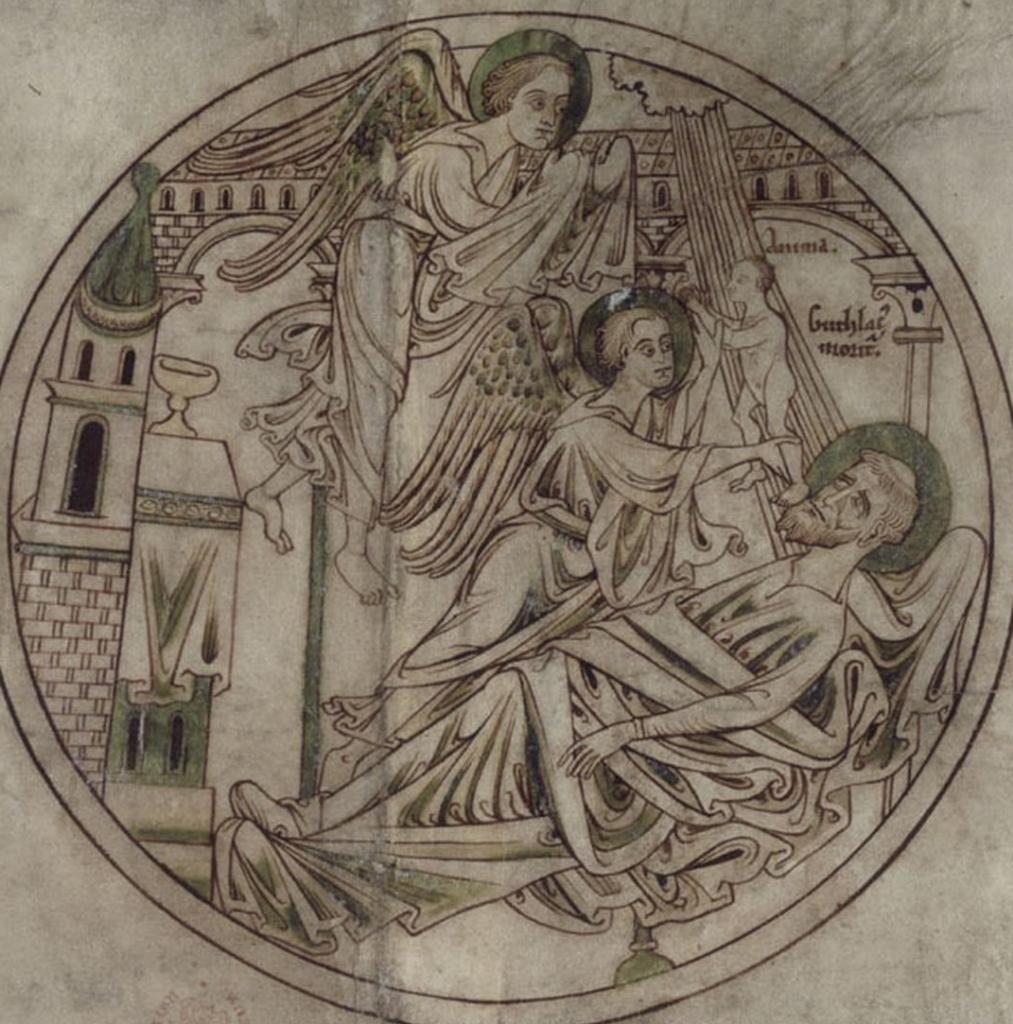
What stories did he reflect on, if Felix's description has any basis in reality? It would be wonderful to know. Perhaps the tales of his ancestors in the tribe of the Guthlacingas, or the kings of the royal line of Mercia - but those stories are all lost to us, and we can only speculate. Whatever it was, the sudden awareness of death brought about a great change in Guthlac: he gave up his military life and became first a monk at Repton and then a hermit at Crowland, exchanging battles with the king's enemies for fierce struggles against demons. His story was vividly brought to life by a later Crowland artist, working probably at the beginning of the thirteenth century, who produced a series of pictures illustrating Guthlac's life on a long roll of parchment (now British Library Harley Roll Y. 6). Above is Guthlac bidding farewell to a soldier's life; then we see him receiving the tonsure at Repton:


The Crowland artist has fudged the truth here in showing Guthlac receiving the tonsure from a bishop; Repton was a double monastery (i.e. for men and women) under the rule of an abbess, and the Life is clear that Guthlac received the tonsure under Abbess Ælfthryth. I wrote about Repton, still a fantastically evocative place for imagining Guthlac's Mercia, here.

Then we see Guthlac, looking pensive, arriving at Crowland in the wilds of the Lincolnshire fens, on St Bartholomew's Day 699:


(Compare the same scene rendered in stone at Crowland). Guthlac established a hermitage for himself in an earthen mound, and there he underwent many trials, including being assailed by devils which were vividly imagined by the Crowland artist:


He overcame the devils with the help of St Bartholomew, his patron, and became a miracle-worker and counsellor to kings. You can see illustrations of all this in the Guthlac Roll.


After he died and was buried at Crowland, a monastery was later founded at the site of his hermitage. As well as the Life written by Felix, there are two Old English poems about him, and a post-Conquest account, produced by Orderic Vitalis at the direction of the monks of Crowland, who were ever enthusiastic workers in Guthlac's cause. This is what Crowland Abbey looks like today, a magnificent structure even now it's half in ruins:


Here, and at a number of other churches named for him in Lincolnshire, Guthlac was long venerated. And thus, in fleeing glory, he won himself fame which has lasted 1300 years.