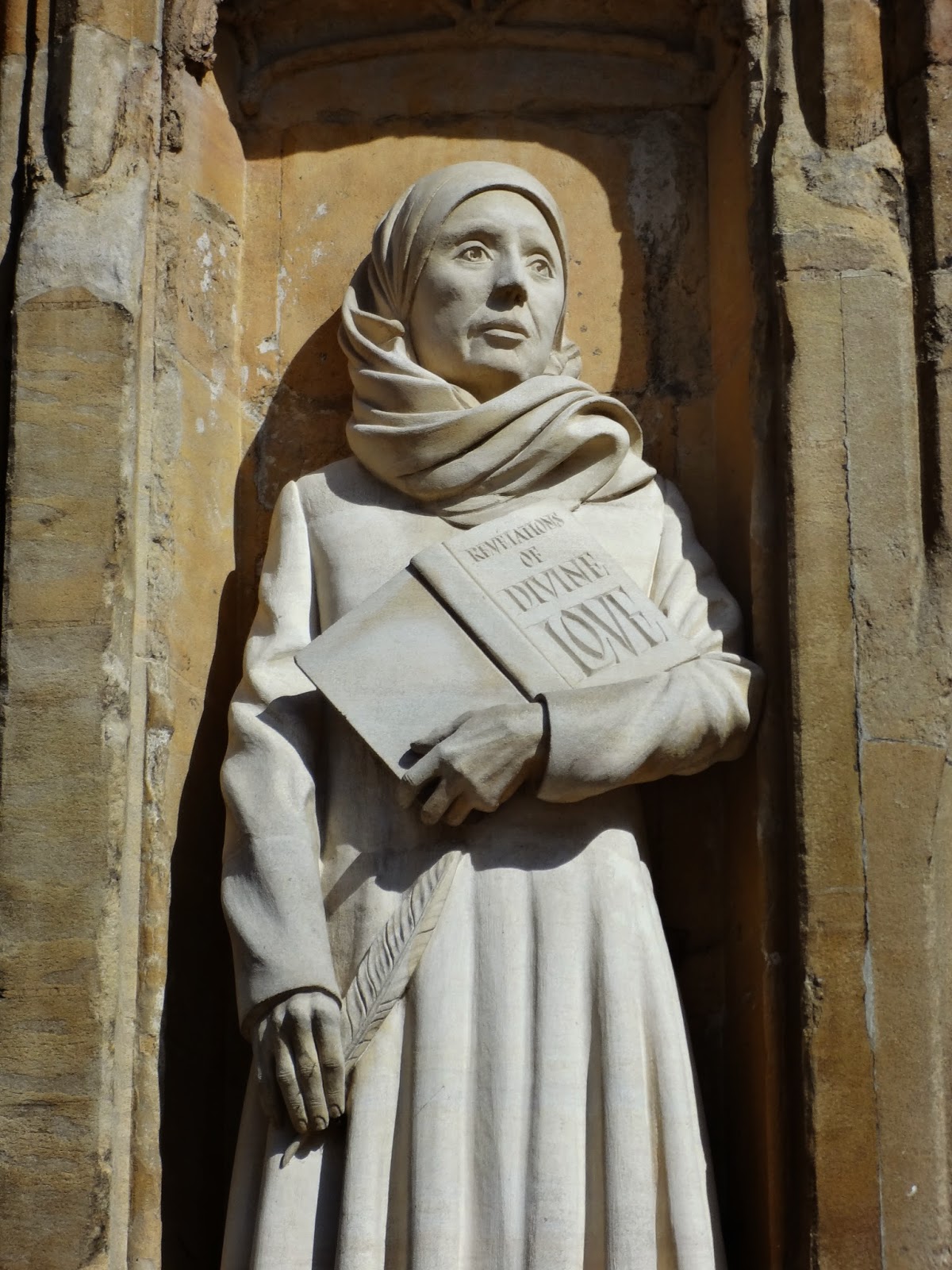
Showing posts with label Julian of Norwich. Show all posts

Wednesday, 12 February 2014

'They find St Julian’s house, which wayfaring men earnestly seek'


Since today is the feast-day of St Julian the Hospitaller, patron saint of pilgrims and travellers, I was reminded of the following passage from Ancrene Wisse, the thirteenth-century guide for anchorites. This comes from the beginning of Part 6.

Threo manere men of Godes i-corene livieth on eorthe: the ane mahe beon to gode pilegrimes i-evenet; the othre, to deade; the thridde, to i-hongede with hare gode wil o Jesuse rode. The forme beoth gode; the othre beoth betere; the thridde best of alle.

To the forme gredeth Seinte Peter inwardliche, Obsecro vos, tanquam advenas et peregrinos, ut abstineatis vos a carnalibus desideriis, que militant adversus animam. "Ich halsi ow," he seith, "as el-theodie ant pilegrimes, thet ye withhalden ow from fleschliche lustes the weorrith ayein the sawle." The gode pilegrim halt eaver his rihte wei forth-ward. Thah he seo other here idele gomenes ant wundres bi the weie, he ne edstont nawt as foles doth, ah halt forth his rute ant hiheth toward his giste. He ne bereth na gersum bute his speonse gnedeliche, ne clathes bute ane theo thet him to neodeth. This beoth hali men the, thah ha beon i the world, ha beoth th'rin as pilegrimes ant gath with god lif-lade toward te riche of heovene, ant seggeth with the Apostle, Non habemus hic manentem civitatem, set futuram inquirimus - thet is, "nabbe we na wununge her, ah we secheth other." Beoth bi the leaste thet ha mahen, ne ne haldeth na tale of na worltlich frovre, thah ha beon i worltlich wei - as ich seide - of pilegrim, ah habbeth hare heorte eaver toward heovene, ant ahen wel to habben. For other pilegrimes gath [i] muche swinc to sechen ane sontes banes, as Sein James other Sein Giles, ah theo pilegrimes the gath toward heovene, ha gath to beon i-sontet, ant to finden Godd seolf ant alle his hali halhen, liviende i blisse, ant schulen livien with him i wunne buten ende. Ha i-findeth i-wis Sein Julienes in, the wei-fearinde men yeornliche bisecheth.

Nu beoth theose gode, ah yet beoth the othre betere, for allegate pilegrimes, as ich ear seide, al gan ha eaver forth-ward, ne bicumen burh-men i the worldes burh, ham thuncheth sum-chearre god of thet ha seoth bi weie, ant edstuteth sum-deal, thah ha ne don mid alle, ant moni thing ham falleth to hwer-thurh ha beoth i-lette, swa thet - mare hearm is! - sum kimeth leate ham, sum neaver mare. Hwa is thenne skerre, ant mare ut of the world then pilegrimes? - thet is to seggen, then theo men the habbeth worltlich thing ant ne luvieth hit nawt, ah yeoveth hit as hit kimeth ham, ant gath untrusset, lihte as pilegrimes doth toward heovene? Hwa beoth betere thene theos? Godd wat, theo beoth betere the the Apostle speketh to, ant seith in his epistle, Mortui estis et vita vestra abscondita est cum Christo in Deo. Cum autem apparuerit vita vestra, tunc et vos apparebitis cum ipso in gloria. "Ye beoth deade ant ower lif is i-hud mid Criste. Hwen he thet is ower lif eadeaweth ant springeth as the dahunge efter nihtes theosternesse, ant ye schulen with him springen schenre then the sunne into eche blisse." The nu beoth thus deade, hare lif-lade is herre, for pilegrim eileth moni-hwet. The deade nis noht of, thah he ligge unburiet ant rotie buven eorthe. Preise him, laste him, do him scheome, sei him scheome - al him is i-liche leof. This is a seli death thet maketh cwic mon thus, other cwic wummon, ut of the worlde. Ah sikerliche hwa-se is thus dead in hire-seolven, Godd liveth in hire heorte. For this is thet te Apostle seith, Vivo ego iam non ego. Vivit autem in me Christus. "Ich livie - nawt ich, ah Crist liveth in me" thurh his in-wuniende grace, ant is as thah he seide, "worltlich speche, worltlich sihthe, ant euch worltlich thing i-findeth me deade. Ah thet te limpeth to Crist, thet ich seo ant here, ant wurche i cwicnesse." Thus riht is euch religius dead to the worlde ant cwic thah to Criste.

This is an heh steire, ah yet is thah an herre. Ant hwa stod eaver th'rin? Godd wat, the the seide, Michi absit gloriari nisi in cruce Domini mei, Jesu Christi, per quam michi mundus crucifixus est et ego mundo. This is thet ich seide th'ruppe: "Crist me schilde for-te habben eani blisse i this world bute i Jesu Cristes rode, mi Laverd, thurh hwam the world is me unwurth, ant ich am unwurth hire, as weari the is ahonget." A, Laverd, hehe stod he the spec o thisse wise. Ant this is ancre steire thet ha thus segge, Michi autem absit gloriari, et cetera. "I na thing ne blissi ich me bute i Godes rode, thet ich tholie nu wa ant am i-tald unwurth as Godd wes o rode." Lokith, leove sustren, hu this steire is herre then eani beo of the othre. The pilegrim i the wor[l]des wei, thah he ga forth-ward toward te ham of heovene, he sith ant hereth unnet, ant speketh umbe-hwile, wreatheth him for weohes, ant moni thing mei letten him of his jurnee. The deade nis na mare of scheome then of menske, of heard then of nesche, for he ne feleth nowther, ant for-thi ne ofearneth he nowther wa ne wunne. Ah the the is o rode ant haveth blisse th'rof, he wendeth scheome to menske ant wa into wunne, ant ofearneth for-thi hure over hure. This beoth theo the neaver ne beoth gleade i-heortet bute hwen ha tholieth sum wa other sum scheome with Jesu on his rode. For this is the selhthe on eorthe, hwa-se mei for Godes luve habben scheome ant teone. Thus, lo, rihte ancres ne beoth nawt ane pilegrimes, ne yet nawt ane deade, ah beoth of theos thridde. For al hare blisse is for-te beon ahonget sariliche ant scheomeliche with Jesu on his rode.

'Three kinds of men of God’s chosen ones live on earth: one may be likened to good pilgrims; another to the dead; the third to men who are voluntarily hanged on Jesus’ cross. The first are good, the second are better, and the third are best of all.

St Peter cried out to the first sort from the heart, Obsecro vos, tanquam advenas et peregrinos, ut abstineatis vos a carnalibus desideriis, que militant adversus animam. I implore you, he says, as foreigners and pilgrims, abstain from carnal lusts, which wage war against the soul. The good pilgrim always keeps on the direct road forward. Although he may see or hear idle games and marvels along the way, he does not stop, as fools do, but keeps on his road and hastens towards his lodging. He does not carry any treasure except his frugal expenses, and no clothes except only those which are necessary to him. These are holy men who, though they live in the world, live in it as pilgrims, and travel in a good way of living towards the kingdom of heaven, and say with the apostle, Non habemus hic manentem civitatem, set futuram inquirimus; that is, we do not have a dwelling here, but we seek another. They make do with the least they can, and do not set any store by earthly comfort, though they are on the worldly road, as I said, as pilgrims; but their hearts are always directed towards heaven, and well they ought to be. For other pilgrims travel with great labour to seek the bones of a single saint, such as St James or St Giles, but these pilgrims, who travel towards heaven, go to be made saints and to find God himself and all his holy hallows living in glory, and will live with him in joy without end. They truly find St Julian’s house, which wayfaring men earnestly seek.

Now these men are good, but the other sort are still better: because invariably pilgrims, as I said before, although they keep going forwards and do not become residents in the city of the world, on occasion something they see by the road looks attractive to them and they stop for a while, though not permanently, and many things happen to them by means of which they are hindered, with the result – more’s the pity! – that some get home late, and some never at all. Who then is holier and more out of the world than pilgrims? That is to say, than those men who have worldly possessions and do not care for them, but give them away as they come to them, and travel light, unburdened, as pilgrims do towards heaven? Who are better than these? God knows they are better whom the apostle speaks to, saying in his epistle, Mortui estis et vita vestra abscondita est cum Christo in Deo. Cum autem apparuerit vita vestra, tunc et vos apparebitis cum ipso in gloria. You are dead and your life is hidden in Christ. When he who is your life appears again and rises like the day after the darkness of the night, you will rise with him, brighter than the sun, into eternal glory. The life of those who are now dead in this way is more exalted. For many things afflict pilgrims. It does not matter to the dead man if he lies unburied and rots above the ground – praise him, blame him, mistreat him, revile him, it is all equally dear to him. It is a blessed death which makes living men like this, or living women, separate from the world; but certainly whoever is dead in this way, God lives in her heart, for this is what the apostle says, Vivo ego iam non ego. Vivit autem in me Christus: I live; not I, but Christ lives in me through his indwelling grace; and it is as though he said, earthly speech, earthly vision and every earthly thing finds me dead; but that which belongs to Christ, that I see and hear and do in lively fashion. To this extent every religious person is dead to the world and yet alive to Christ.

This is a noble level, but there is one still more exalted. And who always stands there? God knows it is he who said, Michi absit gloriari nisi in cruce Domini mei, Jesu Christi, per quam michi mundus crucifixus est et ego mundo; this is what I said previously, Christ keep me from having any joy in this world except in the cross of Jesus Christ my Lord, through whom the world is worthless to me and I am worthless to it, like a criminal who is hanged. Ah, Lord, he stood high who spoke thus! And this is the level of an anchorite who has said in this way: Michi autem absit gloriari, et cetera: I glory in nothing except the cross of God, so that I now endure pain and am considered worthless as God was on the cross. Look, dear sisters, how this level is higher than any of the others is. The pilgrim on the way of the world, though he travels forward towards his home in heaven, sees and hears – and speaks, at times – what is unprofitable, and becomes angry because of injuries; and many things may hinder him from his journey. The dead man cares no more for shame than for honour, for the rough than for the smooth, because he feels neither; and so he earns neither grief nor joy; but he who is on the cross and has glory on that account, he turns shame into honour and grief into joy, and earns an outstanding reward thereby. These are the people who are never glad at heart except when they are suffering some pain or some shame with Jesus on his cross. And so this is bliss on earth, to have shame and hurt for God’s love. See then, true anchorites are not pilgrims, nor yet one of the dead, but they are of the third kind: because all their joy is to be hanged painfully and shamefully with Jesus on his cross.'

Pilgrims (Canterbury Cathedral)

The anonymous author of Ancrene Wisse is a superb writer of prose, with a flexible style which moves fluidly between high rhetoric and the rhythm and syntax of everyday speech, between the technical language of theology and ordinary English diction. Rhetorically speaking, this is my favourite bit:
Nu beoth theose gode, ah yet beoth the othre betere, for allegate pilegrimes, as ich ear seide, al gan ha eaver forth-ward, ne bicumen burh-men i the worldes burh, ham thuncheth sum-chearre god of thet ha seoth bi weie, ant edstuteth sum-deal, thah ha ne don mid alle, ant moni thing ham falleth to hwer-thurh ha beoth i-lette, swa thet - mare hearm is! - sum kimeth leate ham, sum neaver mare. Hwa is thenne skerre, ant mare ut of the world then pilegrimes? - thet is to seggen, then theo men the habbeth worltlich thing ant ne luvieth hit nawt, ah yeoveth hit as hit kimeth ham, ant gath untrusset, lihte as pilegrimes doth toward heovene?

Now these men are good, but the other sort are still better: because invariably with pilgrims, as I said before, although they keep going forwards and do not become residents in the city of the world, on occasion something they see by the road looks attractive to them and they stop for a while, though not permanently, and many things happen to them by means of which they are hindered, with the result – more’s the pity! – that some get home late, and some never at all. Who then is holier and more out of the world than pilgrims? That is to say, than those men who have worldly possessions and do not care for them, but give them away as they come to them, and travel light, unburdened, as pilgrims do towards heaven?
I love the thought of pilgrims going 'untrussed', unburdened by the things of the world. His unidealised view of pilgrims - heading to heaven, but easily distracted by 'idle games and marvels' beside the roadside - is appealing and recognisable. But the extract which reminded me of this passage today was:
For other pilegrimes gath i muche swinc to sechen ane sontes banes, as Sein James other Sein Giles, ah theo pilegrimes the gath toward heovene, ha gath to beon i-sontet, ant to finden Godd seolf ant alle his hali halhen, liviende i blisse, ant schulen livien with him i wunne buten ende. Ha i-findeth i-wis Sein Julienes in, the wei-fearinde men yeornliche bisecheth.

For other pilgrims travel with great labour to seek the bones of a single saint, such as St James or St Giles, but these pilgrims, who travel towards heaven, go to be made saints and to find God himself and all his holy hallows living in glory, and will live with him in joy without end. They truly find St Julian’s house, which wayfaring men earnestly seek.

The distinction is between going to seek 'ane sontes banes' and going 'to beon i-sontet' (to seek saints and to be 'sainted', i.e. 'made saints'); the contrasting emphasis falls beautifully on the little words, ane and beon.

The author's discussion of the three kinds of model which a holy person can follow - pilgrim, dead man, sufferer on the cross - is based on a sermon by Bernard of Clairvaux, but the saints' names here are his own addition. James, Giles and Julian were the three saints most closely associated with pilgrimage in the thirteenth century - James in particular, the archetypal pilgrim with his scrip and cockle-shell. St Julian was known instead as an accommodator of pilgrims, as a result of the legend about his life which grew up in the thirteenth century. There's a useful overview of his story here. According to the Golden Legend, Julian learned as a young man that he was destined to kill his parents. Trying to escape his fate, he fled his home (that never works, Julian!) and settled in a distant country. He got married, but one day when he was away from home his parents arrived at his house and his wife, fatally hospitable, gave them her own bed to sleep in. When Julian returned and saw the sleeping couple, he thought it was his wife in bed with another man, and so he killed them both. In penance for his sin he built hospitals and lodgings for travellers, and ferried pilgrims across the river - on one occasion, as depicted at the top of this post and below, he ferried Christ in disguise as a leper, and was told by him that his sin was forgiven.


St Julian therefore became a patron of pilgrims and travellers, a byword for hospitality - Chaucer says of his Franklin, who loves sharing the pleasures of the table and keeps open house for half the neighbourhood, that 'an housholdere, and that a greet, was he; Seint Julian was he in his contree'. And so in Ancrene Wisse 'St Julian's house' is heaven, the destination of wayfarers, a permanent lodging-place for those who pass as strangers and pilgrims through this world. Pilgrims travel to their 'home in heaven', but that journey is best made, Ancrene Wisse argues, not by travellers but by anchorites, who seek God in one fixed and steadfast place. In that dwelling, as a later English anchorite - another Julian - wrote, they find the union with God which means he becomes infinitely intimate, homely, with the soul: 'for in us is His homeliest home'.

Tuesday, 7 May 2013

Some Miracles of St John of Beverley: 'an hende neybur and of our knowyng'


7 May is the feast of the Anglo-Saxon bishop St John of Beverley (shown with cross and mitre in the image above), who died in 721. Most of our evidence for John's life is provided by Bede - John actually ordained Bede, as a deacon and a priest, which is itself a pretty good claim to fame! John was educated under St Hilda at Whitby, became Bishop of Hexham and then of York, and in old age retired to a monastic life at Beverley, where he was buried. Bede describes a number of his miracles of healing, but his posthumous reputation was nonetheless far out of proportion to the rather scanty evidence for his life, and by the later Middle Ages his shrine attracted pilgrims from all over England. Two colourful miracle stories illustrate the vitality of his legend, centuries after his death. First, a miracle recorded by William of Malmesbury in the first half of the twelfth century:

John, a man of exemplary virtue, finds a well-known eulogist, Bede, in his History of the English. But he lives up to his praises even now, and his miracles are not yet over. The most noteworthy is the one made into a show by the inhabitants of Beverley, where he lies buried. Savage bulls are brought up, tied fast, by strong men sweating profusely; but as soon as they enter the churchyard they lose all their ferocity and become, you might suppose, no more than innocent sheep. So they are untied and left to frolic in the yard, though previously they used to go for anything in their way with horns and hooves.
William of Malmesbury, Gesta Pontificum Anglorum, ed. and trans. Michael Winterbottom and R. M. Thomson (Oxford, 2007), vol. I, pp.373-5.

John of Beverley in a 15th-century window, All Souls' chapel, Oxford

And another miracle from a letter of Edward I, written in 1301 to demonstrate the ancient history of England's rights over Scotland (despite the reference to Athelstan, the story is not attested before the mid-twelfth century):

It is worthy to be remembered that this same Athelstan, on the intercession of St John of Beverley, formerly archbishop of York, overcame the Scots who were in rebellion against him. Devoutly giving thanks to God, he besought Him in prayer that by the intervention of the blessed John he would show him some manifest sign, by which men present and to come could recognise that the Scots were rightly subject to the realm of England. When he saw some overhanging crags at a place near Dunbar, in Scotland, he drew his sword from its scabbard and smote upon the rock, which at the blow of the sword, by reason of God’s providence, was so hollowed out that the measure of an ell can be fitted in the length of it, and it may still be seen as a manifest record of this event. The deed is recited in the church of Beverley, every week throughout the year, as a miracle for the praise and honour of St John, when the life of St John is read, and there exists to the present day a solemn commemoration of it, both in England and in Scotland.
Anglo-Scottish Relations 1174-1328, Some Selected Documents, ed. and trans. E. L. G. Stones (London, 1965), p.99.

Tamer of bulls and bulwark of English imperial ambition - it's something of a mystery how a humble Anglo-Saxon bishop gained such a reputation! Rather more in keeping with what John and Bede might have wanted is Julian of Norwich, writing nearly 700 years after John's death, who describes how a vision of this saint was revealed to her:

For in thys syte myn understondyng was lift up into Hevyn, and than God browte merily to my minde David and other in the Old Law without numbre. And in the New Law He browte to my mynd first Mary Magdalen, Peter and Paul, and Thomas of Inde, and Saynt John of Beverly, and other also without noumbre, how thei are knowen in the church in erth with ther synnes, and it is to hem no shame, but al is turnyd hem to worship. And therfore our curtes Lord shewith for them here in party like as it is there in fulhede. For ther the token of synne is turnyd to worshippe.

And Seynt John of Beverley, our Lord shewid hym ful heyly in comfort to us for homlyhed, and browte to my mynde how he is an hende neybor and of our knowyng. And God called hym Seynt John of Beverley pleynly as we doe, and that with a full glad, swete chere, shewyng that he is a ful hey seynt in Hevyn in His syght, and a blisfull. And with this he made mention that in his youngth and in his tendyr age he was a derworthy servant to God, mekyl God lovand and dredand; and nevertheless God suffrid him to fall, hym mercyfully kepand that he perishid not ne lost no tyme. And afterward God reysyd hym to manyfold more grace; and be the contrition and mekenes that he had in his living, God hat goven hym in Hevyn manyfold joyes overpassing that he shuld hav had if he had not fallen. And that thys is soth, God shewith in erth with plentiuous miracles doyng aboute his body continuly. And al was this to make us glad and mery in love.
[In this vision my understanding was lifted up into Heaven, and then God brought joyfully to my mind David and others of the Old Law, without number. And of the New Law he brought to my mind first Mary Magdalen, Peter and Paul, and Thomas of India, and St John of Beverley, and others also without number, how they are known in the church on earth together with their sins, and that is no shame to them, but all is turned into honour. And therefore our courteous Lord showed this of them here in part, as it is there in fullness. For there the token of sin is turned to honour.

And St John of Beverley, our Lord showed him in glory as a comfort to us because of his familiarity, and brought to my mind how he is a kindly neighbour and known to us. And God called him 'St John of Beverley' simply, as we do, and did so with a very glad, sweet expression, showing that he is a very high saint in heaven in his sight, and a blissful one. And with this he made mention that in his youth and in his tender age he was a beloved servant of God, greatly loving and fearing God, and nevertheless God permitted him to fall, keeping him mercifully so that he did not perish nor was ever lost. And afterwards God raised him to manifold times more grace, and by the contrition and meekness which he had in his life, God has given him in heaven manifold joys surpassing those he should have had if he had not fallen. And that this is true, God shows on earth with plenteous miracles being done around his body constantly. And all this was to make us glad and merry in love.]

At first glance it's not quite clear why John of Beverley, of all English saints, should appear to Julian in the role of a comfortably familiar 'neighbour'; Beverley may be closer to Norwich than St Thomas' India, but it's still not exactly next door. However, one of the two different dates given in the manuscript sources for Julian's recovery from illness, and the visions which followed, is May 8, the day following the feast of St John of Beverley. Perhaps she felt close to John not only because he was a saint of her own country, but because she related her recovery from illness to his intercession. These days in some church calendars her own feast now follows his - so they're neighbours in another way.

Monday, 10 December 2012

Three Thoughts: Worlds and Perspectives

I

Thomas Traherne, Centuries of Meditations, 1:19.


You never know yourself till you know more than your body. The Image of God was not seated in the features of your face, but in the lineaments of your Soul. In the knowledge of your Powers, Inclinations, and Principles, the knowledge of yourself chiefly consisteth; which are so great that even to the most learned of men, their Greatness is Incredible, and so Divine, that they are infinite in value.

Alas, the world is but a little centre in comparison of you! Suppose it millions of miles from the Earth to the Heavens, and millions of millions above the stars, both here and over the heads of our Antipodes, it is surrounded with infinite and eternal space; And like a gentleman's house to one that is travelling, it is a long time before you come unto it, you pass it in an instant, and leave it for ever. The Omnipresence and Eternity of God are your fellows and companions, and all that is in them ought to be made your familiar Treasures. Your understanding comprehends the World like the dust of a balance, measures Heaven with a span, and esteems a thousand years but as one day.


II

Bede, Historia ecclesiastica, II:13, reporting words supposedly spoken in 627 by one of the men of King Edwin of Northumbria, as they discussed the question of converting to Christianity.


O king, it seems to me that this present life of man on earth, in comparison to that time which is unknown to us, is as if you were sitting at table in the winter with your ealdormen and thegns, and a fire was kindled and the hall warmed, while it rained and snowed and stormed outside. A sparrow came in, and swiftly flew through the hall; it came in at one door, and went out at the other. Now during the time when he is inside, he is not touched by the winter's storms; but that is the twinkling of an eye and the briefest of moments, and at once he comes again from winter into winter. In such a way the life of man appears for a brief moment; what comes before, and what will follow after, we do not know. Therefore if this doctrine offers anything more certain or more fitting, it is right that we follow it.


III

Julian of Norwich, Revelations of Divine Love, chapter 5

And in þis he shewed me a lytil thyng þe quantite of a hasyl nott, lyeng in þe pawme of my hand as it had semed, and it was as rownde as eny ball. I loked þer upon wt þe eye of my vnderstondyng, and I þought, 'What may þis be?' And it was answered generally thus: 'It is all þat is made.' I merueled howe it myght laste, for me þought it myght sodenly haue fall to nought for lytyllhed. & I was answered in my vnderstondyng: 'It lastyth & euer shall for god louyth it, and so hath all thyng his begynning by þe loue of god.' In this lytyll thyng I sawe thre propertees. The fyrst is þt god made it, þe secunde is þet god louyth it, & þe þrid is, þat god kepith it.

[And in this he shewed me a little thing, the size of a hazelnut, lying in the palm of my hand, as it seemed, and it was as round as a ball. I looked upon it with the eye of my understanding, and I thought, 'What can this be?' And it was fully answered thus: 'It is all that is made.' I marvelled how it could survive, for it seemed to me that it could suddenly have fallen into nothing, it was so little. And I was answered, in my understanding: 'It survives, and ever shall, because God loves it; and so everything has its beginning because of the love of God.' In this little thing I saw three properties. The first is that God made it, the second is that God loves it, and the third is that God keeps it.]


God creating the earth, from British Library MS. Royal 17 E VII

Monday, 5 November 2012

Pope Benedict on Julian of Norwich

So, I see today that Julian of Norwich - and those who study her - have been added to the list of things Catholic bloggers don't approve of.  That list just keeps on growing, doesn't it?  I can hardly keep up.  Poor Julian, to be blamed for the opinions of those who love her!  It's true she's a darling of 'liberal' Christians, but that's hardly her fault; no one could object to her theology of the Trinity, of the Passion, of anything.  It's just as well the Pope has more wisdom, and has spoken warmly of her work; I hate to hear her sneered at, and was heartened to re-read his words on Julian, given at an audience in December 2010:


Dear Brothers and Sisters,

I still remember with great joy the Apostolic Journey I made in the United Kingdom last September. England is a land that has given birth to a great many distinguished figures who enhanced Church history with their testimony and their teaching. One of them, venerated both in the Catholic Church and in the Anglican Communion, is the mystic Julian of Norwich, of whom I wish to speak this morning.

The - very scant - information on her life in our possession comes mainly from her Revelations of Divine Love in Sixteen Showings, the book in which this kindly and devout woman set down the content of her visions.

It is known that she lived from 1342 until about 1430, turbulent years both for the Church, torn by the schism that followed the Pope’s return to Rome from Avignon, and for the life of the people who were suffering the consequences of a long drawn-out war between the Kingdoms of England and of France. God, however, even in periods of tribulation, does not cease to inspire figures such as Julian of Norwich, to recall people to peace, love and joy.

As Julian herself recounts, in May 1373, most likely on the 13th of that month, she was suddenly stricken with a very serious illness that in three days seemed to be carrying her to the grave. After the priest, who hastened to her bedside, had shown her the Crucified One not only did Julian rapidly recover her health but she received the 16 revelations that she subsequently wrote down and commented on in her book, Revelations of Divine Love.

And it was the Lord himself, 15 years after these extraordinary events, who revealed to her the meaning of those visions.

“‘Would you learn to see clearly your Lord’s meaning in this thing? Learn it well: Love was his meaning. Who showed it to you? Love.... Why did he show it to you? For Love’.... Thus I was taught that Love was our Lord’s meaning” (Julian of Norwich, Revelations of Divine Love, Chapter 86).

Inspired by divine love, Julian made a radical decision. Like an ancient anchoress, she decided to live in a cell located near the church called after St Julian, in the city of Norwich - in her time an important urban centre not far from London.

She may have taken the name of Julian precisely from that Saint to whom was dedicated the church in whose vicinity she lived for so many years, until her death.

This decision to live as a “recluse”, the term in her day, might surprise or even perplex us. But she was not the only one to make such a choice. In those centuries a considerable number of women opted for this form of life, adopting rules specially drawn up, for them, such as the rule compiled by St Aelred of Rievaulx.

The anchoresses or “recluses”, in their cells, devoted themselves to prayer, meditation and study. In this way they developed a highly refined human and religious sensitivity which earned them the veneration of the people. Men and women of every age and condition in need of advice and comfort, would devoutly seek them. It was not, therefore, an individualistic choice; precisely with this closeness to the Lord, Julian developed the ability to be a counsellor to a great many people and to help those who were going through difficulties in this life.

We also know that Julian too received frequent visitors, as is attested by the autobiography of another fervent Christian of her time, Margery Kempe, who went to Norwich in 1413 to receive advice on her spiritual life. This is why, in her lifetime, Julian was called “Dame Julian”, as is engraved on the funeral monument that contains her remains. She had become a mother to many.

Men and women who withdraw to live in God’s company acquire by making this decision a great sense of compassion for the suffering and weakness of others. As friends of God, they have at their disposal a wisdom that the world - from which they have distanced themselves - does not possess and they amiably share it with those who knock at their door.

I therefore recall with admiration and gratitude the women and men's cloistered monasteries. Today more than ever they are oases of peace and hope, a precious treasure for the whole Church, especially since they recall the primacy of God and the importance, for the journey of faith, of constant and intense prayer.

It was precisely in the solitude infused with God that Julian of Norwich wrote her Revelations of Divine Love. Two versions have come down to us, one that is shorter, probably the older, and one that is longer. This book contains a message of optimism based on the certainty of being loved by God and of being protected by his Providence.

In this book we read the following wonderful words: “And I saw full surely that ere God made us he loved us; which love was never lacking nor ever shall be. And in this love he has made all his works; and in this love he has made all things profitable to us; and in this love our life is everlasting... in which love we have our beginning. And all this shall we see in God, without end” (Revelations of Divine Love, Chapter 86).

The theme of divine love recurs frequently in the visions of Julian of Norwich who, with a certain daring, did not hesitate to compare them also to motherly love. This is one of the most characteristic messages of her mystical theology.

The tenderness, concern and gentleness of God’s kindness to us are so great that they remind us, pilgrims on earth, of a mother’s love for her children. In fact the biblical prophets also sometimes used this language that calls to mind the tenderness, intensity and totality of God’s love, which is manifested in creation and in the whole history of salvation that is crowned by the Incarnation of the Son.

God, however, always excels all human love, as the Prophet Isaiah says: “Can a woman forget her sucking child, that she should have no compassion on the son of her womb? Even these may forget, yet I will never forget you” (Is 49:15).

Julian of Norwich understood the central message for spiritual life: God is love and it is only if one opens oneself to this love, totally and with total trust, and lets it become one's sole guide in life, that all things are transfigured, true peace and true joy found and one is able to radiate it.

I would like to emphasize another point. The Catechism of the Catholic Church cites the words of Julian of Norwich when it explains the viewpoint of the Catholic faith on an argument that never ceases to be a provocation to all believers (cf. nn. 304-313, 314).

If God is supremely good and wise, why do evil and the suffering of innocents exist? And the Saints themselves asked this very question. Illumined by faith, they give an answer that opens our hearts to trust and hope: in the mysterious designs of Providence, God can draw a greater good even from evil, as Julian of Norwich wrote: “Here I was taught by the grace of God that I should steadfastly hold me in the Faith ... and that ... I should take my stand on and earnestly believe in ... that ‘all manner of thing shall be well”’ (The Revelations of Divine Love, Chapter 32).

Yes, dear brothers and sisters, God’s promises are ever greater than our expectations. If we present to God, to his immense love, the purest and deepest desires of our heart, we shall never be disappointed. “And all will be well”, “all manner of things shall be well”: this is the final message that Julian of Norwich transmits to us and that I am also proposing to you today. Many thanks.

Monday, 29 October 2012

'Page after page of jewels of mystical literature glow with this intimate and impassioned love...'

This morning I've been admiring the work of someone who is uploading the entirety of the Cloud of Unknowing on youtube - quite an undertaking!  The text is Evelyn Underhill's 1922 'translation' of the Cloud, which is not really a translation at all - it's very close indeed to the Middle English (a strategy I thoroughly approve of).  Find it here, and enjoy.

While we're on the subject of medieval mystics, I don't think I've yet linked here to my own reading of a short extract from Julian of Norwich - which is definitely in Middle English, or as close as I could manage...  It's not brilliant, but somebody might find it interesting.

And this related video is good too: 'The mystic is "in love with the Absolute" not in any idle or sentimental manner, but in that deep and vital sense which presses forward at all costs and through all dangers towards union with the object beloved...'

Sunday, 13 May 2012

What Julian of Norwich said to Margery Kempe

Julian on the west front of Norwich Cathedral

Julian of Norwich is variously commemorated on the 8th or the 13th of May, the alternatives being the two dates given in different manuscript sources for the beginning of her revelations. I like Julian very much – who doesn’t! – and have posted about her a number of times. Today I thought I’d post something a little different: not an extract from her book, but an account of a conversation with her. This shows her acting almost as a spiritual director, as anchorites were occasionally called on to do, and gives us her words filtered through the impressions of a woman whose spirituality was very unlike her own.

Some time around the year 1413, a few years before the likely date of Julian’s death, Margery Kempe came to pay her a visit in her cell in Norwich (on which, see this post). To give you some sense of their relative ages, Margery Kempe was born around the same year (1373) that Julian had her first revelations at the age of thirty. Though both deeply devout women, their lives could hardly have been more different. Margery was married, the mother of fourteen children, a businesswoman, a widely travelled pilgrim who had been to Jerusalem and Rome; she composed an extraordinarily frank and vivid book about her life, telling of her struggles, her journeys, her visions, her failures, her many clashes with those who would not accept her own particular take on the religious life she wanted to live. Julian, by contrast, tells us almost nothing about herself, and all we know of her life is bounded by the limits of one tiny cell in Norwich. But her mind, and her desire to understand the deepest questions of existence, knew no limits. Hers was a hidden life of prayer and thought, entirely devoted to reasoning out the meaning of a series of revelations from God which she received that one day when she was thirty. 'Love was his meaning', she concluded at last, a meaning that encompassed many other truths; and that has been her legacy.

In her advice to Margery Kempe (at least as Kempe reports it) Julian gives counsel on some of the subjects which occur again and again in Kempe’s account of her life. As a laywoman struggling to find validation for her own form of intense religion devotion, Margery wanted to be exactly told what Julian tells her here: the importance of trusting to personal inspiration, the value of chastity, and the holiness of devout tears (Margery Kempe was notorious for bursting into noisy tears during Mass, much to the annoyance of her neighbours). It's reassuring and affirming counsel, and so Margery clearly received it.

Stained glass from St Julian's church, Norwich

The text is from here, and my translation follows.

And than sche was bodyn be owyr Lord for to gon to an ankres in the same cyté whych hyte Dame Jelyan. And so sche dede and schewyd hir the grace that God put in hir sowle of compunccyon, contricyon, swetnesse and devocyon, compassyon wyth holy meditacyon and hy contemplacyon, and ful many holy spechys and dalyawns that owyr Lord spak to hir sowle, and many wondirful revelacyons whech sche schewyd to the ankres to wetyn yf ther wer any deceyte in hem, for the ankres was expert in swech thyngys and good cownsel cowd gevyn.

The ankres, heryng the mervelyows goodnes of owyr Lord, hyly thankyd God wyth al hir hert for hys visitacyon, cownselyng this creatur to be obedyent to the wyl of owyr Lord God and fulfyllyn wyth al hir mygthys whatevyr he put in hir sowle yf it wer not ageyn the worshep of God and profyte of hir evyn cristen, for, yf it wer, than it wer nowt the mevyng of a good spyryte but rathyr of an evyl spyrit. The Holy Gost mevyth nevyr a thing ageyn charité, and, yf he dede, he wer contraryows to hys owyn self, for he is al charité. Also he mevyth a sowle to al chastnesse, for chast levars be clepyd the temple of the Holy Gost, and the Holy Gost makyth a sowle stabyl and stedfast in the rygth feyth and the rygth beleve. And a dubbyl man in sowle is evyr unstabyl and unstedfast in al hys weys. He that is evyrmor dowtyng is lyke to the flood of the see, the whech is mevyd and born abowte wyth the wynd, and that man is not lyche to receyven the gyftys of God.
What creatur that hath thes tokenys he muste stedfastlych belevyn that the Holy Gost dwellyth in hys sowle. And mech mor, whan God visyteth a creatur wyth terys of contrisyon, devosyon, er compassyon, he may and owyth to levyn that the Holy Gost is in hys sowle. Seynt Powyl seyth that the Holy Gost askyth for us wyth mornynggys and wepyngys unspekable, that is to seyn, he makyth us to askyn and preyn wyth mornynggys and wepyngys so plentyuowsly that the terys may not be nowmeryd. Ther may non evyl spyrit gevyn thes tokenys, for Jerom seyth that terys turmentyn mor the devylle than don the peynes of helle. God and the devyl ben evyrmor contraryows, and thei schal nevyr dwellyn togedyr in on place, and the devyl hath no powyr in a mannys sowle. Holy Wryt seyth that the sowle of a rytful man is the sete of God, and so I trust, syster, that ye ben. I prey God grawnt yow perseverawns. Settyth al yowr trust in God and feryth not the langage of the world, for the mor despyte, schame, and repref that ye have in the world the mor is yowr meryte in the sygth of God. Pacyens is necessary unto yow for in that schal ye kepyn yowr sowle.

Mych was the holy dalyawns that the ankres and this creatur haddyn be comownyng in the lofe of owyr Lord Jhesu Crist many days that thei were togedyr.

Julian in Norwich Cathedral

And then she was bidden by our Lord to go to an anchoress in the same city [Norwich] who was called Dame Julian. And she did so, and displayed to her the graces that God had put in her soul of compunction, contrition, sweetness and devotion, compassion with holy meditation and high contemplation, and full many holy speeches and conversations that our Lord had spoken to her soul, and many wonderful revelations, which she told to the anchoress to learn if there was any deceit in them; for the anchoress was an expert in such things and could give good counsel.

The anchoress, hearing the marvellous goodness of our Lord, highly thanked God with all her heart for his visiting, counselling this creature [Kempe] to be obedient to the will of our Lord God and fulfil with all her might whatever he put in her soul, as long as it was not contrary to the worship of God and the benefit of her fellow-Christians; for, if it was, then it was not the inspiration of a good spirit but of an evil spirit. The Holy Ghost never inspires anything which is contrary to charity; if he did, he would contradict his very self, for he is all charity. Also he inspires a soul to all chastity, for people who live chastely are called the temple of the Holy Ghost, and the Holy Ghost makes a soul stable and steadfast in the true faith and the true belief. And a man who is duplicitous in soul is ever unstable and unsteadfast in all his ways. He who is always doubting is like the flood of the sea, which is moved and borne about with the wind, and that man is not likely to receive the gifts of God.

The creature who receives these signs must steadfastly believe that the Holy Ghost dwells in his soul. And much more, when God visits a creature with tears of contrition, devotion, or compassion, he may and ought to believe that the Holy Ghost is in his soul. Saint Paul says that the Holy Ghost asks for us with mourning and weeping beyond saying, that is to say, he makes us to ask and pray with mourning and weeping so plenteously that the tears may not be counted. No evil spirit can give these tokens, for Jerome says that tears torment the devil more than the pains of hell. God and the devil are always opposite to each other and never dwell together in one place, and the devil has no power in a man’s soul. Holy Writ says that the soul of a righteous man is the seat of God, and so I believe, sister, that you are. I pray God grant you perseverance. Set all your trust in God and do not fear what the world says to you, for the more scorn, shame, and reproof that you have in the world, the more is your merit in the sight of God. Patience is necessary to you, for in that you shall preserve your soul.

Much was the holy conversation that the anchoress and this creature had, communing in the love of our Lord Jesus Christ many days that they were together.

Norwich Cathedral

Friday, 6 April 2012

The Norwich Passion


This glorious golden Crucifixion scene is part of a reredos in Norwich Cathedral, depicting five scenes from the death and resurrection of Christ. It was painted some time around 1380-1400 by an anonymous Norwich artist, and given to the cathedral by Bishop Henry le Despenser. When this was being painted, Julian of Norwich was living in her anchorite's cell in the same city, contemplating the death of Christ and wishing to be "filled with thought and feeling of His blessed passion, for I wished that His pains were my pains, with compassion and afterwards longing to God."

Here's the whole reredos:


I looked with bodily vision [Julian says] into the face of the crucifix hung before me, in which I saw a part of Christ's Passion: contempt, foul spitting, buffeting, and many long-drawn pains, more than I can tell; and his colour often changed.


The fair skin was deeply broken into the tender flesh, through the vicious blows delivered all over the lovely body. The hot blood ran out so plentifully that neither skin nor wounds could be seen, but everything seemed to be blood.


Suddenly, as I looked at the same cross, he changed to an appearance of joy. The change in his blessed countenance changed mine, and I was as glad and joyful as I could possibly be. And then cheerfully our Lord suggested to my mind: 'Where is now any instant of your pain or of your grief?' And I was very joyful. I understood that we are now on his cross with him in our pains, and in our sufferings we are dying, and with his help and his grace we willingly endure on that same cross until the last moment of life. Suddenly he will change his appearance for us, and we shall be with him in heaven.


Then our good Lord put a question to me: "Are you well satisfied that I suffered for you?" I said: "Yes, good Lord, all my thanks to you; yes, good Lord, blessed may you be." Then Jesus our good Lord said: "If you are satisfied, I am satisfied. It is a joy, a bliss, an endless delight to me that ever I suffered my Passion for you; and if I could suffer more, I would suffer more."


I took some of the translations of Julian's words from this excellent article: The Passion in Julian of Norwich.

Friday, 13 May 2011

Julian of Norwich

I wanted to acknowledge Julian of Norwich, who is commemorated today (unofficially - but very appropriately, as 13th May was the day in 1373 on which she was healed of the illness in which she saw her visions of Christ). I had a post, but Blogger ate it, and now I'm too lazy to seek out the quotes again. So I'm just going to post, again, perhaps the most famous of all (the pictures are from Julian's rebuilt cell at Norwich; see also here):

"And after thys oure Lorde brought to my mynde the longyng that I had to hym before. And I saw nothyng lettyd my but synne, and so I behelde generally in us alle. And me thought yf synne had nott be, we shulde alle have be clene and lyke to our Lorde as he made us. And thus in my foly before thys tyme often I wondryd why, by the grete forseyng wysdom of God, the begynnyng of synne was nott lettyd. For then thought me that alle shulde have be wele.

Thys steryng was moch to be forsaken. And, nevyrthelesse, mornyg and sorow I made therfore withoute reson and dyscrecion. But Jesu, that in this vysyon enformed me of alle that me nedyd, answeryd by thys worde and seyde, Synne is behovely, but alle shalle be wele, and alle shalle be wele, and alle maner of thynge shalle be wele."


Easier version (though Julian's Middle English is always fairly easy to read):

"And after this our Lord brought to my mind the longing that I had felt towards him before. And I saw nothing letted [i.e. hindered] me but sin, and so I beheld that it is generally with us all. And it seemed to me that if sin had not existed, we should all have been clean and like to our Lord, as he made us. And thus in my folly before this time often I wondered why, by the great forseeing wisdom of God, the beginning of sin was not letted. For then it seemed to me that all should have been well.

This impulse ought to have been stopped. But, nevertheless, mourning and sorrow I made therefore without reason and discretion. But Jesu, that in this vision informed me of all that was necessary to me, answered by this word and said, Sin is necessary, but all shall be well, and all shall be well, and all manner of things shall be well."

Thursday, 7 April 2011

Stained Glass of Norwich

More modern memorials to medieval people, this time from Norwich.

There, as you would expect, they are very keen on Julian of Norwich. As she is my Lenten reading at the moment, I was totally on board with this. Here she is in a modern window from the rebuilt church of St Julian, on the site of the medieval church where she was an anchoress and from which she took her name, but which was sadly bombed in World War Two:

This window looks from the small side-chapel on the site of her anchorite's cell, through to the chancel. Anchorites used to have small windows looking in from their cells to the church so they could see Mass being said at the altar, and I suppose this window is roughly where Julian's would have been (though much bigger, I should think!). The text says, like everything else at this church which has become a shrine to her, 'All shall be well'.

She is also commemorated in a (very) modern life-size statue on the front of Norwich Cathedral, commissioned to celebrate the millennium. She and St Benedict together flank the west door, which probably would have horrified humble Julian.


Here she is again, next to St Edmund, and complete with cat:


On the premise that some anchoresses had cats (it's in Ancrene Wisse, if I remember rightly).

Next to Edmund and Julian are two saints who brought Christianity to East Anglia, St Felix of Burgundy and St Fursey:

Fursey was an Irish monk who famously had visions of the afterlife; Felix the first bishop in East Anglia. After the monastery he founded was destroyed by the Vikings, Felix's relics were transferred (during the reign of Cnut, patron of the Fenland abbeys) to Ramsey Abbey.

The rest of the pictures are from one window in Norwich Cathedral, a tribute to the cathedral's Benedictine history, installed in 1963. This is what the whole thing looks like:


In chronological order, we have St Benedict:


And Gregory sending Augustine to convert the English:


Here's Augustine arriving in Kent (last seen in glass here), and meeting King Æthelbert - under a tree, note, because Æthelbert insisted on meeting Augustine in the open air lest the Christians put spells on him:

And then the founder of Bede's monastery at Wearmouth-Jarrow, Benedict 'Biscop', who also, appropriately, was the first to introduce glass-makers into England, from France. So without him this whole post wouldn't exist...


I like the glass window he's holding in his hand. And next Bede himself (looking rather younger than usual!):


Skipping on a few centuries, we have Dunstan, Oswald and Æthelwold, leaders of the tenth-century Benedictine Revival which reinvigorated monasticism in England:


And passing swiftly over the Norman Conquest we have St Anselm, and as a bonus Henry I, who seems to get himself into these windows despite not being very saintly at all (there's a similar one at Canterbury in which he also appears):


I choose to imagine that the window depicts them having this conversation.

And we will end, as seems appropriate, with Julian again:


"And after thys oure Lorde brought to my mynde the longyng that I had to hym before. And I saw nothyng lettyd my but synne, and so I behelde generally in us alle. And me thought yf synne had nott be, we shulde alle have be clene and lyke to our Lorde as he made us. And thus in my foly before thys tyme often I wondryd why, by the grete forseyng wysdom of God, the begynnyng of synne was nott lettyd. For then thought me that alle shulde have be wele.

Thys steryng was moch to be forsaken. And, nevyrthelesse, mornyg and sorow I made therfore withoute reson and dyscrecion. But Jesu, that in this vysyon enformed me of alle that me nedyd, answeryd by thys worde and seyde, Synne is behovely, but alle shalle be wele, and alle shalle be wele, and alle maner of thynge shalle be wele."

The Showings of Julian of Norwich, ch.27.

Saturday, 12 March 2011

Clad and enclosed

As the body is cladd in the cloth, and the flessch in the skynne, and the bonys in the flessch, and the harte in the bowke, so are we, soule and body, cladde and enclosydde in the goodnes of God. Yee, and more homely, for all they vanyssch and wast awey; the goodnesse of God is ever whole and more nere to us withoute any comparison.

Julian of Norwich, Revelations of Divine Love, ch.6.