Showing posts with label Charles Dickens. Show all posts

Friday, 31 October 2014

'An earthy flavour'

Rochester in the rain
Not only is the day waning, but the year.  The low sun is fiery and yet cold behind the monastery ruin, and the Virginia creeper on the Cathedral wall has showered half its deep-red leaves down on the pavement.  There has been rain this afternoon, and a wintry shudder goes among the little pools on the cracked, uneven flag-stones, and through the giant elm-trees as they shed a gust of tears.  Their fallen leaves lie strewn thickly about.  Some of these leaves, in a timid rush, seek sanctuary within the low arched Cathedral door; but two men coming out resist them, and cast them forth again with their feet. 

In the waning days of October, I've been re-reading Charles Dickens' final, unfinished novel, The Mystery of Edwin Drood. I first read it nearly two years ago, at a particularly impressionable period, and it hit me hard, the way novels sometimes can. It strikes some personal chords, since it's set in the kind of place where my imagination often wanders (and my work often takes me), within a cathedral community burdened by a half-remembered past.

For sufficient reasons, which this narrative will itself unfold as it advances, a fictitious name must be bestowed upon the old Cathedral town. Let it stand in these pages as Cloisterham. It was once possibly known to the Druids by another name, and certainly to the Romans by another, and to the Saxons by another, and to the Normans by another; and a name more or less in the course of many centuries can be of little moment to its dusty chronicles.

An ancient city, Cloisterham, and no meet dwelling-place for any one with hankerings after the noisy world. A monotonous, silent city, deriving an earthy flavour throughout from its Cathedral crypt, and so abounding in vestiges of monastic graves, that the Cloisterham children grow small salad in the dust of abbots and abbesses, and make dirt-pies of nuns and friars; while every ploughman in its outlying fields renders to once puissant Lord Treasurers, Archbishops, Bishops, and such-like, the attention which the Ogre in the story-book desired to render to his unbidden visitor, and grinds their bones to make his bread.

A drowsy city, Cloisterham, whose inhabitants seem to suppose, with an inconsistency more strange than rare, that all its changes lie behind it, and that there are no more to come. A queer moral to derive from antiquity, yet older than any traceable antiquity. So silent are the streets of Cloisterham (though prone to echo on the smallest provocation), that of a summer-day the sunblinds of its shops scarce dare to flap in the south wind; while the sun-browned tramps, who pass along and stare, quicken their limp a little, that they may the sooner get beyond the confines of its oppressive respectability. This is a feat not difficult of achievement, seeing that the streets of Cloisterham city are little more than one narrow street by which you get into it and get out of it: the rest being mostly disappointing yards with pumps in them and no thoroughfare—exception made of the Cathedral-close, and a paved Quaker settlement, in colour and general confirmation very like a Quakeress’s bonnet, up in a shady corner.

In a word, a city of another and a bygone time is Cloisterham, with its hoarse Cathedral-bell, its hoarse rooks hovering about the Cathedral tower, its hoarser and less distinct rooks in the stalls far beneath. Fragments of old wall, saint’s chapel, chapter-house, convent and monastery, have got incongruously or obstructively built into many of its houses and gardens, much as kindred jumbled notions have become incorporated into many of its citizens’ minds. All things in it are of the past.

This description is recognisably Rochester in Kent, which Dickens knew very well, but it could apply to many ancient cities. The setting of the novel is cathedral crypt and churchyard, amid the dust of graves and masonry, and the whole novel is obsessed with death; it is, after all, a murder mystery, of sorts, and Dickens died before it was completed. In the description above, it is (you won't be surprised to learn) the monastic graves which most appeal to me. As a lover of medieval monks, I'm always very aware when visiting cathedrals and monastery ruins that the dust of their former inhabitants is mingled with the ground you walk on and the air you breathe. Cathedrals are full of the tombs of kings and late-medieval archbishops, but the early medieval monks who mean the most to me rarely have anything to show where they were buried; at Rochester I tread unaware on the graves of Gundulf and Paulinus, at Canterbury I breathe the dust of Dunstan and Anselm, Eadmer and Osbern. (For some reason I always associate the latter with The Mystery of Edwin Drood, since it's the story of a troubled young cathedral precentor!) This is not an unpleasant or a morbid thought - actually I find it comforting. I have far more attachments among the dead than among the living, and am sometimes more at home there, too.


Durdles is a stonemason; chiefly in the gravestone, tomb, and monument way, and wholly of their colour from head to foot.  No man is better known in Cloisterham.  He is the chartered libertine of the place.  Fame trumpets him a wonderful workman—which, for aught that anybody knows, he may be (as he never works); and a wonderful sot—which everybody knows he is.  With the Cathedral crypt he is better acquainted than any living authority; it may even be than any dead one.  It is said that the intimacy of this acquaintance began in his habitually resorting to that secret place, to lock-out the Cloisterham boy-populace, and sleep off fumes of liquor: he having ready access to the Cathedral, as contractor for rough repairs.  Be this as it may, he does know much about it, and, in the demolition of impedimental fragments of wall, buttress, and pavement, has seen strange sights.  He often speaks of himself in the third person; perhaps, being a little misty as to his own identity, when he narrates; perhaps impartially adopting the Cloisterham nomenclature in reference to a character of acknowledged distinction.  Thus he will say, touching his strange sights: ‘Durdles come upon the old chap,’ in reference to a buried magnate of ancient time and high degree, ‘by striking right into the coffin with his pick.  The old chap gave Durdles a look with his open eyes, as much as to say, “Is your name Durdles?  Why, my man, I’ve been waiting for you a devil of a time!”  And then he turned to powder.’  With a two-foot rule always in his pocket, and a mason’s hammer all but always in his hand, Durdles goes continually sounding and tapping all about and about the Cathedral...

He lives in a little antiquated hole of a house that was never finished: supposed to be built, so far, of stones stolen from the city wall. To this abode there is an approach, ankle-deep in stone chips, resembling a petrified grove of tombstones, urns, draperies, and broken columns, in all stages of sculpture. Herein two journeymen incessantly chip, while other two journeymen, who face each other, incessantly saw stone; dipping as regularly in and out of their sheltering sentry-boxes, as if they were mechanical figures emblematical of Time and Death.

Erthe oute of erthe is wondirly wroghte,
Erthe has geten one erthe a dignite of noghte,
Erthe appon erthe hase sett alle his thoghte
How that erthe upon erthe may be heghe broghte.

Erthe upon erthe wolde be a kinge
Bot how erthe to erthe sall, thinkes he no thinge.
When erthe bredes erthe and his rentes home bringe
Thane shall erthe of erthe have full harde parting.

Erthe upon erthe winnes castells and towrres;
Thane sayse erthe unto erthe, "This es al ourres!"
When erthe upon erthe has bigged up his bourres
Thane shall erthe for erthe suffere sharpe scourres.

Erthe gos upon erthe as molde upon molde
He that gose upon erthe, gleterande as golde,
Like as erthe never more go to erthe scholde
And yitt schall erthe unto erthe ga rathere than he wolde

Now why that erthe luffes erthe, wondere me thinke
Or why erthe for erthe sholde other swete or swinke
For when erthe appon erthe has broughte within brinke
Thane shall erthe of erthe have a foul stinke.

(For more on this poem, see this post.)


You might mistake this for a Halloween post, but it's not; as I think I've said before, I'm not a big fan of Halloween. I do like winter rituals of the kind described in this article (East Kent's hoodening tradition is wonderfully scary) and I have happy childhood memories of Bonfire Night, but when I was growing up Halloween was only celebrated by teenagers who had seen it on American TV and wanted an excuse to intimidate the neighbours. Consequently I'm one of those people who dislikes and slightly resents it, or at least the social pressure that comes with it. Over the past few months I've been thinking a lot about the seasons as they are represented in medieval literature - witness, for instance, this growing series of posts on the Anglo-Saxon year - and the more I do this, the more I object to the media forcing their shallow, ersatz constructions of seasonal ritual upon us, in their own version of trick-or-treat intimidation. Festivals of light and darkness, and seasons for remembering the dead, are too important and too beautiful to be monopolised in this way, or reduced to one homogeneous holiday which pushes aside the rich diversity of other traditions and practices. Nothing will ever stop the media doing this, but we don't have to pretend to like it, or go along with it ourselves.

As a medievalist, I'm particularly uncomfortable with co-opting medieval art and literature into the day as it's now celebrated, as if the grinning skeletons of medieval art had anything to do with plastic pumpkins and kids dressed up as Disney characters. Almost every feature of modern Halloween is later than the medieval period, and pretending there's any such thing as 'medieval Halloween', even just in fun, is pretty misleading - one of those occasions where we remake the past in our own image, for our own entertainment, rather than making an imaginative effort to perceive the ways in which the medieval world was different from our own. There's been a lot of this circulating on Twitter this week, and it makes me squirm. I don't care what people do with manuscript images of black cats and spiders, but I have to demur at the grinning skeletons, and especially at co-opting The Three Living and the Three Dead, which has nothing whatsoever to do with Halloween. In medieval literature there is no season more appropriate than any other for a memento mori; you get them in season and out of season, in spring as much as in November, and the whole point of an image like the Three Living and the Three Dead is that at any moment you are close to death - not just on 31 October. If anything, it's an anti-Halloween image; yet I've seen one particular version (Arundel MS 83, f. 127v) posted by five different people today, without context but with some jokey comment about how it's 'seasonal'. This is a distortion. To a modern audience such images may seem strange and comic - and grim humour forms part of their power, as it does in 'Erthe upon erthe' (and the works of Dickens, for that matter) - but I don't like the idea of laughing at them; they are supposed to be strange, and disquieting, and they deserve to be taken seriously. Allow them to scare you. We're all children in the face of death, 'growing small salad in the dust of abbots and abbesses', but the purpose of such images is to teach us to be wiser, to remind us what we are:

'Quid est homo?'
Man is dethys underlyng
Man is a gest in hys dwellyng
Man is a pylgrym in his pasyng.

It's nice that there are people happy and secure enough to make a joke of this, who are so full of life that they find it easy to giggle at other cultures' representations of death; but I'll never be one of them, I think.

Saturday, 20 April 2013

Medieval People in Modern Art, Rochester Edition

When I wrote this post last year about Rochester Cathedral I hadn't visited it for several years, and was relying on memory and a patchy collection of photographs. Over Easter I went there with my medievalist hat on, and with a new appreciation of Bishop Gundulf - so here's an edition of 'medieval people in modern art' which also features various types of actual medieval art which I had previously overlooked.

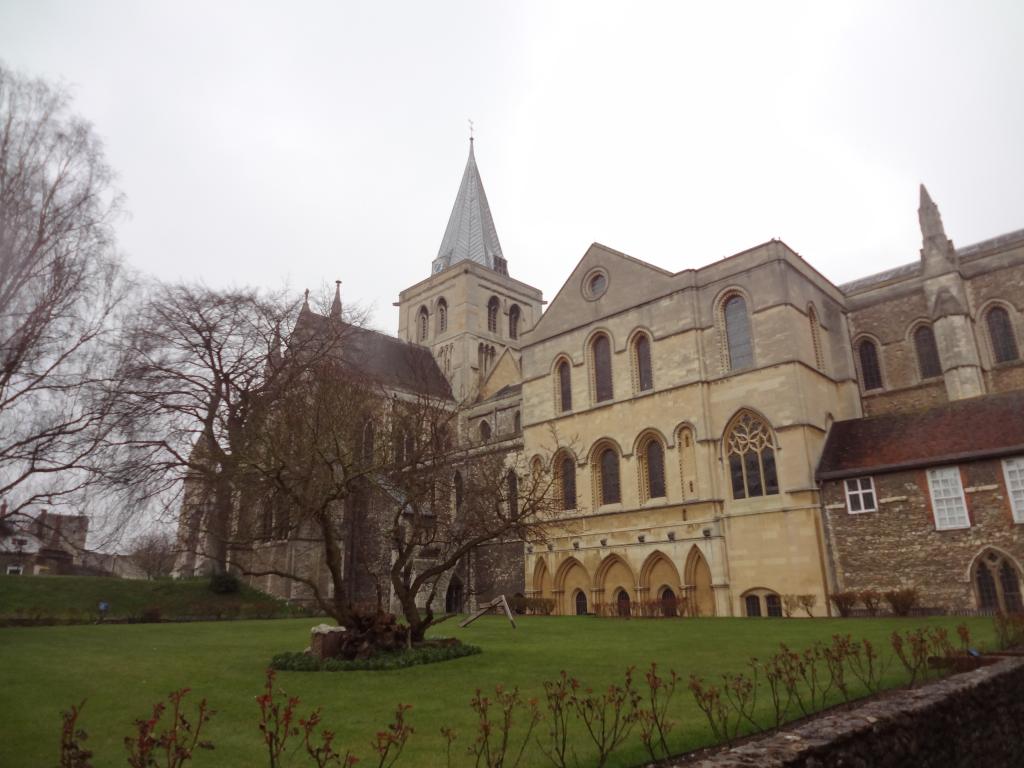
Rochester is a lovely old-fashioned place, an oasis in the middle of an area of Kent increasingly spoilt by development. I don't believe the high street (essentially the only street) boasts a single chain store; it's all bookshops and quirky little antique shops, with one of the nicest local history museums you'll ever see. The local council like to pretend Rochester is just one part of 'the city of Medway', but of course it isn't any such thing; it's a city in its own right, and was so even before the Romans came. The history of Rochester ranges from Dutch invasion to Charles Dickens, but we'll concentrate today on the medieval (of course!). Two medieval buildings dominate the town: the castle and the cathedral. The cathedral you see above, and this is the castle:


It was snowing when I went there (which was a bit of a shock, because it was two days after this glorious sunny day in Canterbury), so my outside shots of the town are rather limited.  But this house is where Edwin Drood was murdered (or was he?):

(Note the board for 'Tiny Tim's' sandwich shop - they're proud of their Dickens connection here!)


The snow was a particular inconvenience because the west door of the cathedral is glorious, and I was much too cold to do it justice.  But it looks like this:

This is 'substantially unaltered' since the time of Bishop Ernulf (1115–1124); here's the tympanum:


A close-up - the scene shows Christ in a mandorla, supported by angels and other winged creatures, and with the apostles below:

Flanking the door are two much-eroded statues, which are said to represent Henry I and his queen Matilda:

The king's face is gone, but you can just about see a crown:

And the queen has rather wonderful plaits:


Modern depictions of Saxon women often have them in long plaits, and it's nice to see (apparent) evidence that this isn't just fancy.

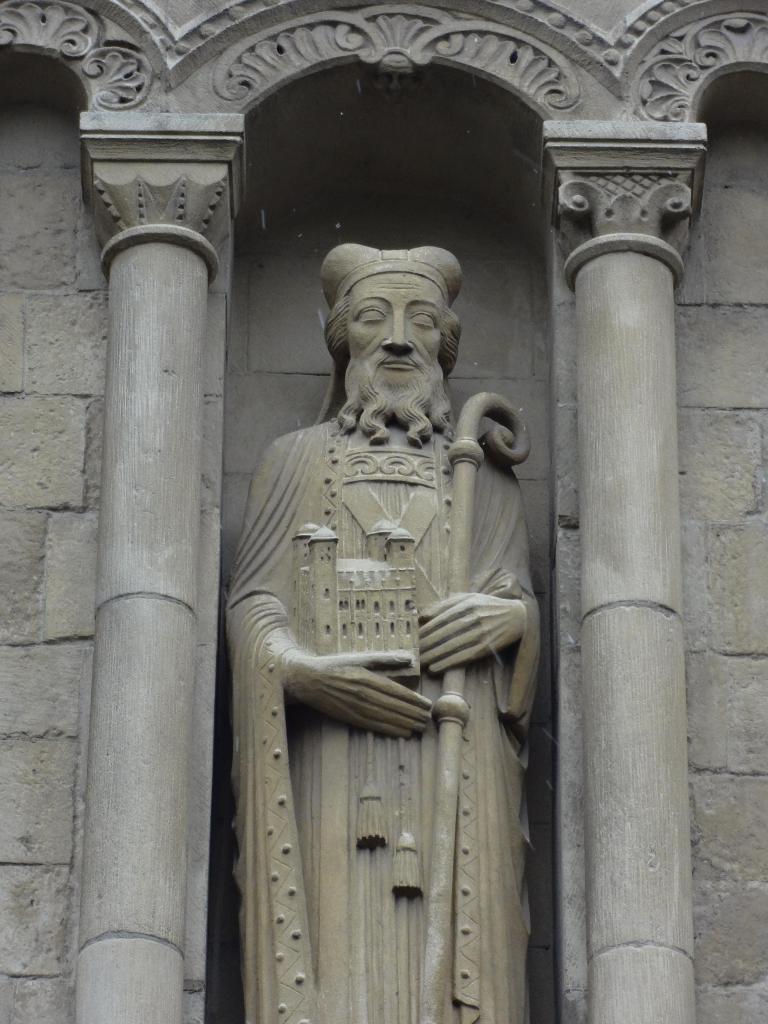
Modern statues above the door show two builder-bishops, our friend Gundulf (d.1108):


And Bishop John (1125-1137):

They're both holding (snow-covered) buildings, and, as it will transpire, bishops holding little buildings constitute a large part of Rochester's medieval past.  Bishops of Rochester have done some interesting things apart from building churches, but you wouldn't really know it from looking round the cathedral!

There's also this darling little fellow by the door, but I don't know who (or what) he's supposed to be:

Now very cold, we move inside...

This post is about modern memorials to various people, but when it comes to Gundulf, of whom I was chiefly thinking while I was there, the truth is - 'if you seek his monument, look around you':


This splendid Norman nave is his work, which adds an extra piquancy to the Life of Gundulf's story about him hiding away in a stable to pray in peace.  Of the builder-bishops of Rochester, he was the first and greatest; he also designed the White Tower, the earliest part of the Tower of London, and castles both here in Rochester and at Colchester.  Don't let anyone tell you that eleventh-century monks had no practical skills.

A survey of Rochester's most famous figures is provided by statues in the quire screen.  Here are three pre-Conquest men (King Ethelbert and Bishops Justus and Paulinus):


On the other side, four post-Conquest bishops (Gundulf, William of Hoo - another man holding a little building! - Walter de Merton, and John Fisher):


I talked about these figures in my previous post on Rochester, so we'll move on swiftly to the stained glass.  It's really rather interesting, as Victorian glass goes, and the cathedral very helpfully has a special booklet telling us who designed most of the windows.  This is far more than most churches manage to do, and this blogger is grateful for it.

Let's start with Gundulf in the north quire transept, with a window installed (says the booklet) by Clayton and Bell in 1885:

The architectural motifs, the windows at the bottom and the castellation above his head, seem particularly appropriate, and it's nice to see that he looks, accurately, like an old man.  Several stories in the Life of Gundulf emphasise his age (he was 83 when he died in 1108), which makes his achievements as bishop all the more remarkable.  Below him is a scene of the building of his cathedral:

Holding the plans while the builders break the ground is taking overseeing the work a little far, Gundulf ;)

By the same designers, and on the same wall, is Walter de Merton:

Walter de Merton was Bishop of Rochester two centuries after Gundulf, in the 1270s.  He's another man with a little building, because he founded what is now Merton College, Oxford.  Below his window, he's accompanied by some of his Oxford clerks:

Obviously I was happy to see this!  We don't dress like that any more - well, not often.  The middle scene is a recognisable (if unusually colourful) depiction of Merton College - compare this picture.

Between these two bishops is the only pre-Conquest bishop of Rochester to get much of a look-in here, Paulinus:

Paulinus did his best work far from Rochester, in Northumbria, which is perhaps why he doesn't feature much in the cathedral - but Bede wouldn't be happy if we overlooked him.

For some reason he's surrounded here by a whole host of post-Conquest bishops, with not an Ithamar in sight.  It's true the pre-Conquest bishops of Rochester are an obscure lot; between the seventh century and the eleventh there's not one who played much of a role in history.  They're a bare series of names and dates, and the people behind the names are lost to us.

However, Paulinus is great enough to make up for it; below his window is a scene, partially obscured, of him with a king - Edwin of Northumbria, presumably.

Above Paulinus, and a bad picture because this window is right up in the roof, we have Gregory the Great (mostly because I can't resist a 'Non Angli, sed Angeli' scene):

What brightly-coloured Saxon boys!

The monument obscuring Paulinus and Edwin is the tomb of Walter de Merton:

He lies in state with four panels of glass (Ninian Comper, 1911 - thanks, guidebook) behind him:


One of these is Rochester's pilgrim saint, William of Perth (d. c.1201).  William, with his pilgrim's badge and scrip, looks pensive, as well he might; he is famous for being murdered, while on pilgrimage to Rochester, by his own adopted son - kind of the opposite of what happened to young Edwin Drood (or is it?).


Apparently 'the body was discovered by a mad woman, who plaited a garland of flowers and placed it first on the head of the corpse and then her own, whereupon the madness left her. On learning her tale the monks of Rochester carried the body to the cathedral and there buried it.'  His tomb attracted pilgrims, so many that you can still see the steps worn down by their passing feet; but it's not the most edifying story, even as medieval hagiography goes, and one can't help thinking that the monks of Rochester promoted this saint pretty much only because they didn't have any better ones.

None of the builder-bishops attracted much in the way of a cult (the best efforts of the Life of Gundulf notwithstanding), and I was surprised to see so many of them commemorated in the cathedral - Gundulf, Paulinus and Walter de Merton are not so unexpected, but William of Hoo?  And here, Haymo de Hythe (1317-1352), yet another bishop-with-a-building?:


More familiar to me is Ernulf:


Ernulf, like Gundulf, was a monk of Bec who originally came to England with Lanfranc, to Canterbury; he was made prior of Canterbury in 1096, successor to the Prior Henry whom Osbern (Ælfheah's hagiographer), as a teenage rebel, refused to obey.  Ernulf did some building at Canterbury - he built the existing crypt, and there's a statue of him down there which is one of the ugliest I've ever seen - and some more when he became Bishop of Rochester in 1114.  More exciting than his building work is, however, his role in the compilation of the Textus Roffensis, medieval Rochester's greatest legacy to the study of Anglo-Saxon England.  This manuscript preserves the earliest surviving English law code, dating back to the reign of Ethelbert in the seventh century (and thus the earliest written text in the English language).  I'd like to think the scene below Ernulf (Powell of Whitefriars, c.1917) depicts the copying of the Textus Roffensis.

There are exciting plans afoot to create a permanent display for the Textus Roffensis in the crypt at Rochester, which sounds like an eminently worthy project.

Speaking of Ethelbert, here he is in a Kempe window of 1889:

I like his furs!

I don't know what St Margaret of Scotland is doing down here in Kent, but it's always nice to see her.  She was keeping company with a sort-of medieval but definitely not saintly figure:

King Arthur!  Why?  His thoroughly ridiculous helmet is entertaining, though.

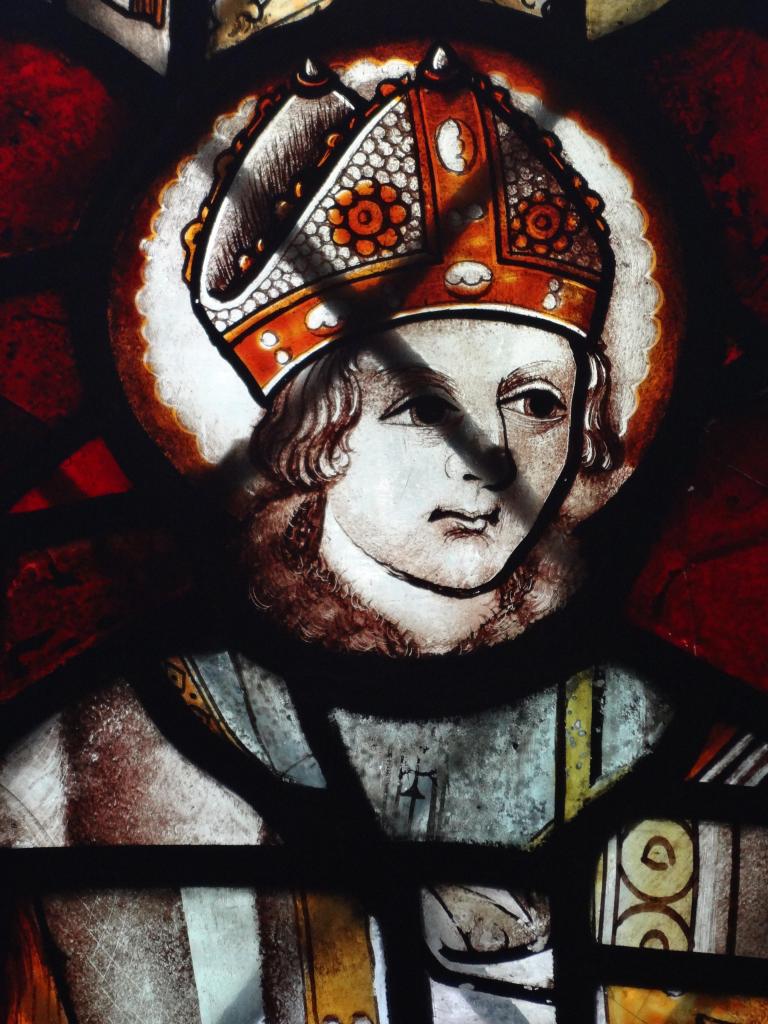
After suffering through all that Victorian glass, here's a reward: some beautiful, though fragmentary, medieval windows down in the crypt.

There's nothing to show who this handsome young bishop was meant to be, but at least he's not carrying a building...

This poor monk has had his head put on a body too small for him, but he looks calm enough about it:


Back outside in the snow:


This was the cloister and chapter-house, and it has some remnants of medieval carving; though the tympanum, which might have been as impressive as the one we began with, is no more:


At least this little angel survives, though; he's probably withstood worse than a bit of April snow in his eight centuries of life:

Tuesday, 14 February 2012

Sam Weller's Valentine

From The Pickwick Papers, chapter 33.


As he was sauntering away his spare time, and stopped to look at almost every object that met his gaze, it is by no means surprising that Mr. Weller should have paused before a small stationer's and print-seller's window; but without further explanation it does appear surprising that his eyes should have no sooner rested on certain pictures which were exposed for sale therein, than he gave a sudden start, smote his right leg with great vehemence, and exclaimed, with energy, 'if it hadn't been for this, I should ha' forgot all about it, till it was too late!'

The particular picture on which Sam Weller's eyes were fixed, as he said this, was a highly-coloured representation of a couple of human hearts skewered together with an arrow, cooking before a cheerful fire, while a male and female cannibal in modern attire, the gentleman being clad in a blue coat and white trousers, and the lady in a deep red pelisse with a parasol of the same, were approaching the meal with hungry eyes, up a serpentine gravel path leading thereunto. A decidedly indelicate young gentleman, in a pair of wings and nothing else, was depicted as superintending the cooking; a representation of the spire of the church in Langham Place, London, appeared in the distance; and the whole formed a 'valentine,' of which, as a written inscription in the window testified, there was a large assortment within, which the shopkeeper pledged himself to dispose of, to his countrymen generally, at the reduced rate of one-and-sixpence each.

'I should ha' forgot it; I should certainly ha' forgot it!' said Sam; so saying, he at once stepped into the stationer's shop, and requested to be served with a sheet of the best gilt-edged letter-paper, and a hard-nibbed pen which could be warranted not to splutter. These articles having been promptly supplied, he walked on direct towards Leadenhall Market at a good round pace, very different from his recent lingering one. Looking round him, he there beheld a signboard on which the painter's art had delineated something remotely resembling a cerulean elephant with an aquiline nose in lieu of trunk. Rightly conjecturing that this was the Blue Boar himself, he stepped into the house, and inquired concerning his parent.

'He won't be here this three-quarters of an hour or more,' said the young lady who superintended the domestic arrangements of the Blue Boar.

'Wery good, my dear,' replied Sam. 'Let me have nine-penn'oth o' brandy-and-water luke, and the inkstand, will you, miss?'

The brandy-and-water luke, and the inkstand, having been carried into the little parlour, and the young lady having carefully flattened down the coals to prevent their blazing, and carried away the poker to preclude the possibility of the fire being stirred, without the full privity and concurrence of the Blue Boar being first had and obtained, Sam Weller sat himself down in a box near the stove, and pulled out the sheet of gilt-edged letter-paper, and the hard-nibbed pen. Then looking carefully at the pen to see that there were no hairs in it, and dusting down the table, so that there might be no crumbs of bread under the paper, Sam tucked up the cuffs of his coat, squared his elbows, and composed himself to write.

To ladies and gentlemen who are not in the habit of devoting themselves practically to the science of penmanship, writing a letter is no very easy task; it being always considered necessary in such cases for the writer to recline his head on his left arm, so as to place his eyes as nearly as possible on a level with the paper, and, while glancing sideways at the letters he is constructing, to form with his tongue imaginary characters to correspond. These motions, although unquestionably of the greatest assistance to original composition, retard in some degree the progress of the writer; and Sam had unconsciously been a full hour and a half writing words in small text, smearing out wrong letters with his little finger, and putting in new ones which required going over very often to render them visible through the old blots, when he was roused by the opening of the door and the entrance of his parent.

'Vell, Sammy,' said the father.

'Vell, my Prooshan Blue,' responded the son, laying down his pen. 'What's the last bulletin about mother-in-law?'

'Mrs. Veller passed a very good night, but is uncommon perwerse, and unpleasant this mornin'. Signed upon oath, Tony Veller, Esquire. That's the last vun as was issued, Sammy,' replied Mr. Weller, untying his shawl.

'No better yet?' inquired Sam.

'All the symptoms aggerawated,' replied Mr. Weller, shaking his head. 'But wot's that you're a-doin' of? Pursuit of knowledge under difficulties, Sammy?'

'I've done now,' said Sam, with slight embarrassment; 'I've been a-writin'.'

'So I see,' replied Mr. Weller. 'Not to any young 'ooman, I hope, Sammy?'

'Why, it's no use a-sayin' it ain't,' replied Sam; 'it's a walentine.'

'A what!' exclaimed Mr. Weller, apparently horror-stricken by the word.

'A walentine,' replied Sam.

'Samivel, Samivel,' said Mr. Weller, in reproachful accents, 'I didn't think you'd ha' done it. Arter the warnin' you've had o' your father's wicious propensities; arter all I've said to you upon this here wery subject; arter actiwally seein' and bein' in the company o' your own mother-in-law, vich I should ha' thought wos a moral lesson as no man could never ha' forgotten to his dyin' day! I didn't think you'd ha' done it, Sammy, I didn't think you'd ha' done it!' These reflections were too much for the good old man. He raised Sam's tumbler to his lips and drank off its contents.

'Wot's the matter now?' said Sam.

'Nev'r mind, Sammy,' replied Mr. Weller, 'it'll be a wery agonisin' trial to me at my time of life, but I'm pretty tough, that's vun consolation, as the wery old turkey remarked wen the farmer said he wos afeerd he should be obliged to kill him for the London market.'

'Wot'll be a trial?' inquired Sam.

'To see you married, Sammy--to see you a dilluded wictim, and thinkin' in your innocence that it's all wery capital,' replied Mr. Weller. 'It's a dreadful trial to a father's feelin's, that 'ere, Sammy--'

'Nonsense,' said Sam. 'I ain't a-goin' to get married, don't you fret yourself about that; I know you're a judge of these things. Order in your pipe and I'll read you the letter. There!'

We cannot distinctly say whether it was the prospect of the pipe, or the consolatory reflection that a fatal disposition to get married ran in the family, and couldn't be helped, which calmed Mr. Weller's feelings, and caused his grief to subside. We should be rather disposed to say that the result was attained by combining the two sources of consolation, for he repeated the second in a low tone, very frequently; ringing the bell meanwhile, to order in the first. He then divested himself of his upper coat; and lighting the pipe and placing himself in front of the fire with his back towards it, so that he could feel its full heat, and recline against the mantel-piece at the same time, turned towards Sam, and, with a countenance greatly mollified by the softening influence of tobacco, requested him to 'fire away.'

Sam dipped his pen into the ink to be ready for any corrections, and began with a very theatrical air--

'"Lovely--"'

'Stop,' said Mr. Weller, ringing the bell. 'A double glass o' the inwariable, my dear.'

'Very well, Sir,' replied the girl; who with great quickness appeared, vanished, returned, and disappeared.

'They seem to know your ways here,' observed Sam.

'Yes,' replied his father, 'I've been here before, in my time. Go on, Sammy.'

'"Lovely creetur,"' repeated Sam.

''Tain't in poetry, is it?' interposed his father.

'No, no,' replied Sam.

'Wery glad to hear it,' said Mr. Weller. 'Poetry's unnat'ral; no man ever talked poetry 'cept a beadle on boxin'-day, or Warren's blackin', or Rowland's oil, or some of them low fellows; never you let yourself down to talk poetry, my boy. Begin agin, Sammy.'

Mr. Weller resumed his pipe with critical solemnity, and Sam once more commenced, and read as follows:

'"Lovely creetur I feel myself a damned--"'

'That ain't proper,' said Mr. Weller, taking his pipe from his mouth.

'No; it ain't "damned,"' observed Sam, holding the letter up to the light, 'it's "shamed," there's a blot there--"I feel myself ashamed."'

'Wery good,' said Mr. Weller. 'Go on.'

'"Feel myself ashamed, and completely cir--' I forget what this here word is,' said Sam, scratching his head with the pen, in vain attempts to remember.

'Why don't you look at it, then?' inquired Mr. Weller.

'So I am a-lookin' at it,' replied Sam, 'but there's another blot. Here's a "c," and a "i," and a "d."'

'Circumwented, p'raps,' suggested Mr. Weller.

'No, it ain't that,' said Sam, '"circumscribed"; that's it.'

'That ain't as good a word as "circumwented," Sammy,' said Mr. Weller gravely.

'Think not?' said Sam.

'Nothin' like it,' replied his father.

'But don't you think it means more?' inquired Sam.

'Vell p'raps it's a more tenderer word,' said Mr. Weller, after a few moments' reflection. 'Go on, Sammy.'

'"Feel myself ashamed and completely circumscribed in adressin' of you, for you are a nice gal and nothin' but it."'

'That's a wery pretty sentiment,' said the elder Mr. Weller, removing his pipe to make way for the remark.

'Yes, I think it is rayther good,' observed Sam, highly flattered.

'Wot I like in that 'ere style of writin',' said the elder Mr. Weller, 'is, that there ain't no callin' names in it--no Wenuses, nor nothin' o' that kind. Wot's the good o' callin' a young 'ooman a Wenus or a angel, Sammy?'

'Ah! what, indeed?' replied Sam.

'You might jist as well call her a griffin, or a unicorn, or a king's arms at once, which is wery well known to be a collection o' fabulous animals,' added Mr. Weller.

'Just as well,' replied Sam.

'Drive on, Sammy,' said Mr. Weller.

Sam complied with the request, and proceeded as follows; his father continuing to smoke, with a mixed expression of wisdom and complacency, which was particularly edifying.

'"Afore I see you, I thought all women was alike."'

'So they are,' observed the elder Mr. Weller parenthetically.

'"But now,"' continued Sam, '"now I find what a reg'lar soft-headed, inkred'lous turnip I must ha' been; for there ain't nobody like you, though I like you better than nothin' at all." I thought it best to make that rayther strong,' said Sam, looking up.

Mr. Weller nodded approvingly, and Sam resumed.

'"So I take the privilidge of the day, Mary, my dear--as the gen'l'm'n in difficulties did, ven he valked out of a Sunday--to tell you that the first and only time I see you, your likeness was took on my hart in much quicker time and brighter colours than ever a likeness was took by the profeel macheen (wich p'raps you may have heerd on Mary my dear) altho it DOES finish a portrait and put the frame and glass on complete, with a hook at the end to hang it up by, and all in two minutes and a quarter."'

'I am afeerd that werges on the poetical, Sammy,' said Mr. Weller dubiously.

'No, it don't,' replied Sam, reading on very quickly, to avoid contesting the point--

'"Except of me Mary my dear as your walentine and think over what I've said.--My dear Mary I will now conclude." That's all,' said Sam.

'That's rather a sudden pull-up, ain't it, Sammy?' inquired Mr. Weller.

'Not a bit on it,' said Sam; 'she'll vish there wos more, and that's the great art o' letter-writin'.'

'Well,' said Mr. Weller, 'there's somethin' in that; and I wish your mother-in-law 'ud only conduct her conwersation on the same genteel principle. Ain't you a-goin' to sign it?'

'That's the difficulty,' said Sam; 'I don't know what to sign it.'

'Sign it--"Veller",' said the oldest surviving proprietor of that name.

'Won't do,' said Sam. 'Never sign a walentine with your own name.'

'Sign it "Pickwick," then,' said Mr. Weller; 'it's a wery good name, and a easy one to spell.'

'The wery thing,' said Sam. 'I COULD end with a werse; what do you think?'

'I don't like it, Sam,' rejoined Mr. Weller. 'I never know'd a respectable coachman as wrote poetry, 'cept one, as made an affectin' copy o' werses the night afore he was hung for a highway robbery; and he wos only a Cambervell man, so even that's no rule.'

But Sam was not to be dissuaded from the poetical idea that had occurred to him, so he signed the letter--

'Your love-sick
Pickwick.'

And having folded it, in a very intricate manner, squeezed a downhill direction in one corner: 'To Mary, Housemaid, at Mr. Nupkins's, Mayor's, Ipswich, Suffolk'; and put it into his pocket, wafered, and ready for the general post.

Wednesday, 8 February 2012

Dickens and Lost Love


I wanted to post an extract from one of Dickens' novels yesterday, but drew a blank on which one, and went with the Chesterton instead; then today this one came to mind. It comes from chapter 28 of Little Dorrit, about a third of the way through the novel, and concerns the parting of the hero, Arthur Clennam, from the woman with whom he has been secretly in love, because she is about to marry another man. It's a beautiful, subtle, gentle scene - qualities people don't usually associate with Dickens.

The only backstory you need to know is this: Arthur loves Minnie ('Pet', as her parents call her), who is much younger than him, and he knows that their different lives make any return of his love impossible. This is how he thinks it over to himself at the end of chapter 16:

'Suppose that a man,' so his thoughts ran, 'who had been of age some twenty years or so; who was a diffident man, from the circumstances of his youth; who was rather a grave man, from the tenor of his life; who knew himself to be deficient in many little engaging qualities which he admired in others, from having been long in a distant region, with nothing softening near him; who had no kind sisters to present to her; who had no congenial home to make her known in; who was a stranger in the land; who had not a fortune to compensate, in any measure, for these defects; who had nothing in his favour but his honest love and his general wish to do right--suppose such a man were to come to this house, and were to yield to the captivation of this charming girl, and were to persuade himself that he could hope to win her; what a weakness it would be!'

He softly opened his window, and looked out upon the serene river. Year after year so much allowance for the drifting of the ferry-boat, so many miles an hour the flowing of the stream, here the rushes, there the lilies, nothing uncertain or unquiet.

Why should he be vexed or sore at heart? It was not his weakness that he had imagined. It was nobody's, nobody's within his knowledge; why should it trouble him? And yet it did trouble him. And he thought--who has not thought for a moment, sometimes?--that it might be better to flow away monotonously, like the river, and to compound for its insensibility to happiness with its insensibility to pain.

He makes a resolution to conquer his feelings, and the narrator maintains the conceit that it is not Arthur but 'nobody' who is in love with Pet. His feelings remain unspoken, half-repressed, acknowledged only through reference to this 'nobody' who is Arthur's hazy hypothetical double - the person he would be if he were not himself (Pet has her own shadowy double in the twin sister who died when they were children, mentioned, significantly, in this scene).

Pet falls in love with someone else and marries him and (spoiler!) so does Arthur, so in the end it doesn't really matter (though maybe Dickens didn't know that when he was writing this chapter); but as a depiction of the ending of a dream this scene nonetheless has power even out of context. It's all about what isn't said.


Clennam had stopped, not for the first time by many times, to look about him and suffer what he saw to sink into his soul, as the shadows, looked at, seemed to sink deeper and deeper into the water. He was slowly resuming his way, when he saw a figure in the path before him which he had, perhaps, already associated with the evening and its impressions.

Minnie was there, alone. She had some roses in her hand, and seemed to have stood still on seeing him, waiting for him. Her face was towards him, and she appeared to have been coming from the opposite direction. There was a flutter in her manner, which Clennam had never seen in it before; and as he came near her, it entered his mind all at once that she was there of a set purpose to speak to him.

She gave him her hand, and said, 'You wonder to see me here by myself? But the evening is so lovely, I have strolled further than I meant at first. I thought it likely I might meet you, and that made me more confident. You always come this way, do you not?'

As Clennam said that it was his favourite way, he felt her hand falter on his arm, and saw the roses shake.

'Will you let me give you one, Mr Clennam? I gathered them as I came out of the garden. Indeed, I almost gathered them for you, thinking it so likely I might meet you. Mr Doyce arrived more than an hour ago, and told us you were walking down.'

His own hand shook, as he accepted a rose or two from hers and thanked her. They were now by an avenue of trees. Whether they turned into it on his movement or on hers matters little. He never knew how that was.

'It is very grave here,' said Clennam, 'but very pleasant at this hour. Passing along this deep shade, and out at that arch of light at the other end, we come upon the ferry and the cottage by the best approach, I think.'

In her simple garden-hat and her light summer dress, with her rich brown hair naturally clustering about her, and her wonderful eyes raised to his for a moment with a look in which regard for him and trustfulness in him were strikingly blended with a kind of timid sorrow for him, she was so beautiful that it was well for his peace--or ill for his peace, he did not quite know which--that he had made that vigorous resolution he had so often thought about.

She broke a momentary silence by inquiring if he knew that papa had been thinking of another tour abroad? He said he had heard it mentioned. She broke another momentary silence by adding, with some hesitation, that papa had abandoned the idea.

At this, he thought directly, 'they are to be married.'

'Mr Clennam,' she said, hesitating more timidly yet, and speaking so low that he bent his head to hear her. 'I should very much like to give you my confidence, if you would not mind having the goodness to receive it. I should have very much liked to have given it to you long ago, because--I felt that you were becoming so much our friend.'

'How can I be otherwise than proud of it at any time! Pray give it to me. Pray trust me.'

'I could never have been afraid of trusting you,' she returned, raising her eyes frankly to his face. 'I think I would have done so some time ago, if I had known how. But I scarcely know how, even now.'

'Mr Gowan,' said Arthur Clennam, 'has reason to be very happy. God bless his wife and him!'

She wept, as she tried to thank him. He reassured her, took her hand as it lay with the trembling roses in it on his arm, took the remaining roses from it, and put it to his lips. At that time, it seemed to him, he first finally resigned the dying hope that had flickered in nobody's heart so much to its pain and trouble; and from that time he became in his own eyes, as to any similar hope or prospect, a very much older man who had done with that part of life.

He put the roses in his breast and they walked on for a little while, slowly and silently, under the umbrageous trees. Then he asked her, in a voice of cheerful kindness, was there anything else that she would say to him as her friend and her father's friend, many years older than herself; was there any trust she would repose in him, any service she would ask of him, any little aid to her happiness that she could give him the lasting gratification of believing it was in his power to render?

She was going to answer, when she was so touched by some little hidden sorrow or sympathy--what could it have been?--that she said, bursting into tears again: 'O Mr Clennam! Good, generous, Mr Clennam, pray tell me you do not blame me.'

'I blame you?' said Clennam. 'My dearest girl! I blame you? No!'

After clasping both her hands upon his arm, and looking confidentially up into his face, with some hurried words to the effect that she thanked him from her heart (as she did, if it be the source of earnestness), she gradually composed herself, with now and then a word of encouragement from him, as they walked on slowly and almost silently under the darkening trees.

'And, now, Minnie Gowan,' at length said Clennam, smiling; 'will you ask me nothing?'

'Oh! I have very much to ask of you.'

'That's well! I hope so; I am not disappointed.'

'You know how I am loved at home, and how I love home. You can hardly think it perhaps, dear Mr Clennam,' she spoke with great agitation, 'seeing me going from it of my own free will and choice, but I do so dearly love it!'

'I am sure of that,' said Clennam. 'Can you suppose I doubt it?'

'No, no. But it is strange, even to me, that loving it so much and being so much beloved in it, I can bear to cast it away. It seems so neglectful of it, so unthankful.'

'My dear girl,' said Clennam, 'it is in the natural progress and change of time. All homes are left so.'

'Yes, I know; but all homes are not left with such a blank in them as there will be in mine when I am gone. Not that there is any scarcity of far better and more endearing and more accomplished girls than I am; not that I am much, but that they have made so much of me!'

Pet's affectionate heart was overcharged, and she sobbed while she pictured what would happen.

'I know what a change papa will feel at first, and I know that at first I cannot be to him anything like what I have been these many years. And it is then, Mr Clennam, then more than at any time, that I beg and entreat you to remember him, and sometimes to keep him company when you can spare a little while; and to tell him that you know I was fonder of him when I left him, than I ever was in all my life. For there is nobody--he told me so himself when he talked to me this very day--there is nobody he likes so well as you, or trusts so much.'

A clue to what had passed between the father and daughter dropped like a heavy stone into the well of Clennam's heart, and swelled the water to his eyes. He said, cheerily, but not quite so cheerily as he tried to say, that it should be done--that he gave her his faithful promise.

'If I do not speak of mama,' said Pet, more moved by, and more pretty in, her innocent grief, than Clennam could trust himself even to consider--for which reason he counted the trees between them and the fading light as they slowly diminished in number--'it is because mama will understand me better in this action, and will feel my loss in a different way, and will look forward in a different manner. But you know what a dear, devoted mother she is, and you will remember her too; will you not?'

Let Minnie trust him, Clennam said, let Minnie trust him to do all she wished.

'And, dear Mr Clennam,' said Minnie, 'because papa and one whom I need not name, do not fully appreciate and understand one another yet, as they will by-and-by; and because it will be the duty, and the pride, and pleasure of my new life, to draw them to a better knowledge of one another, and to be a happiness to one another, and to be proud of one another, and to love one another, both loving me so dearly; oh, as you are a kind, true man! when I am first separated from home (I am going a long distance away), try to reconcile papa to him a little more, and use your great influence to keep him before papa's mind free from prejudice and in his real form. Will you do this for me, as you are a noble-hearted friend?'

Poor Pet! Self-deceived, mistaken child! When were such changes ever made in men's natural relations to one another: when was such reconcilement of ingrain differences ever effected! It has been tried many times by other daughters, Minnie; it has never succeeded; nothing has ever come of it but failure.

So Clennam thought. So he did not say; it was too late. He bound himself to do all she asked, and she knew full well that he would do it.

They were now at the last tree in the avenue. She stopped, and withdrew her arm. Speaking to him with her eyes lifted up to his, and with the hand that had lately rested on his sleeve trembling by touching one of the roses in his breast as an additional appeal to him, she said:

'Dear Mr Clennam, in my happiness--for I am happy, though you have seen me crying--I cannot bear to leave any cloud between us. If you have anything to forgive me (not anything that I have wilfully done, but any trouble I may have caused you without meaning it, or having it in my power to help it), forgive me to-night out of your noble heart!'

He stooped to meet the guileless face that met his without shrinking. He kissed it, and answered, Heaven knew that he had nothing to forgive. As he stooped to meet the innocent face once again, she whispered, 'Good-bye!' and he repeated it. It was taking leave of all his old hopes--all nobody's old restless doubts. They came out of the avenue next moment, arm-in-arm as they had entered it: and the trees seemed to close up behind them in the darkness, like their own perspective of the past.

The voices of Mr and Mrs Meagles and Doyce were audible directly, speaking near the garden gate. Hearing Pet's name among them, Clennam called out, 'She is here, with me.' There was some little wondering and laughing until they came up; but as soon as they had all come together, it ceased, and Pet glided away.

Mr Meagles, Doyce, and Clennam, without speaking, walked up and down on the brink of the river, in the light of the rising moon, for a few minutes; and then Doyce lingered behind, and went into the house. Mr Meagles and Clennam walked up and down together for a few minutes more without speaking, until at length the former broke silence.

'Arthur,' said he, using that familiar address for the first time in their communication, 'do you remember my telling you, as we walked up and down one hot morning, looking over the harbour at Marseilles, that Pet's baby sister who was dead seemed to Mother and me to have grown as she had grown, and changed as she had changed?'

'Very well.'

'You remember my saying that our thoughts had never been able to separate those twin sisters, and that, in our fancy, whatever Pet was, the other was?'

'Yes, very well.'

'Arthur,' said Mr Meagles, much subdued, 'I carry that fancy further to-night. I feel to-night, my dear fellow, as if you had loved my dead child very tenderly, and had lost her when she was like what Pet is now.'

'Thank you!' murmured Clennam, 'thank you!' And pressed his hand.

'Will you come in?' said Mr Meagles, presently.

'In a little while.'

Mr Meagles fell away, and he was left alone. When he had walked on the river's brink in the peaceful moonlight for some half an hour, he put his hand in his breast and tenderly took out the handful of roses. Perhaps he put them to his heart, perhaps he put them to his lips, but certainly he bent down on the shore and gently launched them on the flowing river. Pale and unreal in the moonlight, the river floated them away.

The lights were bright within doors when he entered, and the faces on which they shone, his own face not excepted, were soon quietly cheerful. They talked of many subjects (his partner never had had such a ready store to draw upon for the beguiling of the time), and so to bed, and to sleep. While the flowers, pale and unreal in the moonlight, floated away upon the river; and thus do greater things that once were in our breasts, and near our hearts, flow from us to the eternal seas.