Showing posts with label Language. Show all posts

Saturday, 10 November 2018

All Things Weird


My column in the November issue of History Today can be read online here (and do buy the magazine - lots of good stuff in it this month!). Here's an extract:

There is a widespread myth about the history of the English language, which goes like this: it began as the sturdy, rugged Germanic tongue of the Anglo-Saxons – good for writing about battles, but not much else – and was refined into a decent level of sophistication by the influence of Norman French, which shaped it into a language fit for discussing elegant and cultured topics. This trajectory – from earthy to elegant, coarse to cultured – is a story regularly repeated in popular narratives of English history, usually by those who have not read much Anglo-Saxon literature; the stereotype of Old English as unsophisticated or ‘rude’ (in every sense of that word) falters in the face of contact with the intricate poetry or thoughtful prose written in that language.

In the late Anglo-Saxon period, Old English was developing a sophisticated technical vocabulary with which to discuss scholarly, scientific and theological subjects. Many of these terms have not survived to the present day, but they are evidence of how carefully some Anglo-Saxon writers thought about their own language and how much consideration went into the production of new words and compounds.

One example is an intriguing word that brings us back to my opening question: wyrdwritere, meaning ‘historian’. This word was coined towards the end of the Anglo-Saxon period, probably in the tenth century, as an English equivalent for the Latin word historiographus. It was then adopted by some Anglo-Saxon scholars to refer to writers of various works of history, including the authors of the historical books of the Old Testament and Roman historians.
Read the rest here, on what the Old English word wyrd might actually mean and how it became our modern weird. I'm fascinated by this word and the twists and turns of its history, from The Wanderer to Macbeth; at no point is it particularly easy to define, and any single translation ('Fate', especially) has the potential to be misleading. I've discussed this mysterious power as it appears in some different Old English poems here and here, but wyrdwritere is a term from learned Old English prose, coined (as Mechthild Gretsch argues in The Intellectual Foundations of the English Benedictine Reform, pp. 160-2) in the tenth century by scholars glossing the works of Aldhelm. This usage of the word very definitely refers to works of written history, but there is a broader sense in which wyrd, in poetry, often appears in connection with reflections on the passage of time and the contemplation of the remains of past societies - the stuff of history, at least as medieval writers understood it. Most famously:

Hwær cwom mearg? Hwær cwom mago? Hwær cwom maþþumgyfa?
Hwær cwom symbla gesetu? Hwær sindon seledreamas?
Eala beorht bune! Eala byrnwiga!
Eala þeodnes þrym! Hu seo þrag gewat,
genap under nihthelm, swa heo no wære.
Stondeð nu on laste leofre duguþe
weal wundrum heah, wyrmlicum fah.
Eorlas fornoman asca þryþe,
wæpen wælgifru, wyrd seo mære,
ond þas stanhleoþu stormas cnyssað,
hrið hreosende hrusan bindeð,
wintres woma.

Where is the horse? Where is the warrior? Where is the treasure-giver?
Where are the seats of feasting? Where are the joys of the hall?
Alas, the bright cup! Alas, the mailed warrior!
Alas, the glory of the prince! How that time has passed away,
grown dark under the cover of night, as if it had never been.
There stands now in the tracks of the dear troop
a wall, wondrously high, decorated with serpents.
The warriors were taken away by the power of spears,
weapons greedy for slaughter, wyrd the famous;
and storms batter those rocky cliffs,
snow falling fetters the earth,
the tumult of winter.
(The Wanderer)

Wrætlic is þes wealstan, wyrde gebræcon;
burgstede burston, brosnað enta geweorc.
Hrofas sind gehrorene, hreorge torras...
ældo undereotone. Eorðgrap hafað
waldend wyrhtan forweorone, geleorene,
heardgripe hrusan, oþ hund cnea
werþeoda gewitan.

Wondrous is this wall-stone, wrecked by wyrd,
cities broken open, the work of giants destroyed.
Roofs are ruined, towers fallen...
eaten by age. The grip of earth holds
the mighty builders, decayed and gone,
the hard grasp of the ground, until a hundred generations
of peoples have passed away.
(The Ruin)

In The Seafarer, the reflection that 'there are no kings or caesars, nor gold-givers as there once were' prompts the conclusion:

Wyrd biþ swiþre,
meotud meahtigra þonne ænges monnes gehygd.

Wyrd is stronger,
the Measurer mightier than any man's thought.

And in Maxims II, as well as the cities of past societies, wyrd's power is somehow connected with the passage of time through the seasons of the year, and through the Anglo-Saxon Chronicle:

Cyning sceal rice healdan. Ceastra beoð feorran gesyne,
orðanc enta geweorc, þa þe on þysse eorðan syndon,
wrætlic weallstana geweorc. Wind byð on lyfte swiftust,

þunar byð þragum hludast. Þrymmas syndan Cristes myccle.
Wyrd byð swiðost. Winter byð cealdost,
lencten hrimigost - he byð lengest ceald -
sumor sunwlitegost - swegel byð hatost -
hærfest hreðeadegost, hæleðum bringeð
geres wæstmas, þa þe him god sendeð.


A king should defend a kingdom. Cities are seen from afar,
the skilful work of giants, which are on this earth,
wondrous work of wall-stones. The wind in the sky is swiftest,
thunder is loudest in season. Great are the powers of Christ.
Wyrd is the most powerful thing. Winter is coldest,
spring frostiest - it is the longest cold -
summer sun-brightest - the sun is hottest -
harvest most glory-blessed; it brings to men
the year's fruits, which God sends them.

Perhaps it's not difficult to see the movement from this to the historian's contemplation of past events, expressed by the word wyrdwritere. Wyrd in these contexts is usually translated as 'fate', but here at least I tend to think that it means rather 'the passage of time': an inexorably unfolding sequence of events, which from moment to moment can only sweep us forwards. It does mean other things in other contexts, most notably in the (imagined) pagan world of Beowulf, but the instance I think of most often comes from Solomon and Saturn:

Gewurdene wyrda,
ðæt beoð ða feowere fæges rapas. (156-7)

The second line means 'those are the four ropes of the doomed', and the first something like 'things which have happened', or 'deeds done'. Simple, and astonishingly powerful.

Ælfric's Wyrdwriteras us secgað (Oxford, Bodleian MS. Hatton 115, f. 63)

I first encountered wyrdwritere in the short piece by Ælfric known as Wyrdwriteras us secgað, where he adduces a number of historical precedents on the question of whether kings ought to lead their armies into battle themselves, or delegate to trusted commanders. (A controversial issue in the reign of Æthelred, it seems...) Ælfric uses wyrdwritere a number of times in his writings, but elsewhere he also explicitly objects to ideas of fate and destiny relating to ðan leasan wenan, þe ydele men gewyrd hatað ('that false idea, which foolish men call wyrd'). So the question of what he personally understood the word wyrdwritere to mean is an intriguing one. The origins of wyrd, as far as we can guess, are likely to be pre-Christian - a power which corresponds to some kind of pagan idea of destiny. But there is also a significant Christianised understanding of the word which Ælfric must have been familiar with from other Anglo-Saxon sources: in the Old English translation of Boethius' Consolation of Philosophy, attributed to Alfred the Great, wyrd is the term used to refer to the working-out of God's will in time (Boethius' fatum).

Se God wunaþ simle on þære hean ceastre his anfealdnesse and bilewitnesse. Ðonan he dælþ manega 7 mistlice gemetgunga eallum his gesceaftum and þonon he welt eallra. Ac þæt, þætte we hataþ Godes foreþonc 7 his foresceawung, þæt biþ ða hwile þe hit þær mid him biþ, on his mode, ærþam þe hit gefremed weorþe ða hwile þe hit geþoht biþ. Ac siððan hit fullfremed bið, ðonne hatað we hit wyrd.

Be þy mæg ælc mon witan þæt hi sint ægþer ge twegen naman ge twa ðing: foreþonc and wyrd. Se foreþonc is sio godcunde gesceadwisnes. Sio is fæst on þam hean sceopppende þe eall forewrat hu hit geweorþan sceal ær ær hit geweorþe. Ac þæt, þæt we wyrd hataþ, þæt biþ Godes weorc þe ælce dæg wyrcþ, ægþer ge þæs þe we geseoþ, ge þæs þe us ungesewenlic biþ. Ac se godcunda foreþonc heaþeraþ ealle gesceafta þæt hi ne moton toslupan of heora endebyrdnesse. Sio wyrd ðonne dælþ eallum gesceaftum andwlitan and stowa and tida and gemetgunga. Ac sio wyrd cymþ of þam gewitte and of þam foreþonce þæs ælmihtigan Godes. Se wyrcþ æfter his unasecgendlicum foreþonce þonne swa hwæt swa he wille. Swa swa ælc cræftega þencþ and mearcaþ his weorc on his mode ær ær he it wyrce, and wyrcþ siððan eall, þios wandriende wyrd þe we wyrd hataþ færþ æfter his foreþonce and æfter his geþeahte, swa swa he tiohhaþ þæt hit sie.

[God dwells eternally in the high city of his oneness and mercy; from there he deals out many and various measures to all his creatures, and in that way he governs them all. But regarding that which we call God’s forethought and his foresight, it exists while it abides with him in his mind, before it is brought to pass, and while it is only thought. But as soon as it is accomplished, then we call it wyrd.

From this everyone may know that there are two names and two things: forethought and wyrd. Forethought is the Divine Reason, and remains fast in the high Creator who knows how everything shall come to pass before it happens. But that which we call wyrd is God’s work, which he works day by day, both that which we see, and that which is invisible to us. The divine forethought holds up all creatures, so that they may not fall asunder from their true place. Wyrd therefore allots to all things their forms, places, seasons, and proportions; but wyrd comes from the mind and the forethought of Almighty God. He causes to happen whatever he chooses, according to his ineffable forethought. Just as every craftsman thinks over and marks out his work in his mind before he works it out, and then carries it out altogether, so this changing wyrd [perhaps here 'course of events'] that we call wyrd proceeds according to his forethought and purpose, just as he determines that it shall be done.]

(Isn't that glorious prose? Nothing earthy or 'rude' about that!) This seems to be the careful adoption of a native term into the discourse of Christian philosophy - almost, perhaps, an attempt to give the word a new definition, or to clarify what it means in this particular context as distinct from its various other meanings. It was perhaps in this sense that Ælfric used wyrdwritere, especially when thinking about the writers of the Old Testament: those who chronicle the unfolding of God's purpose as it is revealed in time.

An illustration from the Old English translation of the Book of Genesis 
(of Jacob and his people journeying to Egypt), in BL Cotton Claudius B IV, f. 66v

Whatever way you take it, it is very different from the modern understanding of a historian's role. Getting away from the Anglo-Saxons for a moment, I'm interested in the idea of alternative words for historian in part because it's a term whose use today is somewhat contested. Every so often in the history corner of Twitter (a lively place!) there's a skirmish about the question of who is entitled to call themselves, or to be called, a 'historian'. Is it a term which requires particular qualifications? Should it be restricted to those who have an undergraduate degree in History, or a doctorate in History, or are engaged in academic teaching and research in the field? Or can it be used more loosely to refer to anyone writing or broadcasting about the past? These disagreements usually break out in response to the British media's very liberal approach to the term, where it is applied to just about anyone who does any activity relating to anything which happened more than a decade or two ago (especially if it's a man and he's famous). Professional historians, understandably, are often troubled by this and argue back against it. You might think this is primarily an academic concern, but the question does seem to worry the audiences of popular history too - I lurk in a big amateur history group on Facebook where these debates pop up regularly and become pretty acrimonious. Many people attach a very definite status to the word historian, and object to what they see as its misuse.

Related to this is the question of how far people who feel strongly about the term will allow it to be applied to pre-modern writers about the past; they often propose that such writers, too, should be subjected to some kind of qualifying test. Medievalists tend to call writers like Bede and William of Malmesbury historians (though with the implicit understanding that their conception of the purpose of writing about history was different from our own), but there are those who argue that the presence of miracle-stories or anecdotes in the works of medieval historians disqualifies them entirely - if it's not academic history in the modern sense, they say, it shouldn't be called history at all. It gets more complicated still with the multifarious medieval forms of writing about the past which are less palatable to modern historians even than historia and chronicle: romance history or hagiography, for example, which don't fit easily into modern generic categories but which were for many centuries immensely popular and influential ways of writing about what we call 'history'.

Of course the reason for all this is that historian is a term which means different things to different people, with connotations formed in a particular social, cultural, and institutional context, and therefore no more easy to define than wyrdwritere is. I don't personally have strong feelings about the question - though I do understand why some professional historians do - and as an observer I find the debate quite interesting. My own academic background is in English literature, so I don't tend to think of myself as a historian; those of us who work on the Middle Ages get to use the conveniently general term medievalist, and like many medievalists, my work is very much interdisciplinary, since the boundaries between history and literature are less strictly drawn in my field of study than they are for those who work on later periods. I research, teach and write about texts which straddle the boundary, which don't belong by rights to one field or the other, and that's a common and understood practice within my discipline. But medievalist is a term not much used outside academia, and I was a bit taken aback a few years ago when this blog started to get a bigger audience and all of a sudden people were referring to me as a historian. By the definition of the people I mentioned above who have strong feelings about historians' qualifications, I'm not a historian at all, nor do I particularly want to be one (I like studying literature!) - but what other term is there? In public, I pretty much have to be a 'historian'. Outside academia, that's almost the only word available for people who write about the past - from whatever angle - but it's not a perfect one, and no wonder it's contested.

My field doesn't have an equivalent term, and so we don't really have equivalent debates about how to define or defend it (there aren't exactly tons of media personalities clamouring to declare themselves literary critics). But it's also a disadvantage when it comes to public communication, and that does trouble me a bit. There's an established market and an audience for popular history as there isn't for other fields, and so for public consumption everything relating to the literature, art, religion, and intellectual culture of the past tends to be subsumed into 'history'. This can be done well - History Today, for instance, does it very well indeed, offering an interdisciplinary and holistic view of the past by using a very inclusive definition of 'history' for a wide audience. Not all forums for popular history are so broad-minded, and I think there are a lot of topics which don't get as much attention as they should, or don't perhaps get the right kind of attention, because they can't be squeezed into 'history'. It's not that there are no forums for discussing those topics, but they don't feature much at the more popular end of the pop history spectrum (especially in the publishing of popular history books) - and I think that's a shame. I'm convinced that one reason the popular stereotype of the dark and stupid Middle Ages persists is that there are not many places where the interested public can be introduced to what medieval people thought, rather than just what they did - so they conclude, not unnaturally, that medieval people didn't really think at all. It's hard to hear their voices, their words, ideas, beliefs, and stories, if popular history insists on focusing only on their deeds; and for the medieval period, popular history usually means battles - kings and battles. That's the only thing that sells, publishers say, and I expect they're right - but then, it's the only thing they offer for sale. (It would be hypocritical of me to say I'm opposed to books on kings and battles, of course, though my book too fits uneasily under the 'history' label, and I wish there was somewhere else for it to go). It's no wonder that people think that kings and battles are all the medieval period consisted of, and it's a vicious cycle; if only this kind of history gets published, only this kind of history sells, so only this kind of history gets published. And many of the people who are successful at writing this kind of history, as I said above, have a particular view of what history should and shouldn't consist of and have been trained in a way which makes them well-informed about some aspects of the past but not about others (which is why some popular historians keep saying English evolved from the Anglo-Saxons' rugged earthy grunting into a sophisticated... you know. Because they never read Ælfric.)
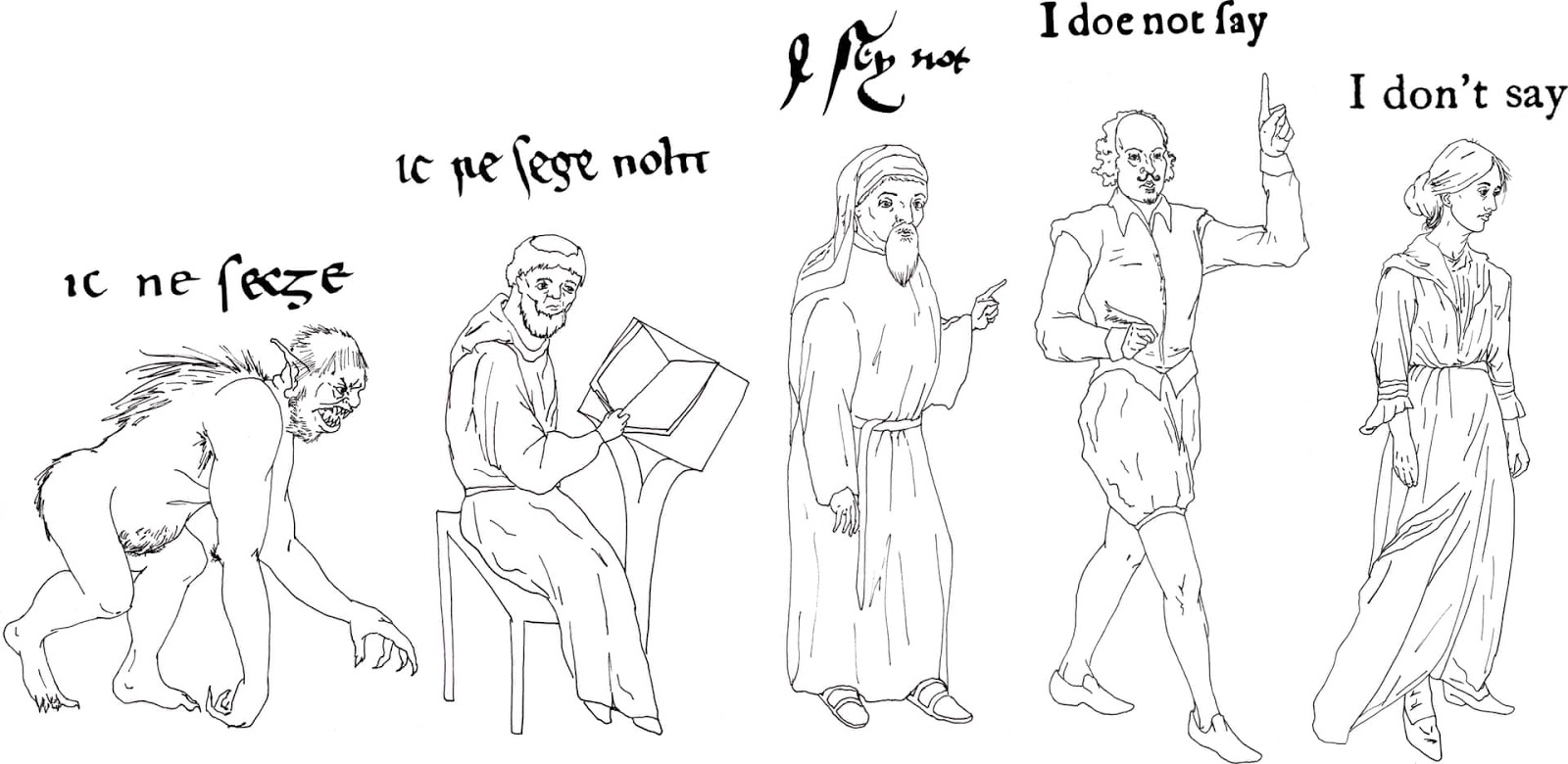
The evolution of English from its monstrous origins, as illustrated for us by the Guardian

Anyway, there's not much any of us can do about this (gæð a wyrd swa hio scel), but it's good to remember that terms like historian have a history themselves, and do not set the limits of our potential interest in the past. Wyrd doesn't have much to do with history as modern historians understand it, because it relates not so much to what happens as why, in the largest possible sense of that question: what is the power which governs events in the world, which makes leaves grow and cities fall? Fate, time, God - all are possible explanations, and the question is still one which human beings seek to answer, and probably always will. It's not a question which belongs within the discipline of history as currently understood, though it used to be, and may one day be again - you never know, wyrd being what it is. But it's a timeless question, which many people have thought about over the centuries, and a question where writers, thinkers, and poets of the past have valuable perspectives to contribute. The reason I'm not a historian is, partly, that I care about their thoughts, and their words, on this and many other matters too deep for the historian's art.

Saturday, 13 February 2016

The Language of Anglo-Saxon Love

A long, long time ago, back in the early days of this blog (2011) I wrote two not-entirely-serious posts compiling some lists of Medieval Compliments and Medieval Terms of Endearment. To my surprise and amusement these have since proved to be far and away the most popular posts on this blog, with page-views in the tens of thousands. They always get a big spike around Valentine's Day, and I like to think that people are still using them (along with my Resources for a Medieval Valentine's Day) to add a little medieval flavour to the day.

Most of the words and phrases in those posts came from Middle English texts, so today I thought I'd offer up some Old English terms in which you might wish to express your admiration or love. Now, some people will tell you that Anglo-Saxon literature is devoid of romance, and it is true that the Anglo-Saxons did not write much love poetry, nor did they celebrate St Valentine's feast as a romantic holiday (surely proof, if any more were needed, that English literature has been going downhill since 1066). But while romance may have come to us (etymologically and historically speaking) from the French, it was the Anglo-Saxons who gave us the word love - and there's plenty of love in Old English literature, if you're looking for some inspiration today.

Lovers in the Old English Hexateuch (illustrating Genesis 6)

So, let's imagine you want to send what Beowulf calls a luftacen - a token of your affection - to express what lies on heortscræfe 'in the cavern of the heart'. The obvious place to start for Valentine's card inspiration is the poem known as The Husband's Message, in which a man forcibly separated from his lover sends her a message urging her to join him:

þec þonne biddan het se þisne beam agrof
þæt þu sinchroden sylf gemunde
on gewitlocan wordbeotunga,
þe git on ærdagum oft gespræcon...
Heht nu sylfa þe
lustum læran, þæt þu lagu drefde,
siþþan þu gehyrde on hliþes oran
galan geomorne geac on bearwe.
Ne læt þu þec siþþan siþes getwæfan,
lade gelettan lifgendne monn...

Nis him wilna gad,
ne meara ne maðma ne meododreama,
ænges ofer eorþan eorlgestreona,
þeodnes dohtor, gif he þin beneah.

He who carved this wood [did I mention your Valentine's message should be carved in runes?]
instructed me to bid you, treasure-adorned one,
to recall to mind the vows
which you two often spoke in days gone by...
Now he himself has commanded me
to joyfully instruct you to take to the sea,
after you have heard by the cliff's edge
the mourning cuckoo sing in the woods.
Do not then let any man living prevent your coming
or hinder your journey...
He has no lack of joy,
nor of horses, nor treasures, nor the pleasures of mead,
any of the noblest riches upon earth,
if he has you, prince's daughter.

You too should promise, of course, that your lover will find in you tirfæste treowe, 'fidelity of steadfast glory'; or such vows as appear in The Wife's Lament, where the speaker says of her husband:

Ful oft wit beotedan
þæt unc ne gedælde nemne deað ana,
owiht elles.

Very often we two vowed
that we would not be parted except by death alone,
nothing else.

You're going to need the dual pronoun wit 'we two' if you want to compose a properly intimate Old English love-message.

As compliments go, sinchroden ('treasure-adorned') may not get you very far these days. You might have better luck with the veritable flurry of compliments provided by the poem Juliana, in which the heroine is variously called seo dyreste ond seo sweteste in sefan minum, 'the dearest and the sweetest in my soul', minra eagna leoht 'light of my eyes', min se swetesta sunnan scima 'my sweetest sunbeam', and so on. Unfortunately, the speakers of these words are very unpleasant characters - Juliana's bullying father and nasty would-be husband - and they're trying to butter her up with these endearments to force her into an unwanted marriage. So that's a bit of a downer. (Maybe it suggests something about what one Anglo-Saxon poet thought of such flowery endearments and the people who use them.)

Let's try again. The heroine of Judith is described (by the narrator this time) as gleaw on geðonce, ides ælfscinu 'clever in thought, a woman beautiful as an elf' - both excellent terms of praise. I don't really think you can beat 'elf-shining' as a compliment, but there's also fæger ('fair', obviously) and wlitig 'beautiful', which works for both men and women: St Guthlac, for instance, is described as wlitig on ansyne 'beautiful of face' and Eve (in the poem Genesis) as wifa wlitegost 'most beautiful of women' and wlitesciene wif 'woman of radiant beauty'.

'gleaw on geðonce, ides ælfscinu' (BL Cotton Vitellius A XV, f.202)

Juliana's flatterers aside, lovers in Old English poetry tend to be on the restrained side with their terms of endearment. Even in The Wife's Lament, the speaker mostly calls her husband min freond and min wine, which both mean 'my friend'; min wine is also the heroine's choice of address in the fragmentary Waldere, in the middle of an impassioned speech, so it must have had more intimate overtones than simply 'friend'. But my favourite endearment was one I mentioned in this post, from a sermon in which God, speaking to the Virgin Mary, calls her min meregrot... min eorclanstan 'my pearl, my precious jewel'. You're not going to get a better endearment than 'my arkenstone', now, are you?

In Old English someone you love is leof 'dear, beloved' and therefore lufsum 'lovesome, lovable' and dyre 'dear, precious', perhaps even your deorling 'darling' (although that doesn't always have positive overtones). Leof can also be used as an address - one might, for instance, address someone as leofa Beowulf 'beloved Beowulf' (assuming their name was Beowulf). As the advertisers are so keen to convince us around Valentine's Day, everyone wants someone to love: Æfter leofan menn langað swiðost 'People long most for a loved one', says one of the Durham Proverbs. (Which is very sweet, but the compiler of the proverb-collection rather wickedly juxtaposes it with another proverb about unsatisfied desire: Hwilum æfter medo menn mæst geþyrsteð 'Sometimes men are thirstiest after drinking mead'. I see what you did there, you cynical monk.)

Leof and longung go together, alliteratively speaking, in Old English poetry. The speaker of The Wife's Lament, separated from her husband, describes herself as oflangod, 'seized with longing', and concludes by saying:

Wa bið þam þe sceal
of langoþe leofes abidan.

Grief it is for the one who must
wait in longing for the beloved.

Beowulf movingly describes the overwhelming love felt by Hrothgar for Beowulf as the latter prepares to leave Heorot (Beowulf 1876-9):

Wæs him se man to þon leof
þæt he þone breostwylm forberan ne mehte,
ac him on hreþre hygebendum fæst
æfter deorum men dyrne langað
beorn wið blode.

To him that man was so beloved
that he could not restrain the surging of his breast;
in his heart, fast in the mind's bonds,
a hidden longing for the dear man
burned in the blood.

Love is often described as surging, burning and 'hot' - like the treowlufu, hat æt heortan, 'true love, hot in the heart' of Christ II (539). With hot hearts and love-longing we should mention a third alliterative pair, the verbs clyppen and cyssan 'to embrace and to kiss', which frequently appear together. (Hug came later, probably from Old Norse - those cuddly Vikings!).

Symptoms of love-longing also include 'sickness', like the woman in Wulf and Eadwacer, who cries:

Wulf, min Wulf! wena me þine
seoce gedydon, þine seldcymas,
murnende mod, nales meteliste.

Wulf, my Wulf! My hopes of you
have made me sick - your rare visits,
a mourning heart, not lack of food.

Wulf is generally taken to be the man's name, rather than a term of endearment, but I suppose you could use it that way if you chose...

To return to what you might write (or carve) in a Valentine's card: when the princess Arcestrate in the prose romance Apollonius of Tyre falls in love with Apollonius, she writes a letter confessing her love in which she says:

Gif ðu wundrige þæt swa scamfæst fæmne swa unforwandigendlice ðas word awrat, þonne wite þu þæt ic hæbbe þurh weax aboden ðe nane scame ne can þæt ic silf ðe for scame secgan ne mihte.

If you wonder that so modest a girl should so boldly write these words, then know that I have declared to you through wax, which does not know shame, what I myself could not say to you for shame.

When Apollonius reads her letter, he turns red as a rose (mid rosan rude... eal oferbræded). She has fallen in love (gefeol hire mod on his lufe) with him in part because he's such a good harpist, and it gives her a sleepless night:

þæt mæden hæfde unstille niht, mid þare lufe onæled þara worda and sanga þe heo gehyrde æt Apollonige.

The maiden had a restless night, kindled to love by the words and songs which she had heard from Apollonius.

In general, however, songs are a good remedy for those suffering 'longing': longað þonne þy læs þe him con leoþa worn, says Maxims I ('he is less troubled by longing who knows many songs'). The same poem famously sketches a little pen-portrait of a sailor's wife waiting for her leof:

Leof wilcuma
Frysan wife, þonne flota stondeð;
biþ his ceol cumen ond hyre ceorl to ham,
agen ætgeofa, ond heo hine in laðaþ,
wæsceð his warig hrægl ond him syleþ wæde niwe,
liþ him on londe þæs his lufu bædeð.
Wif sceal wiþ wer wære gehealdan, oft hi mon wommum belihð...
Lida biþ longe on siþe; a mon sceal seþeah leofes wenan,
gebidan þæs he gebædan ne mæg.

The loved one is welcome
to the Frisian's wife, when the ship docks.
His boat has come and her husband is home,
her own provider; and she calls him in,
washes his sea-stained clothes and gives him fresh garments,
grants him on land what his love asks for.
A woman should keep faith with a man; often they are accused of sins...
A sailor is long away; but still one should hope for the beloved,
wait for what cannot be hastened.

How's that for Anglo-Saxon romance?

Anglo-Saxon calendar for February, including St Valentine's feast, but no hearts and flowers

Tuesday, 24 December 2013

Three Christmas Readings

'It came to pass in those days...' (BL Royal 1 A XIV, f.86)

A little while ago I recorded readings of several passages from an Old English translation of the Gospels, and I thought today I might post the three short extracts which relate to Christmas. This translation dates from the end of the tenth century, the version known as the West Saxon Gospels. It's always a rewarding experience to read familiar texts in an unfamiliar language, so I hope you find these interesting - though the recordings aren't perfect, so please be forgiving of any mistakes!

First, the opening of the Gospel of John:


On frymðe wæs Word, and þæt Word wæs mid Gode, and God wæs þæt Word. Þæt wæs on fruman mid Gode. Ealle þing wæron geworhte ðurh hyne; and nan þing næs geworht butan him. Þæt wæs lif þe on him geworht wæs; and þæt lif wæs manna leoht. And þæt leoht lyht on ðystrum; and þystro þæt ne genamon.

Mann wæs fram Gode asend, þæs nama wæs Iohannes. Ðes com to gewitnesse, þæt he gewitnesse cyðde be ðam leohte, þæt ealle menn þurh hyne gelyfdon. Næs he leoht, ac þæt he gewitnesse forð bære be þam leohte. Soð leoht wæs þæt onlyht ælcne cumendne man on þisne middaneard. He wæs on middanearde, and middaneard wæs geworht þurh hine, and middaneard hine ne gecneow. To his agenum he com, and hig hyne ne underfengon. Soðlice swa hwylce swa hyne underfengon, he sealde him anweald þæt hi wæron Godes bearn, þam ðe gelyfað on his naman: ða ne synt acennede of blodum, ne of flæsces willan, ne of weres willan, ac hig synt of Gode acennede. And þæt Word wæs flæsc geworden, and eardode on us, and we gesawon hys wuldor, swylce acennedes wuldor of Fæder, þæt wæs ful mid gyfe and soðfæstnysse.

In the beginning was the Word, and the Word was with God, and God was that Word. It was in the beginning with God. All things were made through him, and nothing was made without him. That was life, which was created through him; and that life was the light of men. And the light shone in the darkness, and the darkness did not overcome it.

There was a man sent from God, whose name was John. He came as a witness, to bear witness to the light, that all men through him might believe. He was not the light, but he bore witness to the light. That was the true light, which lightens every man who comes into the world. He was in the world, and the world was made by him, and the world did not know him. To his own he came, and they did not receive him. Truly, as many as received him, to them he gave power to become the sons of God, to those who believe in his name; who were born, not of blood, nor of the will of the flesh, nor of the will of man, but were born of God. And the Word was made flesh, and dwelt among us, and we beheld his glory, glory as of the only begotten of the Father, full of grace and truth.


And the birth of Christ in Luke 2:1-7:


Soþlice on þam dagum wæs geworden gebod fram þam casere Augusto þæt eall ymbehwyrft wære tomearcod. Þeos tomearcodnes wæs æryst geworden fram þam deman Syrige Cirino. And ealle hig eodon, and syndrie ferdon on hyra ceastre. Þa ferde Iosep fram Galilea of þære ceastre Nazareþ: on Iudeisce ceastre Dauides seo is genemned Beþleem (forþam þe he wæs of Dauides huse and hirede), þæt he ferde mid Marian þe him beweddod wæs, and wæs geeacnod. Soðlice wæs geworden, þa hi þar wæron, hire dagas wæron gefyllede þæt heo cende, and heo cende hyre frumcennedan sunu, and hine mid cildclaþum bewand, and hine on binne alede, forþam þe hig næfdon rum on cumena huse.
Truly it came to pass in those days that there went out a decree from Caesar Augustus that all the world should be taxed. This tax was first made when Cyrenius was governor of Syria. And all went out, and each travelled to his own city. Then Joseph went from Galilee, out of the city of Nazareth, into Judaea, to the city of David, which is called Bethlehem, because he was of the house and lineage of David, to be taxed with Mary, who was betrothed to him and was pregnant. Truly it happened that while they were there, her days were fulfilled that she should give birth. And she brought forth her firstborn son, and wrapped him in swaddling clothes, and laid him in a manger, because there was no room for them in the inn.

The Visit of the Shepherds (Luke 2: 8-20):


And hyrdas wæron on þam ylcan rice waciende: and nihtwæccan healdende ofer heora heorda. Þa stod drihtnes engel wiþ hig, and Godes beorhtnes him ymbelscean: and hi him mycelum ege adredon. And se engel him to cwæð: Nelle ge eow adrædan. Soþlice nu ic eow bodie mycelne gefean, se bið eallum folce. Forþam todæg eow ys hælend acenned, se is drihten Crist on Dauides ceastre. And þis tacen eow byð: Ge gemetað an cild hreglum bewunden, and on binne aled. And þa wæs færinga geworden mid þam engle mycelnes heofonlices werydes, God heriendra, and þus cweþendra: Gode sy wuldor on heahnesse and on eorðan sybb mannum godes willan. And hit wæs geworden þa ða englas to heofene ferdon, þa hyrdas him betwynan spræcon and cwædon: Utun faran to beþleem, and geseon þæt word þe geworden is þæt drihten us ætywde. And hig efstende comon, and gemetton Marian and Iosep and þæt cild on binne aled. Þa hi þæt gesawon þa oncneowon hig be þam worde þe him gesæd wæs be þam cilde. And ealle þa ðe gehyrdon wundredon be þam þe him þa hyrdas sædon. Maria geheold ealle þas word on hyre heortan smeagende. Þa gewendon ham þa hyrdas, God wuldriende and heriende on eallum þam ðe hi gehyrdon and gesawon, swa to him gecweden wæs.

And there were shepherds in the same country, awake, and keeping night-watch over their flocks. Then the angel of the Lord stood before them, and the brightness of God shone around them: and they were greatly afraid. And the angel said to them, Do not be afraid. Truly, I now bring you tidings of great joy, which shall be to all people. For to you is born this day a Saviour, who is Christ the Lord, in the city of David. And this shall be a sign to you: you shall find a child wrapped in swaddling clothes, and laid in a manger. And suddenly there was with the angel a multitude of the heavenly host praising God, and thus saying, Glory to God in the highest, and on earth peace to men of good will. And it came to pass, when the angels had gone away into heaven, the shepherds spoke to one another and said, Let us go to Bethlehem, and see this thing which is come to pass, which the Lord has made known to us. And they came with haste, and found Mary, and Joseph, and the child lying in a manger. And when they had seen that, they understood the words which had been spoken to them about this child. And all those who heard it wondered at the things which the shepherds told them. Mary kept all these words in her heart, thinking about them. Then the shepherds returned home, glorifying and praising God for all the things that they had heard and seen, as it was said to them.

Saturday, 21 December 2013

The Sonne

As a kind of follow-up to my post on 'O Oriens', and as appropriate for the Winter Solstice, this is George Herbert's 'The Sonne'. Metaphysical poets liked this particular felicity of the English language as much as their Anglo-Saxon forebears did.


Let forrain nations of their language boast,
What fine varietie each tongue affords:
I like our language, as our men and coast:
Who cannot dresse it well, want wit, not words.
How neatly doe we give one onely name
To parents issue and the sunnes bright starre!
A sonne is light and fruit; a fruitfull flame
Chasing the fathers dimnesse, carri’d farre
From the first man in th’ East, to fresh and new
Western discov’ries of posteritie.
So in one word our Lords humilitie
We turn upon him in a sense most true:
For what Christ once in humblenesse began,
We him in glorie call, The Sonne of Man.

Saturday, 30 November 2013

St Andrew and the Bargain of Heaven

Prayers for the feast of St Andrew, BL Arundel 109, f.162

Here are some extracts from Ælfric's sermon for St Andrew's Day, 30 November, written at the end of the tenth century. (The whole sermon can be found here, but this is my translation.)

Crist on sumere tide ferde wið þære Galileiscan sæ, and geseah twegen gebroðra, Simonem, se wæs geciged Petrus, and his broðor Andream: et reliqua. 

Swa swa hi ær mid nette fixodon on sælicum yðum, swa dyde Crist þæt hi siððan mid his heofonlican lare manna sawla gefixodon; forðan ðe hi ætbrudon folces menn fram flæsclicum lustum and fram woruldlicum gedwyldum to staðolfæstnysse lybbendra eorðan, þæt is to ðam ecan eðle, be ðam cwæð se witega þurh Godes gast, "Ic asende mine fisceras, and hi gefixiað hi; mine huntan, and hi huntiað hi of ælcere dune and of ælcere hylle." Fisceras and ungetogene menn geceas Drihten him to leorningcnihtum, and hi swa geteah, þæt heora lar oferstah ealne woruldwisdom, and hi mid heora bodunge caseras and cyningas to soðum geleafan gebigdon. Gif se Hælend gecure æt fruman getinge lareowas, and woruldlice uðwitan, and ðyllice to bodigenne sende, þonne wære geðuht swilce se soða geleafa ne asprunge ðurh Godes mihte, ac of woruldlicere getingnysse. He geceas fisceras ærðan ðe he cure caseras, forðan ðe betere is þæt se casere, þonne he to Romebyrig becymð, þæt he wurpe his cynehelm, and gecneowige æt ðæs fisceres gemynde, þonne se fiscere cneowige æt þæs caseres gemynde. Caseras he geceas, ac ðeah he geendebyrde þone unspedigan fiscere ætforan ðam rican casere. Eft siððan he geceas ða welegan; ac him wære geðuht swilce hi gecorene wæron for heora æhtum, gif he ær ne gecure þearfan. He geceas siððan woruldlice uðwitan, ac hi modegodon, gif he ær ne gecure þa ungetogenan fisceras...

Wen is þæt eower sum cweðe to him sylfum on stillum geðohtum, Hwæt forleton has gebroðru, Petrus and Andreas, þe for nean nan ðing næfdon? ac we sceolon on þisum ðinge heora gewilnunge swiðor asmeagan þonne heora gestreon. Micel forlæt se ðe him sylfum nan ðing ne gehylt. Witodlice we healdað ure æhta mid micelre lufe, and ða ðing þe we nabbað we secað mid ormætre gewilnunge. Micel forlet Petrus and Andreas, ðaða heora ægðer þone willan to hæbbenne eallunga forlet, and agenum lustum wiðsoc.

Cwyð nu sum mann, Ic wolde geefenlæcan þam apostolum, þe ealle woruldðing forsawon, ac ic næbbe nane æhta to forlætenne. Ac God sceawað þæs mannes heortan, and na his æhta. Ne he ne telð hu miccle speda we on his lacum aspendon, ac cepð mid hu micelre gewilnunge we ða lac him geoffrion. Efne nu þas halgan cypan, Petrus and Andreas, mid heora nettum and scipe him þæt ece lif geceapodon. Næfð Godes rice nanes wurðes lofunge, ac bið gelofod be ðæs mannes hæfene. Heofonan rice wæs alæten þisum foresædum gebroðrum for heora nette and scipe, and eft syððan ðam rican Zacheo to healfum dæle his æhta, and sumere wudewan to anum feorðlinge, and sumum menn to anum wæteres drence... Mine gebroðra, scrutniað nu ða mid hu waclicum wurðe Godes rice bið geboht, and hu deorwurðe hit is to geagenne. Se ceap ne mæg wið nanum sceatte beon geeht, ac he bið ælcum men gelofod be his agenre hæfene.


'Christ at a certain time went by the Galilean sea, and saw two brothers, Simon, who was called Peter, and his brother Andrew, et cetera.

Just as they had first fished with nets on the waves of the sea, Christ made it so that afterwards they would fish with his heavenly teaching for the souls of men; for they drew people from bodily lusts and from worldly sins to the stability of the land of the living, that is, to that eternal homeland of which the prophet [Jeremiah] spoke through God's spirit: "I will send my fishers, and they will fish for them; my hunters, and they will hunt them from every mountain and from every hill." God chose fishers and untaught men for his disciples, and taught them so that their learning excelled all the wisdom of the world, and with their preaching they brought kings and emperors to the true faith.

[In Old English this opposition between untaught disciples and wisdom of the world is reinforced by the fact that the OE word for 'disciple', leorningcniht ('learning-boy') preserves the Latin's relationship to the verb 'to learn' (discere).]

If the Saviour had from the beginning chosen eloquent teachers and men wise in the world, and sent such people to preach, then it would have seemed as if the true faith had not arisen through the power of God, but through worldly eloquence. He chose fishermen before he chose emperors, because it is better that the emperor, when he comes to Rome, should cast down his crown and kneel at the tomb of the fisherman than that the fisherman should kneel at the emperor’s tomb. Emperors he did choose, but nonetheless he appointed the poor fisherman before the powerful emperor. Again, he later chose the wealthy, but it might have seemed as if they were chosen for their goods, if he had not previously chosen the poor. He later chose men wise in the world, but they would have grown proud, if he had not previously chosen the unlearned fishermen...

It may be that one of you is thinking in his secret thoughts, “What did those brothers Peter and Andrew leave, if they had almost nothing?” But in this we should consider their desire rather than their possessions. He leaves much who keeps nothing for himself. Truly, we hold on to our possessions with great love, and the things we do not have we seek for with immense desire. Peter and Andrew left much, when they both entirely left the will to possess anything, and renounced their own desires.

Now someone might say, "I would imitate the apostles, who renounced all worldly things, but I don’t have any possessions to renounce." But God considers a man’s heart, and not his possessions. He does not count what great riches we spend in offerings to him, but observes with how great a desire we make offerings to him. Now truly, these holy traders, Peter and Andrew, with their nets and boats purchased for themselves eternal life. The kingdom of God has no valuation of price, but is priced according to what a man has. The kingdom of heaven was given to these brothers in exchange for their nets and boats, and afterwards to the wealthy Zacchaeus for half his possessions, and to a certain widow for a farthing, and to a certain man for one drink of water... My brothers, consider now at how small a price God’s kingdom is purchased, and how precious it is to possess! This bargain cannot be bought with any money, but is priced for every man according to what he possesses.'

Prayers to St Andrew, Yates Thompson 13

This reflection on value and exchange plays around with the language of economic transactions: bycgan 'to buy' and ciepan 'to purchase, to barter'. It seems even more appropriate now that St Andrew's Day falls in the middle of Christmas shopping! (I assume it wasn't in Ælfric's day; at least, I don't think the Anglo-Saxons had a version of Black Friday...) Ælfric calls the kingdom of God a ceap, a 'bargain' - the word from which we get 'cheap', as well as many English place-names like Cheapside, Chipping, Chepstow, the names of places which were once (and often still are) areas of markets and trading. Peter and Andrew, who purchase heaven by giving up their boats, become halgan cypan 'holy traders' - holy hagglers, you might say.

Ælfric goes on to describe Andrew's martyrdom, and to interpret the names of the apostles; Andrew's he interprets (accurately, I think?) as 'manly', in Old English ðegenlic, 'thegn-like'.  Elsewhere in Anglo-Saxon literature, this is a term of the highest approbation applied to a warrior of Essex named Offa, who died in battle at Maldon, killed beside his lord fighting against the Vikings: he læg ðegenlice ðeodne gehende, 'he lay, as befits a thegn, next to his lord'. In Old English poetry the apostles are regularly called 'Christ's thegns' and Andrew, of course, was martyred for his lord; it's nice to think that Offa and Andrew, though their lives were so different, had something in common in their deaths.

St Andrew in a 13th-century Psalter (BL Add. 50000, f. 8v)

Andrew's cult has a long history in England: Andrew was the dedicatee of one of the earliest churches founded after the conversion of the Anglo-Saxons, when in 604 Archbishop Justus founded St Andrew's at Rochester (now Rochester Cathedral). Andrew is also the subject of a remarkable Old English poem, known as Andreas, which tells a fantastic story about Andrew's journey to rescue St Matthew from the hands of cannibals, guided by Christ disguised as a sailor. Perhaps St Andrew's most enthusiastic Anglo-Saxon fan was St Dunstan, who owned a staff with one of Andrew's teeth set in the top of it, encased in silver, because of his devotion to the saint. Dunstan had broken a previous staff fighting against the devil (in the shape of a bear), and made this replacement with Andrew's tooth because he said the devil would never be able to break it. In the late eleventh century, pilgrims to Canterbury were miraculously healed by water in which this staff had been dipped, infused with the joint power of Dunstan and Andrew. (I can't help imagining that the staff looked like this...)

There are also plenty of later medieval depictions of St Andrew from England, as you can see from the images in this post (which are mostly fourteenth/fifteenth century), and as late as the nineteenth century the lacemakers of Bedfordshire and the Midlands were celebrating St Andrew's feast with 'tandry cakes', cross-dressing and elderberry wine; in Kent they apparently celebrated by going squirrel-hunting on this day! In the British Isles St Andrew now belongs by right to Scotland, but he has a good venerable history in England; we should enjoy his day too ;)

Andrew, Peter and Paul, in a medieval painting at Norwich Cathedral

Wednesday, 16 October 2013

A Morning Hymn: 'Now the day's star in his heavenly sphere'

Now the deys sterre in hys hevynly spere,
ffresche as febus, a peryth in owr syght,
Whos bryghtnes gladeth all owre emyspere,
Chasyng a wey the darknes of þe nyght;
Prey we þe lord of mercy and of myght
That he vs kepe frome synne and all noysaunce
Thys dey, and haue us in hys gouernance.

And þat he wyll owr tunge rule & restrayne,
Gydyng hyt so þis dey by temporance,
That non offence we do wyth wurdes veyne,
Cawsyng debat ne Stryff or perturbance;
And of owr syght he have þe governance,
That worldly thyng wyche we be hold and see,
Ne styr us nott to caduk vanite.

Thyntralys of owr hert be clene and pure,
By meditacione contemplatyff,
Soo þat noo cowardie us disensure
A yenst þe flesch whan we debat and stryve
To valour heer, and downe heer pryd to drive;
We may her kepen vndir subiugate
In meyt and drynk yff we be moderate.

And erly makene we owr preyer
That whan þe dey shall nighene with hys lyght,
Causing the nyght wyth drawene and dispare,
Be abstinence we ben in clennes dyght,
That we may syng vnetyll owr lord a ryght
Ympnes and song and laude & glorie,
Wyche is þe dey lastyng eternally.


I awoke this morning to a fiery red dawn, an occurrence to be treasured in the midst of cloudy October, and it made me think of this poem. It's a translation of the sixth-century hymn 'Iam lucis orto sidere', used in the morning Office. I can never get enough of morning and evening hymns, which elevate and sanctify the cycle of the day and night, and encourage us to be mindful of the passing of time. The poetic language of dawn and sunrise is also worth paying attention to. I was recently teaching my students the Old English word dægred, 'dawn', literally 'day-reddening', which survived into Middle English and provided one English version of the name of the Office of Lauds: daired-sang, 'dawn song' (for 'song' as 'office', cf. 'Evensong', the medieval English name for Vespers).  The origin of our word 'dawn' is in the Old English verb dagian, 'to become day'; in a world of electric light, where we can make day happen at the flick of a switch, it can be startling to be reminded by etymology that 'dawning' is a process of becoming, a gradual growth of light.

Old English also has a word for the period just before dawn, uht, and so another name for one of the morning Offices was uhtsang, 'song before dawn' (it can refer either to Nocturns or Matins). In poetic compounds, this gives us the wonderful Old English word for a feeling of dread before the dawn, uhtcearu, 'morning care' - it seems to refer to the anxiety of lying awake in the early morning, waiting to get up, and worrying over what the day will bring.  In Beowulf, a dragon is an uhtfloga, a creature which flies before dawn; something to worry about, indeed.

As for day, the Middle English dictionary entry for compounds with dai makes evocative reading: 'day's eye' (the sun), 'day-gleam' (dawn), 'day-rim' (the rays of dawn), 'day-star', of course, and 'dayspring', a word which is so familiar from religious contexts that it's easy to forget its origin as a Middle English poetic compound.

Here's a modernised version of the Middle English poem, which comes from British Library, MS. Additional 34193:


Now the day's star in his heavenly sphere,
Fresh as Phoebus, appeareth in our sight,
Whose brightness gladdeth all our hemisphere,
Chasing away the darkness of the night;
Pray we the Lord of mercy and of might
That he us keep from sin and all noisaunce [trouble, distress]
This day, and have us in his governance.

And that he will our tongue rule and restrain,
Guiding it so this day by temperance,
That no offence we do with wordes vain,
Causing debate nor strife nor perturbance;
And of our sight he have the governance,
That worldly things which we behold and see
May stir us not to caduk vanity. [transitory, fleeting vanity]

The entrails of our heart be clean and pure,
By meditation contemplative,
So that no cowardice us disensure [unsettle, deprive of assurance]
Against the flesh when we debate and strive
For valour here, and down its pride to drive;
We may our flesh keep subjugate
In meat and drink if we be moderate.

And early maken we our prayer
That when the day shall draw nigh with his light,
Causing the night to withdraw and disappear,
By abstinence we be in cleanness dight, [we may be made pure by abstinence]
That we may sing unto our Lord aright
Hymns and songs and laud and glory,
Who is the day lasting eternally.

Thursday, 13 September 2012

Te lucis ante terminum: Various Translations


Way back in Lent I posted some translations of the Compline hymn 'Christe, qui lux es et dies', and so here are some versions of another, 'Te lucis ante terminum'. 'Te lucis' dates probably from the seventh century, and in Latin goes like this:

Te lucis ante terminum,
rerum Creator, poscimus,
ut solita clementia,
sis praesul et custodiam.

Procul recedant somnia,
et noctium phantasmata:
hostemque nostrum comprime,
ne polluantur corpora.

Praesta, Pater omnipotens,
per Iesum Christum Dominum,
qui tecum in perpetuum
regnat cum Sancto Spiritu.


Very literally:
To thee, before the end of the light, Creator of all things, we pray, that thy accustomed mercy may be our protector and guard.
Let dreams depart from us, and the phantoms of night, and restrain our enemy, that our bodies may not be polluted.
Grant this, all-powerful Father, through Jesus Christ our Lord, who with thee in eternity reigns with the Holy Spirit.


Here's Thomas Tallis' setting:


And perhaps you know the one by Henry Balfour Gardiner (1877-1950), staple of many an Evensong:


But back to translations. The English version best known to me, because we sing it at Compline in my college, is J. M. Neale's:

Before the ending of the day,
Creator of the world, we pray
That with Thy wonted favour Thou
Wouldst be our guard and keeper now.

From all ill dreams defend our eyes,
From nightly fears and fantasies;
Tread under foot our ghostly foe
That no pollution we may know.

O Father, that we ask be done
Through Jesus Christ, thine only Son,
Who with the Holy Ghost and Thee
Dost live and reign eternally.


This is Neale in appropriately archaic mode: my favourite line is 'tread under foot our ghostly foe', which nicely plays with all the senses of the word 'ghostly' - it means 'spiritual', of course, but it's particularly appropriate in the context of a verse about dreams, illusions and fantasies. It's interesting to compare it to this sixteenth-century version, which is from a Prymer (that is, a vernacular Book of Hours intended for the use of the laity) dated to 1545. The words (from this book, p.68) are:


O Lorde, the maker of al thyng,
We pray the nowe in this euenyng
Us to defende, through thy mercy,
From all disceite of oure enemy.

Let vs neither deluded be,
Good lorde with dreame or phantasy:
Oure hearte wakyng in the thou kepe,
That we in sinne, fal not on slepe.

O father, throughe thy blessed sonne,
Graunt vs this, oure peticion:
To whom with the holy gost alwaies
In heauen and yearth, be laude and praise.


This text is sometimes attributed, like a number of other sixteenth-century verses, to the authorship of Henry VIII; well, you never know, but it looks spurious. The interesting vocabulary is all in the second verse; we'll get to dreams and phantasies in a moment, but it's useful to note deluded, a relatively new word in English at this date. In this sense to delude means "To befool the mind or judgement of, so as to cause what is false to be accepted as true; to bring by deceit into a false opinion or belief; to cheat, deceive, beguile; to impose upon with false impressions or notions." (OED 3a). This is stronger and scarier, perhaps, than its modern overtones.


Here's an Old English interlinear gloss of the hymn which, while not strictly a translation, provides some insight into how the vocabulary might have been translated in the eleventh century:

þe leohtes ær geendunge
gescæfta scyppend, we biddaþ
þæt gewunelicre mildheortnyssa
þu sy wealdend to heordrædene.

Feor aweg-gewitan swefna
7 nihta gedwymeru
7 feond urne ofþrece 7 ofsete
þæt ne beon besmitene lichoman.

Gitiða fæder, o eala þu ælmihtiga,
þurh hælend crist drihten
þe mid þe on ecnyssa
rixað mid halgan gaste.

(From here, with punctuation added by me)


You'll notice that the word dream doesn't appear in the Old English; instead there's swefna, an OE word which literally means 'sleep', but is also the usual word for 'dream' in the modern sense. That's because dream in Old English means 'joy, revelry, gladness' and also 'music, melody', but not (to the confusion of many poor undergraduates learning Old English) 'dream' in the sense of 'vision'.

(For the double meaning of 'joy' and 'music' you might want to compare the semantic range of glee, which I discussed here a little while back. I think it tells us something pretty great about Anglo-Saxon culture that there's so much overlap between words meaning 'joy, revelry' and 'music, melody'...)

Anyway, dream in the sense of 'joy' fell out of use early in the Middle English period (though the sense 'music' survived a little longer in poetry). This was partly through the influence of Old Norse, where draumr always meant essentially what dream means in Modern English - sleeping or waking visions. This is why the word was available to the 1545 translator but not, apparently, to the person who made the Old English gloss.

(I might as well also note the tangentially-related point that Neale's use of ill in the phrase "ill dreams" - i.e. "evil dreams", a usage now a tiny bit archaic - is another word derived from Old Norse; it came into Middle English from ON illr, which means 'bad, wicked'.)

The other kind of dream in this hymn is the phantasmata of the Latin, rendered by the 16th-century translator and by Neale as fantasy. This word, which is ultimately of Greek origin, first came into English in the fourteenth century, via French (which means that to the author of this poem, to which it is central, the new word probably had a slightly technical, learned sound; he's almost flaunting his knowledge of it). The Old English has gedwymeru, a form of gedwimer, which means 'an illusion produced by sorcery'. It has a wonderful (I almost said a fantastic) sound.


This seems like a good place to post a description of the purpose of Compline in Old English, which I came across a little while ago. It’s from a manuscript made in c.1065 at the Benedictine monastery at Worcester. The manuscript gives a brief outline of the form of each of the monastic hours, with a few sentences to describe the role of each. This is the description of Compline:

On foran-niht we sculon God herian ær we to bedde gan and gemunan þæt Crist on byrgene neah foran-nihte bebyrged wearð and ðær his lichaman on gereste swa lange swa his willa wæs. Þonne age we þæs micle þearfe þæt we þæt geþencan and us sylfe on ðone timan Gode betæcan ær we to bedde gan and hine biddan þæt he us gedefre reste geunne and wið deofles costnunga gescylde swa his wylla sy.

The Benedictine Office: An Old English Text, ed. James M. Ure (Edinburgh, 1957), pp.99-100.


"In the first part of the night we ought to praise God before we go to bed, and remember that in the first part of the night Christ was buried in the tomb, and there his body rested as long as it was his will. At this time we have great need to think on that, and at that hour to entrust ourselves to God before we go to bed; and to ask him to grant us a quiet rest and shield us against the temptations of the devil, as it may be his will."

Wednesday, 1 August 2012

Latter Lammas and Second Shoots

Sir George Clausen, 'Harvest (Tying the Sheaves)'

August 1st is Lammas Day, the earliest Anglo-Saxon festival of the harvest - a day of first-fruit offerings, on which loaves of bread made from the first corn were blessed. The word comes from the Old English hlaf, 'loaf' + mæsse, 'mass'. And if you want to see the word hlafmæssedæg in the wild, as it were, there's an Anglo-Saxon charm for the protection of grain that goes like this:

[...] lange sticcan feðerecgede 7 writ on ægðerne sticcan[...] ælcere ecge an pater noster oð ende 7 lege þone [...]an þam berene on þa flore 7 þone oðerne on [...] ofer þam oðrum sticcan. þæt þær si rode tacen on 7 nim of ðam gehalgedan hlafe þe man halgie on hlafmæssedæg feower snæda 7 gecryme on þa feower hyrna þæs berenes. þis is þeo bletsung þærto. Vt surices garbas non noceant has preces super garbas dicis et non dicto eos suspendis hierosolimam ciuitate. ubi surices nec habitent nec habent potestam. nec grana colligent. nec triticum congaudent. þis is seo oðer bletsung. Domine deus omnipotens qui fecisti celum et terram. tu benedicis fructum istum in nomine patris et spiritus sancti. amen. 7 Pater noster.

So this is what you should do to protect your harvested corn from mice and other pests:

[Take two] long pieces of four-edged wood, and on each piece write a Pater noster, on each side down to the end. Lay one on the floor of the barn, and lay the other across it, so that they form the sign of the cross. And take four pieces of the hallowed bread which is blessed on Lammas day, and crumble them at the four corners of the barn. This is the blessing [you should say] for that: "So that mice do not harm these sheaves, say prayers over the sheaves and do not cease from saying them. City of Jerusalem [?], where mice do not live they cannot have power, and cannot gather the grain, nor rejoice with the harvest." This is the second blessing: Lord God Almighty, who made heaven and earth, bless these fruits in the name of the Father and the Holy Spirit. Amen. And [then say] a Pater Noster."

I'd welcome a better translation of the first Latin section if anyone can provide one; the second is obvious enough, but I can't make much sense of the first. This is one of those fascinating mixtures of folk-custom and Christianity which you often get in Anglo-Saxon charms - is this pagan magic or Christian ritual? Or both? It's hard to tell. The manuscript from which this charm comes (British Library, Cotton Vitellius E xviii) was written in a monastery at Winchester in c.1030 - perhaps the very heart of Christian orthodoxy in Anglo-Saxon England - and this charm survives alongside other prayers, rituals and an assorted collection of highly useful information: good and bad days for bloodletting, how to cure sick cattle and sheep, how to keep people from stealing your bees, the most lucky days for childbirth, and so on. (A list can be seen here). Since Lammas itself, like many agricultural festivals, is a place where Christian and pagan practices find common ground in a universal human need - daily bread - it's no wonder its blessing had a special power.

Harvesting sheaves, in British Library, Lansdowne 383, f.6v

On another note, what really intrigued me today when I looked up the word 'Lammas' was the third definition in the OED entry:

latter Lammas, a day that will never come. at latter Lammas: humorously for ‘never’.

1567 GASCOIGNE Instruct. Making Verse Posies (1575) Many writers...draw their sentences in length, & make an ende at latter Lammas.

1576 GASCOIGNE Steele Glas. This is the cause (beleue me now my Lorde)...That courtiers thriue, at latter Lammas day.

1642 FULLER Holy State. IV. xv. 316 This your will At latter lammas wee'l fulfill.

a1734 NORTH Lives of Norths (1826) I. 4 The very expectation of them puts me in mind of latter Lammas.

1805 W. TAYLOR in Ann. Rev. III. 244 This convocation was somewhat unbecomingly postponed to latter Lammas.

1857 KINGSLEY Two Years Ago vii, A treatise...which will be published probably...in the season of Latter Lammas, and the Greek Kalends.


I'm fond of quaint expressions for 'a day that will never come'. Good examples include when two Sundays come together and not in a month of Sundays, as well as St Tib's Eve and the twelfth of never. Besides 'latter Lammas', the OED has now added to this list on the Greek Calends, which it explains is "humorous for Never; since the Greeks used no calends in their reckoning of time". That's donnish humour, I suppose!

At the opposite extreme, expressions meaning 'for ever' also tend to have an unearthly ring to them, like 'forever and a day' or the fantastic phrase 'world without end', which is such a wonderful translation of in saecula saeculorum. I wrote about some alternative earlier English forms of that expression in one of my psalm translations posts: through worlds of worlds, in all the worlds, from world into world... But world without end is still the best. Although it's most familiar from the doxologies of the Book of Common Prayer, it also makes me think of Shakespeare's Sonnet 57: "nor dare I chide the world-without-end hour / Whilst I, my sovereign, watch the clock for you..." Waiting for a lover who would only come, perhaps, at latter Lammas.

And perhaps even better is the concept of 'lammas growth':

Lammas growth, also called Lammas leaves, Lammas flush, second shoots, or summer shoots, is a season of renewed growth in some trees in temperate regions put on in July and August (if in the northern hemisphere, January and February if in the southern), that is around Lammas day, August 1, which is the Celtic [sic!] harvest festival.
I don't know why, but that really caught my imagination. A flush of fresh growth in a mature tree - isn't there a poem waiting to be written in that? 'Lammas leaves', you could call it - or perhaps 'second shoots'. But each of those phrases would make a wonderful title. 'Lammas flush'. Beautiful.

Monday, 30 July 2012

Evening in the Village


Evenen in the Village

Now the light o' the west is a-turn'd to gloom,
An' the men be at hwome vrom ground;
An' the bells be a-zendén all down the Coombe
From tower, their mwoansome sound.
An' the wind is still,
An' the house-dogs do bark,
An' the rooks be a-vled to the elems high an' dark,
An' the water do roar at mill.

An' the flickerén light drough the window-peäne
Vrom the candle's dull fleäme do shoot,
An' young Jemmy the smith is a-gone down leäne,
A-plaÿén his shrill-vaiced flute.
An' the miller's man,
Do zit down at his ease
On the seat that is under the cluster o' trees,
Wi' his pipe an' his cider can.


This is another William Barnes poem (as if you couldn't tell!). I was struggling to imagine exactly how this Dorset dialect would sound, so I went to the British Library's sound archive and found this lovely recording of a Dorset farmer made in 1956; he was born in 1871 and Barnes died in 1886, so I guess this is not far off. And the life he describes is pure Thomas Hardy (because this is Hardy's Wessex, of course) - listen to what he says about how much cider people used to drink!

I just love the BL sound archive - it's such a treasure-trove of fascinating things! And the Survey of English Dialects is so interesting. I imagine some of my international readers will never have heard many of these accents, since you'd never hear them on TV and so many are disappearing. The most distinctive ones belong to people born at the end of the nineteenth century, like our Dorset farmer. I especially love listening to the different accents of southern England: in Suffolk this year I was fascinated to hear a young gardener who sounded pretty much exactly like this, and if you're lucky in Oxford you can still overhear people who sound like this, a lovely Oxfordshire accent (listen to how they say 'excited' and 'let us pray'). And here's a thick Crowland accent (I love how he says 'Peterborough') and a shepherd from Hampshire (a voice straight out of Jane Austen country!); here's a Kentish one from near Canterbury - the name of which the speaker pronounce something like 'Cannerberry', which I don't think I've ever heard anyone say today. And the woman from the Isle of Wight is interesting linguistically (listen for her pronouns) but very moving, too.

Thursday, 14 June 2012

Psalm Translations: I was glad

Some medieval translations of Psalm 122 (123), which we've been hearing rather a lot in this Jubilee year, because of its use in the coronation service. I like this psalm very much in its Book of Common Prayer formulation, so I was curious to see how earlier translators had rendered it.

To start with the most familiar version, this is the BCP:

1. I was glad when they said unto me : We will go into the house of the Lord.
2. Our feet shall stand in thy gates : O Jerusalem.
3. Jerusalem is built as a city : that is at unity in itself.
4. For thither the tribes go up, even the tribes of the Lord : to testify unto Israel, to give thanks unto the Name of the Lord.
5. For there is the seat of judgement : even the seat of the house of David.
6. O pray for the peace of Jerusalem : they shall prosper that love thee.
7. Peace be within thy walls : and plenteousness within thy palaces.
8. For my brethren and companions' sakes : I will wish thee prosperity.
9. Yea, because of the house of the Lord our God : I will seek to do thee good.


I was disappointed not to be able to find a version of this set to Anglican chant on youtube; there's at least one particularly lovely setting, and the words really lend themselves to that aesthetic, especially the first declaration "I was glad" and the gorgeous rich alliteration of 6-8: pray, peace, prosper, plenteousness, palaces, prosperity... So much fun to sing!

However, I suppose we ought to have a link here to Parry instead:


And now for some medieval translations. Here's the Latin from which most of the medieval translators were working:

1. Laetatus sum in his quae dicta sunt mihi in domum Domini ibimus.
2. Stantes erant pedes nostri in atriis tuis Hierusalem.
3. Hierusalem quae aedificatur ut civitas cuius par ticipatio eius in id ipsum.
4. Illic enim ascenderunt tribus tribus Domini testimonium Israel ad confitendum nomini Domini.
5. Quia illic sederunt sedes in iudicium sedes super domum David.
6. Rogate quae ad pacem sunt Hierusalem et abundantia diligentibus te.
7. Fiat pax in virtute tua et abundantia in turribus tuis.
8. Propter fratres meos et proximos meos loquebar pacem de te.
9. Propter domum Domini Dei nostri quaesivi bona tibi.


Here's an Old English translation from the Paris Psalter (online here) - this is from the tenth century. I've inserted verse numbers which match up with the Latin, so you can compare.

(1) Ic on ðyssum eom eallum bliðe,
þæt me cuðlice to acweden syndon,
and on godes hus gange syððan.

(2) Wæron fæststealle fotas mine
on þinum cafertunum, þær ure cyðð wæs,
on Hierusalem geara ærest.

(3) Hierusalem, geara ðu wære
swa swa cymlic ceaster getimbred,
þær syndon dælas on sylfre hire.

(4) þær cneorisse cende wæron
cynn æfter cynne; cuðan þa drihten
and on þære gewitnesse wæran Israelas,
þe his naman neode sceoldon
him andetnes æghwær habban.

(5) Oft hi þær on seldon sæton æt domum;
þu eart ðonne dema, Dauides hus,
þæt on heofenum siteþ heah gestaðelod.

(6) Biddað eow bealde beorhtere sibbe,
ða ðe on Hierusalem gode syndan;
and geniht agun, þa þe neode þe
on heora lufun lustum healdað.

(7) Si þe on þinum mægene sib mæst and fyrmest,
and on þinum torrum wese tidum genihtsum.

(8) For mine broðru ic bidde nu,
and mine þa neahstan nemne swylce,
þæt we sibbe on ðe symble habbon.

(9) And ic for mines godes huse georne þingie,
and to minum drihtne deorum sece,
þæt ic god æt him begitan mote.


This is a poetic translation, not a literal one, and I'll discuss the vocabulary in a moment; first, let's have two later translations (both from the fourteenth century). This is a Wycliffite translation:

1. I am glad in these thingis, that ben seid to me; We schulen go in to the hous of the Lord.
2. Oure feet weren stondynge; in thi hallis, thou Jerusalem.
3. Jerusalem, which is bildid as a citee; whos part taking therof is in to the same thing.
4. For the lynagis, the lynagis of the Lord stieden thidir, the witnessing of Israel; to knouleche to the name of the Lord.
5. For thei saten there on seetis in doom; seetis on the hous of Dauid.
6. Preie ye tho thingis, that ben to the pees of Jerusalem; and abundaunce be to hem that louen thee.
7. Pees be maad in thi vertu; and abundaunce in thi touris.
8. For my britheren and my neiyboris; Y spak pees of thee.
9. For the hous of oure Lord God; Y souyte goodis to thee.


And this is from the Surtees Psalter:

1. I am faine in þa þate saide are to me:
“In hous ofe lauerd ga sal we”.

2. Standande ware our fete als beme
In þi porches ofe Iherusaleme.

3. Ierusalem, þat bigged als cite isse,
Ofe wham in him-selfe del-taking hisse.

4. Þider sothlike vpstegh on heght
Kinde, kinde ofe lauerd reght,
Witnes ofe Irael þe same,
For to schriue to lauerdes name.

5. For þare sat þai setels in dome with,
Setel ouer þe hous ofe Dauid.

6. Biddes whilke at pais ere Ierusalem land,
And mightsomnes to þe louand.

7. Pais be in þi might esse,
And in þi toures mightsomnes.

8. For mi brethre and mi neghburghs be,
Spake I mikel pais of þe.

9. For hous ofe lauerd, our god es he,
Soght I godes vnto þe.


The first words of this psalm gives us an opportunity to explore medieval terms for happiness - "Laetatus sum!" Last time I did one of these psalm translation posts, I ended up talking about various kinds of curses, and the time before that it was words for sorrow and sadness, but this is a nicer subject! These three translations have, respectively, blithe, glad, and fain, all lovely words. The Old English begins Ic eom bliðe, which means 'I am glad, I rejoice'. Modern English blithe can have slightly negative overtones ('oblivious, careless'), but it was entirely positive in Old English: in this case it means 'glad, merry, joyful', but it could also mean 'kind, mild, gentle, merciful' (cf., I suppose, the last of these terms of endearment). Blithe and glad are both Old English words and together they became a very common phrase in Middle English poetry - "ever he was glad and blithe", says the author of Havelok about the most good-humoured hero in English literature. Fain often appears in these doublet phrases too - glad and fain, fain and merry, blithe and fain, all largely interchangeable. (Mentioning fain means I also have to give a link here to this post about one particularly lovely phrase - 'as fain as a bird when the day dawns'.)

An interesting feature of all three words is that they share a similar three-fold range of meaning, according to the OED: 1) the primary sense, 'glad, joyful', 2) 'kind, mild, gentle', and 3) 'beautiful', literally and metaphorically, and in the case of both glad and blithe, 'shining, bright'. I think it's delightful that these three qualities meet in these words; it's both more vague and more precise than our sense of gladness. It's a bit like how Old English uses 'bright' to describe anything lovely - on the one hand it seems thoughtless and just a meaningless stock phrase (as sometimes it is), but it also expresses something of a sense of what constitutes beauty. Similarly, glad, blithe and fain (and also merry) tell us about what constitutes happiness in medieval literature. Happiness is not exactly a feeling, or not just a feeling - these words all suggest a particular kind of cheerfulness which is also a moral quality, an indwelling sense of joy which is the rejoicing of the angels but also expresses itself in everyday courtesy, simple kindness and generosity. I think that to understand this helps make various things about medieval literature more comprehensible - saints' lives, for instance. A saint like Edward the Confessor is often credited with a mild cheerfulness which doesn't entirely fit with our idea of how a royal saint should behave (in these stories, for instance), and saintly jests are a mini-genre of their own (think of Wulfstan's 'Cat of God' joke). It seems almost undignified to us, but I think it's supposed to express a sense of abiding light-heartedness, a constant rejoicing in God which makes for gentleness and a peaceful spirit.

This question reminds me a little of what Chesterton says about pre-modern joy as embodied in the works of Dickens, and C. S. Lewis talks about this somewhere when he describes medieval ideas of what it is to be 'jovial'. We tend to denigrate medieval merriment as the stereotyped jolliness of Errol Flynn's Robin Hood - contrived tricks and schemes, and sudden bursts of slightly forced laughter. Medieval gladness is somehow 'lighter' than that - if the Green Knight is jovial, Gawain is constantly glad (and not just because it alliterates with his name!). In the romances such gladness belongs to courteous heroes, good-humoured and humble, generous and open-handed. In an utterly characteristic passage, Langland describes Charity as follows, while riffing on 1 Corinthians 13:4-8:

He is glad with alle glade and good til alle wikkede,
And leneth and loveth alle that Oure Lord made.
Corseth he no creature, ne he kan bere no wrathe,
Ne no likynge hath to lye ne laughe men to scorne.
Al that men seyn, he leet it sooth, and in solace taketh,
And alle manere meschiefs in myldenesse he suffreth.
Coveiteth he noon erthely good but heveneriche blisse...
For Charite is Goddes champion, and as a good child hende,
And the murieste of mouth at mete where he sitteth.
The love that lith in his herte maketh hym light of speche,
And is compaignable and confortatif, as Crist bit hymselve:
Nolite fieri sicut ypocrite tristes &c.
For I have seyen hym in silk and som tyme in russet,
Bothe in grey, and in grys, and in gilt harneis -
And as gladliche he it gaf to gomes that it neded.

[He is glad with all who are glad [i.e. 'rejoices with those who rejoice'] and good to all the wicked, and gives freely and loves all whom Our Lord made. He curses no creature, and bears no grudges, and never takes delight in lying or laughing men to scorn. All that people say he trusts to be the truth, and takes it as comfort, and he bears every kind of injury with mildness. He covets no earthly good, only the bliss of heaven... For Charity is God's champion, as gracious as a well-behaved child, and the merriest in conversation at dinner wherever he goes. The love that lies in his heart makes him light of speech, and he is sociable and cheerful, as Christ himself taught: 'Do not be sad like the hypocrites [Matt. 6:16]'. For I have seen Charity in silk and in woolen cloth, both in rich furs and in gilt armour - and he gave it away gladly to anyone who needed it.]

That says it all - no sour-faced saints here! St Paul doesn't actually mention cheerfulness and good dinner-table conversation as expressions of Love, but in my experience they really can be. "The love that lith in his herte maketh hym light of speche" - how beautiful.


Oh right, the psalm. I'll just point one or two more things:
- Note that in the Old English Jerusalem is a ceaster, which is the OE word for a fortified city like a Roman castrum, and therefore the source of many English place names of towns which had been Roman settlements: Chester, Worcester, Gloucester, Colchester, etc.
- I like how the Surtees Psalter has the psalmist standing "in the porches of Jerusalem"! Seems like a perfectly reasonable translation of atrium to me...
- a funny piece of linguistic history is illustrated in verse 7. The word to be translated is abundantia, 'abundance' (the BCP's splendid plenteousness). The Wycliffite translation logically renders it abundaunce. The Old English equivalent is tidum genihtsum, 'plentiful seasons'; this latter word means 'plentiful', and the Surtees Psalter's mightsomnes is sort of derived from the Old English word, but in an odd way. In Early Middle English the word genyhtsumnes became inihtsumnesse, which was rare and seems to have been misunderstood by the medieval scribes who copied it; if you imagine inihtsumnesse written in a manuscript, with all those joined-up minim strokes, you can see how a scribe unfamiliar with Old English might think the word was mihtsomnesse. Such a word had never existed in English, but in this way it was born - though it only appears in this one Psalter, a number of times. You have to sympathise with those poor scribes...