Friday, 8 June 2012

The Translation of St Alphege (yes, again)


I've gone on about St Ælfheah rather a lot in this, his millennial year, although he is almost the definition of a niche interest! But I have one more thing to post about him, because as I mentioned the other day in reference to Anglo-Saxon river pageants, the body of St Ælfheah was carried from St Paul's down the Thames to Canterbury in 1023 in a great public ceremony that was probably almost as memorable and splendid as the Jubilee festivities we've had this week (if perhaps with fewer fireworks). That was on June 8, i.e. today, and the date was subsequently commemorated at Canterbury as the feast of Ælfheah's translation.

(You may or may not know that saints often have two feasts, the first usually the day of their death and the second the day on which their relics were 'translated' to a new shrine. The movement of relics might not sound like a big deal today, but it makes sense within the context of a world where saints' relics were considered to be both precious miracle-working possessions and physical embodiments of the community which honoured them. You often find that the feast of the saint's death focuses on the saint and how he or she lived and died, while the feast of the translation focuses on everything that came after the saint's death: the first recognition of sanctity, posthumous miracles, and especially the role of the community - the church, town, king or family - which most valued them. I hope that makes sense; if you want more, wikipedia is fairly useful on this subject).

The account of Ælfheah's translation written at Canterbury in the 1080s, by Osbern, is a fascinating text and in honour of the day I thought I'd post a bit of it. In line with what I just said, it's not really about Ælfheah at all: it's about Canterbury. Specifically, about its Archbishop, Æthelnoth (1020-1038), and its monks, and how much they love Ælfheah, and how they are the proper people to honour him and look after his tomb. It's also substantially about how great Cnut is, and I always like that.

So: after he was murdered by a Danish army at Greenwich in 1012, Ælfheah's body was buried in London at St Paul's, and he quickly began to be considered a martyr. When, some five years after his death, Cnut became king of England, the shrine of Ælfheah was an obvious potential focus of anti-Danish feeling, and Cnut apparently began to feel he ought to do something about it; by a public act of respect towards Ælfheah, he would propitiate the wrath of God - and the wrath of the English - against the Danes for the archbishop's death.

Therefore, Osbern says:

"He sent a messenger and summoned Æthelnoth, who at that time was the most important priest in the holy church of Canterbury. He was a holy, good man and much in favour with the king because he had anointed him. He came to London on Saturday the eve of Pentecost, and commanded the king who, as it happened, was getting into the bath [! an odd detail, but there were apparently public bath-houses near St Paul's Cathedral], to come to him in the church of the blessed apostle Paul and declare what he wished to have done.

"When he (Cnut) heard this, he rose up from his ablutions without delay and, wrapping merely a cloak around his naked body, he placed his feet in plain sandals and thus quickly made his way to the archbishop. He told all the soldiers of his household, who are called 'housecarls' in the language of the Danes, that some of them should incite strife at the outer gates of the city, and others, fully armed, should take possession of the bridge and the banks of the river, so that the people of London would not be able to stand in the way of those leaving with the saint's body.

"The king went into the church, embraced the archbishop and kissed him, then, as soon as the doors had been closed, cried in a voice shaking with joy: 'Behold the day which the Lord hath made: let us be glad and rejoice therein. Behold the day of which the Lord said that the treasure of the relics of Lord Ælfheah should be transferred from a guest-house to his patriarchal dwelling.'"


Osbern claims that Æthelnoth, surprised but happy, agrees. It seems more likely that in fact Æthelnoth petitioned Cnut to give permission for this translation, so he can't have been that surprised; but let's go with it...

Æthelnoth, however, has one concern: he hasn't brought enough men with him to roll away the stone from the tomb. There's only him, the king, and two Canterbury monks he had brought with him - and this stone could hardly be moved by many teams of oxen. "The idea is ridiculous," says Æthelnoth. "It must be contemplated at another time and with other forces."

But the king won't hear of it: "It will be very clear, holy father, that the holy man himself wishes to go off with us, if he makes possible of his own will that which is impossible for men. For a difficulty always manages to produce a miracle. Let your holiness therefore prostrate yourself in prayer to God; let the monks approach with confidence to open the doors of the tomb. I shall take on the role of door-keeper [ostiarius]."

The monks - Godric, later dean of Christ Church, Canterbury, and Ælfweard the Tall, who had been a follower of St Dunstan - approach the tomb (as they later told Osbern), "tore up the iron candelabrum which stood on the spot, and achieved a break in the upper structure which had been firmly attached to the wall." But, they said, "the hands of the monks had scarcely began to be raised before small stones, lumps of mortar and whatever material was on top of it, came raining down like the leaves of trees tossed by the first winds of winter. When they reached the stone cover of the exposed monument they knelt down and bent forwards upon the ground and, placing their shoulders under it, they pushed and soon easily moved it aside... The king and archbishop, struck dumb with admiration, rushed up and, with tears in their eyes, looked inside."

There they see the body of St Ælfheah, undecayed in the eleven years since his death, and Cnut exclaims, "Most holy father, sweeter than all delight, most blessed father, more precious than all the treasures of the world, have pity on this sinner of a king, lest either the first indignity or the later cruelty unjustly perpetrated on you by my kinsmen against justice and goodness, should stand to my charge."

[This is a very interesting speech for Osbern, possibly himself of Danish descent, to have put into Cnut's mouth...]

They cover the body with the shroud they've brought but Godric, seeing a part of the body remaining uncovered, runs to a nearby altar and grabs the altar cloth to use as another shroud, leaving half a pound of gold to pay for the cloth. I find that detail kind of amusing.

The two monks pick up the body and carry it on their shoulders down to the river, where a "royal longship with golden dragon prows" is waiting to meet them. Cnut jumps in and takes the body in his arms, then steers the ship - personally, himself at the helm (yes, Osbern, whatever you say) - diagonally across the river to Southwark, the Danish garrison. There the body is transferred to a cart and carried off to Canterbury, defended by a force of Danish soldiers.

As they approach the city they are welcomed by "a large crowd of Kentish folk, on horseback and on foot, men and women, old and young, each leading choirs through their ranks, striking harps, as though escorting with song the Ark of the Lord's Covenant... As for the citizens of Canterbury, when they heard that their father in life and companion in death was approaching, they rose up, like Jacob woken out of a deep sleep because of Joseph and, dissolved in tears of joy, ran to meet him. They rejoiced to see again him whose beneficence both in life and death their kinsmen had felt in so many ways.

"The monks of Christ Church rejoiced more than anyone. Preparing their church according to solemn ritual, they dressed themselves in the robes of deacons and priests. Some of them continually clashed cymbals together, others carried in their hands lamps, gospel books and bejewelled crosses; and, chanting, they marched out to meet him beyond the limits of the city."

Osbern concludes by saying: "These are the ceremonies of this feast day, this day of solemnity... And however much we all celebrate together the day of his Passion, we ought to celebrate the day of his Translation above all others. For on the former we have one sole reason for joyfulness, but on the latter we have the gift of twofold joy: on the first day we have related that he was borne up to Heaven, on the second day he was both crowned in Heaven and also given by God to us [that is, Canterbury] on Earth. Blessed be the Son of God who both crowned him in Heaven and, in answer to our prayers, granted him to us on Earth; who, with the Father and the Holy Ghost liveth and reigneth, God, world without end. Amen."


All quotations are from the translation by Rosemary Morris and Alexander Rumble, printed as an appendix to the excellent collection of essays edited by Rumble, The Reign of Cnut: King of England, Denmark and Norway (London, 1994), pp.283-315.

Thursday, 7 June 2012

A Poem for Corpus Christi

Elevation of the Eucharist, on the medieval font at Westhall, Suffolk

It semes white and is red;
It is quik and semes dede;
It is fleshe and semes bred;
It is on and semes too;
It is God body and no mo.

This is a very short medieval poem on the properties of the Eucharist, which presents its paradoxes almost in the form of a riddle. It's part of the growing interest in defending and explaining the meaning of the Eucharist and the doctrine of transubstantiation which was building through the fourteenth and fifteenth centuries across Europe, and which found expression in various kinds of vernacular literature. This poem (which survives in a number of different versions dating from the mid-15th century) is not really polemical, but at the same time, it's totally clear about what it claims the Eucharist to be. It's intended to be memorable, and is probably meant to be a catechetical mnemonic: it effectively says "this is what we believe, and nothing else".

It could be translated:

It seems white and is red;
It is alive, and seems dead;
It is flesh, and seems bread;
It is one, and seems two; [i.e. to be composed of many parts]
It is God's body, and no mo. [nothing else]

The poem is from BL Royal 17 A XVI, some images of which you can see here.

BL Royal 2 B XIII, f.22 (London, c.1508)

The DIMEV offers another version, even more catchy:

Hit semeth whiȝth & hit is reed
Hit is quyk & semeþ deed
Hit is flessh & semeth breed
and veray god in his godhed.

It seemeth white and it is red;
It is alive and seemeth dead;
It is flesh and seemeth bread;
And is true God in his Godhead.

Corpus Christi procession, BL Harley 7026, f. 13 (England, c.1400-c.1410)

Tuesday, 5 June 2012

The Jubilee in Oxford

At the time of the Queen's Golden Jubilee, I was a teenager living at home in Kent and doing my GCSE exams. I remember going to a service of thanksgiving in my little parish church, on a Sunday so sunny that the honey-coloured church was golden with light. I don't remember if I gave any thought then to where I might be at the time of the Diamond Jubilee - did we expect to see one? - but I certainly didn't think I would be at Oxford. But here am I, and so here are some pictures of this very moment, history even as it happens: celebrations to mark the Diamond Jubilee, June 2012.


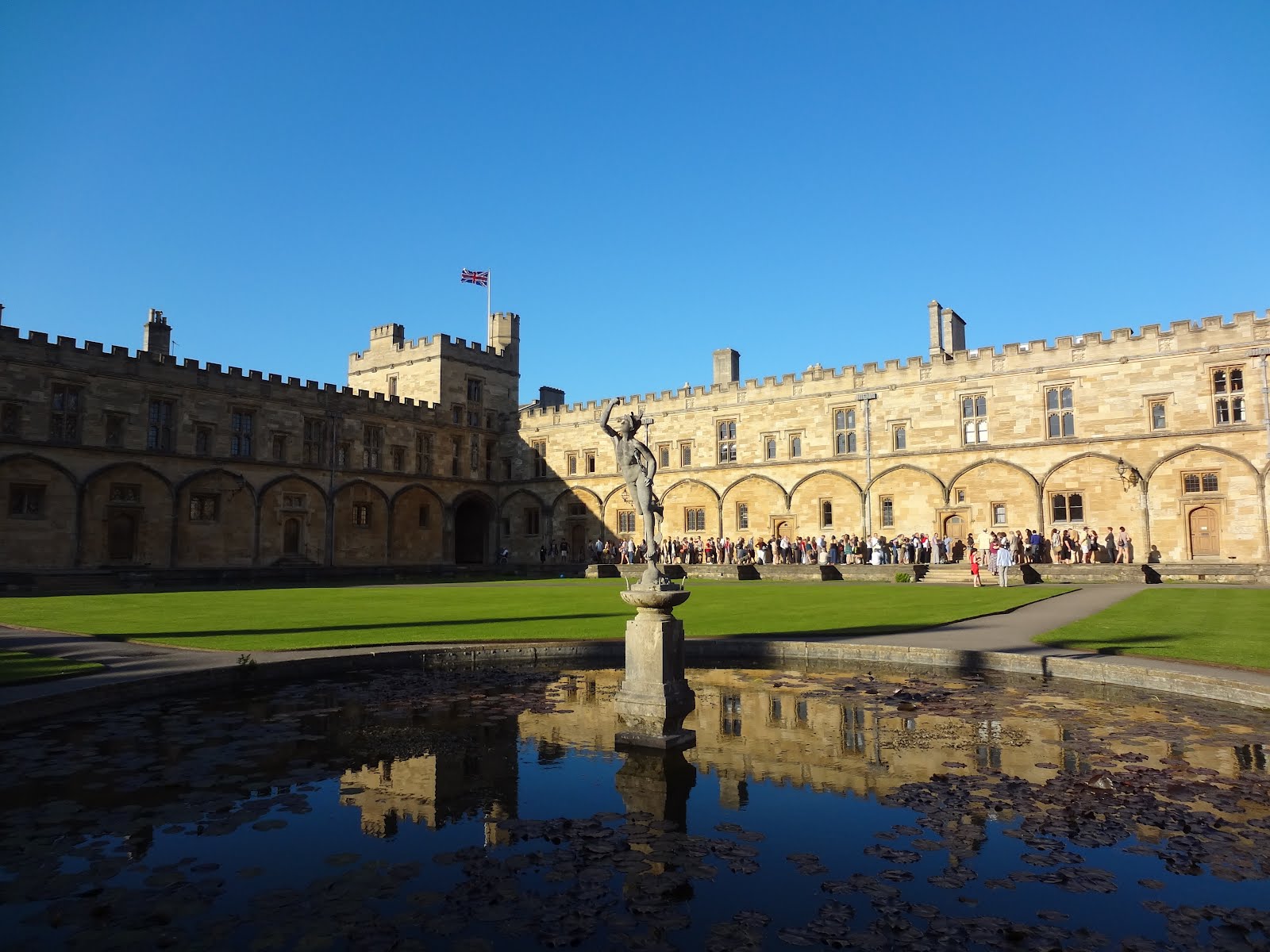
Christ Church college flying the Union flag.


Red, white and blue balloons add a festive touch to Christ Church Cathedral.


Oxford's Jubilee beacon, on top of Magdalen tower.


Towers at sunset, yesterday evening.


The Grand Cafe!


The moon rising over Magdalen. It rose huge and orange-coloured - it was one of those times when you can't be sure you're looking at the moon and not an alien spacecraft.


The moon and the towers of All Souls.


Radcliffe Square.


Monday, 4 June 2012

Rags of heart


The Broken Heart
John Donne


He is stark mad, whoever says,
That he hath been in love an hour,
Yet not that love so soon decays,
But that it can ten in less space devour;
Who will believe me, if I swear
That I have had the plague a year?
Who would not laugh at me, if I should say
I saw a flash of powder burn a day?

Ah, what a trifle is a heart,
If once into love's hands it come!
All other griefs allow a part
To other griefs, and ask themselves but some;
They come to us, but us love draws;
He swallows us and never chaws;
By him, as by chain'd shot, whole ranks do die;
He is the tyrant pike, our hearts the fry.

If 'twere not so, what did become
Of my heart when I first saw thee?
I brought a heart into the room,
But from the room I carried none with me.
If it had gone to thee, I know
Mine would have taught thine heart to show
More pity unto me; but Love, alas!
At one first blow did shiver it as glass.

Yet nothing can to nothing fall,
Nor any place be empty quite;
Therefore I think my breast hath all
Those pieces still, though they be not unite;
And now, as broken glasses show
A hundred lesser faces, so
My rags of heart can like, wish, and adore,
But after one such love, can love no more.

Sunday, 3 June 2012

"Nocte pluit tota, redeunt spectacula mane"


It rains all night, but the public games take place in the morning;

You, Caesar, hold divided empire with Jove.


This pseudo-Virgilian Latin tag seems almost impossibly appropriate on this rainy day of royal pageantry. It was quoted by the author of the Encomium Emmae Reginae in praise of Cnut: he wanted to describe the general awesomeness of the Viking king of England by comparing him to great emperors of the past, and now nearly a thousand years later it seems just as relevant to Cnut's many-times successor, the current Queen.

This BBC slideshow helpfully explains how the pageant just about to begin on the River Thames takes its inspiration principally from the royal displays of the seventeenth and eighteenth centuries, but Anglo-Saxon and Anglo-Danish kings were just as keen on river pageantry. When King Edgar was crowned by Archbishop Dunstan on Whitsunday 973, in the first occurrence of the coronation ceremony which is the basis of the one still used today, he was rowed up the river Dee in great state by six British kings who had submitted to his overlordship.


Edgar's coronation depicted at Bath Abbey

The present Queen is Edgar's direct descendant, and is certainly following in his wake today.

As for Cnut, well, he was a Viking: they loved their ships. This is the anonymous encomiast's depiction of Cnut's fleet:

On one side lions moulded in gold were to be seen on the ships, on the other birds on the tops of the masts indicated by their movements the winds as they blew, or dragons of various kinds poured firefrom their nostrils. Here there were glittering men of solid gold or silver nearly comparable to live ones, there bulls with necks raised high and legs outstretched were fashioned leaping and roaring like live ones. One might see dolphins moulded in electrum, and centaurs in the same metal, recalling the ancient fable. In addition, I might describe to you many examples of the same celature, if the names of the monsters which were there fashioned were known to me. But why should I now dwell upon the sides of the ships, which were not only painted with ornate colours, but were covered with gold and silver figures?

The royal vessel excelled the others in beauty as much as the king preceded the soldiers in the honour of his proper dignity, concerning which it is better that I be silent than that I speak inadequately. Placing their confidence in such a fleet, when the signal was suddenly given, they set out gladly, and, as they had been ordered, placed themselves round about the royal vessel with level prows, some in front and some behind. The blue water, smitten by many oars, might be seen foaming far and wide, and the sunlight, cast back in the gleam of metal, spread a double radiance in the air.

There's a bit of poetic license here, but not much!

So great, also, was the ornamentation of the ships, that the eyes of the beholders were dazzled, and to those looking from afar they seemed of flame rather than of wood. For if at any time the sun cast the splendour of its rays among them, the flashing of arms shone in one place, in another the flame of suspended shields. Gold shone on the prows, silver also flashed on the variously shaped ships.

We know of one occasion when these golden dragon-ships rowed down the Thames in glorious procession - on 8 June 1023, when the body of St Ælfheah was carried in state from St Paul's down the river towards Canterbury, accompanied by a magnificant company of earls, archbishops, monks and Viking warriors, and in the presence of the king and queen, Cnut and Emma, and their young son. That was 989 years ago, almost to the very day - and look at the river at this minute! Does anything ever really change?

Quotations from the Encomium Emmae Reginae, ed. and trans. Alistair Campbell (London, 1949).

Saturday, 2 June 2012

Joy-jaunts


Today is Thomas Hardy's birthday, so here is his very cheeriest poem. Only a true man of Wessex would put 'cider' at the top of his list of great things in the world...


Sweet cyder is a great thing,
A great thing to me,
Spinning down to Weymouth town
By Ridgway thirstily,
And maid and mistress summoning
Who tend the hostelry:
O cyder is a great thing,
A great thing to me!

The dance it is a great thing,
A great thing to me,
With candles lit and partners fit
For night-long revelry;
And going home when day-dawning
Peeps pale upon the lea:
O dancing is a great thing,
A great thing to me!

Love is, yea, a great thing,
A great thing to me,
When, having drawn across the lawn
In darkness silently,
A figure flits like one a-wing
Out from the nearest tree:
O love is, yes, a great thing,
A great thing to me!

Will these be always great things,
Great things to me?...
Let it befall that One will call,
"Soul, I have need of thee":
What then? Joy-jaunts, impassioned flings,
Love, and its ecstasy,
Will always have been great things,
Great things to me!

Friday, 1 June 2012

Only the road and the dawn, the sun, the wind, and the rain


Today, 1 June, is the anniversary of the birth of John Masefield in 1878. I haven't read much of Masefield's work (to be fair, there is a lot to read), though 'The West Wind' is my favourite of his mellifluous poems. And here's something else in honour of his birthday - a wanderers' poem.

For something on a similar theme, compare The Song of the Pilgrims.


The Seekers

Friends and loves we have none, nor wealth nor blessed abode,
But the hope of the City of God at the other end of the road.

Not for us are content, and quiet, and peace of mind,
For we go seeking a city that we shall never find.

There is no solace on earth for us - for such as we -
Who search for a hidden city that we shall never see.

Only the road and the dawn, the sun, the wind, and the rain,
And the watch fire under stars, and sleep, and the road again.

We seek the City of God, and the haunt where beauty dwells,
And we find the noisy mart and the sound of burial bells.

Never the golden city, where radiant people meet,
But the dolorous town where mourners are going about the street.

We travel the dusty road till the light of the day is dim,
And sunset shows us spires away on the world's rim.

We travel from dawn to dusk, till the day is past and by,
Seeking the Holy City beyond the rim of the sky.

Friends and loves we have none, nor wealth nor blest abode,
But the hope of the City of God at the other end of the road.


Spires at sunset (Oxford, June 2011)