Monday, 13 February 2012

Some Pictures from St Bartholomew's, Goodnestone


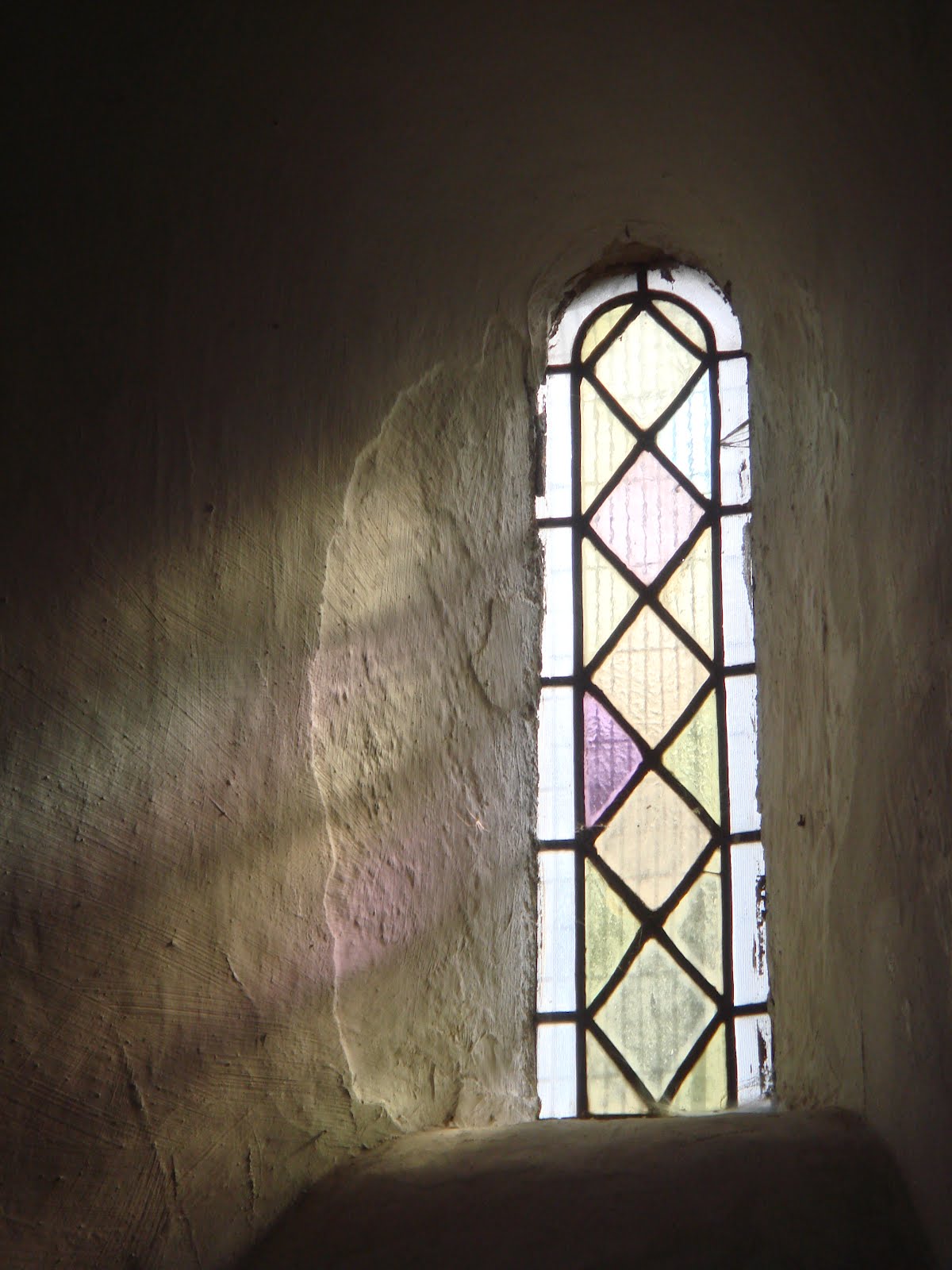
The tiny Norman church of St Bartholomew's, Goodnestone, stands in a field, next to a farm, in the middle of nowhere (or as close as you can get to the middle of nowhere in well-populated Kent).


There are two places in Kent called Goodnestone: one has a picture-perfect estate village, a beautiful and well-used church, a stately home with delightful gardens, and a connection to Jane Austen. This is the other one.


It's near Faversham, in north Kent, on the edge of Graveney Marsh. The advantage of being so far away from everywhere is that the church is largely unchanged since it was built, c.1100; the disadvantage is that it is now disused, though it's cared for by the fine people at the Churches Conservation Trust.

Unchanged means not extended, though you can't really get a sense even from this picture of how tiny it is. I was standing right against the back wall when I took it!
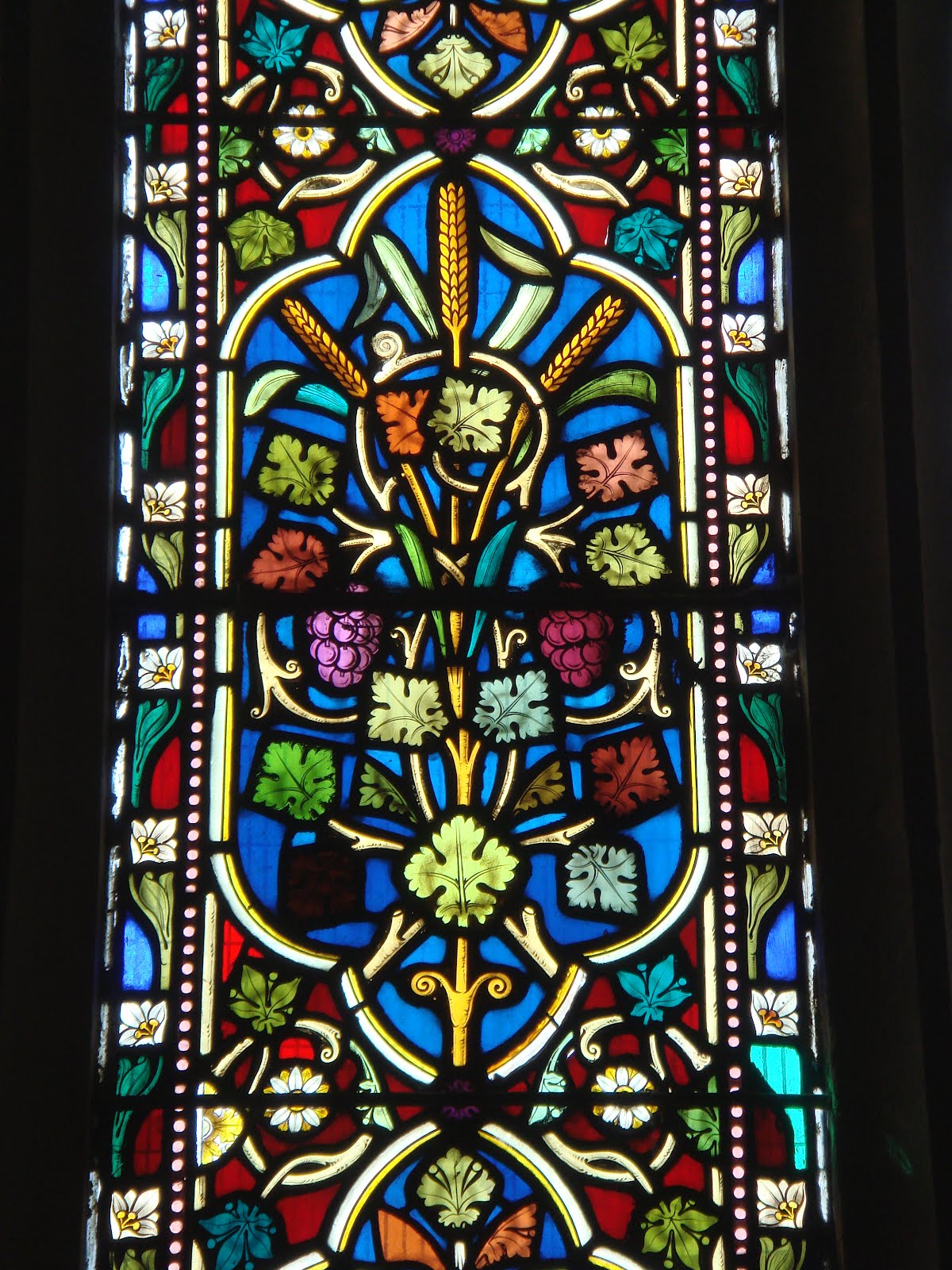

One of the nicest things about it is the stained glass, some of which is by 'the Father of Victorian Stained Glass', Thomas Willement. Willement lived not far away at Davington Priory, on the outskirts of Faversham, which I suppose is how St Bartholomew's got his attention. (Similarly, and not far away, the equally isolated Kingsdown was much beautified by a church designed by Edward Welby Pugin, son of Augustus).


St Bartholomew's made me appreciate once more just how much stained glass, even of indifferent quality, can add to a church. "Colour fulfils where Music has no power", as Kipling puts it, especially in an otherwise plain and simple setting. There was something about the mixture of patterns in these windows that seemed to elevate the whole place; to reify light itself.


Sunday, 12 February 2012

Sunday Lyric: Love me brought

Another lyric from John of Grimestone's commonplace book, in which Christ addresses mankind. It's in the same Christ-as-wooer vein as this extract from Ancrene Wisse.


Love me brouthte
And love me wrouthte,
Man, to be thy fere.
Love me fedde
And love me ledde
And love me lettet here.

Love me slou
And love me drou
And love me layde on bere.
Love is my pes,
For love I ches,
Man to buyen dere.

Ne dred thee nought,
I have thee sought
Bothen day an night.
To haven thee,
Well is me,
I have thee wonnen in fight.


Rough translation:

Love me brought
And love me wrought,
Mankind, to be thy fere. [companion]
Love me fed
And love me led
And love now keeps me here.

Love me slew
And love me drew
And love me laid on bier.
Love is my peace,
For love I choose
Mankind to buy so dear.

Now fear thee not,
I have thee sought
Both day and night.
To have thee
Is joy to me;
I won thee in the fight.

Saturday, 11 February 2012

He Wonders Whether To Praise or Blame Her


I have peace to weigh your worth, now all is over,
But if to praise or blame you, cannot say.
For, who decries the loved, decries the lover;
Yet what man lauds the thing he's thrown away?

Be you, in truth, this dull, slight, cloudy naught,
The more fool I, so great a fool to adore;
But if you're that high goddess once I thought,
The more your godhead is, I lose the more.

Dear fool, pity the fool who thought you clever!
Dear wisdom, do not mock the fool that missed you!
Most fair, -- the blind has lost your face for ever!
Most foul, -- how could I see you while I kissed you?

So . . . the poor love of fools and blind I've proved you,
For, foul or lovely, 'twas a fool that loved you.

Friday, 10 February 2012

The Story of St Scholastica in Old English

St Scholastica, from a window in St Thomas', Oxford

St Scholastica, sister of St Benedict, was commemorated in medieval England (as elsewhere) on 10 February, from the Anglo-Saxon period onwards. Everything that is known about her comes from her appearance in Gregory's Dialogues, but this in itself was enough to ensure high regard in Anglo-Saxon England - the Dialogues was, after all, one of the texts Alfred the Great considered 'necessary for all men to know'. As the first and greatest example of a consecrated Benedictine woman she provided a female pattern for Benedictine monasticism, which gave Anglo-Saxon England such remarkable women as Hilda of Whitby and Etheldreda of Ely, among many others. There were also some pairs of holy brothers and sisters who followed the model of Scholastica and Benedict's close sibling relationship, most notably St Guthlac and his sister Pega, but perhaps St Æthelburh of Barking and her brother Earconwald too.

This is how Ælfric tells Gregory's famous story about her, in his homily on St Benedict:

Se halga wer hæfde ane eawfæste swustor, Scolastica gehaten, seo wæs fram cildhade Gode gehalgod, on mægðhade him ðeowigende, on gehendnysse his mynstres wunigende; þa geneosode se halga wer symle æne ymbe geares ymbrene. Þa gecom he sume dæge to hyre cytan æfter gewunan mid sumum his gebroðrum, and hi ealne ðone dæg on Godes herungum and halgum spræcum adrugon. Efne ða on æfnunge, ðaða hi æt gereorde sæton, cwæð þæt halige mæden to hire arwurðfullan breðer, "Ic bidde ðe, broðer min, ne forlæt ðu me on þissere nihte, þæt wit magon smeagan ymbe gefean þæs heofenlican lifes oð merigen." Ða andwyrde se arwurða broðor, "Hwaet cweðst þu, sweoster? Ne mæg ic nateshwon buton mynstre nihtes wunian." And wæs ða swa stille weder, þæt nan wolcn næs on ðære lyfte gesewen. Hwæt ða, seo mynecynu, ðaða heo his andsæc gehyrde, beclypte hire neb mid handum, and ahylde hire heafod to ðære mysan, biddende þone Ælmihtigan Drihten. Þa mid ðam ðe heo hire heafod of ðære mysan ahefde, ða abærst swa micel ðunor and liget, and swilc storm yðigende feoll, swa þæt se halga wer and his gebroðra ne mihton, for ðam ormætan gyte, heora fet of ðære cytan astyrian. Ða cwæð se halga wer to his sweoster, "Arie ðe se Ælmihtiga God, sweoster: hwæt hæfst þu gedon?" Heo andwyrde, "Efne ic bæd þe, and þu me noldest tiðian; ða bæd ic minne Drihten, and he me gehyrde. Gang nu to mynstre, gif ðu mage, and me ana forlæt." He ða ne mihte buton ðam hrofe acuman, ac ðær wunode þa niht unwilles, seðe sylfwilles nolde. And hi ealle ða niht mid halgum spræcum þæs gastlican lifes ðurhwacole aspendon.

Eft siððan ymbe ðry dagas stod se halga wer on his gebedum, and beseah ut, and geseah ðære ylcan mynecene his sweoster sawle lædan to heofenan, on anre culfran hiwe. He ða hire wuldres blissigende, ðam Ælmihtigan Gode þancode, and hire forðsið his gebroðrum cyðde, and sende hi ðærrihte, þæt hi hire lic to mynstre feredon, and on his agenre byrgene, þær he sylf licgan wolde, mid arwurðnysse bebyrigdon; þæt heora lichaman on anre byrgene hi gereston, swa swa heora mod on annysse symle Gode ðeowode.
This would make a good exercise for translating Old English, and the dialogue especially is not hard to recognise: "Ic bidde ðe, broðer min, ne forlæt ðu me on þissere nihte", and "Arie ðe se Ælmihtiga God, sweoster: hwæt hæfst þu gedon?" (once you know that 'arie' means 'have mercy'!). Here's my translation of Ælfric, who is himself closely translating St Gregory:
The holy man had a pious sister named Scholastica, who from childhood was consecrated to God, serving Him in virginity and living near his monastery. The holy man always visited her once in the course of the year. One day he came to her cell, according to his custom, with some of his fellow monks, and they spent the whole day in the praise of God and in holy discourse. Then in the evening, when they were sitting at their meal, the holy maiden said to her venerable brother, "I ask you, my brother, not to leave me tonight, so that we may talk together about the joys of the heavenly life until morning." The venerable man answered, "What are you saying, sister? I cannot for any reason be away from the monastery at night." And at that moment there was such calm weather that not a cloud could be seen in the sky; but then the nun, when she heard his refusal, covered her face with her hands and bowed her head to the table, praying to the Almighty Lord. Then, when she raised her head from the table, there burst forth such great thunder and lightening, and such a surging storm fell, that the holy man and his brothers could not stir their feet from the cell because of the immense downpour. Then the holy man said to his sister, "Almighty God have mercy on you, sister! What have you done?" She answered, "Well, I asked you, and you would not grant my request; so I asked my Lord, and he heard me. Go to the monastery now, if you can, and leave me here alone." But he could not go out from under that shelter, and stayed there that night – unwillingly, since he would not stay willingly. And they spent all that night, thoroughly awake, in holy discourse about the spiritual life.

Three days later, the holy man was standing at his prayers, and he looked out, and saw the soul of that same nun his sister being led to heaven in the form of a dove. Rejoicing in her glory, he thanked Almighty God, and told his brothers of her death. He straightaway sent them to bring her body to the monastery and bury her in his own tomb, where he intended to lie himself, with great honour; so that their bodies might rest in one grave, just as their minds, with one thought, had always served God.
Scholastica's name in an Anglo-Saxon litany (the Ramsey Psalter, BL Harley 2904, f. 211v)

This is how the same story is told in a Middle English Life of Scholastica, which dates to the late thirteenth century (from this site, which also contains a useful overview of Scholastica's legend):

Sori were this holi thinges bothe tho it was eve;
Seyn Benet to his soster sede that he ne mighte noleng bileve.
Sori was this maide tho; "Brother," heo sede, "thin ore!
This holi wordes so murie beth, yut we mote telle more.
Wen we in Godes service beth, ne dorre we our ordres breke.
Icham so feble that I ne wene never eft with thee speke;
Bileve we togadere this one nyght, vor Him that ous dere aboghte.
Ichot He wole it ous vorgive, vor we doth it in gode thoghte."
"Be stille," quath Seyn Benet, "loke wat thou dost telle;
Wel thou wost that I ne may bi nyghte be fram my celle."
Tho this maide isei that it ne huld to bidde hire brother more,
Hire heved heo gan to honge adoun and wep swithe sore.
"Lord," heo sede, "Thou art fol of milce and of ore;
Let me, yif Thi wille beo, hure more of Thi lore.
Ne let noght my brother tonyght, Lord, fram me wende,
Ac let ous with tales of Thi blisse this night bringe to ende."
As this maide lokede up, tho heo hadde ido hire bone,
That weder that was so cler and vair bigan to chaungi sone.
Hit gan to snywe and thondri, lighte, and eke reyne,
That ver withynne nyght it was ar that weder wolde fyne,
That wel was ech quic best that was in eny inne.
Nou was this a maister maide that such weder couthe awynne!

Tho ne mighte Seyn Benet for weder thenne wende.
"Soster," he sede, "wat hastou do? Thou fondest me to scende!
Yif it my Loverdes wille nere wel ne dudestou noght;
That ich schal myn ordre breke so nadde ich never ithoght."
"Leve brother," the maide sede, "ich bad thee swithe yerne
To bileve her thus nyght, and ever thou dust werne.
Ich bad mi Lord another bone and He me herde anon.
Ches wether thou wolt bileve, other henne gon.
Bilef me al one yif thou wolt, vor no thonk ne can ich thee;
Ich thonke God of Hevene that so sone hurde me."
Tho hi ne mighte departi noght al nyght togadere hi woke,
And tolde of the swetnesse that was myd God in tale and eke in boke.
The nyght hem thoghte swithe scort, and sori aten ende
Hi were, tho hi seie dai, that hi moste ato wende.

[Sorry were both these holy ones when the evening came; St Benedict said to his sister that he could stay no longer.  Sorry was this maiden then. "Brother," she said, "your pity!  These holy words are so pleasant that we may yet say more. Since we are in God's service, we do not dare break our vows, but I am so weak that I do not expect to speak with you again; let us stay together this one night, for the sake of him who so dearly redeemed us. I know he will forgive us for it, for we do it with good intentions." "Be quiet," said St Benedict, "and consider what you are saying; you know very well that I cannot be away from my cell at night." When this maiden saw that it would do no good to ask her brother any longer, she began to hang down her head and wept sorely.  "Lord," she said, "you are full of mercy and of pity; allow me, if it be your will, to hear more of your teaching. Do not allow my brother, Lord, to go from me tonight, but let us spend this whole night in talking of your bliss." As this maiden looked up, when she had made her prayer, the weather that was so clear and fair suddenly began to change. It began to snow and thunder, with lightning and rain too; the night would be far advanced before it began to clear, and it was well for any living creature which could find shelter. Now this was a master-maid who could control such weather!  Then St Benedict could not go from there because of the weather. "Sister," he said, "what have you done?  You are trying to destroy me! If it were not my Lord's will, you would be able to do nothing; I never would have thought I should break my vow in this way."  "Dear brother," said the maiden, "I asked you very earnestly to stay here this night, but you repeatedly refused.  I asked my Lord for another favour, and he heard me. Choose whether you will stay, or go from here. Leave me all alone if you want, for I owe you no thanks; I thank God of Heaven who so swiftly heard me!"  Since he could not depart, they stayed awake together all night, and talked of the sweetness that was with God in tales and books too.  The night seemed very short to them, and they were sorry at the end, when they saw the dawn, that they had to part from each other.]


Benedict and Scholastica, with the storm gathering (St Edmund's, Bungay)

Thursday, 9 February 2012

Medieval Valentine's Day


Every year I can tell from my stats page when the googling world starts preparing itself for Valentine's day, and in light of the number of people who arrive at this blog in search of medieval love poems, medieval terms of endearment, and ways to compliment their sweethearts in various medieval languages, I thought it might be a public service to combine the lot of them in one post of many links.

Valentine's Day is in a way a medieval invention, in that the first association between Valentine and romantic love appears in Chaucer (the Parliament of Fowls):

For this was on seynt Valentynes day,
Whan every foul cometh ther to chese his make.

He might have been talking about May rather than February, but never mind that; here we have the beginning of the modern idea of St Valentine's Day (blame Chaucer, as so often!). Regardless of the history of the actual festival, what I offer here is a variety of resources from real medieval texts for the discerning would-be wooer.

So - we have medieval compliments and terms of endearment for your sweetheart (and I can't resist including a link to this idiom for happiness. Please do tell your Valentine that her love makes you 'gladder than a bird on a bright morning' - I know it would melt my heart!)

Or take inspiration from King Malcolm of Scotland and decorate her books, even if you can't read them yourself.

What do we have in the way of romantic literature? Well, there's this, one of the earliest bits of prose romance in the English language. Yes, it's about Christ, but appropriate all the same. There's this idyllic depiction of a married couple whose 'love was ever new' - and their lovely honeymoon dreams, but unless you have the whole country of Denmark to present to your lover, that may not be for you (if you do have Denmark to present and no one to give it to, please get in touch...).

Here are the various medieval love poems I've posted:

Praise of a pale beauty - 'Her gladness will never pass away / as long as I can sing.'

An appeal to Fortune - 'Think what sorrow is the parting / of two true hearts loving faithfully.'

The power of memory - 'So deep ye be / Graven, parde, / Within mine heart, / That afore me / Ever I you see / In thought covert.'

Remembering what has been - 'Once I was he to whom ye spake, "Have here my heart! It is thy own."'

Unshakeable fidelity - 'Where I have chosen, steadfast will I be.'

Absence makes the heart grow fonder - 'She sayeth that she hath seen it written / That seldom seen is soon forgotten; / It is not so!'

But is hard to bear - 'And love is into my heart gone / With one spear so keen, / Night and day my blood it drinks; / Mine heart doth me teen.'

Lamenting a lover's lack of truth - 'If it were undone what now is done...'

A lover become a stranger - 'As he is my heart's love,/ My dearest dear, blest may he be!/ I swear by God that is above, /None hath my love but only he.'

Mourning for lost love - 'Therefore I take mine aventure, iwiss, / As she that hath forsaken joys all, /And to all pain is both subject and thrall.'

A very sweet little carol - 'For weal or woe I will not flee / To love the heart that loveth me'.

And for the sake of balance, we have: a poem on the fun of not being in love, a brilliantly silly parody love poem, and a reminder that (alas!) 'All other love is like the moon'...


But if you want to impress, don't forget the power of fine clothes, as attested to by a scene in Laxdaela saga. Wear your best clothes and your golden sword, and go talk to the girl yourself - that's all it takes (if you're a Viking).

Now the Vikings did not, of course, have anything so ridiculous as Valentine's Day, but I have to end by observing that nonetheless, the best Viking of them all literally owns St Valentine's Day. Because King Cnut and his wife Emma did in fact own the head of St Valentine. (As a saint's relic, I hasten to add, not as some kind of weird trophy). And Emma gave it to the New Minster in Winchester, more than three centuries before Chaucer helped to mix up Valentine with romantic sentiment. Trust Cnut and Emma to make even Valentine's Day interesting.

In Tenebris II: 'one born out of due time'


More Thomas Hardy, following on from In Tenebris I.


Considerabam ad dexteram, et videbam; et non erat qui cognosceret me... Non est qui requirat animam meam. - Psalm 142:5

['I looked also upon my right hand, and saw there was no man that would know me; no man cared for my soul.']


When the clouds' swoln bosoms echo back the shouts of the many and strong
That things are all as they best may be, save a few to be right ere long,
And my eyes have not the vision in them to discern what to these is so clear,
The blot seems straightway in me alone; one better he were not here.

The stout upstanders say, All's well with us; ruers have nought to rue!
And what the potent say so oft, can it fail to be somewhat true?
Breezily go they, breezily come; their dust smokes around their career,
Till I think I am one born out of due time, who has no calling here.

Their dawns bring lusty joys, it seems; their evenings all that is sweet;
Our times are blessed times, they cry: Life shapes it as is most meet,
And nothing is much the matter; there are many smiles to a tear;
Then what is the matter is I, I say. Why should such a one be here? ...

Let him in whose ears the low-voiced Best is killed by the clash of the First,
Who holds that if way to the Better there be, it exacts a full look at the Worst,
Who feels that delight is a delicate growth cramped by crookedness, custom and fear,
Get him up and be gone as one shaped awry; he disturbs the order here.

Wednesday, 8 February 2012

Dickens and Lost Love


I wanted to post an extract from one of Dickens' novels yesterday, but drew a blank on which one, and went with the Chesterton instead; then today this one came to mind. It comes from chapter 28 of Little Dorrit, about a third of the way through the novel, and concerns the parting of the hero, Arthur Clennam, from the woman with whom he has been secretly in love, because she is about to marry another man. It's a beautiful, subtle, gentle scene - qualities people don't usually associate with Dickens.

The only backstory you need to know is this: Arthur loves Minnie ('Pet', as her parents call her), who is much younger than him, and he knows that their different lives make any return of his love impossible. This is how he thinks it over to himself at the end of chapter 16:

'Suppose that a man,' so his thoughts ran, 'who had been of age some twenty years or so; who was a diffident man, from the circumstances of his youth; who was rather a grave man, from the tenor of his life; who knew himself to be deficient in many little engaging qualities which he admired in others, from having been long in a distant region, with nothing softening near him; who had no kind sisters to present to her; who had no congenial home to make her known in; who was a stranger in the land; who had not a fortune to compensate, in any measure, for these defects; who had nothing in his favour but his honest love and his general wish to do right--suppose such a man were to come to this house, and were to yield to the captivation of this charming girl, and were to persuade himself that he could hope to win her; what a weakness it would be!'

He softly opened his window, and looked out upon the serene river. Year after year so much allowance for the drifting of the ferry-boat, so many miles an hour the flowing of the stream, here the rushes, there the lilies, nothing uncertain or unquiet.

Why should he be vexed or sore at heart? It was not his weakness that he had imagined. It was nobody's, nobody's within his knowledge; why should it trouble him? And yet it did trouble him. And he thought--who has not thought for a moment, sometimes?--that it might be better to flow away monotonously, like the river, and to compound for its insensibility to happiness with its insensibility to pain.

He makes a resolution to conquer his feelings, and the narrator maintains the conceit that it is not Arthur but 'nobody' who is in love with Pet. His feelings remain unspoken, half-repressed, acknowledged only through reference to this 'nobody' who is Arthur's hazy hypothetical double - the person he would be if he were not himself (Pet has her own shadowy double in the twin sister who died when they were children, mentioned, significantly, in this scene).

Pet falls in love with someone else and marries him and (spoiler!) so does Arthur, so in the end it doesn't really matter (though maybe Dickens didn't know that when he was writing this chapter); but as a depiction of the ending of a dream this scene nonetheless has power even out of context. It's all about what isn't said.


Clennam had stopped, not for the first time by many times, to look about him and suffer what he saw to sink into his soul, as the shadows, looked at, seemed to sink deeper and deeper into the water. He was slowly resuming his way, when he saw a figure in the path before him which he had, perhaps, already associated with the evening and its impressions.

Minnie was there, alone. She had some roses in her hand, and seemed to have stood still on seeing him, waiting for him. Her face was towards him, and she appeared to have been coming from the opposite direction. There was a flutter in her manner, which Clennam had never seen in it before; and as he came near her, it entered his mind all at once that she was there of a set purpose to speak to him.

She gave him her hand, and said, 'You wonder to see me here by myself? But the evening is so lovely, I have strolled further than I meant at first. I thought it likely I might meet you, and that made me more confident. You always come this way, do you not?'

As Clennam said that it was his favourite way, he felt her hand falter on his arm, and saw the roses shake.

'Will you let me give you one, Mr Clennam? I gathered them as I came out of the garden. Indeed, I almost gathered them for you, thinking it so likely I might meet you. Mr Doyce arrived more than an hour ago, and told us you were walking down.'

His own hand shook, as he accepted a rose or two from hers and thanked her. They were now by an avenue of trees. Whether they turned into it on his movement or on hers matters little. He never knew how that was.

'It is very grave here,' said Clennam, 'but very pleasant at this hour. Passing along this deep shade, and out at that arch of light at the other end, we come upon the ferry and the cottage by the best approach, I think.'

In her simple garden-hat and her light summer dress, with her rich brown hair naturally clustering about her, and her wonderful eyes raised to his for a moment with a look in which regard for him and trustfulness in him were strikingly blended with a kind of timid sorrow for him, she was so beautiful that it was well for his peace--or ill for his peace, he did not quite know which--that he had made that vigorous resolution he had so often thought about.

She broke a momentary silence by inquiring if he knew that papa had been thinking of another tour abroad? He said he had heard it mentioned. She broke another momentary silence by adding, with some hesitation, that papa had abandoned the idea.

At this, he thought directly, 'they are to be married.'

'Mr Clennam,' she said, hesitating more timidly yet, and speaking so low that he bent his head to hear her. 'I should very much like to give you my confidence, if you would not mind having the goodness to receive it. I should have very much liked to have given it to you long ago, because--I felt that you were becoming so much our friend.'

'How can I be otherwise than proud of it at any time! Pray give it to me. Pray trust me.'

'I could never have been afraid of trusting you,' she returned, raising her eyes frankly to his face. 'I think I would have done so some time ago, if I had known how. But I scarcely know how, even now.'

'Mr Gowan,' said Arthur Clennam, 'has reason to be very happy. God bless his wife and him!'

She wept, as she tried to thank him. He reassured her, took her hand as it lay with the trembling roses in it on his arm, took the remaining roses from it, and put it to his lips. At that time, it seemed to him, he first finally resigned the dying hope that had flickered in nobody's heart so much to its pain and trouble; and from that time he became in his own eyes, as to any similar hope or prospect, a very much older man who had done with that part of life.

He put the roses in his breast and they walked on for a little while, slowly and silently, under the umbrageous trees. Then he asked her, in a voice of cheerful kindness, was there anything else that she would say to him as her friend and her father's friend, many years older than herself; was there any trust she would repose in him, any service she would ask of him, any little aid to her happiness that she could give him the lasting gratification of believing it was in his power to render?

She was going to answer, when she was so touched by some little hidden sorrow or sympathy--what could it have been?--that she said, bursting into tears again: 'O Mr Clennam! Good, generous, Mr Clennam, pray tell me you do not blame me.'

'I blame you?' said Clennam. 'My dearest girl! I blame you? No!'

After clasping both her hands upon his arm, and looking confidentially up into his face, with some hurried words to the effect that she thanked him from her heart (as she did, if it be the source of earnestness), she gradually composed herself, with now and then a word of encouragement from him, as they walked on slowly and almost silently under the darkening trees.

'And, now, Minnie Gowan,' at length said Clennam, smiling; 'will you ask me nothing?'

'Oh! I have very much to ask of you.'

'That's well! I hope so; I am not disappointed.'

'You know how I am loved at home, and how I love home. You can hardly think it perhaps, dear Mr Clennam,' she spoke with great agitation, 'seeing me going from it of my own free will and choice, but I do so dearly love it!'

'I am sure of that,' said Clennam. 'Can you suppose I doubt it?'

'No, no. But it is strange, even to me, that loving it so much and being so much beloved in it, I can bear to cast it away. It seems so neglectful of it, so unthankful.'

'My dear girl,' said Clennam, 'it is in the natural progress and change of time. All homes are left so.'

'Yes, I know; but all homes are not left with such a blank in them as there will be in mine when I am gone. Not that there is any scarcity of far better and more endearing and more accomplished girls than I am; not that I am much, but that they have made so much of me!'

Pet's affectionate heart was overcharged, and she sobbed while she pictured what would happen.

'I know what a change papa will feel at first, and I know that at first I cannot be to him anything like what I have been these many years. And it is then, Mr Clennam, then more than at any time, that I beg and entreat you to remember him, and sometimes to keep him company when you can spare a little while; and to tell him that you know I was fonder of him when I left him, than I ever was in all my life. For there is nobody--he told me so himself when he talked to me this very day--there is nobody he likes so well as you, or trusts so much.'

A clue to what had passed between the father and daughter dropped like a heavy stone into the well of Clennam's heart, and swelled the water to his eyes. He said, cheerily, but not quite so cheerily as he tried to say, that it should be done--that he gave her his faithful promise.

'If I do not speak of mama,' said Pet, more moved by, and more pretty in, her innocent grief, than Clennam could trust himself even to consider--for which reason he counted the trees between them and the fading light as they slowly diminished in number--'it is because mama will understand me better in this action, and will feel my loss in a different way, and will look forward in a different manner. But you know what a dear, devoted mother she is, and you will remember her too; will you not?'

Let Minnie trust him, Clennam said, let Minnie trust him to do all she wished.

'And, dear Mr Clennam,' said Minnie, 'because papa and one whom I need not name, do not fully appreciate and understand one another yet, as they will by-and-by; and because it will be the duty, and the pride, and pleasure of my new life, to draw them to a better knowledge of one another, and to be a happiness to one another, and to be proud of one another, and to love one another, both loving me so dearly; oh, as you are a kind, true man! when I am first separated from home (I am going a long distance away), try to reconcile papa to him a little more, and use your great influence to keep him before papa's mind free from prejudice and in his real form. Will you do this for me, as you are a noble-hearted friend?'

Poor Pet! Self-deceived, mistaken child! When were such changes ever made in men's natural relations to one another: when was such reconcilement of ingrain differences ever effected! It has been tried many times by other daughters, Minnie; it has never succeeded; nothing has ever come of it but failure.

So Clennam thought. So he did not say; it was too late. He bound himself to do all she asked, and she knew full well that he would do it.

They were now at the last tree in the avenue. She stopped, and withdrew her arm. Speaking to him with her eyes lifted up to his, and with the hand that had lately rested on his sleeve trembling by touching one of the roses in his breast as an additional appeal to him, she said:

'Dear Mr Clennam, in my happiness--for I am happy, though you have seen me crying--I cannot bear to leave any cloud between us. If you have anything to forgive me (not anything that I have wilfully done, but any trouble I may have caused you without meaning it, or having it in my power to help it), forgive me to-night out of your noble heart!'

He stooped to meet the guileless face that met his without shrinking. He kissed it, and answered, Heaven knew that he had nothing to forgive. As he stooped to meet the innocent face once again, she whispered, 'Good-bye!' and he repeated it. It was taking leave of all his old hopes--all nobody's old restless doubts. They came out of the avenue next moment, arm-in-arm as they had entered it: and the trees seemed to close up behind them in the darkness, like their own perspective of the past.

The voices of Mr and Mrs Meagles and Doyce were audible directly, speaking near the garden gate. Hearing Pet's name among them, Clennam called out, 'She is here, with me.' There was some little wondering and laughing until they came up; but as soon as they had all come together, it ceased, and Pet glided away.

Mr Meagles, Doyce, and Clennam, without speaking, walked up and down on the brink of the river, in the light of the rising moon, for a few minutes; and then Doyce lingered behind, and went into the house. Mr Meagles and Clennam walked up and down together for a few minutes more without speaking, until at length the former broke silence.

'Arthur,' said he, using that familiar address for the first time in their communication, 'do you remember my telling you, as we walked up and down one hot morning, looking over the harbour at Marseilles, that Pet's baby sister who was dead seemed to Mother and me to have grown as she had grown, and changed as she had changed?'

'Very well.'

'You remember my saying that our thoughts had never been able to separate those twin sisters, and that, in our fancy, whatever Pet was, the other was?'

'Yes, very well.'

'Arthur,' said Mr Meagles, much subdued, 'I carry that fancy further to-night. I feel to-night, my dear fellow, as if you had loved my dead child very tenderly, and had lost her when she was like what Pet is now.'

'Thank you!' murmured Clennam, 'thank you!' And pressed his hand.

'Will you come in?' said Mr Meagles, presently.

'In a little while.'

Mr Meagles fell away, and he was left alone. When he had walked on the river's brink in the peaceful moonlight for some half an hour, he put his hand in his breast and tenderly took out the handful of roses. Perhaps he put them to his heart, perhaps he put them to his lips, but certainly he bent down on the shore and gently launched them on the flowing river. Pale and unreal in the moonlight, the river floated them away.

The lights were bright within doors when he entered, and the faces on which they shone, his own face not excepted, were soon quietly cheerful. They talked of many subjects (his partner never had had such a ready store to draw upon for the beguiling of the time), and so to bed, and to sleep. While the flowers, pale and unreal in the moonlight, floated away upon the river; and thus do greater things that once were in our breasts, and near our hearts, flow from us to the eternal seas.