Friday, 8 March 2013

Gundulf, bishop of Rochester


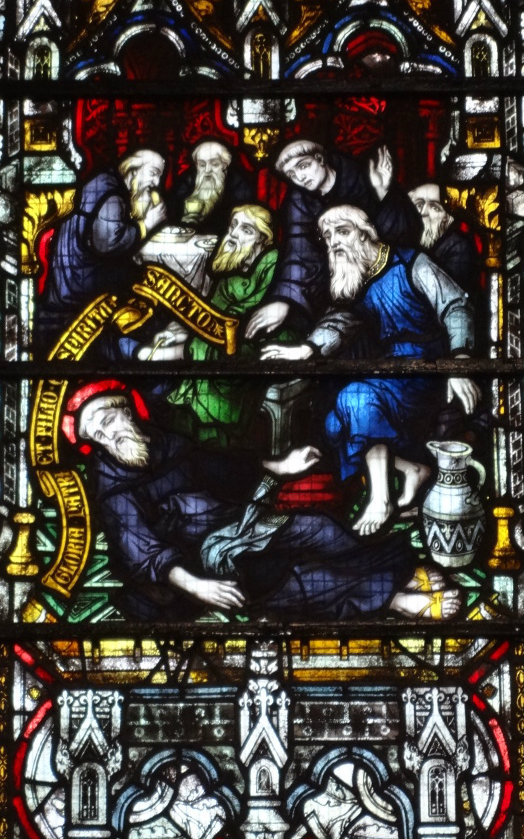
8 March is the anniversary of the death in 1108 of Gundulf, one of the first post-Conquest bishops of Rochester. Gundulf came to England a few years after the Norman Conquest, apparently to be Lanfranc's right-hand man in his new position as Archbishop of Canterbury; in 1077 Gundulf was made bishop of the other Kent diocese, where he remained for the rest of his life. Among his other achievements, he was a skilled architect: he is credited with overseeing the building of the White Tower, the keep of the Tower of London, as well as Rochester Castle and the cathedral church at Rochester. He's of interest to me not just because of his role in the post-Conquest English church but also because he was a life-long friend of St Anselm (they became monks at Bec in the same year, 1059) and the subject of a short biography, written by a monk of Rochester who had probably read Eadmer's life of Anselm. Three brief passages from that biography brought Gundulf to life for me - and so here they are.

The quotations are from The Life of Gundulf, translated by the nuns of Malling Abbey (West Malling, 1984) - Malling was originally founded by Gundulf.


His biographer says that, after becoming Bishop of Rochester,
there were times when he was greatly pressed in his unremitting care of the poor, or hindered by his duties as steward, or had no place where, hidden from the eyes of men, he could spend himself before God as was his wont in prayers and tears. At night he would take a candle and go out as if to see whether his horses had been properly cared for, settling himself on the top of their manger or hiding away in some other corner. Then, as he had been unable or unwilling to do in the day with others watching him and, with an ardour that matched his seclusion, he laid up in heaven the sweat of his toil, watered by his sobs in prayer and his most sweet compunction.

Gundulf had a devout practice of offering two Masses a day, and his biographer says that at the second Mass, while the boys sang the offertory chant, 'Domine Jesu Christe' or 'O pie Deus', Gundulf would sit on his sedilia listening and weeping:

It was his custom moreover when he heard some sweet melody or the pleasant sound of chiming bells, or anything of that kind, to sigh deeply and say, 'O how great must be the joy in heaven where the praise of God is heard continually and without discord forever! When the human hand or tongue shall be able to of their own power to express such concordant melody!'

A music-loving introvert - from these anecdotes (not unusual for saints' lives, but perfectly plausible), Gundulf appeals to me. There are also lots of other stories in the Life about his piety and his concern for the poor, of course.


The third passage I liked records a conversation between Anselm and Gundulf, in which the two men discuss whether they are able to remember everything they hear in church.  Anselm says, “I do indeed endeavour earnestly to remember everything that I hear there, but it more often goes out of my head when I try to take in everything at once.” Gundulf replies, “For myself I do not give equal attention to everything that I hear, but select from it all one thought which appeals most to my heart and, holding it fast, I draw from it some sweetness of divine love. In the same way, if several kinds of good are offered to a sick man he does not take them all but picks out the one he finds most palatable, perhaps some fruit, so that it may be an efficacious remedy in his weakness." The biographer comments: "these were his words, and we who were sufficiently familiar with his life from what we saw and heard can testify that this was constantly his own practice." It's funny to see the biographer presenting Gundulf here as the wiser of the two friends - taking a little bit of pride in his own bishop, even at the expense of one of the greatest minds of the Middle Ages.

Anselm conducted Gundulf's funeral after he died on 8 March 1108, the third Sunday in Lent; he was aged around 85, and had been a monk for 51 years and a bishop for 31. Anselm himself died a little over a year later, in April 1109.


The colourful manuscript images in this post are from books produced at Rochester in the last quarter of the eleventh or first quarter of the twelfth century. One of the things Lanfranc and Gundulf did at Rochester was to stock its rather impoverished library with a fitting collection of important (and beautiful) books.

Sunday, 3 March 2013

Psalm Translations: O God, thou art my God

Some medieval English translations of Psalm 62/63, which I know best for this setting by Purcell:


The whole psalm in the Book of Common Prayer goes like this:

1. O God, thou art my God: early will I seek thee.
2. My soul thirsteth for thee, my flesh also longeth after thee: in a barren and dry land where no water is.
3. Thus have I looked for thee in holiness: that I might behold thy power and glory.
4. For thy loving-kindness is better than the life itself: my lips shall praise thee.
5. As long as I live will I magnify thee on this manner: and lift up my hands in thy Name.
6. My soul shall be satisfied, even as it were with marrow and fatness: when my mouth praiseth thee with joyful lips.
7. Have I not remembered thee in my bed: and thought upon thee when I was waking?
8. Because thou hast been my helper: therefore under the shadow of thy wings will I rejoice.
9. My soul hangeth upon thee: thy right hand hath upholden me.
10. These also that seek the hurt of my soul: they shall go under the earth.
11. Let them fall upon the edge of the sword: that they may be a portion for foxes.
12. But the King shall rejoice in God; all they also that swear by him shall be commended: for the mouth of them that speak lies shall be stopped.


An Old English translation, from the Paris Psalter (Paris, Bibliothèque Nationale, MS 8824):

God min, god min, ic þe gearuwe to
æt leohte gehwam lustum wacie.
Min sawl on ðe swyðe þyrsteð
and min flæsc on ðe fæste getreoweð.
On westene and on wege swylce
and on wæterflodum wene ic swiðe,
þæt ic ðe on halgum her ætywe,
þæt ic þin wuldur and mægen wis sceawige.
Ys þin milde mod micele betere
þonne þis læne lif þe we lifiað on;
weleras ðe mine wynnum heriað.
Swa ic ðe on minum life lustum bletsige
and ic on naman þinum neode swylce
mine handa þwea halgum gelome.
Ys sawl min swetes gefylled,
swa seo fætte gelynd, fægeres smeoruwes;
weleras mine wynnum swylce
þinne naman nu ða neode heriað.
Swa ic þin gemynd on modsefan
on minre reste rihte begange,
and on ærmergen on ðe eac gewene,
forðon þu me on fultum fæste gestode.
Ic beo fægere beþeaht fiðerum þinum
and hiht on ðon hæbbe georne,
forðon min sawl on ðe soðe getreoweþ;
me ðin seo swiðre onfencg symble æt ðearfe.
Forðon hi on idel ealle syððan
sohton synlice sawle mine,
and geond eorðscræfu eodon geneahhe;
nu hi wæran geseald under sweordes hand,
syndon fracuðe nu foxes dælas.
Kynincg sceal on drihtne clæne blisse
hluttre habban, and hine heriað eac
ealle þa ðe on hine aðas sweriað;
forþon synt gemyrde muðas ealle
þa unriht sprecað ahwær landes.

One of the things I find interesting - and if I'm honest, quite moving - about comparing translations is spotting the phrases which have barely changed over the centuries. 'Min sawl on ðe swyðe þyrsteð' - once you know that swyðe means 'greatly', you can recognise exactly what that phrase is, even though this is the English of more than a thousand years ago.  It's our English but it's also very much the English of its time: this is a poetic translation rather than a literal one, and there are some familiar features of Old English poetic diction here - for example, in the phrase 'Ys þin milde mod micele betere þonne þis læne lif þe we lifiað on' ('thy merciful spirit is much better than this fleeting life in which we live').  The word læne crops up frequently in Old English poetry to describe human life on earth (there's a list of examples here); the sense behind it is of something 'loaned' and temporary - life is only a lease and can be taken away at any time.

Here's an illustration of the psalm from the eleventh-century manuscript British Library Harley 603 - I particularly like the smiling sun:


But better still is the invisible line of sight, right at the heart of the picture, which runs between the hand of the psalmist reaching up to heaven (from his bed) and the hand of God reaching down.  With the other hand the psalmist gestures towards his lips.  The trees and plants and goats (?) suggest a wilderness, and heaven is on the other side of the swirl of watery green, under the shadow of sweeping wings.  On the right side of the picture are the enemies 'going under the earth' and being made the prey of foxes, while a crowned king 'rejoices in God' by raising up his hands.

And a Middle English translation, from a Wycliffite Bible:

God, my God, Y wake to thee ful eerli.
Mi soule thirstide to thee; my fleisch thirstide to thee ful many foold.
In a lond forsakun without wei, and without water, so Y apperide to thee in hooli; that Y schulde se thi vertu, and thi glorie.
For thi merci is betere than lyues; my lippis schulen herie thee.
So Y schal blesse thee in my liif; and in thi name Y schal reise myn hondis.
Mi soule be fillid as with inner fatnesse and vttermere fatnesse; and my mouth schal herie with lippis of ful out ioiyng.
So Y hadde mynde on thee on my bed, in morewtidis Y shal thenke of thee; for thou were myn helpere.
And in the keueryng of thi wyngis Y schal make ful out ioye, my soule cleuede after thee;
thi riythond took me vp.
Forsothe thei souyten in veyn my liif, thei schulen entre in to the lower thingis of erthe;
thei schulen be bitakun in to the hondis of swerd, thei schulen be maad the partis of foxis.
But the king schal be glad in God; and alle men schulen be preysid that sweren in hym, for the mouth of hem, that speken wickid thingis, is stoppid.

Thursday, 28 February 2013

St Oswald of Worcester: Monastic Reformer, Grandson of a Viking


St Oswald of Worcester (not to be confused with Bede's St Oswald, the seventh-century King of Northumbria) was Archbishop of York from 972-992, and a leading figure in the reform of the Anglo-Saxon church which took place in the second half of the tenth century. He died on 29th February in 992, and leap years being what they are, his feast is usually celebrated on the 28th. I'm interested in him not only for his importance in tenth-century history, but because the story of his family provides a tantalising glimpse at the assimilation of pagan Danish settlers into Anglo-Saxon England.

We don't know anything about Oswald's parents, but his uncle, Oda, was the son of a Viking who had come to England in c.865 in the army led by the sons of Ragnar Lothbrok, Ivar and Ubbe. This was the so-called 'Great Heathen Army', which raided and conquered large parts of England in a series of devastating campaigns lasting nearly fifteen years - the army which killed St Edmund of East Anglia and nearly defeated Alfred the Great. When after numerous battles Alfred at last made peace with them, they didn't return to Scandinavia, but settled in England in what became the Danelaw. Later medieval writers (and modern TV shows) tend to play up the pagan ferocity of this army and its semi-legendary leaders, but however far that may be exaggerated, they certainly were not Christians. But once settled in England they quickly became so, and in one generation some of them were already leading members of the English church - Oswald's uncle Oda went right to the top, and ended up as Archbishop of Canterbury. We have very little information to tell us how this remarkable conversion was brought about, and it's frustrating not to know a bit more about Oda's early life. The story told by his later hagiographers (not really to be relied upon) was that as a young man he defied his pagan father to go and hear Christian preaching, and eventually ran away from home to seek refuge with an English Christian nobleman, who encouraged him to enter the church. But who knows how it really happened? As Archbishop of Canterbury, Oda seems to have made a special effort to support the church in his native East Anglia, perhaps to repair some of the damage his Danish ancestors had done there. After his death in 958 he was known at Canterbury as 'Oda se Goda', 'Oda the Good' (it rhymes in Old English), and commemorated as a saint in his own right.


Under his uncle's patronage, young Oswald was educated at the abbey of Fleury (a great centre of learning, which at the time had the largest library in Europe), and learned there the Benedictine ideals he would later bring to England. He became bishop of Worcester in 961, and introduced Benedictine monks there in place of its secular canons. Together with Dunstan and Æthelwold, and aided by the support of King Edgar, he participated in the reform of English monastic practice which was supposed to bring it more closely in line with the ideals of the Benedictine Rule. Around 972 Oswald was made Archbishop of York but retained the bishopric of Worcester too, and we know much more about what he did in his southern see than his northern one. Like his uncle Oda, he seems to have taken a particular interest in renewing the church in the Danelaw: one of his most lasting achievements was the foundation of Ramsey Abbey, which went on to become one of the great Fenland monasteries. He brought the scholar Abbo of Fleury to Ramsey, and while there, Abbo wrote the first account of the death of St Edmund of East Anglia (based on information obtained from St Dunstan) - which only seems appropriate, considering the life of Oswald's grandfather.


Oswald had a custom of washing the feet of the poor every day in Lent, and died after completing this service, at Worcester, on 29 February 992.


He was buried at Worcester, and was quickly regarded as a saint. Within a few years of his death, a Vita Oswaldi was written by the scholar and scientist Byrhtferth, a monk belonging to Oswald's foundation at Ramsey. Oswald was admired by his post-Conquest successor as Bishop of Worcester, St Wulfstan, who supposedly wept publicly when he found himself tearing down the church Oswald had built. Later Oswald and Wulfstan were regarded as the two chief saints of Worcester, and you can see them together, for instance, flanking the tomb of King John before the high altar of the cathedral.


The stained-glass illustrations of Oswald's life in this post can all be found at Worcester Cathedral, but we can finish with some images which are more authentically Anglo-Saxon: first, monastic foot-washing of the kind Oswald performed, as depicted in the Harley Psalter (BL Harley MS. 603, f.66v). This manuscript was produced at Christ Church, Canterbury, within a few decades of Oswald's death, and here the artist adds to his exemplar two images connected with contemporary Maundy practice: foot-washing, and a king distributing alms.


So this is how we might imagine the scene of Oswald's death; but we come even closer to him with a tenth-century manuscript, BL Harley 2904, which is a Psalter probably made for Oswald's own use. You can leaf through this magnificent book in its entirety here, and see selected images here. After some prefatory prayers, it opens with this wonderful Crucifixion scene:


And opposite it, impressive in a different way, this glorious, intricate initial B:


The text is written throughout in even and beautiful script, and all the initials - at the beginning of each psalm and of every single individual verse - are in gold:


There are some more large initials too (this is f.144):


Since the churches built by Oswald and his fellow reformers no longer survive (most were, like Oswald's church at Worcester, rebuilt or replaced after the Norman Conquest), the books made for Oswald, Dunstan and Æthelwold provide the best remaining glimpse into their world. You might like to compare Oswald's psalter with the Benedictional of St Æthelwold, a gorgeously illustrated book produced for Æthelwold when he was Bishop of Winchester; or with the Bosworth Psalter, probably made for use at Canterbury under the influence of St Dunstan; or with the Glastonbury Classbook, less ornate than the others but remarkable for containing what might be a self-portrait by Dunstan himself, depicted as a little monk kneeling before Christ.

To return to Oswald's psalter, here's part of the Litany at the end of the book (ff.209 and 210v):


Half way down the first column here, two names above that prominent gold 'St Benedict', you can see the name 'Eadmunde' - St Edmund of East Anglia, among the list of martyrs, where the Viking army put him. Oswald's family had come a long way since then.

Sunday, 24 February 2013

Ethelbert, King of Kent


24 February is the anniversary of the death in 616 of Ethelbert, king of Kent, one of the most important rulers in Anglo-Saxon history. It was during his reign that Augustine and his companions arrived in England, seeking to convert the land of the Angles (sorry, Gregory - 'angels'). As Bede tells the story, King Ethelbert, though initially sceptical, eventually agreed to be baptised, and gave the Augustinian mission political and material support in their efforts to spread Christianity. Ethelbert thus has a good claim to be the first English Christian king, and that was how the Anglo-Saxon church later saw him. This is how Bede tells of his death (from the Historia Ecclesiastica, Book II, ch.5, as translated here):

In the year of our Lord's incarnation 616, which is the twenty-first year after Augustine and his companions were sent to preach to the English nation, Ethelbert, king of Kent, having most gloriously governed his temporal kingdom fifty-six years, entered into the eternal joys of the kingdom which is heavenly. He was the third of the English kings that had the sovereignty of all the southern provinces that are divided from the northern by the river Humber, and the borders contiguous to the same; but the first of the kings that ascended to the heavenly kingdom...

King Ethelbert died on the 24th day of the month of February, twenty-one years after he had received the faith, and was buried in St. Martin's porch within the church of the blessed apostles Peter and Paul, where also lies his queen, Bertha. Among other benefits which he conferred upon the nation, he also, by the advice of wise persons, introduced judicial decrees, after the Roman model; which, being written in English, are still kept and observed by them. [And were still being observed long after Bede's time]. Among which, he in the first place set down what satisfaction should be given by those who should steal anything belonging to the church, the bishop, or the other clergy, resolving to give protection to those whose doctrine he had embraced.

I posted the earlier part of Bede's account of Ethelbert's conversion here, and of what came after his death here (hint: bad things for the church). As a native of East Kent and a fan of Anglo-Saxon saints (and in particular, influential queens like Ethelbert's wife Bertha), this whole story is a favourite of mine. I like collecting modern depictions of Ethelbert and Bertha - it's always interesting to see how later artists imagine and present Anglo-Saxon people, and I've previously posted about such depictions at Minster-in-Thanet, Pugin's church in Ramsgate, St Martin's (the church where Bertha worshipped), and Canterbury Cathedral, as well as about the ruins of St Augustine's Abbey, where Ethelbert and Bertha are buried.

Today I want to post some photographs of the most up-to-date of all of these modern depictions.  Between St Augustine's and the Cathedral lies an area of Canterbury known as Lady Wootton's Green:


In 2006, statues of Ethelbert and Bertha were installed here by the Canterbury Commemoration Society (who are now planning to erect a statue of Chaucer in the middle of the city - featuring some, well, surprising faces among the Canterbury pilgrims - so that's something to look forward to!). The figures are the work of sculptor Stephen Melton. Here's Ethelbert:


And here's Bertha:


The idea is that this scene depicts Ethelbert coming to greet Bertha and tell her of the arrival of Augustine and his monks, as she returns from worship at St Martin's Church. (The towers behind her are the gatehouse of St Augustine's Abbey, now part of the King's School). It's very impressive how much research has gone into their clothing and accessories - they're exactly accurate for the period, status and cultural allegiances of Ethelbert and Bertha. Bertha is wearing a Frankish costume based on items found in a sixth-century grave at St Denis, Paris (possibly the grave of Aregund, wife of Chlothar I):


Bertha was a Frankish princess, who was already a Christian before she married the pagan Ethelbert. Some of the jewellery she's wearing will be immediately familiar to anyone who has studied Anglo-Saxon art - for instance, she has a Kentish disc-brooch:


Specifically, she's wearing the splendid Kingston brooch, which was found in a grave in a village near Canterbury, and is one of the largest and most impressive examples of its type. Its glorious gold and garnets, and the exceptionally fine workmanship, are a vivid reminder of the wealth and power of Kent in this period. Her necklace with the cross, appropriate for a Christian queen, is based closely on this one, found at Desborough in Northamptonshire (now in the British Museum). She also has a leather-bound prayer book:


Ethelbert's accoutrements are based on those found at Sutton Hoo:


Compare the Sutton Hoo buckle and purse-lid. If the king buried with these treasures at Sutton Hoo is, as is often suggested, Rædwald of East Anglia, he was closely connected to Ethelbert: Bede tells us that Rædwald was for a time under Ethelbert's overlordship, and accepted baptism at Ethelbert's court (although he soon apostatised on his return to East Anglia). Rædwald's protégé Edwin of Northumbria married Ethelbert's daughter Ethelburh. So Sutton Hoo is just the right place to seek inspiration for Ethelbert's clothing, and this attention to detail is really lovely to see.


For a contrast, here are some more Ethelberts from my collection of pictures, not all of which exhibit a similar concern for Anglo-Saxon accuracy! This is from the ceiling of a chapel in Westminster Cathedral:


I don't know what Ethelbert's supposed to be wearing here, but it is pretty.  Another, from the cloisters at Worcester Cathedral (nice detail on the armour of the man in the foreground, but I suspect it has no real-life parallels!):


More interesting armour at Reculver in Kent:


I've never seen a shield which looked so much like a flower... Opposite this Ethelbert is a depiction of Bertha from the 1970s (?):


The modern church at Reculver replaces one founded in the seventh century on a Kentish royal estate, which was built within the remains of a Roman shore fort. That church has since fallen victim to coastal erosion; as the sea grew closer it was abandoned, and was partially pulled down at the beginning of the nineteenth century. All that remains of it are the two towers of the twelfth-century building, a local landmark which can be seen across the fields from the new church:


Close-up they look like this:


Some later kings of Kent were buried here, but their tombs have long since disappeared.

To return to depictions of Ethelbert, here are some pictures from the church of St Peter and St Paul in the little village of Worth in East Kent:


These are from the Victorian reredos in the medieval church, which is a sweet, funny-shaped thing like a cottage in a fairy-tale:


Right at the back was Ethelbert, in the dark, and so for once I broke my rule of not using flash for photographs and took this bright golden picture:


Bede might have agreed that all this gold seems appropriate for the first English king to wear both an earthly and a heavenly crown.

Saturday, 23 February 2013

A Prayer for the Evening

In manus tuas. Lord, I bitake in to thine hondes, and in to thine hondis of thine halwen, in this nyght my soule and my bodi, myne bretheren and myne sustren, myne frendes, myne cosines, myne kynrede, my goode dedes doares, and alle cristen folk: kepe vs, lord, this nyght, bi the medes and the prayeres of the blessede mayde marie, and of alle halwen, fram vices and couertises, fram sinnes and fram the fendes fondinges, and fram the sodayn deth, and the peynes of helle. Alyghte myne herte of the holi gost, and of thin holi grace: and make me for to ben more bouxom to thi comaundemens, and let me neuere more ben be departed fro the: so be it.


This is a medieval night prayer, preserved in a fourteenth-century manuscript from East Anglia.  Despite its simplicity it has a striking beauty, produced by the rhythmic effect of its calm, measured repetition: fram vices and couertises, fram sinnes and fram the fendes fondinges, and fram the sodayn deth...  It's a style which reached its pinnacle in the elegant collects of the Book of Common Prayer.  And there are some items of vocabulary which delight the ear, too: 'good-deed-doers' as a very literal Englishing of benefactors is perhaps my favourite, but I'm always pleased to see buxom in its original meaning of obedient.

A translation:

Into thy hands. Lord, I commit into thy hands, and into the hands of thy saints, in this night my soul and my body, my brothers and my sisters, my friends, my relations, my family, my benefactors, and all Christian people: protect us, Lord, this night, by the merits and the prayers of the blessed maiden Mary, and of all saints, from vices and desires, from sins and from the fiend's temptations, and from sudden death, and the pains of hell. Illuminate my heart with the Holy Ghost, and with thy holy grace: and make me to be more obedient to thy commandments, and let me never more be parted from thee: Amen.

Two men preparing for bed, from an illustration at the beginning of prayers for Compline,


For more translations of hymns and prayers for the night, see also:

Te lucis ante terminum: Various Translations
Christe qui lux es et dies
'I dwell, laid up in Safety's nest'
'Hail, gladdening light'
Rerum, Deus, tenax vigor

This is a setting of the Compline responsory 'In manus tuas' by John Sheppard (c.1515-1558):

Wednesday, 20 February 2013

A Miracle of Wulfric of Haselbury

The opening of a Life of St Wulfric (BL Cotton MS Tiberius E I/1, f. 40)

Wulfric of Haselbury, who died on this day in 1154 or 1155, was an anchorite who lived in a cell attached to the church in the Somerset village of Haselbury Plucknett. He was noted for his miracles of healing and prophecy, and though he was never canonised, pilgrims were still travelling to his shrine at the time of the Reformation; tales about Wulfric were collected in oral tradition in Somerset as late as 1900.

He's of particular interest because not long after his death a detailed account of his life was written by the prior of Forde Abbey, full of information about the life of a twelfth-century anchorite in a medieval village. There's a useful translation of the Life of Wulfric which you can peek at on Amazon here, but the first reference to Wulfric is by Henry of Huntingdon, who was a contemporary of Wulfric (they were born probably in the same decade, and died possibly in the same year, 1154). After recounting the miracles of a number of earlier English saints, Henry brings his record right up to date by telling the story of how Wulfric

always wore a hauberk next to his flesh to subdue his turbulent passions, and begged a new one from his earthly lord, since his own was almost worn out and torn in pieces by his sweat. He put on the new one, but was enraged at its length, because it might be seen below his garment. So he snatched up the shears and cut the soldered iron rings at the bottom in the opening of the sleeves, as if it were linen cloth. The servant of God applied the shears a second time, in case there was any unevenness, cutting it through without delay or difficulty. Seeing this, his lord was filled with immeasurable joy and sank down at the holy man's feet. The man of the Lord was embarrassed, pulled him upright, and swore him not to tell anyone what he had seen. But it could not be kept secret. For many religious devotees rejoiced to have rings from the holy hauberk, and the famous story has travelled everywhere through all parts of the kingdom. I would not have included this miracle in this cautious and carefully researched work, except that Pope St Gregory gives the narrative of father Benedict and other saints, partly from what he had heard from a fellow monk and partly from other extremely reliable witnesses. The story of Wulfric is attested by those who have seen parts of the hauberk, or visited his delightful presence, or heard his desirable speech, or have freely sought out the religious life and taken it up themselves, and it is also spread among all the people and is commonly known everywhere.
 Henry of Huntingdon, Historia Anglorum, trans. Diana Greenway (Oxford, 1996), p.697.

Miraculous scissors which could cut through metal would come in handy...

The lord mentioned in Henry's story is Wulfric's patron, William FitzWalter, who owned the village where Wulfric was born, Compton in Somerset. Wulfric was born of English parents in c.1090, and ordained as a priest at a young age; at first he lived a worldly life, hawking and hunting, but when he experienced a religious conversion and decided to become a hermit, William FitzWalter placed him at Haselbury and supported him thereafter. Being a hermit with a Norman lord as your patron was not a bad career choice for an Englishman in the twelfth century. One very telling story in the Life of Wulfric describes how Wulfric heals a mute man so that he is all of a sudden miraculously able to speak, in both English and French. Brihtric, the English priest of Haselbury, and usually a good friend to Wulfric, is furious: he rails at Wulfric that he has helped this man to speak two languages, even though, after all their years of mutual assistance, he's never helped Brihtric speak French, and so Brihtric is embarrassed when he goes before the French-speaking bishop and is unable to talk to him. A very interesting spotlight on linguistic relations in twelfth-century Somerset.

BL Egerton 3668, f. 134v, the opening of the book in which Henry talks about St Wulfric 

Monday, 18 February 2013

Thole a little

Louerd, þu clepedest me
an ich nagt ne ansuarede þe
Bute wordes scloe and sclepie:
'þole yet! þole a litel!'
Bute 'yiet' and 'yiet' was endelis,
and 'þole a litel' a long wey is.

This is a haunting little verse from the early fourteenth century, a translation of a passage from St Augustine's Confessions (Book 8, chapter 5):
Non erat quid responderem tibi ueritate conuictus dicenti mihi, 'Surge qui dormis & exurgea mortuis & illuminabit tibi Christus.' Nisi uerba lenta & sompnolenta, 'modo, ecce modo; sine paululum.' Sed 'modo & modo' non habebant modum, & 'sine paululum' in longum ibat.

Nor had I any thing to answer Thee calling to me, 'Awake, thou that sleepest, and arise from the dead, and Christ shall give thee light' [Eph. v.14]. I had nothing to answer but dull and drowsy words, 'Presently, presently', 'wait a little.' But 'presently, presently,' had no present, and my 'little while' went on for a long while.
The Latin passage precedes the English poem in the sole manuscript (Oxford, New College MS. 88), in the form quoted. The wordplay in the Latin is on modo ('presently', in the translation), but in the English poem it's on the word þole. The lazy person tells God 'þole a litel!', meaning 'wait a bit, be patient'; the OED says that 'thole a while' is still an expression in some northern English dialects (though its latest citation is from 1896). But, as the MED entry helps to illustrate, þole also means 'endure, undergo', and so the last line of the poem hints at the sorrow which awaits this dilatory soul, whose lazy response to God to 'wait a while' turns into a never-ending delay.

'Suffer' has a similar double meaning, and so the poem might be translated:

Lord, you called me
But I never answered thee
Except with words slow and sleepy:
'Suffer yet, suffer a little!'
But 'yet' and 'yet' was endless,
And 'suffer a little' a long way is.

Once this poem is stuck in your head, it will never leave; it's not a bad reminder not to put things off!

Two images illustrating Accidia (Sloth) in BL Royal 6 E VI, f. 37v