Tuesday, 14 October 2014

Hastings and the Hermit King

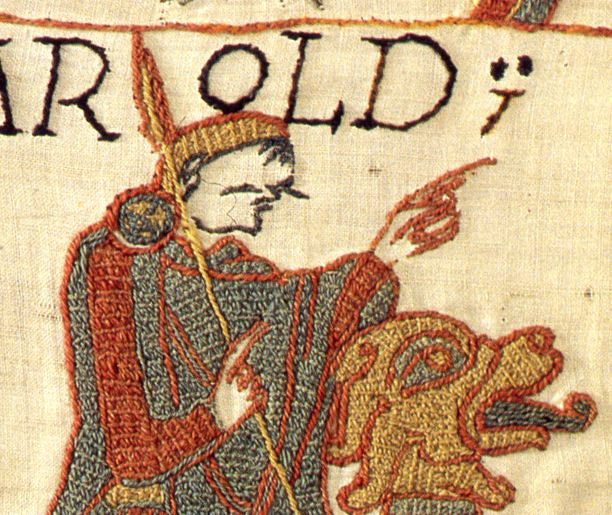
Harold's death (from wikipedia)

A few weeks ago I posted a narrative about the Battle of Stamford Bridge from a fourteenth-century Old Norse text called Hemings þáttr, which tells the story of a (fictional) Norwegian named Heming who becomes involved in the English battles of 1066. Having seen what happened at Stamford Bridge, we can now look at this text's narrative of Hastings - and what came afterwards.

I should emphasise from the beginning that this story is not and does not claim to be in any way a reliable historical source, but it's a fascinating and entertaining text nonetheless. My post about Stamford Bridge has been one of the most popular on this blog in recent months - I don't think I'd be exaggerating to say that more people have read that post in the past few weeks than have (ever?) read Hemings þáttr - and I think the popularity of that post suggests something about the appeal of a narrative like this: historical fiction which explores the implications of a momentous real-life event, drawing out its various possible meanings through a study of character, of the power of words and individual choices, of 'what might have been'. In this text the story of Hastings is a story about loyalty and fidelity: Harold inspires the love and loyalty of his men (and especially of Heming, the saga's main character), even after his death - loyalty of a kind which William, in every other way so successful, can never obtain.

We take up the story when Harold has just defeated the Norwegians (and his own brother Tostig) at Stamford Bridge. William, in Normandy, hears that Harold has been fighting off an attack from the north. At this point in the saga, William and Harold have an uneasy though ostensibly amicable relationship: they long ago entered into a pact of friendship and swore oaths of loyalty to each other, but Harold has also been suspected of having an affair with William's wife. William's decision to go to England is born of this friendship-slash-rivalry: he explains to his men that if Harold has been killed he will avenge him, but if Harold is still alive he can get revenge on him - and seize control of England, because Harold's men will be wounded or exhausted from battle. The Norman leader is shockingly ruthless:

On the day William rode out of Rouen, his wife came up to him when he was mounted on his horse, and took hold of his stirrup, wanting to speak to him; but he struck the horse with his spurs and she fell before it, and the horse trampled her down and she was killed at once. He said, "When things are worst, that's when they get better; this means our journey's likely to be successful."
What he actually says is a proverb, býsna skal til batnaðar, in effect something like the Old Norse equivalent of 'it's always darkest just before the dawn'. A pretty heartless thing to say when you've just killed your wife! William sails to England, raids and harries the land, and burns the body of Ivar the Boneless (taking necessary precautions for a successful conquest). Meanwhile, Harold hears he has arrived:
King Harold heard this, and gathered his men around him. His army was very badly wounded. The king bid them leave the country if they thought they were not strong enough to follow him, but all said that they would stay with him. The king said, "Give me up if you will not follow me loyally," but they said they would never part from him.

He mustered his forces to meet William, and a hard battle began. That was nineteen days after the day when Harald [Hardrada] fell. There was a great slaughter among the Englishmen, because many in the battle were not strong enough to be there. They fought all day, and in the evening King Harold Godwineson fell. But Heming and Helgi and Waltheof drew up their men in a 'swine's snout' formation, and no one could break through it.
[Helgi and Heming are fictional characters but Waltheof was a real person, who in this text is said to be King Harold's younger brother.]
Then William said, "I will give you a truce, Waltheof, if you will swear loyalty to me, and you will have your inheritance and your earldom."

Waltheof said, "No oaths will I swear to you, but I will promise loyalty to you, if you do this."

"On those terms, we can make peace," said William.

Waltheof asked, "What options will these others, Helgi and Heming, be given, if they make peace with you?"

William replied, "Helgi shall have his inheritance and earldom. He must swear loyalty to me, and advise me about those matters in which he is better-informed than I. And Heming shall stay with me, and if he is loyal to me, I shall value him more than any other man."

Waltheof asked them, "What do you two plan to do?"

Helgi replied, "Heming shall decide."

Heming replied, "I know that to you Englishmen it will seem best to put an end to this strife, but to me it seems no joy to go on living after this battle. But I will not keep you in danger any longer than you wish, although I think that for Waltheof this peace will prove brief."

Waltheof replied, "Better we be overthrown than that we trust no one! No more men will lose their lives for my sake."

They gave up the fighting, and made peace. Then William was accepted as king, and rode away from there to London. Waltheof asked for leave to go home, and received it; he rode away with twelve men.

The king watched him go, and said, "It's unwise to allow a man to ride away free who refuses to swear any oaths to us. Ride after him and kill him." They did so. Waltheof dismounted, and forbade his men to defend him. He went to a church and was killed there, and there he was buried; and men believe he is a saint.

William, ruthless again. The real Waltheof was too young to fight at Hastings, but he did lead rebellions against the Normans a few years later and was executed for treason against William. After his execution he was indeed venerated as a martyr - 'men believe he is a saint' - although mostly just at Crowland Abbey.

On the night after Harold Godwineson fell, an old cottager and his wife went to the battlefield to strip the bodies of the slain and get riches for themselves. They saw a great pile of bodies, and noticed a bright light above it. They discussed it, and said that there must be a holy man among the slain. They began to clear away the bodies where they had seen the light, and they saw the arm of a man sticking out of the heap of corpses. There was a large gold ring on it. The cottager took hold of the arm and asked whether the man was alive. He answered, "I'm alive."

The cottager said, "Get the corpses off him - I think it's the king."

They pulled the man up and asked if he could be healed. The king said, "I think I could be healed, but I don't think you two could do it."

The old woman said, "We'll try."

They picked him up and laid him in their cart, and went home with him.

They keep him in secret, and lie to King William's men when they come looking for Harold's body, following a trail of blood leading to their house: the old couple say that the woman has gone mad and killed their horse, and that's where the blood came from. (She acts mad to back up the story.) The king's men believe them, and go back and tell William that Harold is dead and his body can't be found. Then the old woman goes to Heming, and tells him that Harold is still alive.
The next day Heming came to the king and there was a very joyful meeting. They talked all that day. Heming asked the king to go through the whole country and gather an army. "You'll soon win the land back from William."

The king said, "I see that could be done; but then many men would be forced to break their oaths [to William], and I do not want so much evil to happen because of me. I will follow the example of King Olaf Tryggvason, who after he was defeated at Wendland would not go back to his kingdom, but went out to Greece, and served God there while he lived. I will have a hermit's cell built for me now in Canterbury, where I will be able to see King William in the church as often as possible. And I will live only on the food you bring me."

This Heming agreed to. The king gave the peasants ample money, and then he went into his hermit's cell. He was there for three years, and no one knew who he was, except Heming and the priest who heard his confessions. Then one day when Heming came to see Harold, he told him he had contracted an illness which would be his death.

And one day when King William was sitting at table, they heard bells ringing throughout the town. The king asked why they were ringing so beautifully. Heming answered, "I think a monk has died - the one named Harold."

"Which Harold is that?" asked the king.

"Godwineson," said Heming.

"Who has been looking after him?" asked the king.

Heming replied, "I have."

"If that is true," said the king, "it will be your death! But we wish to see his body."

He went to the cell where the body lay. It had been stripped bare, but they all recognised King Harold. The body was beautiful and fair to look on, and they noticed a sweet smell, so that all who were there understood that he was truly a holy man.

The king asked Heming what he was prepared to do to save his life. Heming replied, "What are you asking for?"

The king said, "That you swear this to me: that you will be as true to me, all your life, as you have been to King Harold, and that you will follow me as you followed him."

Heming said, "I would rather die with him than live with you. I might have betrayed you long ago, if I had wished to!"

"It is true," said the king, "that if you were killed, there would be one less valiant man in England. I will now make you an offer: you will be the foremost baron in England, you will be in my own bodyguard, and you will be the leader of them all. If you do not want that, I will give you three pounds every year in reward for your service, and you can live anywhere you like in England."

Heming thanked the king for his offer, and said, "I will accept to stay in England, but from henceforth I have no desire to own any goods. This I will ask from you: that you promise to give me this very cell, and here I will live the rest of my days."

The king was silent for a long time, and then he said, "Because this request is made with a pure heart, it will be granted."

Then King William had King Harold's body clothed in a king's shroud, and his body carried out as honourably as possible. He was interred with the greatest honours. Shortly afterwards, Heming went into this cell, and served God there until the days of his old age; and at last his sight failed, and he died in that hermitage. And now there is no more to tell of Heming.
Bayeux Tapestry detail, from wikipedia

I love this ending - so much better than what really happened. There are various legends about Harold's survival after Hastings: better known than this one is the English story (in the Vita Haroldi) that Harold lived on as a hermit first by the cliffs in Dover and then in Chester, adopting the name Christian, and cryptically telling people who asked him whether he knew Harold Godwineson that "no one was closer to Harold than I'. There are many similar legends about the supposed survival of kings killed in battle, and Hemings þáttr actually draws attention to the motif by having Harold self-reflexively compare himself to the most famous such 'survivor' in Scandinavian tradition, Olaf Tryggvason. Even today this myth seems to have its appeal. It is myth, nothing more, but it's a powerful myth, and it's worth thinking a little about where that power lies. (I wrote most of this post before Harold's supposed survival became a news story; if this is relevance, it's only accidental...) If you're interested in the historical facts, the answer to the question 'Did Harold survive Hastings?' is 'no', and really 'of course not', because the evidence is all against it, and anyway it's impossible to imagine any scenario in which fearless Harold Godwineson would live quietly as a hermit through the anti-Norman rebellions of the 1070s. But once you've dismissed the question of whether it's factually accurate, there are other questions remaining; what these texts do with the myth of Harold's survival is important, and with texts like Hemings þáttr and the Vita Haroldi which deliberately and consciously blur the lines between fact and fiction, 'is it factually accurate?' is not really the most interesting question to ask.

For instance, I'm struck by the way in which these texts don't just say that Harold survived: they tell stories about what happened to him afterwards which exploit the rich narrative potential of the situation. They are interested in the figure of a king who has lost his kingdom, strength, status, even his proper name, and yet in that loss acquires a kind of spiritual power over his conquerors. Hemings þáttr imagines one final encounter between Harold and his former enemy, in which the outcome of Hastings is in some way reversed, and justice is restored: in death, Harold is the better man after all. It's a moment of sharp juxtaposition, where the new king is brought face to face with the old - as if Harold is a ghost haunting the new Norman world, a spectre at the feast. The fictional character Heming acts as the bridge between the two worlds; as a Norwegian in England he's an outsider, free to give his allegiance to whomever he considers most deserving, and therefore a kind of barometer of moral and martial worth. His loyalty to Harold is unconquerable: "I would rather die with him than live with you", he tells William. And William, silenced, is forced to confront the purity of Heming's devotion and the evident holiness of the defeated English king.

If juxtaposition contributes to the power of this myth, Hemings þáttr's picture of Harold spending the rest of his life in Canterbury is particularly appealing; in this alternative reality we could imagine him living in Canterbury at the same time as the Bayeux Tapestry was being made there, and while Lanfranc and Anselm were debating whether dying at the hands of conquerors could make an Englishman a saint (sort of), and so on. I suspect the Icelandic author only picked Canterbury because in his day it was one of the more familiar English cities to a Scandinavian audience, due to the fame of Thomas Becket - the aim is probably to endow Harold with some of the spiritual power of England's premier site of pilgrimage. But the Vita Haroldi (being naturally a bit more attuned to English geography) places its hermit Harold within a hugely significant and charged landscape: first on the cliffs of Dover, the very edge of England, then as now an area strongly associated with conquest and invasion; and later on the Welsh border, another marginal space, and the site of the historical Harold's greatest military triumphs. The text has a serious moral point to make about the limits of worldly power and the nature of true strength: by his life of humility, humiliation and loss, Harold becomes the ultimate conqueror.

[Harold], already conqueror of the world and of the Prince who is of the world, began to conquer his conquerors by a new warfare and a new art of fighting...  He had learned to fight for his lost kingdom, but for a celestial rather than an earthly one, knowing that having obtained it, it could never be lost to any enemy.

Vita Haroldi, in Three Lives of the Last Englishmen, trans. Michael Swanton (New York, 1984) p.28.

I like to think of the Vita Haroldi as somewhat akin to modern counterfactual history, a thought experiment which explores one of history's perpetual 'what ifs'; as with many medieval historical texts, to take it too literally is to underestimate its complexity. (Basing an archaeological dig on what it says is, therefore, not the greatest idea.) This is not bad history; it's good fiction.

The opening of the only surviving manuscript of the Vita Haroldi (BL Harley 3776, f.1)

Sunday, 12 October 2014

Two Canterbury Visions

Wilfrid (St Augustine's, Ramsgate)

I've recently been reading a Life of St Wilfrid which was written in the last decade of the eleventh century by the English monk and historian Eadmer of Canterbury. Wilfrid, who died c.709, was an important figure in the early history of the English church, but my interest is less in him than in Eadmer, who chose Wilfrid as the subject of what was (probably) his first major work of hagiography, undertaken when he was around thirty years old. Eadmer was interested in Wilfrid because Canterbury believed it was in possession of the saint's relics, which had been brought there from Ripon by Archbishop Oda in the tenth century. (Oda, grandson of a Viking, was to be the subject of Eadmer's second hagiographical work.) Wilfrid was thus one of a group of saints from the Anglo-Saxon period whose lives were being thought about and written about at Canterbury in the decades after the Norman Conquest: Oda, Dunstan, Alphege, Augustine and his companions, Mildred, and more. Eadmer doesn't add much to his sources for Wilfrid's life, except what relates to Canterbury's claim to Wilfrid's relics: he describes Oda's translation of the relics to Canterbury and how, after the fire which devastated the cathedral in the year of the Norman Conquest, they were reburied in Lanfranc's new church:

Although [the relics] were preserved unharmed in their first setting for many years, and from the time in which they were first placed here a hundred years and more had elapsed, by the just and secret judgement of Almighty God nearly the entire city of Canterbury was then burnt by fire, and the church built in Christ's name there was set alight in the same conflagration. In the third year after this blaze, Lanfranc, of both happy and glorious memory, the abbot of the monastery at Caen, was appointed to govern that church. After he had been honourably confirmed everywhere in the patriarchate of the foremost see of the English, he demolished whatever ancient parts of that church remained because he intended to rebuild everything anew. And when the altar mentioned previously was tipped over, the relics of the blessed Wilfrid were discovered and raised up and placed together in a shrine. When after a number of years there was agreement among the brothers that it would be more fitting for the relics to be enclosed in a permanent position, a tomb was constructed for them on the northern side of the altar and they were placed within it on the twelfth of October.

Vita Sancti Wilfridi Auctore Edmero: The Life of Saint Wilfrid by Edmer, ed. and trans. Bernard J. Muir and Andrew J. Turner (Exeter, 1998), p.147.

Wilfrid, from Chichester Cathedral
(with a seal, because he was bishop of Selsey...)

Eadmer also records two visions witnessed by monks of Christ Church on Wilfrid's feast day, probably in the 1070s. Since at Canterbury Wilfrid's feast was kept on 12 October (in other places it was on 24 April), I thought I'd post these stories today. These stories can both be found in Eadmer's Breuiloquium Vitae Sancti Wilfridi, in Muir and Turner, Vita Sancti Wilfridi Auctore Edmero: The Life of Saint Wilfrid by Edmer, pp.179-81, from which all the quotations are taken.

Wilfrid, in a window from St Etheldreda's, Ely

The first vision was experienced by a monk named Godwine, "a man of great simplicity and innocence", who was a former sacristan of the monastery. While asleep on the eve of Wilfrid's feast, he was woken by sounds in the choir: he heard the singing of the familiar chants appointed for the beginning of the vigil - Domine, labia mea aperies; Deus, in adiutorium meum intende - and the Psalm, Domine, quid multiplicati sunt. Then he heard voices singing Unum Deum in Trinitate fideliter adoremus, cuius fide Deo uiuit sanctus presul Wilfridus - "Let us faithfully worship one God in the Trinity, through faith in whom holy Bishop Wilfrid lives in God". When he heard this, Godwine thought he must have overslept, so he jumped up and hurried to the choir, chastising himself for his laziness. He reached the entrance to the choir and hesitated, realising that he didn't recognise the voices which were singing as those of his brother monks.

Then he looked into the choir, and it was empty. Since he could still hear the singing, he thought his eyes must be blurred by sleep, so he went to his usual place in the choir; but as he stood there he could see everything clearly, and there was no one there. But he could still hear singing - a multitude of voices in harmony. "But now it seemed to him that he was not hearing them singing psalms nearby, but rather from above, as if they were in the rafters of the church; and so, ascending as they sang and escaping as they ascended from the ears of the brother listening to them, these holy angels who had come, praising in hymns God who lives gloriously in his saint, once again sought the heavenly realms."

Canterbury arches (from after Eadmer's time, but close to the spot where Godwine stood)

The second miracle also concerns a sacristan of Christ Church, this time named Ælfwine, "a religious man and most worthy of credence". His miracle also took place on the feast of St Wilfrid, the year after Godwine's:

He says that on the very night of the festival he was resting outside of the choir in a certain elevated place in this church before the altar, above which at that time the remains of blessed Wilfrid had been placed on a bier; and while he was lying neither fully awake nor fully asleep, looking up he saw the whole church refulgent with a marvellous and indescribable light. Moreover, the altar itself seemed to be entirely made of gold and to be gleaming in an abundant array of precious stones. Meanwhile, in the choir he heard a great multitude of people pressed together singing the nightly vigils for Saint Wilfrid with festive music. And when it came to the lections and responses, he noticed that those whose duty it was either to read or to sing were mounting up the spiral staircase and bending down in front of the altar and before the blessed man's body as if to receive a blessing. When they had done this, they at once turned about and came down again and carried out in a most becoming manner the ritual of reading and singing where it is usually done in this church.

Two English monks, two miracles, both in the most familiar of settings to Eadmer and his Canterbury audience - within the liturgy and within the choir of their own cathedral. The power of such stories comes in part from the tension between familiarity and strangeness, that dream-like state between sleeping and waking in which the everyday and the expected is transfigured into something new and strange, and choirs of monks into choirs of angels. These visions are generically conventional, but so vivid - you can just picture the stream of music and the flood of light, as if the entrance to the choir through which Godwine hesitated to peep was the gate of heaven itself.

The end of Eadmer's Life of Wilfrid in BL Arundel 91, f.145 
(made just across the road from Canterbury Cathedral at St Augustine's, c.1110)

Friday, 10 October 2014

St Paulinus and the Sparrow

Paulinus in Rochester Cathedral

Paulinus, a member of St Augustine's mission to the Anglo-Saxons who became the first bishop of York, died on 10 October 644, and was commemorated as a saint on this day. Bede's Historia Ecclesiastica gives us a wealth of fascinating detail about Paulinus' missionary work in Northumbria after he accompanied Ethelburga, daughter of the king of Kent, when she went to marry the pagan King Edwin. I wrote about Ethelburga here, but Paulinus deserves a post of his own too. When I post about Anglo-Saxon saints I generally attempt to do more than just reproduce extracts from the relevant sources, but in this case there's really no substitute for reading Bede's account of Paulinus, Edwin and Ethelburga; it's one of the most memorable parts of the Historia Ecclesiastica, and needs no embellishments. So here are some extracts from HE Book II, taken from this site.

At this time the nation of the Northumbrians, that is, the nation of the Angles who live on the north side of the river Humber, with their king, Edwin, received the faith through the preaching of Paulinus... The occasion of this nation's embracing the faith was their aforesaid king being allied to the kings of Kent, having taken to wife Ethelburga, otherwise called Tate, daughter to King Ethelbert. He having by his ambassadors asked for her in marriage from her brother Eadbald, who then reigned in Kent, was answered, "It was not lawful to marry a Christian virgin to a pagan husband, lest the faith and the mysteries of the heavenly King should be profaned by her cohabiting with a king who was altogether a stranger to the worship of the true God." This answer being brought to Edwin by his messengers, he promised in no manner to act in opposition to the Christian faith, which the virgin professed; but would give leave to her, and all that went with her, men or women, priests or ministers, to follow their faith and worship after the custom of the Christians. Nor did he deny but that he would embrace the same religion, if, being examined by wise persons, it should be found more holy and more worthy of God.

Hereupon the virgin was promised, and sent to Edwin, and pursuant to what had been agreed on, Paulinus, a man beloved of God, was ordained bishop, to go with her, and by daily exhortations, and celebrating the heavenly mysteries, to confirm her and her company, lest they should be corrupted by the company of the pagans. Paulinus was ordained bishop by the Archbishop Justus, on the 21st day of July, in the year of our Lord 625, and so he came to King Edwin with the aforesaid virgin as a companion of their union in the flesh. But his mind was wholly bent upon reducing the nation to which he was sent to the knowledge of truth; according to the words of the apostle, "To espouse her to one husband, that he might present her as a chaste virgin to Christ." Being come into that province, he laboured much, not only to retain those that went with him, by the help of God, that they should not revolt from the faith, but, if he could, to convert some of the pagans to a state of grace by his preaching.
The opening of Book II of the Historia Ecclesiastica, in a 12th-century Rochester MS (BL Harley 3680, f.36v)

The next year there came into the province a certain assassin, called Eumer, sent by the king of the West Saxons, whose name was Cuichelm, in hopes at once to deprive King Edwin of his kingdom and his life. He had a two-edged dagger, dipped in poison, to the end that if the wound were not sufficient to kill the king, it might be performed by the venom. He came to the king on the first day of Easter, at the river Derwent, where then stood the regal city, and being admitted as if to deliver a message from his master, whilst he was in an artful manner delivering his pretended embassy, he started suddenly, and drawing the dagger from under his garment assaulted the king. Lilla, the king's beloved minister, observed this, and having no buckler at hand to secure the king from death, interposed his own body to receive the stroke; but the wretch struck so home, that he wounded the king through the knight's body. Being then attacked on all sides with swords, he in that confusion also slew another soldier, whose name was Forthhere.

On that same holy night of Easter Sunday, the queen had brought forth to the king a daughter, called Eanfled. The king, in the presence of Bishop Paulinus, gave thanks to his gods for the birth of his daughter; and the bishop, on the other hand, returned thanks to Christ, and endeavoured to persuade the king, that by his prayers to Him he had obtained that the queen should bring forth the child in safety and without much pain. The king, delighted with his words, promised that if God would grant him life and victory over the king by whom the assassin had been sent, he would cast off his idols and serve Christ; and as a pledge that he would perform his promise, he delivered up that same daughter to Paulinus, to be consecrated to Christ. She was the first baptized of the nation of the Northumbrians, on Whitsunday, with twelve others of her family.

(Which gods would a pagan Northumbrian have thanked for his wife's delivery in childbirth, I can't help wondering...)

At that time, the king, being recovered of the wound which he had received, marched with his army against the nation of the West-Saxons; and having begun the war, either slew or subdued all those that he had been informed had conspired to murder him. Returning thus victorious unto his own country, he would not immediately and unadvisedly embrace the mysteries of the Christian faith, though he no longer worshipped idols, ever since he made the promise that he would serve Christ; but thought fit first at leisure to be instructed, by the venerable Paulinus, in the knowledge of faith, and to confer with such as he knew to be the wisest of his prime men, to advise what they thought was fittest to be done in that case. And being a man of extraordinary sagacity, he often sat alone by himself a long time, silent as to his tongue, but deliberating in his heart how he should proceed, and which religion he should adhere to.
 
Paulinus (St John the Baptist, Norwich)

Bede's lengthy and detailed account of Edwin's conversion includes Paulinus' preaching, long letters from the Pope, and a miraculous vision - and this, one of the most famous sections in Bede's history, and in all Anglo-Saxon literature:

The king... answered [to Paulinus] that he was both willing and bound to receive the faith which he taught; but that he would confer about it with his principal friends and counsellors, to the end that if they also were of his opinion, they might all together be cleansed in Christ the Fountain of Life. Paulinus consenting, the king did as he said; for, holding a council with the wise men, he asked of every one in particular what he thought of the new doctrine, and the new worship that was preached? To which the chief of his own priests, Coifi, immediately answered, "O king, consider what this is which is now preached to us; for I verily declare to you, that the religion which we have hitherto professed has, as far as I can learn, no virtue in it. For none of your people has applied himself more diligently to the worship of our gods than I; and yet there are many who receive greater favours from you, and are more preferred than I, and are more prosperous in all their undertakings. Now if the gods were good for any thing, they would rather forward me, who have been more careful to serve them. It remains, therefore, that if upon examination you find those new doctrines, which are now preached to us, better and more efficacious, we immediately receive them without any delay."

Another of the king's chief men, approving of his words and exhortations, presently added: "The present life of man, O king, seems to me, in comparison of that time which is unknown to us, like to the swift flight of a sparrow through the room wherein you sit at supper in winter, with your commanders and ministers, and a good fire in the midst, whilst the storms of rain and snow prevail abroad. The sparrow, I say, flying in at one door, and immediately out at another, whilst he is within, is safe from the wintry storm; but after a short space of fair weather, he immediately vanishes out of your sight, into the dark winter from which he had emerged. So this life of man appears for a short space, but of what went before, or what is to follow, we are utterly ignorant. If, therefore, this new doctrine contains something more certain, it seems justly to deserve to be followed." The other elders and king's counsellors, by divine inspiration, spoke to the same effect.

But Coifi added that he wished more attentively to hear Paulinus discourse concerning the God whom he preached; which he having by the king's command performed, Coifi, hearing his words, cried out, "I have long since been sensible that there was nothing in that which we worshipped; because the more diligently I sought after truth in that worship, the less I found it. But now I freely confess, that such truth evidently appears in this preaching as can confer on us the gifts of life, of salvation, and of eternal happiness. For which reason I advise, O king, that we instantly abjure and set fire to those temples and altars which we have consecrated without reaping any benefit from them." In short, the king publicly gave his licence to Paulinus to preach the Gospel, and renouncing idolatry, declared that he received the faith of Christ: and then he inquired of the high priest who should first profane the altars and temples of their idols, with the enclosures that were about them, he answered, "I; for who can more properly than myself destroy those things which I worshipped through ignorance, for an example to all others, through the wisdom which has been given me by the true God?" Then immediately, in contempt of his former superstitions, he desired the king to furnish him with arms and a stallion; and mounting the same, he set out to destroy the idols; for it was not lawful before for the high priest either to carry arms, or to ride on any but a mare. Having, therefore, girt a sword about him, with a spear in his hand, he mounted the king's stallion and proceeded to the idols. The multitude, beholding it, concluded he was distracted; but he lost no time, for as soon as he drew near the temple he profaned the same, casting into it the spear which he held; and rejoicing in the knowledge of the worship of the true God, he commanded his companions to destroy the temple, with all its enclosures, by fire. This place where the idols were is still shown, not far from York, to the eastward, beyond the river Derwent, and is now called Godmundinghan, where the high priest, by the inspiration of the true God, profaned and destroyed the altars which he had himself consecrated.
The Old English translation of the nameless adviser's speech is a beautiful piece of prose (hear it read here):

Þyslic me is gesewen, þu cyning, þis andwearde lif manna on eorðan, to wiðmetenesse þære tide þe us uncuð is, swylc swa þu æt swæsendum sitte mid þinum ealdormannum 7 þegnum on wintertide, 7 sie fyr onælæd 7 þin heall gewyrmed, 7 hit rine 7 sniwe 7 styrme ute; cume an spearwa 7 hrædlice þæt hus þurhfleo, cume þurh oþre duru in, þurh oþre ut gewite. Hwæt he on þa tid, þe he inne bið, ne bið hrinen mid þy storme þæs wintres; ac þæt bið an eagan bryhtm 7 þæt læsste fæc, ac he sona of wintra on þone winter eft cymeð. Swa þonne þis monna lif to medmiclum fæce ætyweð; hwæt þær foregange, oððe hwæt þær æfterfylige, we ne cunnun. Forðon gif þeos lar owiht cuðlicre 7 gerisenlicre brenge, þæs weorþe is þæt we þære fylgen.

"O king, it seems to me that this present life of man on earth, in comparison to that time which is unknown to us, is as if you were sitting at table in the winter with your ealdormen and thegns, and a fire was kindled and the hall warmed, while it rained and snowed and stormed outside. A sparrow came in, and swiftly flew through the hall; it came in at one door, and went out at the other. Now during the time when he is inside, he is not touched by the winter's storms; but that is the twinkling of an eye and the briefest of moments, and at once he comes again from winter into winter. In such a way the life of man appears for a brief moment; what comes before, and what will follow after, we do not know. Therefore if this doctrine offers anything more certain or more fitting, it is right that we follow it."

(Worcester Cathedral)

King Edwin, therefore, with all the nobility of the nation, and a large number of the common sort, received the faith, and the washing of regeneration, in the eleventh year of his reign, which is the year of the incarnation of our Lord 627, and about one hundred and eighty after the coming of the English into Britain. He was baptized at York, on the holy day of Easter, being the 12th of April, in the church of St. Peter the Apostle, which he himself had built of timber, whilst he was catechising and instructing in order to receive baptism. In that city also he appointed the see of the bishopric of his instructor and bishop, Paulinus. But as soon as he was baptized, he took care, by the direction of the same Paulinus, to build in the same place a larger and nobler church of stone, in the midst whereof that same oratory which he had first erected should be enclosed. Having therefore laid the foundation, he began to build the church square, encompassing the former oratory. But before the whole was raised to the proper height, the wicked assassination of the king left that work to be finished by Oswald his successor. Paulinus, for the space of six years from that time, that is, till the end of the reign of that king, by his consent and favour, preached the word of God in that country, and all that were preordained to eternal life believed and were baptized.
This prosperous state of affairs ended when Edwin was killed in battle on 12 October 633 (or 634), and Paulinus and Ethelburga had to flee back to Kent. Paulinus "brought with him many rich goods of King Edwin, among which were a large gold cross, and a golden chalice, dedicated to the use of the altar, which are still preserved, and shown in the church of Canterbury." (Sadly, no longer!) While Ethelburga went to Lyminge, Paulinus was made Bishop of Rochester; "and held it until he departed to heaven, with the glorious fruits of his labours."

His successor at Rochester was Ithamar, the first English-born bishop since the conversion. Although Paulinus' achievements at York are more significant than the years he spent in Rochester, in his latter see he was commemorated as Rochester's first and for a long time its only saint. His cult was particularly important in the period after the Norman Conquest, when Archbishop Lanfranc, having installed Gundulf as bishop of Rochester, arranged for the translation of Paulinus' relics to a grander shrine. A marginal note in this twelfth-century manuscript of the HE (BL Harley 3680, f.31) draws attention to the first appearance of Paulinus, as a matter of local interest:


I wrote about beautiful underrated Rochester and its memorials to its medieval bishops, Paulinus included, here.

'St Paulinus rests at Rochester' (BL Stowe 944, f.38)

Monday, 6 October 2014

'And þus ȝirnez þe ȝere in ȝisterdayez mony'


On autumn and the changing of the year, from Sir Gawain and the Green Knight (ll.516-533):

After þe sesoun of somer wyth þe soft wyndez
Quen Zeferus syflez hymself on sedez and erbez,
Wela wynne is þe wort þat waxes þeroute,
When þe donkande dewe dropez of þe leuez,
To bide a blysful blusch of þe bryȝt sunne;
Bot þen hyȝes heruest, and hardenes hym sone,
Warnez hym for þe wynter to wax ful rype;
He dryues wyth droȝt þe dust for to ryse,
Fro þe face of þe folde to flyȝe ful hyȝe;
Wroþe wynde of þe welkyn wrastelez with þe sunne,
Þe leuez lancen fro þe lynde and lyȝten on þe grounde,
And al grayes þe gres þat grene watz ere;
Þenne al rypez and rotez þat ros vpon fyrst,
And þus ȝirnez þe ȝere in ȝisterdayez mony,
And wynter wyndez aȝayn, as þe worlde askez,
no fage,
Til Meghelmas mone
Watz cumen wyth wynter wage.


Gawain is difficult to translate without losing the poetry, but here's my attempt:

Then comes the season of summer, with its soft winds,
When Zephyrus breathes on seeds and herbs,
- A great good is the plant that grows thus –
When the drenching dew drops from the leaves
To await the bright blush of the burning sun;
But then hies harvest, and quickly hardens it,
And warns it to wax ripe against the winter’s coming;
He drives in drought and rises the dust
Flying up high from the face of the earth;
Wrathful winds from the sky wrestle with the sun
The leaves are loosed from the linden and light on the ground,
And all the grass greys that green was before;
Then all ripens and rots that formerly arose;
And thus runs the year in yesterdays many,
And winter wakes again, as the world asks,
in truth,
Until the Michaelmas moon was come
With the first pledge of winter.

Sunday, 5 October 2014

An Autumn Scene

From Persuasion, chapter 10.

Anne's object was not to be in the way of anybody; and where the narrow paths across the fields made many separations necessary, to keep with her brother and sister. Her pleasure in the walk must arise from the exercise and the day, from the view of the last smiles of the year upon the tawny leaves and withered hedges, and from repeating to herself some few of the thousand poetical descriptions extant of autumn, that season of peculiar and inexhaustible influence on the mind of taste and tenderness, that season which has drawn from every poet, worthy of being read, some attempt at description, or some lines of feeling. She occupied her mind as much as possible in such-like musings and quotations; but it was not possible, that when within reach of Captain Wentworth's conversation with either of the Miss Musgroves, she should not try to hear it... After one of the many praises of the day, which were continually bursting forth, Captain Wentworth added --

"What glorious weather for the Admiral and my sister! They meant to take a long drive this morning; perhaps we may hail them from some of these hills. They talked of coming into this side of the country. I wonder whereabouts they will upset to-day. Oh! it does happen very often, I assure you; but my sister makes nothing of it; she would as lieve be tossed out as not."

"Ah! You make the most of it, I know," cried Louisa; "but if it were really so, I should do just the same in her place. If I loved a man as she loves the Admiral, I would be always with him, nothing should ever separate us, and I would rather be overturned by him than driven safely by anybody else."

It was spoken with enthusiasm.

"Had you?" cried he, catching the same tone; "I honour you!" And there was silence between them for a little while.

Anne could not immediately fall into a quotation again. The sweet scenes of autumn were for a while put by, unless some tender sonnet, fraught with the apt analogy of the declining year, with declining happiness, and the images of youth, and hope, and spring, all gone together, blessed her memory.

Saturday, 4 October 2014

A Song for St Francis, 2

St Francis (England, 14th or 15th century; BL Royal 16 E XII f.152)

A few years ago I posted a fifteenth-century carol to St Francis of Assisi by John Audelay, 'Saint Francis, to thee I say, / Save thy brethren both night and day'. I'm always interested in vernacular medieval tributes to saints; non-medievalists are often surprised that such things exist at all, let alone that they survive in such large numbers, so it's good to give them a bit of exposure - and in the case of St Francis vernacular songs always seem particularly appropriate. Between John of Grimestone, William Herebert, Audelay and James Ryman, Franciscan friars number among some of the very best writers and collectors of Middle English poems, songs and carols.

So here are two poems addressed to St Francis, from the end of the fifteenth century, which come from the big manuscript collection of poems and carols made by the friar James Ryman. Ryman was based in Canterbury at the first Franciscan house founded in England, which had been established in 1224, two years before St Francis' death. Ryman's collection includes one long poem to St Francis, as well as these two short ones (the text is taken from Julius Zupitza, 'Die Gedichte des Franziskaners Jacob Ryman', Archiv für das Studium der neueren Sprachen und Literaturen 89 (1892), 167-338 (237-8 and 283), which can be read online here).

Hayle, holy fader of the high cuntrey,
Of frere mynours the beawtie and light,
Of a iust man the rightful wey,
Of goode maners the rule moost right:
By thy vertu and goostely myght,
Out of this lyfe when we shull wende,
To blisse lede us, that hath noon ende.

That is:

Hail, holy father of the high country,
Of Friars Minor the beauty and light,
Of a just man the rightful way,
Of good manners [i.e. conduct] the rule most right;
By thy virtue and ghostly might,
Out of this life when we shall wend
To bliss lead us that hath no end.

One of the earliest depictions of St Francis in England, painted c.1250
(Doddington, Kent)

The other piece is a translation of a Latin sequence for St Francis, 'Laetabundus Francisco', and all the Latin phrases here come from that sequence.

Laetabundus Francisco decantet clerus, alleluia.

1. Now gladly shall the clergy singe
To seint Fraunceys, this hevenly thinge,
Alleluia;

2. Whome Criste hath fixte, that lover true,
Hert, hande and foote transfourmed new,
Res miranda.

3. His myende in his flesshe did appere,
And in new wyse he shone full clere,
Sol de stella.

4. This man, the whiche this wyse did floure,
Taught birdes with voice God to honoure
Semper clara.

5. And, as Crist hath taught, poverte
In wille, dede and thought kepe did he
Pari forma.

6. He wolde, nouther in wille nor dede,
That his doughter dere shulde possede
Hec corrupta.

7. Now he joieth above in blisse,
With tokenes newe shynyng he is
Valle nostra.

8. Eyen with light by hym renewed,
A chielde with tunge he hath endewed
Carne sumpta.

9. Sume having speche, sume lyfe agayn,
Heresy by hym is knowen full playne
Esse ceca.

10. Dume, blynde and lame taking comforte
Divers kingdomes knowing reporte
Hec predicta.

11. The sawdons fraude he did despise,
And yet hym hurt hath in no wise
Gens misera.

12. His woundes sheweth gyftes newe
Geven of Criste borne of Marie true,
Puerpera.

Francis preaching to the birds (England, 14th century; BL Yates Thompson 13, f.181v)

Thursday, 2 October 2014

'Remembering from afar': The Wanderer


Today is National Poetry Day in the UK, and since the theme is 'Remember', when I obediently followed the instruction to 'think of a poem' what sprang to mind was The Wanderer, an Old English poem much concerned with memory and the workings of the mind. This poem is probably familiar to many of you, perhaps over-familiar to some of you, but to me it's one of those poems which never becomes tiresome; however many times I study, teach, or translate it, this 1000-year-old poem never gets old. Like so many poems, the more you read it, the more it sinks into your mind - the more it opens up to you. So in the interests of enjoying Anglo-Saxon poetry as poetry - and as part of the history of English poetry - here are my favourite sections of the poem.

(You can listen to the whole poem in Old English here, and there's a parallel-text translation here.)

Gemon he selesecgas ond sincþege,
hu hine on geoguðe his goldwine
wenede to wiste. Wyn eal gedreas!
Forþon wat se þe sceal his winedryhtnes
leofes larcwidum longe forþolian,
ðonne sorg ond slæp somod ætgædre
earmne anhogan oft gebindað.
þinceð him on mode þæt he his mondryhten
clyppe ond cysse, ond on cneo lecge
honda ond heafod, swa he hwilum ær
in geardagum giefstolas breac.
ðonne onwæcneð eft wineleas guma,
gesihð him biforan fealwe wegas,
baþian brimfuglas, brædan feþra,
hreosan hrim ond snaw, hagle gemenged.
þonne beoð þy hefigran heortan benne,
sare æfter swæsne. Sorg bið geniwad,
þonne maga gemynd mod geondhweorfeð;
greteð gliwstafum, georne geondsceawað
secga geseldan; swimmað eft on weg.
Fleotendra ferð no þær fela bringeð
cuðra cwidegiedda. Cearo bið geniwad
þam þe sendan sceal swiþe geneahhe
ofer waþema gebind werigne sefan.

This section is lines 34-57 of the poem, as the speaker, alone and in exile, remembers past joys. My translation:

He remembers hall-comrades and treasure-giving,
how in youth his lord entertained
him with feasting. Joy is all departed!
And he knows, who must long forego
his lord’s dear counsels,
when sorrow and sleep both together
bind the wretched solitary one,
it seems to him in his mind that he
clasps and kisses his lord, and on his knees lays
hand and head, as when he once,
in days gone by, enjoyed the treasure-throne.
Then the friendless man wakes again,
sees before him the fallow waves.
Sea-birds bathe, spread their wings,
frost and snow fall, mingled with hail.
Then the wounds of the heart are heavier,
aching for the beloved ones. Sorrow is renewed
when the memory of friends passes through the mind;
he greets them with joy, eagerly surveys
the companions of the hall. They swim away again.
The flying spirits bring few
familiar songs. Grief is renewed
for the one who must ever send
his weary heart over the binding waves.

Any translation of these lines belies their complexity; there are some beautiful ambiguities. Perhaps the best is the phrase fleotendra ferð 'flying spirits', which seems to refer both to the seabirds and the insubstantial, departed friends of the speaker's memory; the seabirds have replaced the friends, but both swimmað eft on weg. Everything that happens in this poem (if anything happens at all) takes place within the mind and memory of the speaker; this moment with the seabirds could be dream, hallucination, or imagination, but there's no way of knowing which, and I'm not sure it matters. The poem is full of largely untranslatable words for the mind and spirit - mod, hyge, sefa, ferð - and of compounds for whatever it is that is contained within the body: ferðloca 'spirit-enclosure', hordcofa 'treasure-chamber', breostcofa 'breast-chamber', all kennings for (perhaps) what a later poet might call the heart. But although in one sense enclosed in the body, the mind itself also seems to be one of those flying spirits - what does it mean for the speaker to 'send his weary heart over the binding waves'? All this has been much discussed by scholars, but there are no clear answers. The poem doesn't tell a story, or do more than gesture at what may have happened to the speaker to leave him in this lonely grief; to us, listening to the poem, he's little more than a voice and a mind, like the distant cry of a seabird out of the dark.


This passage from The Wanderer is a locus classicus for considering various typical features of Anglo-Saxon literature, such as the lord-retainer relationship, but (or rather because) the relationships described are so emotionally and physically intimate it feels much more universal than that. The Wanderer is not just describing a particular situation of loneliness; it's telling us that loneliness and loss are part of the human condition. It lists all the ways we can lose people, some of them culturally specific (eaten by wolves), others all too universal (war, sickness). And it's not just individual lives which are brief and fragile; time ends everything:

Ongietan sceal gleaw hæle hu gæstlic bið,
þonne ealre þisse worulde wela weste stondeð,
swa nu missenlice geond þisne middangeard
winde biwaune weallas stondaþ,
hrime bihrorene, hryðge þa ederas.
Woriað þa winsalo, waldend licgað
dreame bidrorene, duguþ eal gecrong,
wlonc bi wealle.

The wise hero must perceive how terrible it will be
when all this world's wealth lies waste,
as now in various places throughout this earth
walls stand blown by the wind,
covered with frost, the buildings snow-swept.
The halls decay, the ruler lies
deprived of joys, the troop all dead,
proud by the wall.

The mind can conjure up the past, but it can also imagine this inevitable future.

The Wanderer and a few other poems like it - a loose grouping generally called, for convenience, the 'Old English elegies' - are often the poems which most attract new readers of Anglo-Saxon literature (except for those people who fall heads over heels for Beowulf, of course!). I was no exception, and like most students I had to be taught not to be taken in by the appearance of personal emotion which makes these poems seem like a direct cry from the heart; they're not narratives or dramatic monologues and shouldn't be treated as either, and it's an easy fallacy to get all capital-R-Romantic about their rainy weather and grieving lovers. But in some ways this only increases the emotional pull of these poems, and of The Wanderer in particular; it asserts a universality for itself, claims the right to speak for all of us. All its relative clauses, 'he who sees this may perceive...', have a generalizing effect: its insights into time and transience are the thoughts of anyone who can call to mind destruction, grief and loss. This most characteristic of Anglo-Saxon poems (as it's often presented today) is also in some ways the poem which most transcends its specific cultural setting. There's an attraction in that tension, and however much my understanding of the poem has changed since I first encountered it, I can't forget being a first-year undergraduate all at once entranced - I remember the particular lecture vividly! - by this:

Se þonne þisne wealsteal wise geþohte
ond þis deorce lif deope geondþenceð,
frod in ferðe, feor oft gemon
wælsleahta worn, ond þas word acwið:
Hwær cwom mearg? Hwær cwom mago? Hwær cwom maþþumgyfa?
Hwær cwom symbla gesetu? Hwær sindon seledreamas?
Eala beorht bune! Eala byrnwiga!
Eala þeodnes þrym! Hu seo þrag gewat,
genap under nihthelm, swa heo no wære.
Stondeð nu on laste leofre duguþe
weal wundrum heah, wyrmlicum fah.
Eorlas fornoman asca þryþe,
wæpen wælgifru, wyrd seo mære,
ond þas stanhleoþu stormas cnyssað,
hrið hreosende hrusan bindeð,
wintres woma, þonne won cymeð,
nipeð nihtscua, norþan onsendeð
hreo hæglfare hæleþum on andan.
Eall is earfoðlic eorþan rice,
onwendeð wyrda gesceaft weoruld under heofonum.
Her bið feoh læne, her bið freond læne,
her bið mon læne, her bið mæg læne,
eal þis eorþan gesteal idel weorþeð.

He who thought wisely on this foundation,
and deeply considers this dark life,
wise in spirit, remembers often from afar
much slaughter, and speaks these words:
Where is the horse? Where is the young warrior? Where is the treasure-giver?
Where are the seats of feasting? Where are the joys of the hall?
Alas, the bright cup! Alas, the mailed warrior!
Alas, the glory of the prince! How that time has passed away,
grown dark under the cover of night, as if it had never been.
There stands now in the tracks of the dear troop
a wall, wondrously high, decorated with serpents.
The warriors were taken away by the power of spears,
weapons greedy for slaughter, fate the famous;
and storms batter those rocky cliffs,
snow falling fetters the earth,
the tumult of winter. Then dark comes,
night-shadows deepen; from the north comes
a fierce hailstorm hostile to men.
All is full of hardship in this earthly realm,
the course of events changes the world under the heavens.
Here wealth is fleeting, here friend is fleeting,
here man is fleeting, here kinsman is fleeting,
all the foundation of this world turns to waste.


Whenever I see seabirds 'spreading their feathers' I think of The Wanderer; so the pictures in this post are the 'fleotendra ferð' of Oxford's Port Meadow.